Pacific Report
pp. 119-151 · Read in the full issue

The month’s round-up of news and pictures of people and ents, from PIM correspondents in the South Pacific.
Will Help Establish
in the Rewa
0 consultants from Australia ;o help in investigating rice ng prospects in the Rewa y area of Viti Levu, Fiji. many years the Rewa Valley been producing sugar cane 1 has been bought by the dal Sugar Refining Company crushed at their mill at Dri. The mill is to be closed le end of the 1959 crushing n and farmers in the area are urged to switch to other crops, statement by the CSR in lary said that rice was already stablished crop in the Rewa y and farmers were familiar it. Much of the land was )le for rice-growing and there a market for rice in the y. i company had decided, with ;nowledge of the Government, eck and confirm the general ects of production and markets le rice industry on the Rewa, ;termine the requirements of and equipment, the financial gements for purchasing padi narketing rice and, finally, to s on the kind of organisation, i would facilitate the develop of the industry. ; company had engaged two Itants who would serve on an ;igational committee. They Mr. A. G. Lowndes and Mr.
Dean.
Lowndes is in private Iting practice in Sydney in ts of land utilisation and ng economics. He is a )er of the Australian Broad ig Commission and has been nan of the Australian ute of Political Science for il years.
Dean is production and sales ger of a firm which has rice ig interests in New South >• vever, as PIM reports have ited over the last 12 months, is no guarantee that the will be able to interest all the farmers in rice, or any other ns are still going ahead for the
£l-million Fiji Sugar Company Limited, registered last December, and whose shares (40,000 at £25) are now being subscribed. It has been launched with the backing of Indians who believe there is still a sound future for sugar in the Rewa, despite the CSR’s decision to pull out.
The company is planning to operate from 1960, and negotia tions are going ahead for machinery.
The company will compete with the CSR in the cane fields, and act as buyers and sellers of other produce in the Rewa.
The man behind the scheme, Mr.
Vishnu Deo, says that the Nausori (Rewa) grower is as old a hand at growing cane as the CSR is a miller of it, and since the CSR is leaving the area, the local growers are entitled to claim their full share of the export quota, “having con tinuously made contributions to build it up”.
Meanwhile, it was also announced
in February that a big land deal has been negotiated between the Government of Fiji and the CSR Company.
A joint statement issued by the Government and the company said that the freehold of almost the whole of the company’s land in the Rewa Valley would be transferred to the Crown in exchange for the freehold of certain Crown land in Viti Levu and Vanua Levu which the company holds under long lease.
The change of ownership is to take effect on January 1, 1960.
The deal is to help the economy of the area following the company’s decision to close the sugar mill at Nausori.
Japanese Banno Interests
Extend Again
The name of Banno is gradually making itself known again in the South Pacific where Banno Brothers was the principal Japanese trad ing interest in immediate pre-war days, especially in Tonga and the Gilbert and Ellice Is.
Mr. Yasunobu Banno, senior partner of Banno Mining Co. Ltd., a £1,000,000 company registered in Suva last July, was in New Zea land in February negotiating the purchase and shipment of timber on a long-term basis from Nelson to Japan.
The timber contract is in associa tion with Mr. Douglas M. Kenrick, a New Zealander living in Japan who was one of the first exporters in that country to reopen trade with
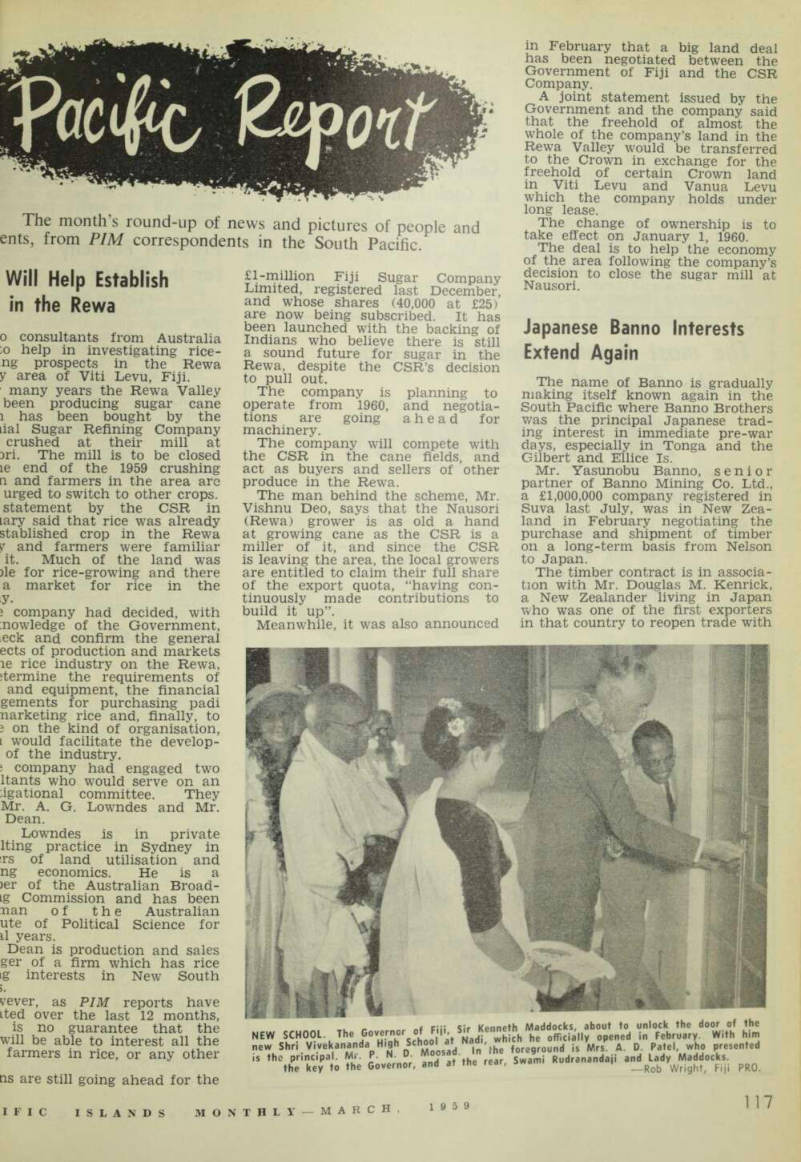
NEW SCHOOL. The Governor of Fiji, sir kenneth Maddocks, about to unlock the door of the new Shri Vivekananda High School at Nadi, which he officially opened in February. With him is the principal. Mr. P. N. D. Moosad. In the foreground is Mrs. A. D. Patel, who presented the key to the Governor, and at the rear, swami Rudranandaji and Lady Maddocks. -Rob Wright, Fiji PRO.
New Zealand and the South Pacific Islands after the war, mainly with cement and building materials, until that trade collapsed through com petition.
One of the Banno brothers is married to the daughter of a well known family of Tonga.
Plan to Avoid
Rarotongan Floods
The Cook Islands Administration is seeking nearby land on Raro tonga for the re-settlement of residents of the low-lying Tuta kimoa area between the twin town ships of Avarua and Avatiu. When ever there are floods, as in the
January “blow” (see February PIM ), these people suffer damage to pro perty and health.
The area is settled largely by im migrants from the Northern Group.
A re-settlement site on the high giound near the Catholic Church is sought.
Co-operative Union
In Cook Islands
An important advance was made in the field of co-operative societies in the Cook Islands recently with the formation of a Co-operative Union.
The union was formed following a meeting in Rarotonga of the rep
resentatives of 21 registered operatives situated there, at M and at Mangaia.
The functions of the union include banking, marketing purchasing, and later audit supervision of the member socie A committee of five has b formed with Mr. Mana Strickll as chairman: Mr. Nikau Tanga, secretary; Mr. Val Savage, treasurer, and Messrs. Alex Mu and Tiakana Numanga as nu bers. All are active members; societies.
Practical Publicity
For the RNZAF
The Royal New Zealand Air F 1 at Laucala Bay, Suva, opened, 1959 programme of taking aid the sick in remote parts of Fiji flying a mercy mission to K( Islands in the Lau Group of !
The Medical Department quested the assistance of RNZAF to fly medical aid to seriously ill woman on the isls An assistant medical offi Pareti, attached to the C 1 Hospital, Suva, and an RN2 nursing sister, flew in the Sunc land. The patient responded treatment on the spot and tl was no need to bring her to Si Many lives have been savedl Fiji, and as far afield as Gilbert and Ellice Islands, San and Niue through the services; these New Zealand airmen, who doing a better job of public relati than any organised high c publicity campaign could.
Manihiki Still Closed
To Divers
Manihiki lagoon, which has yielo as much as £lOO,OOO worth of blai lip mother-of-pearl shell in reci years, is to remain closed to div for the second year in successii according to an official notice issi) under the Cook Island Pearl Sh Fisheries Regulations, 1950. T closure is intended for conservat; purposes.
Manihiki lagoon, which has p;< vided a substantial proportion Cook Islands overseas earnings post-war years, was continuou open until 1956, when it was clos for that year. It was reopen in 1957.
There are differences of opini on whether the lagoon should closed wholly or partly at this ti;. as no research has been earn out in the past. A fishery biolog is now to be appointed so that cc trol of the valuable fishery may more soundly based in the futun Some support for the theory th an excess of undersized shells —ft reason given for the closure —is d; to insufficient rather than excess;; harvesting of the beds, was provid; by a New Zealand zoologist in Fe ruary.
e zoologist, Professor L. R. irdson, of Victoria University, ngton, commenting on New ,nd’s valuable Foveaux Strait s oyster fishery, said “not one 1 study of the needs, habits, re iction, growth-rate, or produc ■ of these oysters has ever published”. believes that these are probably vorld’s most extensive natural r beds “and that they are be jrossly underharvested, to the ment of both the size and by of the oysters that are r. i oyster crop,” the professor “is not like gold in the ground, •Id is not mined, it does not h. If mature fishable oysters lot taken they die and rot in ;ea. Overcrowded beds do not the fastest-growing or best by oysters.” 3 professor concluded—and no can say whether or not this es also to Manihiki: “The de in size and quality of southern rs is strong evidence that these have been persistently operated r their productive capacity.”
Way Grow
ure-Pearls
iris from paua shell-fish may future New Zealand export :rmission can be obtained to je a Japanese expert. 3 paua is best known as the from which New Zealand ifactures the greenish-b 1u e iscent inlaid curios and lery. Another variety of this Jve is known in the United s and elsewhere as abalone. professional paua shell fisher- Mr. E. J. Richardson, of Well n, has been in close touch a Japanese culture-pearl ex who is producing pearls com ially from this type of shell
™ also , poss ? sses a naturally produced pearls which he has found in New Zea-
la ?£? aua -
He has now applied for the lease oi a site on a small island in Island Bay, Wellington, and for permission to engage the Japanese expert. This will have to be arranged at government level as the Japanese government has regulations regarding celses evealinB of culture -P earl p™- Some months ago PIM reported tnat an oyster culture-pearl fishery at d Hon^kon| UCCeSSfUlly established T a * v w In Australia, where war reparations from Japan included the
secrets of pearl culture—on paper— Japanese experts were belatedly brought in a couple of years ago to establish a similar industry in Broome, WA, after Australian scientists had failed to produce any thing in commercial proportions though a lot of experimentation was carried out at Thursday Island by the CSIRO
More Variety in
fnnl/c 7 Cvnstftc
V-Ouks Capoits
Cucumbers and pumpkins, as well as tomatoes and pineapples, may be exported this year from Mangaia, the Hon. Ngatupuna Matepi, the
gaian representative, told the : Islands Legislative Assembly, ingaia, an island of 20 square s and a population of just over lying 110 miles south-east of itonga, has exported as many as 0 cases of pineapples in a year ew Zealand, but production has n off because of the perishable re of the fruit and transport :ulties. There are large areas irtile soil. ousands of coffee trees are now ng along well, the Mangaian tentative told the Assembly, thousands of young coconuts been planted as long-term >•
k Starts On
stwatchers Light
>rk has commenced on the 86gh aluminium scaffolding of a >-shaped lighthouse at Madang, e lighthouse, which is to be id the Coastwatchers’ Memorial :house in memory of the men kept track of enemy troop and movements along the coast ig the war, is to be built of ling white concrete, will be surmounted by a re ig red beacon, which will serve navigational aid to ships and ift. 3 memorial lighthouse was possible by an Australia-wide
subscription appeal and a Common wealth Government grant.
It is planned to illuminate the lighthouse by floodlights.
The floor surrounding the base of the lighthouse will be made of modern terrazzo design. Plaques will bear names of the men in the Coast watchers.
The lighthouse is expected to be completed during April.
Sorry, No Customers
In Fourth Street
Fourth Street, Lae, the condition of which has been a bone of con tention for years at Town Advisory meetings, at last came into its own in February. Teams of native labourers, European supervisors, bulldozers, tractors, lorries, and rollers took over, and kerbed, guttered and sealed it.
During these operations the street was closed to traffic, and the best customer the shopkeepers had was the regular clouds of dust settling on their stock.
Highlight of the week of dust and noise was the day a certain em ployee at a certain store filled in his cash statement. In the space designated for note denomination, he wrote, “Sorry nothing”, and re turned his bag of change intact.
He had not had a customer all day.
They're Neighbours in
Remotest New Guinea
Although Mrs. Cliff Batt and Mrs. Bede Lean are neighbours in New Guinea and have been talking to each other almost daily for three years, they did not meet until they were both in Sydney in January.
Their backyard fence is the 150 miles of Pacific Ocean that sep arates Maron from Wuvulu (better known as Maty Island) and their news-swapping has been by two way radio. Mrs. Lean is the first white woman on Wuvulu; Maron must have seen very few, if any, either The North Western Islands of New Guinea, are about the remotest in the Territory—if you headed north from them you’d likely see no land until you hit the Carolines or Guam—and both Maron and Maty have a place in NG’s more romantic PS Maron (now owned by the Batts) and Wuvulu (owned by the Leans) were old German plantations, and both families live in the houses that were built in the German tlI Maron Plantation was, of course, once owned by H. R. Wahlen, now of Hamburg, and the plantation homestead, usually described y romantic writers as „ a Dr S S w’h«pn called “Wahlenburg”. PIM has seen interested in the fine oldhouse for a long time, and was pleased t
[?]how the new Coastwatchers' Memorial [?]will look. It should be completed in April.
learn from Mrs. Batt that it w not as affected by dry rot as hi been reported. The Batts are r storing it, and when complete i arc to have a photograph.
Progress On
W. Samoa's Roads
Three miles only of road co: struction remain to be done < Upolu (Western Samoa) to comple a traffic circuit of the island. Tb work, which has not yet be( started, involves the bridging of tl Salani River, and it will be nece sary to move inland a little to cro this at the most suitable point.
Seven miles of work have yet be undertaken to complete tl second cross-island road fro Afiamalu to the South Coast Roa This will require, though, a traver of heavy hill country. First stai construction only has been done c the Poutasi-Sapaunau Road, distance of five miles.
But steady progress is being ma* with the major reading of boi Upolu and Savaii. It is limit* mainly by the amount of financ available. Biggest stretch of roadii still to be done to link up the 1 mile circuit of Savaii is the 15-mi gap between Salailua and Lah Gautavai. Six miles of this is part built.
First stage construction has be« done on the eight-mile section h tween Solomea and Puapua and c 15 miles of the Letui-Ao’o pa-Ass Road.
Works now approved and which funds have been provide are the completion of the Salailm Lata section on Savaii, the col struction of one mile east of La‘ towards Gautavai, the building < a 40 ft span bridge at Gautavai ar the widening of one mile of tt Ao’opa-Asau section of the Letui Ao’opa-Asau Road.
Works for which finances a: available on Upolu are the con pletion of the Putasi-Sapanan Road, which is in the first stage ♦ construction, and work on tb Sapanau-Salani River Road. Tb 40-ft span bridge at Sapaunau hs yet to be started, as is the cor; struction of part of a farm feed* road on the line of the fins Sapaunau-Salani River Road, br there is some plant and an er gineering surveyor on the site.
Capital development carried ov in Western Samoa for the ten yeai 1846-1956 —the latest period f a which complete figures are avai] able —cost £2,055,000, of whic £1,604,000 come from Samoan Gov ernment revenue and £451,000 froi the Reparation Estates (which i that term contributed about ono fifth of the Territory’s expenditui on capital development).
iybe New Kind
Mining for NNG
he Overseas Ministry, at The jue, Netherlands, has agreed in iciple to four companies jointly lotting mineral ores in the igeo Island and Cyclops Moun i areas of Netherlands New nea. he names of the companies have been released but it is known t three of them are Dutch and American. s well as undertaking further loratory work, the firms will luce nickel, cobalt and iron from laterite ores already known to it. xploration in NNG in 1952 blished the presence of 55,000,000 s of nickel and cobalt laterite ;. The same variety of ore was id on Waigeo Island in 1955.
w Airservices Bring
julations for Moresbyites
ne of the more pleasant things ut visiting the Territory of ua-New Guinea has always been ease with which the traveller ipleted formalities on arrival. ,rt from being asked by the toms officer whether he were •ying any firearms, ammunition, its, fruit or seeds, the traveller apparently at liberty to sort out own baggage from that lined up :he edge of the tarmac and just going. At all events, this is what did, anyhow. ut when Qantas started their Super Constellation service at end of January, and the new ■seas terminal building was led at Jackson’s airport, there e indications that the good old s were coming to an end. tie same Customs inspector asked same old question about fire s, seeds and plants, but when traveller attempted to remove suitcases in the old way a itas clerk came smartly into on and said, “No, No, No—you t do that until it’s cleared by toms.” After about half an hour ;his, he gave up and the suit is were gathered to the bosoms their owners in the old way. it seemed as though it might ;he thin end of the wedge, ow, with the routing of the igkong service through Port ■esby, to and from Sydney, it is ly “on”. The following official arantine and Customs Pro ires” were issued by the Collector Customs and Director of Public ,Ith in Port Moresby on Feb ry 24: lealth and Customs authorities ise that when the new Qantas ice Hongkong-Manila-Australia ts next week, special arrange its will be necessary at the new
terminal building at Jackson’s air strip, Port Moresby.
“These arrangements require that immediately before the arrival of the planes on the southbound flights, the terminal building be closed to all persons other than officials and the passengers travel ling from Hongkong and Manila, and remain closed until quarantine and customs procedures have been completed. It is expected this will necessitate closing the terminal building to the public for approxi mately half an hour after the planes arrive.
“The first southbound plane from
Hongkong and Manila is due at 8.30 a.m. on March 5, and there after planes are scheduled to arrive from Hongkong and Manila at Port Moresby at 8.30 a.m, every Thurs day.”
The so-called overseas-terminal is not much more than a giant shed (a photograph of the interior appeared in February PIM ) and the closest place to shelter from the rain or Port Moresby’s very hot sun is about half a mile away, so Port Moresbyites meeting the Hong kong plane are going to have a thin time until someone builds them a waiting room. (Over)
y Behaved Like
iled Children
illars flowed freely in Suva in uary, when the luxury Swedish rican Line’s Kungsholm (21,000 i called there in the course of iream cruise” to Pacific and East ports from New York, le mostly wealthy American pas ses were taken on whirlwind > round the city and were 'tained in traditional Fijian at Deuba Beach, 30 miles Suva on the picturesque n’s Road. wever, hounded and pampered a battalion of “cruise staff bers” some of the passengers dy won themselves a reputa for behaving like spoiled ren. ring the official Fijian cere es at Deuba one elderly woman ;nger complained to a member ae cruise staff that an “out ” was sitting in the official dstand, which was reserved )assengers. ice the offending outsider and wife were unable to produce 3s or a Kungsholm ticket, they asked to leave. They did so sfully, and without comment, lent. ter, an embarrassed cruise tor learned that a member of staff had asked the United s Consul for the South Pacific H. G. Shackleton) and his to leave, without as much as g who they were! . Shackleton’s courteous be iur had been in true diplomatic the time the Kungsholm ed Port Moresby, however, the
tourists had become a little less spoiled—or perhaps it was just that Port Moresby people, with far less experience of tourists than Suva has, couldn’t see anything to complain about.
Port Moresby put on its gayest front, and stocked its stores with everything it could lay its hands on.
What a P-NG newspaper termed “pressure-packed public relations” swung into action aboard ship, and invited the local Press to come on and interview passengers. Plenty of free liquid hospitality was on hand
to help make their job easier.
One of the passengers was 13year-pld Elizabeth Conk e y, of Illinois, who with her parents was making her third luxury cruise in three years. She keeps up with her school studies along the way.
Said Elizabeth: “It can get bor ing. There aren’t any young kids like myself aboard, except 11-year cld Bobby Bennett. All the other passengers are too old.”
Ashore, one American amateur photographer took a quick shot of a Hanuabadan girl and gave her £5 for the trouble. Another took some movie shots of two other girls— gave them threepence each.
Samoan Minister Fined
After Club Fracas
Tualaulelei Mauri, aged 55, Min ister for Lands in the present gov ernment of Western Samoa, and a member of the Executive Council, seems to be getting for himself a political reputation as the bad boy of the Territory.
That is a pity. Tualaulelei is a man of outstanding ability, and could give valuable service to W.
Samoa, in the difficult days right ahead. He is his own enemy.
Tualaulelei, last year, spoke scathingly of Europeans (with whom he apparently includes part- Samoans), and his words gained him no new friends, or influenced people in his favour.
Last September, he created a scene in the Apia Club. The house committee asked him to resign. He did not do so.
In discussions in the Assembly, he made statements regarded by the
"Kungsholm", on another Pacific luxury cruise. Seme of her passengers were "like spoiled children ..."
alagi community as very nsive. The Europeans regarded as one prepared to stir up al prejudice at a time when, if 10a is to make progress as a nation, unity is essential and al prejudices may not be toler ctween September and January, tions between the Europeans the Minister were strained. l the evening of January 24, laulelei entered the Club about clock, apparently under the in ace of liquor. He had some beer, went to play billiards. He made t he said was intended as an able remark to a lady there. She nted the approach, and left, r. Ben Smith, a member of the ’s house committee, and a well vn staff man of Nelson and Co„ 'cached Tualaulelei, and told to behave himself, and re ded him that he had no right •e there, anyway—the commit lad asked him to resign, lalaulelei became very excited, Smith (in Samoan) that he “a low-down stinking pig”, and ped his face, with great vigour, lalaulelei walked away and ids got him quickly off the club lises. xe matter was reported immedi j to Mr. Peter Plowman, the 's president, and a committee iing was held. A letter, dated lary 24, was sent to Tualaulelei, ting out that as he had not rered the Committee’s letter of ember 30, requesting his nation, he was regarded as hav removed himself from member ur days later, after some dis ion and deliberation, a charge nst Tualaulelei, that he had ilted Mr. Ben Smith, was lodged the police, le case came before the Samoa i Court (Chief Judge C. C. sack and two Samoan Assessors, ia and Meleisea) on February After hearing a number of esses, and defendant’s evidence he had merely pushed Smith, that the incident anyway was
small and insignificant, the Court fined Tualaulelei £l5. Judge Marsack, after commenting upon Tualaulelei’s position of importance and influ ence in the community, said the position was made somewhat worse by the facts in the letter which de fendant had insisted be produced in Court. This told him, in effect, that his presence at the club was no longer welcome.
He added that though the Court found that defendant not only com mitted assault, but was intoxicated and used bad language, it had to take into account that he was only charged with assault, and it was only on that the Court could im pose a penalty.
The Court conviction does not end the matter for Tualaulelei Mauri.
He also loses his Ministerial post and his Parliamentary seat, for which he was getting a salary of £875 a year.
The W. Samoa High Commissioner, Mr. G. R. Powles, announced after the Court case that the laws of Samoa laid down that his expulsion is automatic. Mr. Powles paid tribute to the past excellent services of the Minister over many years.
However, after paying his fine, Tualaulelei Mauri is eligible for re
election, and the poll for his con stituency, Palauli East, will be held on April 20.
A correspondent reported in late February that opinion in the con stituency appeared to be divided, and his election was by no means certain.
P NG Will Get
A Training Ship
Preliminary plans have been approved for the construction of an £BO,OOO training ship for Papua- New Guinea.
P-NG Marine Superintendent, Captain G. A. Hawley, told an AAP-Reuter man in February that the 90-ft steel ship would be used for the training of native cadets for officer status.
He said the ship could also be used for training ratings.
During four years’ training, cadets will be taught navigation and seamanship, while others will be taught marine engineering. An aggregate of 16 cadets and trained seamen will be accommodated on the ship.
Captain Hawley said a feature of the ship would be a class-room for theoretical teaching. There also had been a proposal that a nautical school be established as well for the training of between 50 and 100 men or boys as seamen and engine operators.
Cap t. Hawley’s announcement answered a request from delegates attending the recent Native Co operative Conference in Port Moresby that the Administration should establish a school for the training of ships’ masters,
Goroka Passion-fruit
Producers Are Too Good
The embarrassing passion-fruit situation in New Guinea which has resulted from a glut of the fruit in the last couple of months, has been
d by a compromise between An ted parties. e New Guinea Highlands are for passion-fruit; they grow ir, quicker and better there anywhere in Australia, and it become one of the favourite •crops of the local natives. a time when processors in 'alia were finding it difficult to sufficient supplies of passion pulp and juice from local es, Cottees Passiona, of Aus set up a small passion-fruit dng plant in Goroka, in 1954, hrough the local extension ser of the Department of Agri re, local natives were en -ged to grow the fruit, ce then more and more natives got the idea, with the result production in 1958-59 season is times what it was in 1954, Jottees Passiona (NG) Ltd. has ient juice concentrates on hand ke care of Australian require -3 until March, 1960. ; trouble is that when you start if these economic balls rolling very primitive community i does not understand the law pply and demand that domin- Western-style commerce, it is dingly difficult to stop it with srupting more than economics, blems associated with market highlands passion-fruit were >sed in February at Goroka r. E. N. Cottee; his local board rectors; Dr. John Gunther, ant Administrator of Papua- Guinea; Mr. J. O. Smith of epartment of Territories, Can
berra the District Commissioner Eastern Highlands, Mr. H. P. Seale, and officials of the P-NG Depart ment of Agriculture.
The result is that Cottees have agreed to go on buying this year’s crop of passion-fruit, but at a re duction of Id a pound (from 3d to 2d delivered at the Goroka factory); they have also agreed to try to find new markets for the increased volume of juice.
The company has already bought, at 3d per pound, sufficient passion
fruit from this season’s crop to pro duce 40,000 gallons of juice, which is far in excess of the 25,000 gallons allowed into Australia duty-free under a Tariff Board ruling of 1957.
Above that figure, there is a duty of 8/3 per gallon—an arrangement designed to protect Australian growers who have frequently pro tested against juice concentrates imported from “cheap black labour” countries such as New Guinea and South Africa.
There has always been the closest co-operation between Cottees Passiona (NG) Ltd. and the Ad ministration, and at the conference in Goroka recently, the Administra tion expressed its appreciation of the company’s efforts to continue to take the whole of the passion-fruit crop. This is entirely a native in dustry and one which has assisted considerably in the advancement of Highland natives.
The company agreed to consult the Administration if continuing excess supplies force the price down still further.
The cult of the passion-fruit has now, of course, spread far beyond Goroka and its environs. On all the roads leading into such centres as Minj and Mt. Hagen there are lines of native women carrying string bags piled high with passion-fruit into the local purchasing point.
The bulk of the crushing and juice extraction is still done at the factory at Goroka but during the season, a portable crushing plant is operated at Mt. Hagen.
The juice is packed in four-gallon cans and kept under refrigeration.
In January, at the peak of the season, cold stores in Madang, the main shipping point, were being utilised to capacity—and there was still a lot awaiting shipment from the Highlands. (Over)
[?] NURSES. This group of Islands' lasses—and one lad —was photographed in Sydney in [?]ry. The lucky lad is Kenneth Janson, of Suva. The girls are all trainee nurses at Sydney's [?]ent's Hospital. They are at rear, Elizabeth Chang, of Suva; Micheline Lew, of Rabaul; and [?] the front, Mary Young, of Suva; Louisa Chan, of Rabaul; and Jessie Sun, of Suva. —Tele-Photos.
itists Discuss
a Pest Problem
entific experts from various Ic islands, the USA, and New nd, met in Fiji in February talk about a beetle —the Dceros beetle which causes is losses to the copra industries me territories and is a threat e industries of others. ; five-day conference was or ed by the Rhinoceros Beetle lical Advisory Committee of onth Pacific Commission. In specialists came from lulu, California and Tonga, ults of present campaigns were yed and new measures ed.
P. D. Macdonald, the ■nor’s Deputy, pointed out copra was Fiji’s second most tant industry and £60,000 a vas being spent in keeping the >ceros beetle in check, added: “The present situa is something like the ‘cold We are simply containing jestle, even though without it reserves and support we t defeat it. That is why we your help. anwhile, we can ill afford to £60,000 a year on this service, (ay this ‘insurance premium’ because we appreciate the trpphic results which would if the beetle managed to 5 our main copra producing Fiji the beetle has been con to the eastern half of the
main island of Viti Levu. The principal measures in the present control campaign are the treating of palms with insecticide and the inspection of vessels leaving Viti Levu for other islands.
Yankee Dr.'s Last
Gift to Suva
Before the late Dr. S. M. Lambert died (shortly after the last war) he expressed a wish that the Central
Medical School in Suva, Fiji, which he helped to organise along its pre sent lines, should have his surgical instruments. The instruments were only recently delivered to the CMS.
Dr. Lambert was connected with the work of the Rockefeller Founda tion. His special area was the Pacific, and his special study was hook-worm. It was due to his work in this connection that many Pacific Islands foreshores are decorated with those extraordinary lavatories stuck out at the end of long piers. (Over)
[?]e, in Suva in February, were delegates [?]conference on the serious rhinoceros [?]roblem. BACK ROW: Dr. P. Surany [?]. A. O'Connor (Fiji), Dr. C. P. Hoyt [?]J. Dumbleton (NZ), R. P. Owen (Koror, [?] Is.), T. R. Cowell, H. W. Simmonds, [?]atson (Fiji), G. S. Dun (NG), N. L. H. [?]Hawaii). FRONT ROW: Dr. Y. Tanada [?]ty of California), A. H. J. Kroon (SPC), [?]Pemberton (Hawaii). Unable to attend [?]ference because of delays in plane [?]were F. Cohic (New Caledonia), P. S. [?]stern Samoa), Dr. Jon Herring (American Samoa), M. Muller (Tonga).
Photo; G. Winkelkoeter.
February was a popular month in Suva for professional get-togethers. Here are delegates and lecrurers to the WHO refresher course in tuberculosis, held at the Central Medical School. STAND ING: AMO's H. Samuel (USTT), D. Tafatu (Fiji), B. Lomaloma (Fiji), T. Kofe (G. and E.), P. 110 (New Hebrides), M. Sapolu (W. Samoa), R. Williams (W. Samoa), W. Tigarea (Fiji), J. Viliua (Niue), F. Aisi (P-NG), S. Tupou (Tonga), J. Kilatu (BSIP), M. Ueki (USTT), T. Gaunede (P-NG). SITTING; Dr.
T. G. Hawley, Dr. L. 0. Roberts (WHO Regional Tuberculosis Adviser), Dr. R. Edmonds (Principal CMS), Sister J. Sinclair, Dr. P. W. Dill-Russell, Sir Harry Wunderly, Dr. W. H. McDonald, Dr. W.
L. I. Verrier. —Caine's Studios.
pies of these may be seen right Samarai in Papua to Polynesia, they really flourish in Samoa e no village is complete with ts rickety small-house dangling iriously over the sea. . Lambert spent 20 years in the ti Pacific, and became well r n in Papua, the Solomons, jrt and Ellice, Polynesia and, of ;e, Fiji. th Dr. Aubrey Montague, Chief cal Officer in Fiji for many !, he was instrumental in the ion of the Central Medical 01, Suva, which trains young from most of the English dng Territories of the South ic to become Assistant Medical titioners. e Rockfeller Foundation was :ed by Dr. Lambert to take a •nal interest in the School and rly years made generous grants e CMS was opened in December, and took the place of a smaller ing establishment carried on the 1880’s by the Fiji Govern alone. In 1953, Her Majesty n Elizabeth II opened the new ings at Tamavua, on the its above Suva. The old school, the Colonial War Memorial ital could accommodate only ;udents; the new, much more rately equipped institution can more than twice that number. 1941, Dr. Lambert, then re and living in the United s, wrote an amusing and in ting book on his experiences ig 20 years in the Pacific. It called “A Yankee Doctor in
Paradise in the original American edition, and “A Doctor In Paradise” in the UK edition.
Vanikoro Seeking
New Manager
The Kauri Timber Company, Ltd., with interests in Australia and New Zealand, was in February seeking through large advertisements in New Zealand newspapers, a man ager for its Vanikoro Island logging station in the eastern Solomons.
The salary offered was “not less than £2,000 per annum” plus bonuses.
According to the February ad vertisement, the company has a staff of 12 Europeans and 150 natives at present.
Levuka Would Like
To Catch and Can Tuna
Levuka, Fiji, which has been do ing a lot of thinking on how best to pull itself out of the economic doldrums by its own boot-straps, is now considering a tuna-fishing industry. (When the MOF nine-years copra agreement finished at the end of 1957, most Fiji copra was shipped direct to the local Suva mill for crushing and Levuka, on Ovalau, which for generations had been the shipping and storing point for copra shipped overseas, found itself completely by-passed).
A syndicate has been formed to
investigate the possibilities of estab lishing a canning factory, after the style of Van Camp’s establish ment in Pago Pago, and of con ducting a fishery much along the lines of the Pago concern which uses Japanese fishing vessels on short-term contract.
At the head of the proposed Levuka venture is Mr. A. G.
McCown, who once had a pine apple cannery on Ovalau, and more recently a pearl-button manufac turing business there, but who always is willing to “have a go” at something new.
A meeting has already been called in Levuka to discuss the proposi tion and £lO,OOO capital has been promised. This, however, would not be sufficient and the Government has been asked if it would consider an interest-free loan, or even a straight-out grant.
The Colonial Secretary (Mr. P. D.
Macdonald) was cautious but pro mised sympathetic consideration if full details of estimate of cost, prospective catches and sales were submitted.
He said the Government would welcome the establishment of a tuna canning or any other economically-sound industry on Ovalau.
If anything comes of it, this would not be the first time Fiji had a canning industry, or even a prospective tuna fishery.
South Seas Marine Products, under the direction of the late Harold Gatty, some years ago, ex-
[?]e Dr. Lambert, as many in Fiji knew him. [?]n this group he is sitting at left.
LEVUKA INDUSTRY IN RUINS. Levuka was once the headquarters of a thriving pineapple canning industry, with pineapples "better than Hawaii's" according to the experts of the day. The in dustry was started by Mr. A. G. McCown (he heads the proposed tuna industry venture-see above), who built it up during the 1930's and 40's and sold it about 1947. The industry once employed 160 people, had more than 430 acres under cultivation, and operated at times for 24 hours a day supplying 10,000 cases of canned pineapple a season to a world market, and 500 cases of fresh pineapples a season to NZ. But the factory closed down in 1952. Today the estate is overgrown and this is all that remains of the factory building.
i a considerable sum of money ■ying to base a tuna industry >uva and a canning industry ago Pago. The enterprise em d the pole-fishing techniques merican tuna fisheries, but in waters it was unsuccessful, e factory at Pago Pago re ed idle until taken over by Camp, American canners, and the Japanese were brought the picture, employing their line methods of catching tuna. then the establishment at Pago has flourished. 3 reason why the Gatty corn established the factory at Pago was in order to escape lean import duty on other American-canned tuna. It was American market that was i at by South Seas Marine lets. s also is the most important et of the fishery now success established at Santo, New des. The Santo establishment not, as yet, can the tuna. It ts the best varieties to the s in frozen state and they are id there. A cannery is to be lished at Santo eventually, by inch company, and it will aim European market. ! biggest difficulty the proposed :a establishment will have to will undoubtedly be that of rket. The Americans seem to an insatiable appetite for id tuna although it does not to appeal to the palates of countries to nearly such a e. ; the American industry is a 7 protected one, and this s it difficult for outsiders to luch of a share of it.
Polio,
i Typhoid
iga, which had experienced a r bad polio epidemic in the part of 1958, with a number laths, was in the midst of a id outbreak in January-Feb , though no deaths had occurred e end of January, i outbreak then was confined ngatapu and included 18 cases ages and from a number of ent villages. The public was warned to take all the usual utions regarding hygiene.
and Canada Can
Hullo By Phone
;h the extension of the over radio telephone service to da and Hawaii, the Solomons oon have a near to world-wide age. 3 radio telephone link to Aus was made in the latter part st year (12/6 a minute, mini three minutes), and services gradually been increased to (Over)
,de USA, United Kingdom, New ind, Cuba, Mexico and New iea, . the local front, facilities have installed, for official use, to ; Tulagi (pre-war capital) into honic communication with ara. Later it is hoped that , Administration headquarters, ita Island, will be included in letwork. ship-to-shore system is now ded for all overseas ships when ort, and this has proved a time-saver for all concerned, aiara has also seen the intro on of a 300 line switchboard subscribers) which has im d communications within the area. However, as with all ional services has come in ed costs and a business phone w £2O per annum (previously and private phones have in sd by £2 to £l2. These charges 11-inclusive, to cover rent and
olic Reservations on
I Education Plan
; Catholic Mission of Alexis . welcomes and will give full eration to the Administration’s tly announced plan for uni . primary education and for rsal literacy in English, iing to a statement made at Catholic Mission headquarters lev. John T. Feeley, SVD, s Word missionary and Educa- Officer for the Alexishafen iate, NG. i new educational plan, which s the entire Territory of i and New Guinea, was an ic e d by the Administrator, flier D, M. Cleland, in Port ;by on January 30 at the be ig of a new scholastic year.
PIM, February, p. 144). statement said that less than of the 400,000 children of i age in the Territory attend ind of school. To remedy the ion, no effort is to be spared tending and developing Ad oration schools. use of local vernaculars will knitted in the lower standards bs) as a medium of instruc vhile the children are being need to oral English, jr 1959, grants-in-aid will no be given to vernacular schools do not teach English, letheless, in spite of the lie Mission’s approval of the il plan, it feels that a blow itruck at Mission schools by Administrator’s ruling on ?n” vernaculars used as teach edia. to the multiplicity of tongues 3W Guinea, and the impos- V of learning them all, flan Missions early adopted r-used vernaculars as media igious and school instruction,
v^came^nderTh^^J 0 all <oT/r- ca - 0 un 9 er their influence.
“Missions using as teaching media, the n m^ ?^ not atteSiS ?ii h A C i llldren trator-i dmmis " ™ tlmt "^schools'^whCTe 6 the
vernacular wil? l *not *be Exempted
but closed in 1960 ” exempted Such srhnnlq if PiHo-ir. ic meant, are now responsible for the education of over 90 per cent of the Territory’s student enrolment. it has been pointed out.
The decision to close such schools next year leaves the Administration With the alternative of either providing ample funds for Mission teacher-training programmes, or of
Poetically strangling primary education in the Territory The Education OffS of the f our principles that would have to b f considered in any successful im ffiSf“tn£e. **“ Adminlstra ' * Fi rst . without sufficient English speaking Native teachers it would be futlle to insist on the universal US6 0f English in the schools, • Secondly these teachers, to be effective in introducing universal literacy in English, must themselves be well trained in English, • Thirdly, the Christian Missions with their highly qualified staffs can train sufficient English-speaking Native teachers for the programme
but the Missions will need consider able financial aid from the Admin istration because they are handi capped by limited resources and facilities, especially buildings. © Fourthly, in order to keep trained Native Mission teachers in the teaching profession, it will be necessary for the Administration to pay them a respectable salary, com parable to that of Native teachers in Administration schools.
Fr. Feeley said he believes the Aaministration intends to put into
effect the above four principles be cause the statement by Brigadier D. M. Cleland promised “adequate financial support from the Adminis tration” for the accelerated de velopment of Mission schools.
The statement further said that the Administration would consider giving more financial assistance to Native Mission teachers, both in training and in service.
At present a maintenance grant of £2O a year is paid by the Ad ministration to the Missions for each teacher in training, and a subsidy of £4O to £6O according to grade, for each certificated teacher employed in Mission schools.
Father Feeley pointed out that an ordinary unskilled labourer on a plantation earns the equivalent of £lOO a year. The incomparably lower salary paid to qualified teach ers, he said, causes much leakage in the teaching profession each year.
He said that Native teachers in Administration schools receive a re spectable salary and rations, and he advocated equality for qualified Mission school teachers.
Last year 300 Native teachers, trained by Christian Missions, passed the Teachers’ Certificate ex aminations conducted by the De partment of Education.
It Was a Nasty
Habit—in Quadruplicate
Now that the discoverers of the Pacific have had their day, have located all the bits and pieces, and gone their way liberally sprinkling the names of their best friends, their patron saints, or their old home towns in duplicate, triplicate— and sometimes quintuplicate; or have renamed islands that had
already been discovered and nar it might not be a bad idea for & geographical SPC to sort out mess they have left behind.
This is one of the problems (see Mailbag this issue) comes for consideration each time, as i that the Pacific Islands Year E is brought up to date.
There are innumerable cases name duplicatian, native and Ei pean, throughout the Pacific. T lead to some confusion—e.g., Pt puka, French Polynesia and Pt puka, Northern Cooks to cite case. But here the spelling universally agreed and there are variations of name in modern m A fair sample of the n troublesome type of situation i be seen in the French Territo of the Western Pacific.
The easternmost of these Fre islands is the Wallis Group, main island of which is spelt on British Admiralty charts i US Hydrographic Office cha Uvea by the American Natic Geographic Society; and by s( authorities, Ouvea.
Further west, in the Fre: Loyalties, there is another isli which New Caledonia survey depj ment maps call Ouvea sometir and Uvea at other times.
The New Caledonia Tourist Bur uses Uvea, but the governm annual economic report uses O w The British Admiralty again s for Uea, but this time the Hydrographic Office says Uvea, does the National Geograp Society.
Not far from the Wallis Gr< are the islands variously designa Hoorn, Horne, and Horn. The f
tie Dutch version—and it was Dutchmen Le Mai r e and luten who discovered and named i. le French use their version, but British Admiralty does not use English form. They accept the iverers’ version. Hydrographic e accepts the French spelling hese new French islands, but mal Geographic prefers Horn! rgest of the Hoorn-Horne-Horn ip is Futuna. Here at least rone seems to agree on the ing of their native name, but ; is still likely to be confusion, urther to the west there is ler island, easternmost of the Hebrides, which the Hydro lic Office charts as Futuna, as the Admiralty, but with the native native name of Erronan given. National Geographic in line with the Admiralty, d so it goes, all over the ic. What needs to be decided, and for all, are these ques ; Should the name and spelling lopted by the first European verer be used; should the ng of that name change with Lationality of the administering r; or should the original native is be used where these are n and an alternative used only e there is duplication of native is? can probably rest assured no agreement on this frustrat problem will be reached this
iry.
aul's Unofficial
i School To Cease
e of Papua-New Guinea’s more su a 1 schools is Rabaul’s entary and High School which evolved in the last 11 years, /ill probably pass out of exist at least in its present form, the new Rabaul High School Lit. e school at present has 260 s, most of them Chinese but some Malays and a few Euro s. It has infant, primary, dary and commercial depart s but when the new all-races School is complete the dary departments will be de id. e school began in 1948 in im sed premises and had 300 s, most of whom would have pre-war to the Methodist seas Mission School which ed for Chinese children.
Longst the first pupils were 7 who, due to internment dur he Japanese occupation and to ears of rehabilitation and ad ient that came after, had missed ears of schooling, e difficulty of arranging grades r these circumstances can be ined; and the teaching posi was not made any easier by fact that the Department of ation, at that time, was very
short-staffed, and the new school had to use a large number of student teachers.
However, by the time the new school year began in 1949, grades had been arranged from preparatory to grade 8. At this stage, students in grades 7 and 8 were frequently just filling in time until they could get jobs. Commercial subjects, in cluding typing and book-keeping were introduced for these students in the following year.
The school continued to flourish and the pupils to improve their grades and at the end of 1955 the secondary-school subsidy was ex tended to Asian children, and the pupils sat for this examination. (The P-NG Administration pays £145 per annum plus one return air fare to European and Asian chil
dren who pass an examination and wish to go to Australia for secondary education.) The extension of the subsidy to Asian children removed some of the brightest pupils (whose parents could afford Australian secondary schools) from the higher classes of the Rabaul school. Nevertheless, the pupils who have remained to finish their education there have done very well.
Some past pupils of the school have done brilliantly. Young Maisie Hui won the first Vacuum Oil Co. scholarship at the end of 1955. Mr.
Paul Mow graduated Bachelor of Economics at Sydney University and is now majoring in political science in America for his MA degree.
Three education officers of the
r Department of Education are mpils, later completing their er training in Australia. In Richard Tsa was Dux of igton College, Sydney, and got liant Leaving Certificate pass, now at the University. ;. Diana Lee, who is a Sister le Nonga Hospital Rabaul, id in Sydney, and three other rls of the school are currently ing in her footsteps by doing nursing training in Brisbane.
A. T. T. Shanley, the school’s laster, currently on leave in island, says that the achieve i of this school show that hing good can come out of the ory. calls it the Territory s first cial high school, built up out existing primary school by ;aff themselves. He says that ill probably be posted else when he returns to the ory, and that the school itself ease to exist in its present when the new Rabaul High I is completed in 1960.
Has Influx Of
itific Head Counters
: the past twelve months s islands in the Solomons been visited by numerous sts, to further their studies of ernes and theories. :ly, there was Professor Elbert svaii University, an expert in eld of Polynesian languages, pent six months on Rennell tellona Islands studying the ile source of the Polynesian there. • there was Dr. William port, an anthropologist who, his wife, was scheduled to 18 months in the Santa Cruz . This stay was cut short by ms attack of malaria which it the doctor back to Honiara.
J recently, Dr. T. Monberg Vlr. W. Anderson, Danish raphers, spent several months nnel and Bellona islands to
study tribal legends and customs.
Most recent visitor of all is Dr William Scheffler, an anthropologist from University of Chicago, accom panied by his wife, who had gone to Choiseul in the Western Solomons A Honiara correspondent reported m February: “Although these visits may emphasise the fact that parts oi the Solomons are untouched from the scientific viewpoint, and may produce some worthwhile dis covery, they leave the man-in-the street perplexed and a little cynical.
“Probably the attitude is best summed up by an old-time Honiara resident who, when asked who so and-so was, exclaimed, ‘Ah, just another Yank to count the natives!’ ”
Fiji Airways Is
Spreading Its Wings
Fiji’s internal airline, Fiji Airways Ltd., took another hop forward in February when the first of two newly acquired De Havilland Heron aircraft arrived to supplement the company’s air fleet.
The airline, started by the late Harold Gatty, had small beginnings in 1951 with De Havilland Rapide aircraft. These were later replaced with the three present Drover air craft, and now the Herons. Fiji Airways will dispose of one Drover aircraft, and maintain the other two together with the Herons.
But passenger seating capacity will double, as the four-engined Herons can carry 15 (and up to 17) passengers compared with the Drover’s eight.
Captain R. O. Mant, Fiji Airways manager and a veteran Qantas
pilot himself, says the acquisition does not mean that Fiji Airways is considering flying services out of Fiji to the other islands “at present”. (It has been suggested by many people in Fiji since Qantas took over control of Fiji Airways in 1958 that the main purpose of the take over was to inaugurate services from Fiji to Tonga and Samoa, to
An interested crowd was at Nausori strip, Fiii in February to see the arrival of the first of Fiji Airways' new four-engined Herons. At top is Captain R. O. Mant, who will shortly hand over mangement of the airline to Mr. Chris Ritchie. He has been responsible for its operation since Qantas bought it from the estate of Harold Gatty last year.
aect passengers from these its with Qantas services out of i Airport). iptain Mant said the Colony’s rnal air traffic requirements * now such that the larger air t were needed. Besides, Pacific services later this year would g an even greater number of travellers to the Colony, le Herons will reduce flying ss considerably, apart from ig extra comfort. (flowing crew conversion ses, the first Heron went into ation in March, and the second >n is expected to arrive in Fiji tiy. iptain Mant says the Colony’s ent airfields are suitable for the >ns, despite their longer take ieeds (2,100 feet, compared with 1 for the Drovers). basa, Savusavu, and Taveuni be the first ports served by lerons in addition to Suva-Nadi ts. The Herons will be available barter work. ieir operating range from Suva be more than 500 miles, e Heron is powered by four >y Queen 30 Mark 2 engines, maximum take-off weight is 0 lbs, and the maximum land veight 12,500 lbs. ii Airways will operate the ns mostly with one pilot and " 15 passengers. A second pilot be carried on some flights. e two Herons have had two ous owners. e first was New Zealand >nal Airways Corporation, which ited them in New Zealand, een Elizabeth flew in one of Herons at one stage of her 1 tour five years ago. e Herons were withdrawn from :e in New Zealand in August, and in January, 1958, went to on Southern Airlines’ services ctoria. ween January and October, they operated regularly from Durne to Bass Strait islands, ceston, western Victoria, Ade and northern Victorian ports, men pilots flew as second crew Ders on the Southern Airlines’ s. They all held radio and pilot :es.
Airways’ chief engineer Ken m flew to Fiji on the delivery of the first Heron last month, lircraft was piloted by Qantas in, Gordon Yorke, who is be ‘conded to Fiji Airways to train ght crews on the Herons.
Airways will also get a new ger—Mr. Chris Ritchie, who oyer from Captain R. O. Mant )ril 1. Captain Mant’s appoint was a temporary one follow lantas’ acquisition of the air •tain Mant will then return to ;y to take up his post as is’ assistant manager flight tions (administration).
Mr. Ritchie is a qualified account ant, a company secretary and holds a radio technician’s diploma.
He served in the RAAF during the war, and with the rank of Flight Lieutenant spent a number of years in Canada as an Empire Air Scheme flying instructor.
He has had 23 years’ experience in the aviation department of Amal gamated Wireless (A/asia) Limited.
Post-war, and until he joined Qantas several months ago, he was assitant manager of AWA’s avia tion department.
He is married with three sons.
"Black Friday" For
Samoan Airways
Samoan Airways’ chartered DC3, by which it plans to inaugurate a regular air service between Pago Pago and Apia ( PIM, January, Feb ruary) got itself into trouble on what turned out to be “Black Fri day”, February 13. , , A 65 mph wind caught it on guard at Tafuna, Pago’s airport, without protection, smashed it into a nearby building, wrecking part of the tail assembly and crumbling a wing tip. j Damage, according to one esti mate, was about $15,000.
Meanwhile, director Lawrence Coleman is still awaiting landing rights in Western Samoa, following his “survey flight” in January, loaded down with VlP’s.
As if that wasn’t enough, Coleman has also been involved in a law suit, brought by pilot Captain Jack Gardner, who alleged that he was hired by Lawrence Coleman in the US as pilot for Samoan Airlines,
and hadn’t been paid what was owing him. . . , .
He sued for $3,500, comprising his wages, fare home and some other expenses. , ..
After appearances, Judge Arthur Morrow adjourned the hearing until later in February to allow Gardner to bring his solicitor, Mr. Reg Phillips, from Apia. Pago has no solicitor in private practise.
Better luck is reported by Trans ocean Air Lines, which established a new air link between Honolulu
Mr. Lawrence Coleman, director of Samoan Airways, photographed in Pago Pago with his sister, Mabel Reid, and brother, the Hon. Peter Coleman, Governor of American Samoa. Mr. Lawrence Coleman was sued in February for 33,500 by his pilot, Captain Jack Gardner. —Pan American Prints.
Captain Jack Gardner, in the court room.
Photo: Pan American Prints.
and American Samoa in January, using Boeing Stratocruisers. The flight takes place on the second Monday of each month, via Canton Island, and bookings are good.
Representatives recently visited Fiji to appoint agents there. One of the visitors, district sales manager Mr. R. Willis, said the company hoped “to generate new traffic in the Pacific.”
Transocean is experienced. It operates regular fights between New York and Okinawa, and charter flights to many places.
A’c he ™£fiX7 Se JZ-\?fn 0 service to Tafuna through Nadi, nobody seems to know. But presumably this is a different kind of traffic and won’t be affected.
Australia Attacks
Canadian Airways
The Australian Government Ministerial level, has intervene the dispute between the Austn Department of Civil Aviation Canadian Pacific Airlines.
The Australian Minister for < Aviation and the Canadian 1 Commissioner in Australia will ] for discussions in Melbourne April 1.
The Australian Department Civil Aviation has had a lot ti with giving Australia one of best air-safety records in the w But in matters of diplomacy, Department’s bureaucrats somet: act like flat-footed policemen.
Some time ago, it instru Canadian Pacific Airlines Ltd cut its weekly trans-Pacific sei to one service per fortnight. It s( to have some legal right to do as the Canadian-Australian Agreement provides only for a vice every two weeks. But C has been running a weekly se] for years, and says that it n a weekly frequency to pick European passengers from its O the-Pole route to Amsterdam.
If forced to cut down to once fortnight, CPAL threatened to v draw from the trans-Pacific sei altogether. Although this com] gets far less publicity than the c two operators, Qantas and American, the service it providi of exceptionally high standarc would be a bad thing for Aust: if this direct link with a s Dominion were cut; and an in] ating thing for CPAL’s many s: fied customers.
It has been said—probably ( wrongly—that the Australian ] was trying to freeze CPAL ou order to get an advantage Qantas. On the other side, it said that Canada refused to Qantas run a service across Cai when permission was requeste 1954. (Since then Qantas has ga permision to fly across the U; No doubt these departmc bickerings will be ironed out v Minister meets High Commissi shortly.
Some Pacific Market
Possibilities?
Among items which seem to export possibilities from j Islands areas were these, mentii in New Zealand news despat during February:
Venison As Pet Food:
least one meat exporter in Zealand is developing a useful t vrith the United States in ver for use as pet food. This exp< is buying carcases at £2 per ] from deer cullers engaged in extermination of deer in the Rot
where, as in many parts of Zealand, these animals are a as pest. cv Caledonia, some islands of and certain other Melanesian Is are stocked with deer, and ew Caledonia especially there >een an important export trade ier hides. iort of carcases depends on re nted shipping connections, but ships are becoming more ion in the trans-Pacific trade some of these shipowners are ig for business where reason shipment quantities are in ch AYFISH: An American fish eting organisation has been ng interest in Fiji as a source tyfish, and has made proposals ;he establishment of a Fiji :shing industry, largely ced by American capital in the instance. New Zealand has a ble crayfish export trade with United States. In February, Mr. asuo, of Shinko Sangyo Trad h. Ltd., of Tokyo, was in New nd seeking to organise a trade is commodity with Japan. The icans want only the tails — est is wasted. The Japanese likely to accept the whole se and their standards of pack might be less rigid. This is ;hly lucrative trade.
SCIAL TIMBERS: Americans been showing great interest in ghly decorative qualities of the ted punga fern timber used in n modern Auckland buildings, aunga fern—or tree-ferns very tr to it—are common in all the r tropical islands, but so far i know, have never been ex d as timber. the island varieties will dress ling like as well as the New nd punga this seems to be a r worth investigating, as it is e luxury class, used for trim » and special pannelling. The s are about 10 ft high and 6
in. in diameter. They are often sawn in lengths and made into garden plant-pots.
In Fiji You Can
Now Drive Yourself
Although Fiji has developed the biggest tourist industry in the South Pacific since the war, one thing was lacking—a drive-yourself car hire service. Now it has got that, too.
The company, Fiji Hire-Drive Ltd., under the management of Mr.
David Hume, started up in business modestly in mid-1958, with a few cars and a large frame building in Walu Bay, Fiji’s industrial suburb.
Now it has 12 late-model cars and three 9-seater Volkswagen Micro buses, which are usually seen out along the Vitu Levu roads at week ends, filled with local picnickers.
Obtaining a Fiji driving licence for visitors (10/-) is only a matter of a few minutes at the Traffic Licensing Authority’s office, if you already hold an Australian, New Zealand or United Kingdom licence.
If you hold one of these and have forgotten to bring it with you, and make a formal declaration to that effect, it still takes only half an hour or so, with the traffic officer co-operating with Fiji Hire-Drive to test the visitor’s driving ability.
Copra Price Continues
To Confound Them
The copra price, which the ex perts have been watching with eagle eye for months, continues to confound everyone and has sailed on into March on the same flood tide. London prices early March were still up above £Stg.9o, per ton c.i.f.
These prices were reflected in local islands prices. In the Solomons, the Copra Board declared the highest price ever, at £A7S f.o.b. per ton for top grade, which was up £AS per ton on the previous month.
In Fiji, the price at the Suva copra-crushing mill was £FBS for top grade—one of the highest prices ever paid in that territory.
Papua-New Guinea planters are now the only ones in a major copra producing area who are being paid far below current values. But they are, so to speak, storing up treasure in heaven, and will get a lump sum in back payment when accounts are squared up at the end of the period.
The market is still, apparently, be ing affected by last year’s drought in the Philippines, the still un settled state of political affairs in Indonesia, and by a couple of ship ping accidents a few months ago.
[?]N FIJI. As recent photographs in "RIM” show. New Guinea now has a big proportion of [?]architecture in its Church buildings. But Fiji is not being outdone. The Mormon Church [?] is one example, and here is another recent one—the Corpus Christi Training College, [?]trains teachers for Catholic schools. The college looks out over Suva Point, and nearby the new Suva Grammar Schools are being built.
continuing high prices are not )ut their dangers, as the ex have been pointing out for time, although there obvi has not been the swing to native “soft” oils as had been ast. e people in the most vulner i position, at present, un tedly are the local oil crushers /horn there is a time lag be i buying copra and shipping selling the oil therefrom. If were a sudden slump in the et, they could find themselves e wrong end of the deal. How the fact that the Suva mill nues to buy at high prices 5 to suggest that the manu rers do not foresee any sudden ic fall. nfic planters do not believe resent halcyon period can con fer ever, but they are very y to accept it while it does, those planters who combine planting with coconuts, the
present high price for copra has coincided with a fall in cocoa prices, so that what they are losing on the roundabout they are making on the swings.
Ml Nightmares and
Wahgi Valley Hysteria
To the Odd and the Interest ing Department (Pacific Islands section) we can now add “dream fish” from Norfolk Island, that are said by the Islanders to produce acute nightmares in those who eat them.
Norfolk Islanders told this story to South Pacific Commission fisheries expert Mr. H. van Pel, dur ing a three weeks fishery survey he conducted there early this year. (As well as the dream-fish, NI waters produce more valuable varieties, including groper, trevally, kingfish and bonito.) Fish are not the only things in the Pacific Islands to produce strange changes in humans.
About 18 months ago a certain fungi in the Wahgi Valley of the New Guinea Western Highlands got a lot of publicity when it was alleged that when natives ate them at certain times of the year, they became hysterical and some went berserk.
The Menyamyas Are
Reformed Characters
The bad boys of Menyamya, Morobe District of New Guinea, are becoming tame, according to a re port by Assistant District Officer Keith Walters, who recently com pleted a 12 days patrol in the Langimar Valley, 14 miles east of the station.
The Menyamya natives are Kuku kukus, and have been some of the most difficult natives to pacify and to bring under the Administration cloak of civilisation. They have pre
ferred to remain under the bark cloaks of their own primitive culture. Colin Simpson, in his book, Adam With Arrows, described these folk and the first European Admin istration officer, Lloyd Hurrell (now a successful Wau farmer), and his family who went to live amongst them, in the early 1950’5.
But it’s all different now. Follow ing ADO Walter’s patrol, this report was issued: The Langimar Valley people appear to have abandoned their inter-tribal feuding, and peace now prevails throughout the area. Dur ing the 12-day patrol no weapons
3sta Ben ...
... and Buka
were seen, and there was no evidence of any disturbances. No re ports of violence were made to the patrol, and the people are now mov ing freely through the valley. The total population is 685.
Of the six villages in the Langi mar Valley one located on the eastern slopes has been under ad ministration influence since pre-war years, and men from this group have had long contact with Wau and Bulolo.
Patrolling of the remaining five villages did not start until 1954, fol lowing the establishment of the Menyamya Station. At that time the people of these villages were still carrying out ritual killings, and murder raids on neighbouring com munities were considered to be the ideal form of relaxation for the young men.
However, since the initial census of these people in 1954 when they were told to cease tribal fighting, there has been no further trouble In the valley apart from a minor skirmish which arose out of a quarrel between two villages over the attempted abduction of a woman.
As a result of this several men served short-term jail sentences on charges of riotious behaviour. This was the last fiare-up of violence and now the whole valley has settled down to peaceful living. Also there are signs that inter-marriage be
tween the groups is taking place and this will strengthen friendly links between former enemies.
The Langimar villages are situ ated on the tops of wind-swept ridges at an elevation of from 4,500 to 5,500 ft above sea level.
Quite a number of the younger
men are now working at Bu Wau and in the Watut areas. ' is assisting in the progress of district because if the young i remained idle in the villages 1 soon get into trouble, and also i are getting a knowledge of a beyond their valleys and ear] money to buy tools and other g( of value to their communitie* The people are anxious to prove the village tracks through district and have asked for f and shovels for this work.
The New Guinea Lutheran Mis has three native missionaries es lished in the area and they 1 been well received by the peo] Food supplies are plentiful the people are growing and u introduced European vegeta such as pumpkins, tomatoes, < and cucumbers in addition to t traditional food crops which sweet potatoes, sugar cane, bam and greens. (Report ends).
But Some Aren't
Too Reformed
At the same time as the a report was issued by the Adi istration about the good beha\ of Menyamya natives, a coupl interesting cases were heard by Justice Kelly, in the Supreme C( at Lae.
In one case, a Menyamya m called Hasing was charged with murder of 11 natives by chop them up with a tomahawk as slept. What is more, he was fc guilty and sentenced to five y< In defence, Hasing said that t people had made threats, he feared for his life and just go first.
In the other case, ano Menyamya native pleaded : defence on a charge of having k his father. He quarrelled with
her who had stolen his wife and ring the fight that developed, her had taken to him with an ». Gwaiye, the wronged husband, i then run away, but whilst in nsit, he asked himself why he s doing this when he was armed h perfectly good arrows and a v. So apparently getting a reply the affirmative from himself, he urned and shot an arrow into his her. ipart from the bow and arrows, s sounds not much different from re civilised court cases that make headlines in Sydney Sunday irspapers.