Pacific Shipping And Cruising Yachts
pp. 103-114 · Read in the full issue
The auxiliary schooner lan Crouch, which disappeared at end of last year somewhere between Hongkong and Australia, s gone to join the now quite imposing list of ships that have ovided Pacific mysteries in recent years.
id-February, the Marine Court ' Inquiry that has been sitting Hongkong to try to sift out ice of what had happened to r essel from mere conjecture, unced the vessel lost at sea ill hands due to unknown cir ances but probably to a local torm.
Justice Gregg, who presided i inquiry, found that she had >een wrongly stowed before g port; or that no cargo or equipment would have en red the safety of the vessel, s found that she was faith built and was seaworthy in respect.
Crouch was built in Hong )y Cheoy Lee Shipyard, to the sments of a South Australia ag company, M. B. Crouch o. She was of 500 gross tons as equipped with sail as well ver. radio equipment was such he would have been out of t with any shore station from the time she left ong until she was close to >me base and, in fact, noth as heard from her after a message received in Hong >n the day following her de e. At that time the condi the sea was affected by the d of a typhoon, but it was )m dangerous. ilarm was felt for the vessel arly November. She was ex to reach Port Adelaide at d of October. A few weeks vide sea and air sweeps were n the New Guinea-Coral Sea flowing a report that a vessel ing lan Crouch’s description een sighted south of New search was taken up later South China Sea, and in ort a RAF Shackleton bomber crew were lost, he indications are that dis l some sort overwhelmed the
between Hongkong and the
ines. But whether it was as t of a normal hazard of the due to human agency, we robably never know. 12 Australians who sailed on pear to have gone to join tims of the Monique, Joyita zlanesia.
Ship Ii Comes
Prince Tungi, of Tonga, s second dream ship come n February. In fact, he did etter than that, and went
the last of the way with her by going to Pago Pago on Tofua and picking the new vessel up there.
She is Hifofua 11, the 500-hp ocean going tug which, like the Aoniu, which was delivered last year, was built in a Dutch shipyard and de livered under contract.
After her call at Pago Pago, American Samoa, to pick up Prince Tungi, she made a “business visit” to Apia, Western Samoa and showed her paces to the High Commissioner, Mr. G. R. Powles, to the local Director of Agriculture, the Min ister for Agriculture and the Apia harbourmaster. It is understood that Hifofua will be available for work outside Tonga. See picture, page 109).
• Newcastle Would Like
TO BUILD THEM: Tenders for the construction of a small vessel for medical work in the New Hebrides closed at the end of February with the French authorities in Vila.
Two Newcastle, NSW, firms are believed to have submitted tenders.
• Two More Apc Ships
SOLD: Former Australasian Petroleum Company vessels Darega and Davara have been sold through the Sydney ship-broking firm of Captain W. L. Kennedy, to Tas manian Interests. This makes four APC vessels sold in the last year (Dobiri went to Hugh Williams, of Rarotonga and Negera to North Queensland interests).
Davara is a 95-ton wooden vessel
built by Lars Halvorsen in 1947. She v/as brought down to Sydney by a native crew and was tied up at Walsh Bay in late February. She will shortly go on to Tasmania, where she will be used by a local small-ships’ owner for the trade be tween Tasmania and King Island.
Darega also will go into the King Island service but will operate from Melbourne, and for another com pany. She is an O/L type, steel vessel of 200 tons powered by twin diesels and commissioned about 1947. Darega was taken to Cairns by Captain E. C. Thorpe and a native crew who were flown back to Port Moresby from there. The new owners took her south from Cairns.
• Danny On The Rocks
AGAIN: The English radio “ham”yachtsman Danny Weil, who caused a deal of excitement in Search and Rescue circles in 1956, finally losing his yacht Yasme on a Coral Sea reef in the Gulf of Papua, on Oc tober 24 of that year, is in trouble again, Yasme 11, successor to Yasme, was wrecked on Union Island, 30 miles north of Grenada, in the West Indies, on January 26.
Weil suffered a broken leg and was in a Curacao hospital in February.
Yasme II and the radio equip ment aboard, was financed by the world’s radio amateurs —mainly American amateurs—who also sank a good deal of capital in Yasme for the first cruise.
Attempts are being made to salvage Yasme 11, or at least the equipment, but even if all is lost the hams may feel that it was all v/orth while, as Weil has been satisfying their intentions that he
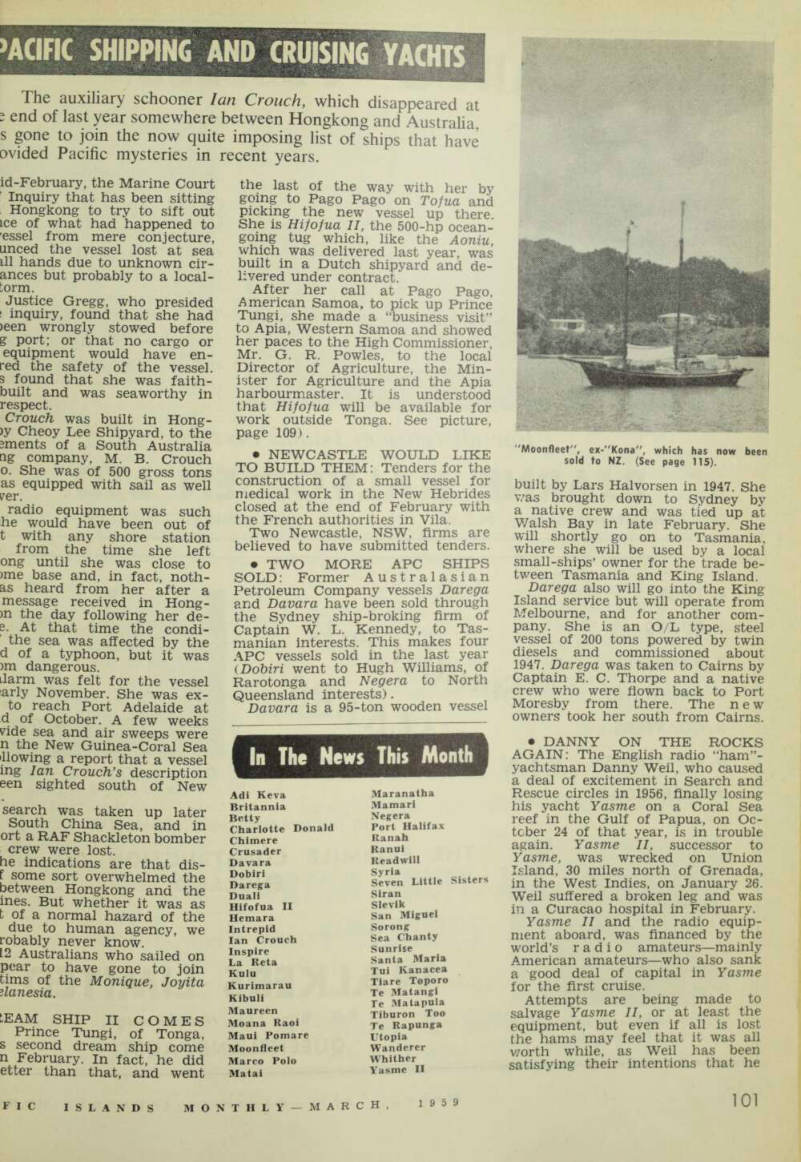
"Moonfleet", ex-"Kona", which has now been sold to NZ. (See page 115).
e from countries where no lams exist, or where there are ’ew, thus providing overseas with the desirable verification confirming radio contact with rare territories, the past year or so Yasme 11, d by Weil, and sometimes ther local ham assistants, has noving about the Caribbean >n these missions. The story ien told in successive issues American ham radio maga 3ST”. n Yasme II was almost ready [ from Holyhead, Wales, in iber, 1957, there was an ex i while Danny was taking board. He was blown over and finished up in hospital, acht was then said to have estroyed—but whether it was or whether the latest Yasme fact Yasme 111 is not known, my case the yacht named II finally sailed April 12, md we’ve been expecting ; ever since. In February Weil i no mood to talk further , but his will to resist might b broken down again by the -if further finance is pro was rescued from the Papuan reef in 1956, by Marshall s, a Qantas Catalina pilot sked the aircraft and his own 3 do it. Burgess was awarded >yal Humane Society’s Certi of Merit for his trouble.
Mother M For Bsip: The
: and Ellice Islands Colony Maureen, 50 tons, which be
came surplus to requirements after the arrival of the new Ninikoria has been sold to the British Solomon Islands Protectorate Government which has been short of small ships since the Melanesia disappeared mysteriously last year.
Three other of these M-class vessels already operate in the BSIP —they are Mary, Margery and Myrtle.
Maureen is expected to arrive in Honiara this month.
• They Pay More In Raro
TONGA: As from January 12, the levy on all cargo imported and ex ported from and to destinations out side the Cook Islands and which
passes through the main port of Avarua has been increased from 1/- per ton to 2/6 per ton.
The new rate is intended to pro vide funds to assist in the develop ment of the port facilities, which are certainly badly needed.
• Someone Lost A Punt:
Captain E. Ward, master of the new Gilbert and Ellice Islands motor ship, Moana Raoi, handed over a 16-ft punt to the Receiver of Wreck, at Suva, when he arrived from the Gilberts on February 2.
Captain Ward reported that he picked up the punt in Georgia Channel, off Kioa, in the Gilberts during his passage to Suva (Over)
[?]uron Too”, a 50-ft vessel built [?]dney shipbuilder R. Gordon [?]ar, and purchased by M. Henri [?]d, of the New Hebrides, is [?]ed to sail from Sydney for her [?]ome port shortly.
name “Maria” was painted bow of the craft, while a nchor and a fishing rod of jsign was found in it.
Iking A Look: The
Raoi, after discharging her 3ngers and small amount of n Suva, followed another and Ellice Island ship, Te la, up the Public Works Be lt slipway at Walu Bay. slipping is mainly for the of inspecting the new hull ending to the normal crop ing troubles found in every ip after, say, the first six of service. agh no dates have yet been :he Te Matapula was ex to return to Tarawa with cargo and passengers about idle of February; and the Raoi towards the end of the
Near-Miss On Naseli:
rris Hedstrom Ltd. auxiliary Tui Kanacea, caused some at Suva when she went on the notorious Naselai ly on February 4, during her from Suva to Levuka. 15-ton cutter was left high r at the following low tide refloated 36 hours later on tide, with the assitance of ;e party sent from Suva in Keva. believed that the Tui i suffered little or no dam li has claimed some victims time, the most tragic loss he Indian immigrant ship diich founded there in 1884 3 loss of more than 60 lives. ; of the Syria’s rusted hull
can be seen today, a mute testi mony of the earlier days of naviga tion when ships were not equipped with the modern aids of today.
• The Inspire Goes Up
WITH A BANG: The Dick Brown Line vessel Inspire, which graced a part of Avatiu basin for about nine months, after she sank at her moorings in April, 1958, is now no more. Recently she was blown up, so an eyesore and a hazard to navi gation is removed. The only people who are sorry are the visiting yachtsmen who liked to tie up against her, and, presumably, her
recent owner who seemed to like to see her around. He asked for a post ponement of the funeral rites so that he could remove parts that he hadn’t got around to removing in the previous eight or nine months.
• An Interesting Bottle:
Though some will contend that an empty bottle is never interesting, one that was plucked from the sea on the south-east side of Atiu Island, Cook Island, last October 21, should prove of very real interest to oreanographers. As reported in De cember PIM (p. 105), there was a note inside promising payment of £1 for return by finder to a London address, but there was no indica tion of where or when the bottle was launched.
Inquiries have since brought the information that the bottle was tossed from the British freighter Port Halifax at a point about 120 miles east of Cocos Island—south of Costa Rica and nearing the Panama Canal—at 2230 GMT on May 17, 1958.
A study of the current charts suggests that the route would be an easy north-bulging curve past the vicinity of the Marquesas and
[?]spire”, which has been an eyesore in Avatiu boat harbour, Rarotonga, [?]he sank at her moorings in April, 1955, was recently destroyed [?]er”. (See belowJ.
Photo: D. C. Berry.
i the north of the Tuamotu to -that is, along the Seven Little ; route of William Willis, more s. measurements make this ice not less than 4,800 nautical in 157 days, or an average of liles per day at least, assum lat the bottle was found im tely on arrival, which, in this ioes seem to have happened, was apparently still afloat, lished ocean current charts te a current movement of 10 niles per day along this route. , with the aid of sails, made 000-mile voyage from Callao r Tutuila—where he was taken v—in 115 days, an average of 52 miles per day. interesting feature of this drift is that it indicates a .urn surface current speed in area and season probably higher than generally led.
Us Si A N Tuna Craft
FED: Some months ago an fishery experts, visiting , announced that Russia might nter the Pacific tuna fishing ry. In October last a Russian r survey vessel was reported ve sailed on an exploratory On February 17, a Japanese essel skipper reported by radio le had passed a Russian-flag vessel in the Caroline Islands Tuna were being hauled I. There appeared to be a of about 20, including some i. Another Russian-flag vessel dng nearby. At beginning of , Russian fishing vessels were ing without permission in 3d Philippines bays, to local ities’ annoyance.
Ther Brown Relics
GrO: At the Rarotonga Island il in mid-January, Councillor ni (trader William Watson’s name) moved that the vessel , lately owned by D. C. Brown tting high on the reef near i Harbour a mile east of In [see above) be also removed.
Resident Commissioner re that it was to be blown up a as permission was obtained ;he owners. wreck changed hands several following the stranding on iber 16, 1954. ever, the Brown organisation it least two other “conspicu recks”—to use a Pilot Book One is the ketch Siran, ;d October 4, 1951, purchased 3 reef, partly salvaged, and in to Avarua, where she t in a cradle ever since and rell have been demolished in sent hurricane, other is the yacht Jopeda, d June, 1957, on the east side s island, purchased by Mr. , and hauled onto the beach itangiia, where she still sits, olition of these would not
contribute to the local larder as they are high and dry. When Inspire went up there was a great harvest of fish for the locals. • NEW OWNER: Burns Philp’s 300-tonner Kulu, laid up in Rabaul for some time past, has been sold to G. & M. Shipping Service of Rabaul, who also own the 195-ton Duali and the 50-ft launch Betty Another BP 300-tonner is also understood to be on offer, and will be replaced by a smaller vessel.
• Tenders For “Pom Pom
No. 2”: There are reliable reports that tenders were received from all over the world for the building of NZ Island Territories Department’s replacement vessel for the present Maui Pomare. Tenders closed in
London at the end of 1958. They are said to be keen, with delivery dates as early as the end of 1960.
Such is the ship building re cession in UK yards that it is re ported that even the great John Browns, of the Clyde, have tendered.
The vessel, it will be recalled, is to be of about 2,750 tons gross with a speed of 13 knots, carrying about 65,000 cu. ft of refrigerated cargo and 40 passengers on the Cook Islands-NZ run.
New Zealand’s financial climate has altered somewhat since tenders were called, and no one will be very surprised if the scheme is shelved, at least for the present.
O The Unshared Secrets:
Though the Union Steam Ship Com
iias undoubtedly endeared it ith its shareholders, it has revealed much to the public sea-going employees, ri the passengers’ point of tie chronic shortage of accom ion along the routes served used ill feeling, whatever the lies involved. Public relations Iso appeared to be conspicu joor. spapers have done much snip sr the fact that the company to publish its annual ts and balance-sheet, sum of which have shown large ofits, in excess of £1,000,000 mt years, despite the world ig recession. current summary issued i reveal taxation or deprecia lowances—a fact which was by the New Zealand md will undoubtedly also not •looked by the labour unions ms for pay increases this le summary of 1958 opera he company says that over t 10 years its tax-paid profit d 4.8 per cent, on the cap olved. il dividend on the ordinary all of which are held by & O Line, was 8 per cent. year’s operations, and 5* t. was paid in respect of the preference shares. 402,000 passengers and over in tons of cargo were carried company’s fleet in 1958. ebruary a group of Indian
residents of Suva rather naively suggested that, with a number of Union Company vessels lying idle in Auckland, one might be available at bargain rates to provide a low cost cruise for Fiji Indians to India after being fitted out with troop ship type accommodation.
Undoubtedly there are plenty of foreign-flag ships available to pro vide such a cruise whenever called upon, but there are plenty of reasons why the laid-up Auckland vessels would not be forthcoming.
• Slevik May Change
HANDS: The small Norwegian tramp Slevik, mentioned in February PIM, may be purchased by Eriama Plantations Ltd. of Papua. The vessel called at Auckland with ex plosives and general cargo from Australia in February returning to Sydney with timber from Tauranga.
She was then to head for New Guinea again.
Chief Officer Sigurd R. Andersen, who has been in the ship ever since she left home 20 months ago, told of her movements since then.
First was a dynamite cargo from Hamburg to Peru and Chile. Next a nitrate cargo from there to Mexico followed by a spell in the Florida- Havana-Gulf trade, then a sugar cargo from Cuba to British Columbia.
From there dynamite for the Philippines and copra to Colombia, Central America. A cargo of fish meal from Callao to San Pedro came next, and another dynamite cargo from James Island, BC, to the Philippines.
Leaving Manila in ballast last September 1 Slevik headed for Queensland and the commencement of her charter to Eriama Planta tions. Since leaving home she has had a change of masters, and is now commanded by Captain Bjarne Sverdrup.
Although listed with Lloyds as 606 tons gross, certain structural alterations have reduced this to 358 tons, permitting the signing of a total crew of 12 instead of 17.
Slevik normally carries two Mates who maintain 6-hour watches, but the Australian Second Mate signed off the ship at Auckland and the captain was standing watches when she left that port. • BROTHERS SANK: The coastal vessel owned by Mr. Charlie Blake, of Rabaul, sank at her moorings in
[?] more small ships from outside Fiji are making use of the Fiji Public Works Depart [?]ipway at Walu Bay, Suva. The slip can accommodate ships up to 1,000 tons. Shown the Gilbert and Ellice Islands Government auxiliary ketch, "Te Matapula". high and dry on the main slipway for routine overhaul and repairs. Stinsons
"Hifofua II", photographed in Pago Pago in February, when on her delivery voyage to Nukualofa. (See page 101). —Photo: Pan American Prints.
1 Harbour in late February.
Lminary inspection showed no Dt reason for the mishap. ;s of the accident gave her mes, Two Brothers and Three rs. You can take your pick.
N Radbroke On Reef: The
lown vessel Stradhroke, owned arua Plantations of New i, ran aground off Cape rt in late February and re are that she will be a total
Onald Ships May
2H: There were reports in .ry that A. B. Donald & Co. soon switch their 309-ton tte Donald from the Cook ; trade to French Polynesia, eturn the 173-ton schooner Taporo to the Cooks, ild’s head office in Auckland led that the matter was consideration but that no de was likely until late March. 3 Taporo, built in 1913, traded Cooks for many years but ansferred to Papeete, where registered, about 1949, when
the company purchased Charlotte Donald from Singapore, where she is still registered.
She is one of the war-time 300tonners, built at Fremantle as AV-1363 but was named Kina batangan when purchased by ABD. • VERSATILE; Captain Charles Smith, a very substantially built Scot and a very versatile one, too, has lately been appointed Harbour master at Apia in succession to Cap tain Jones. Captain Smith served his time as an AB in NZGS Matai, gaining plenty of experience in surf-boat work servicing the light houses round the New Zealand coast when Matai was engaged in that work. Later, when the ship was engaged in ocean telegraph
cable repair work, as an officer he gained useful experience in this specialised field.
He was also in Matai when the vessel was engaged as a supply vessel for the RNZAF bases extend ing north through Norfolk Island to Los Negros.
He had a spell in the Cooks in ter-island trade, first in the Fair mile La Reta, and later as master of Island Territories’ ketch Ranui.
He underwent a training course with the NZ Meteorological Service, was Assistant Harbour Master at New Plymouth for several years, then returned to “Met” to become Port Meteorological Officer at Well ington, visiting and attending to the requirements of shipping using that port. (Over)
It is from that job that he to Apia—so mariners using thi;. will be dealing with a mam knows his hurricanes. He was popular at sea and in “Met”.
• One That Won’T Re1
Captain E. Harness, who r from the busy post of Har master at Suva some months has purchased a home at: Roskill, Auckland. But the Is still have their call.
In January he flew north to relieve Captain R. D. Mat in Kurimarau —which provided! tain Harness with an opport for a new look at an old star ground — the Gilberts. Cap Matheson went south for his a:, leave at his home port of AucM
• Emigrant Ship: An Emi
ship with a difference may up in Rabaul in March or and she will likely call for a fresh water. The ship is the ton Panama-flag vessel San M owned by the Isabel Navigatia of Hongkong, and the emig aboard will be some 1,300 sel cross-bred Jersey Heifers, H from Whangarei, NZ, to the F pines where they will be mated beef bulls.
A steamship 29 years old, Miguel, seems on the surface almost as unlikely a selection the handling of so large a ship of cattle as the steam pass vessel Catusha, 6,923 tons, T last year lost 100 of some 1,200( of bullocks en route from Tauri NZ, to California.
That ship was there held i writ pending settlement of i ance claims, later returned e to Hongkong, and has since broken up.
She appears to have also su succeeded in breaking up what mised to be a valuable live trade between New Zealand!
America as a result of the ver publicity resulting from the but exaggerated—conditions aH There have been no further ments since, though another hi being Investigated.
Late February the route t taken by San Miguel with her lipines cargo was uncertain, 1 number of calls for fresh watr cattle and engines en seemed certain.
• Manus Reef Cla.
VICTIM: Mr. Cliff Batt, of N Plantation, North-Western Is!< New Guinea, has lost his copra scow Kibuli to a Manus Latest advice, end of February that the vessel is a total writ.
The vessel was carrying 20C of copra from the plantatio Lorengau when she went up: Batt is now the owner of fas Maron Plantation, Hermit 0 (about 150 miles, and slightly of west, from Manus) once o by H. R. Wahlen, now of Ham