on Ancient Pacific Writing
pp. 77-79 · Read in the full issue
Petroglyphs In The New Hebrides
T e Need to Search for More Clues on Ancient Pacific Writing
By Brett Hilder
The recent revival of interest in the stone inscriptions in accentuates how meagre such records are in the Pacific.
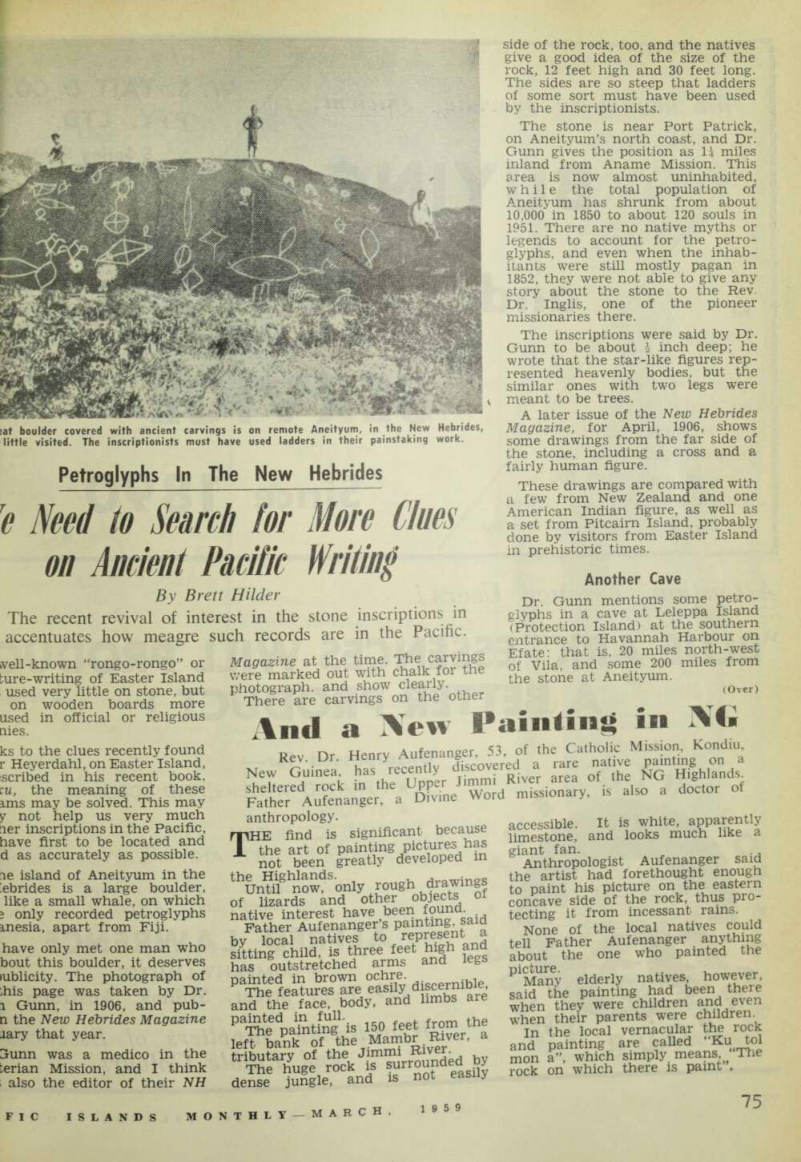
veil-known “rongo-rongo” or ture-writing of Easter Island used very little on stone, but on wooden boards more used in official or religious oies. ks to the clues recently found r Heyerdahl, on Easter Island, scribed in his recent book, :u, the meaning of these ims may be solved. This may y not help us very much ler inscriptions in the Pacific, have first to be located and d as accurately as possible. ne island of Aneityum in the Hebrides is a large boulder, like a small whale, on which s only recorded petroglyphs inesia, apart from Fiji. have only met one man who bout this boulder, it deserves lublicity. The photograph of :his page was taken by Dr. i Gunn, in 1906, and pub n the New Hebrides Magazine iary that year.
Sunn was a medico in the terian Mission, and I think also the editor of their NH
Magazine at the time. The carvings were marked out with chalk for the photograph, and show clearly.
There are carvings on the otner
side of the rock, too, and the natives give a good idea of the size of the rock, 12 feet high and 30 feet long.
The sides are so steep that ladders of some sort must have been used by the inscriptionists.
The stone is near Port Patrick, on Aneityum’s north coast, and Dr.
Gunn gives the position as 14 miles inland from Aname Mission. This area is now almost uninhabited, while the total population of Aneityum has shrunk from about 10,000 in 1850 to about 120 souls in 1951. There are no native myths or legends to account for the petro glyphs, and even when the inhab itants were still mostly pagan in 1852, they were not able to give any story about the stone to the Rev.
Dr. Inglis, one of the pioneer missionaries there.
The inscriptions were said by Dr, Gunn to be about I inch deep; he wrote that the star-like figures rep resented heavenly bodies, but the similar ones with two legs were meant to be trees.
A later issue of the New Hebrides Magazine, for April, 1906, shows some drawings from the far side of the stone, including a cross and a fairly human figure.
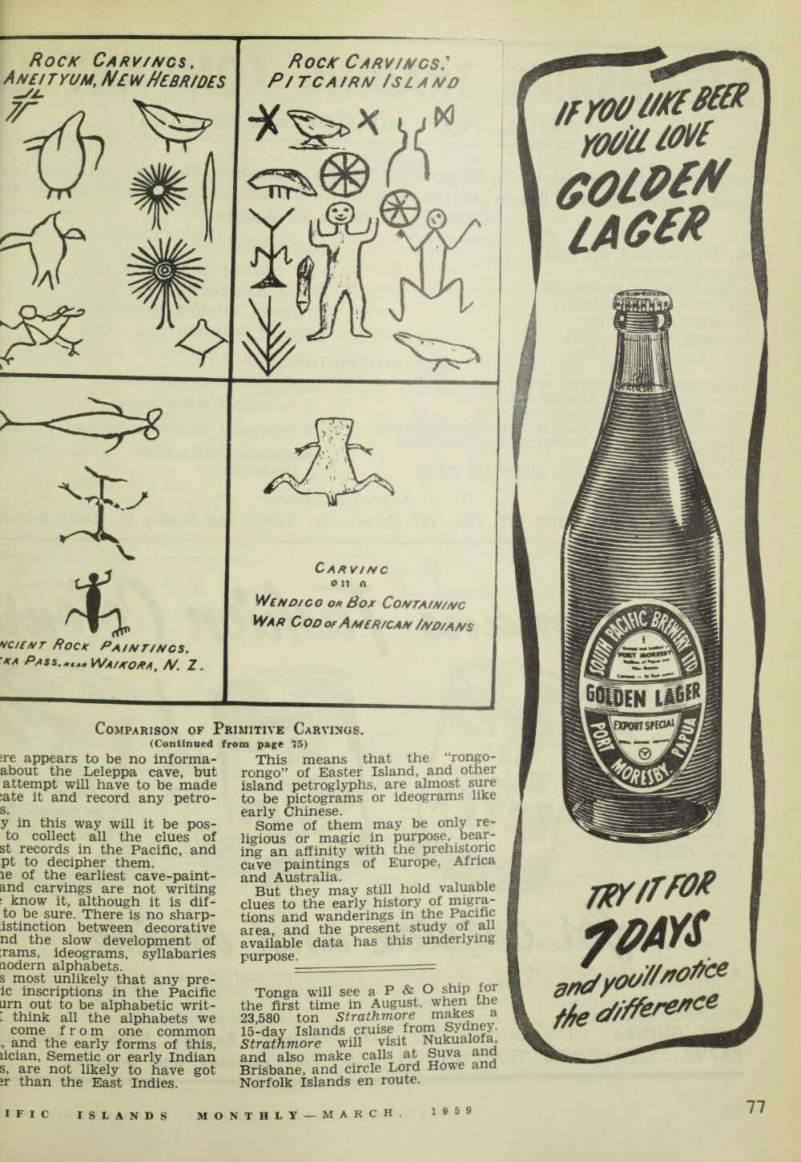
These drawings are compared with a few from New Zealand and one American Indian figure, as well as a set from Pitcairn Island, probably done by visitors from Easter Island in prehistoric times.
Another Cave
Dr. Gunn mentions some petro glyphs in a cave at Leleppa Island (Protection Island) at the southern entrance to Havannah Harbour on Efate; that is, 20 miles north-west of Vila, and some 200 miles from the stone at Aneityum. (Over)
[?]at boulder covered with ancient carvings is on remote Aneityum, in the New Hebrides, [?]little visited. The inscriptionists must have used ladders in their painstaking work.
sre appears to be no informa about the Leleppa cave, but attempt will have to be made sate it and record any petro s. y in this way will it be pos to collect all the clues of st records in the Pacific, and pt to decipher them, re of the earliest cave-paint and carvings are not writing : know it, although it is dit to be sure. There is no sharp istinction between decorative nd the slow development of jams, ideograms, syllabaries aodern alphabets, s most unlikely that any pre ic inscriptions in the Pacific urn out to be alphabetic writ - think all the alphabets we come from one common , and the early forms of this, lician, Semetic or early Indian s, are not likely to have got ?r than the East Indies.
This means that the “rongo rongo” of Easter Island, and other island petroglyphs, are almost sure to be pictograms or ideograms like early Chinese.
Some of them may be only re ligious or magic in purpose, bear ing an affinity with the prehistoric cave paintings of Europe, Africa and Australia.
But they may still hold valuable clues to the early history of migra tions and wanderings in the Pacific area, and the present study of all available data has this underlying purpose.
Tonga will see a P & O ship for the first time in August, when the 23,580 ton Strathmore makes a 15-day Islands cruise from Sydney.
Strathmore will visit Nukualofa, and also make calls at Suva and Brisbane, and circle Lord Howe and Norfolk Islands en route.