Progress v. Cargo Cultism
pp. 71-75 · Read in the full issue


New Guinea Head Tax Trouble Again
The Problems of the Sepik: Progress v. Cargo Cultism
By G. C. Luck
The huge, practically undeveloped Sepik District of Papua w Guinea, long a fertile field for occult practices, has had Dther rash of cargo cults.
T November, native resistance, merated by a long-stand ig cult in the Number 2 Wapei on the southern slopes of the ;elli Mountains, almost cost fe of Patrol Officer Faithfull, the Nuku patrol post, who in a tax-gathering patrol. :hfull, entering one village, net by a crowd brandishing > and strung bows. The ge was simple—they would ay any tax. iding not to retire for re ements in the face of this ition, he went on to the next then, resistance had increased urther, and Faithfull’s patrol let by a wildly militant group tives. threatened him with his and a dangerous situation, could have resulted in the iction of the whole patrol, was d only by an immediate with 1.
Big Patrol Out
Government’s answer was to this show of force with the fcch of a patrol capable of ng, if necessary, that the laws w Guinea must be obeyed, by the Sepik District Officer, 'om Ellis, and including P/O full, ADO Terrell, and P/O , the big patrol hurried into /apei area. 3d this time with the biggest to visit the area since before var, the Wapei people put their weapons. :s soon disclosed that there been misunderstandings on sides—the Wapei people did mow that there were such '< as tax exemptions, and the nment had not made known ull details of the head tax the patrol went in. :imum tax for the area had set at 10/ —a tax tribunal ly granted exemptions to t every man in the group.
Wapei area, peopled by )rs of medium height, liar build, had been the scene i-war trouble. 5 time, however, the trouble
was laid at the door of the cargo cultists.
Director of Native Affairs, Mr.
Alan Roberts in Fort Moresby, said the resistance to tax was not the sophisticated kind experienced in New Britain; that it was linked with a cargo cult that had been very active for some years, and had reached a small climax in December, 1957.
At that time some of the leaders were sentenced to short terms of imprisonment.
Mr. Roberts said the cult had arisen from the Wapei’s general dissatisfaction with their lot, and their realisation that by comparison with the European, they were a backward people. As a result they deeply resented a system that called for them to make a contribution to other people’s prosperity, he added.
Hardly had the recent Wapei situation been quietened than trouble arose in the inland Wewak area, about 50 miles from Wewak up the Maprik Road.
For the last 12 months, the Ad ministration has been aware of cult practices in the area, laced with mysticism, and ideas borrowed from Mission teachings.
However, in early December, the cult took a more dramatic turn, with men reported springing up from holes in the ground to dis tribute money to faithful followers.
Acting District Commissioner Tom Ellis decided the time had come for action against the cultists.
A patrol, under Patrol Officer Jack Mater, was despatched to the two villages of Rabundogum and Bararata, on the edge of the wide Sepik Kunai plain, to investigate the cult and restrain its leaders.
The patrol was lucky enough to catch red-handed, two natives burying money in a cemetery, to
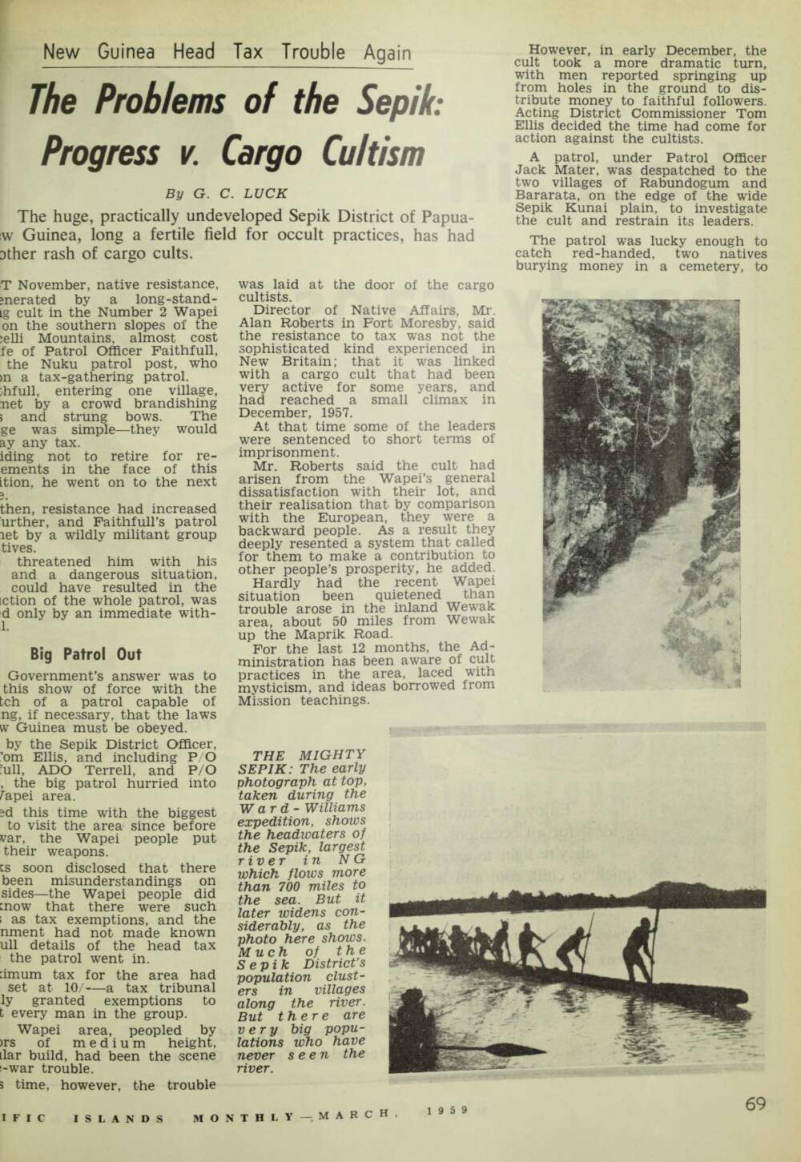
The Mighty
SEPIK: The early photograph at top, taken during the Ward- Williams expedition, shows the headwaters of the Sepik, largest river in N G which flows more than 700 miles to the sea. But it later widens con siderably, as the photo here shows.
Much of the
Sepik District’s
population clust ers in villages along the river.
But there are very big popu lations who have never seen the river.
dug up later as proof of their rer.
DO John Frawley flew from wak late last December to hold ourt; sentenced the two natives he maximum term of six months charges of spreading false re ts. ighteen other natives rounded by Mater’s patrol as playing (ortant parts in the cult were ig brought back to Wewak, bably to undergo a short inten period of “schooling”, with ruction in the principles of the opean economic system, his continual turning to the itical and magical to solve hard nomic problems is proving one ;he major difficulties for admini .tors in the Sepik. With in ising contact with the European, re comes an awareness by the ive of his own lack of amenities cargo. He completely fails to ise that work is necessary to luce the goods. om Ellis puts the crux of the blem bluntly—“ The basis of Jo thinking is that natives want tething for nothing. They have er had to work hard to make existence, and they have no ception of the need to work to 1 a place in the world, rhey believe we have the secret getting the cargo, and do not ■erstand that work is necessary Droduce it.”
But There's Progress
et, in spite of the distraction cults and other mystical ctices, the Sepik district is ?ly beginning to make real gress towards a more soundly ed economic future, he Administration is pinning economic hopes of the district tree crops—coconuts, coffee and Da. And in a vast area with values ranging from only fairly d to very poor, it’s a big job. programme to plant 100,000 new Dnut palms in the Wewak sub-
Robusta raffep" W ,?2’ a .s d eroS in t-hP wLS o g i n ™ th , e areas 117 i? Mapnk areas, 117 acres of coffee have been planted this year, and 50 acres of cocoa have gone in on the coastal The people of the Dagua area who made headlines a fel month! !oc 0 oa by agatst lnS ?n en th e e on ad P vtee tin of Agriculture Denartment d evnerK are working enttasiSallv P ‘ ’ . ° ® encnusiasticaliy, A.s District Office spokesmen say, They want to grow cocoa and they are going to grow cocoa. They realise they won’t achieve the same production as on the Gazelle peninsula, but it’s their decision, and they’re going to stick by it”.
The tree cr °P s win take yeara to com e m, and in the meantime, the Administration is pushing immedi ate cash crons,
Cash Crops First
Peanuts are the greatest money- Promotion is mcreas tons were dug up In the flrst flve months of this financial ? ear (that is ' up to the end ot last November) equal to the entire pro duction in the previous twelve months.
One village, Turengi, 48 miles from Wewak on the Maprik Road, has just bought its own Land-Rover ta take its peanuts to market, Dry rice growing is being tried in the Maprik area, and experimental
s of castor plants have been down. The bush grows dly. reaches a height of about eet, and produces kernels worth per ton. measure of the success attend efforts to improve the immediate Irak area is the impending lation of a council to cover the ) people within a few miles of town. The council should be rporated within the next six ths, the second for the district, r the But-Boiken Council, iwever, big problems lie ahead nd, and even the most far ted administrators find it hard mvisage a successful place in economic picture for the people i Telefomin and the Upper k. it they will somehow have to Dersuaded that cargo cults are the answer to the needs of p districts. id it seems certain that quite iw more charges of “spreading ; reports” will be sustained be the solution is found.