And They May Stay There!
pp. 63-67 · Read in the full issue


The Future of Pacific Tourism
Fiji And The French Are Ahead- And They May Stay There!
The territories of the South Pacific can be divided roughly nto two classes: those that encourage tourists and those which ouldn’t care less. There is at least one territory that is the xception to both above clauses: Tahiti. It gets them, anyway.
JI has made a determined effort in the post-World War II years, and outside of Hawaii, now has the best-organised ’lst industry of all the Pacific nds. iji, of course, has a lot of natural antages for this. It is on the n shipping and air routes be m Australasia and North jrica, and it is natural and easy >tep off there for a few days, i couple of weeks, nericans are doing this to an easing degree, and there is also eady, if unspectacular, flow of ists from New Zealand to Fiji ng the winter months. lot of nasty things are said it NZ tourists in the Colony h as: “A NZ tourist brings md a clean shirt and changes ier”), but the fact is that NZ ides a lot of the bread of Fiji ism, even if the more affuent ir tourists provide most of the er and jam. it Can Still Be
An Adventure
is hard to calculate these ?s, but tourism indirectly and :tly probably is worth a couple ullions of pounds, annually, to these days. s t reputing: it is easy to visit either coming or going from where else; to visit any other
of the Pacific Islands (excluding Hawaii, of course) still takes a determined effort of will and frequently is without encourage
ment from those who would profit most.
Western Samoa is beautiful, interesting, with a variegated and' entertaining history. But at present, it has no organised tourist industry. It has, of course, a thin trickle of overseas visitors; but that isn’t tourism.
By and large, the Samoans are now more preoccupied with taking over their own government, and are not interested in tourists. There are no licensed hotels, because the Territory’s liquor laws are based on “liquor only for medicinal purposes”, for which a permit is issued. There are several guest houses.
The Cook Islands are in a similar position. The group is served by poor shipping services and the air service touches only at Aitutaki.
There is only very limited guest house accommodation in the main island of Rarotonga.
New Caledonia Is
Out for Tourist Business
Tahiti, after a period of isolation, now has two air services and numerous shipping services. The fame of its scenic beauty and the hospitality of its native people have made it a mecca for all sorts and condition of visitors, wanderers and vagabonds, in spite of at times active discouragement from some officials.
American interests are now tak ing an active part in local hotels and mere has been considerable improvement in recent years.
Quite recently New Caledonia has been making a determined effort
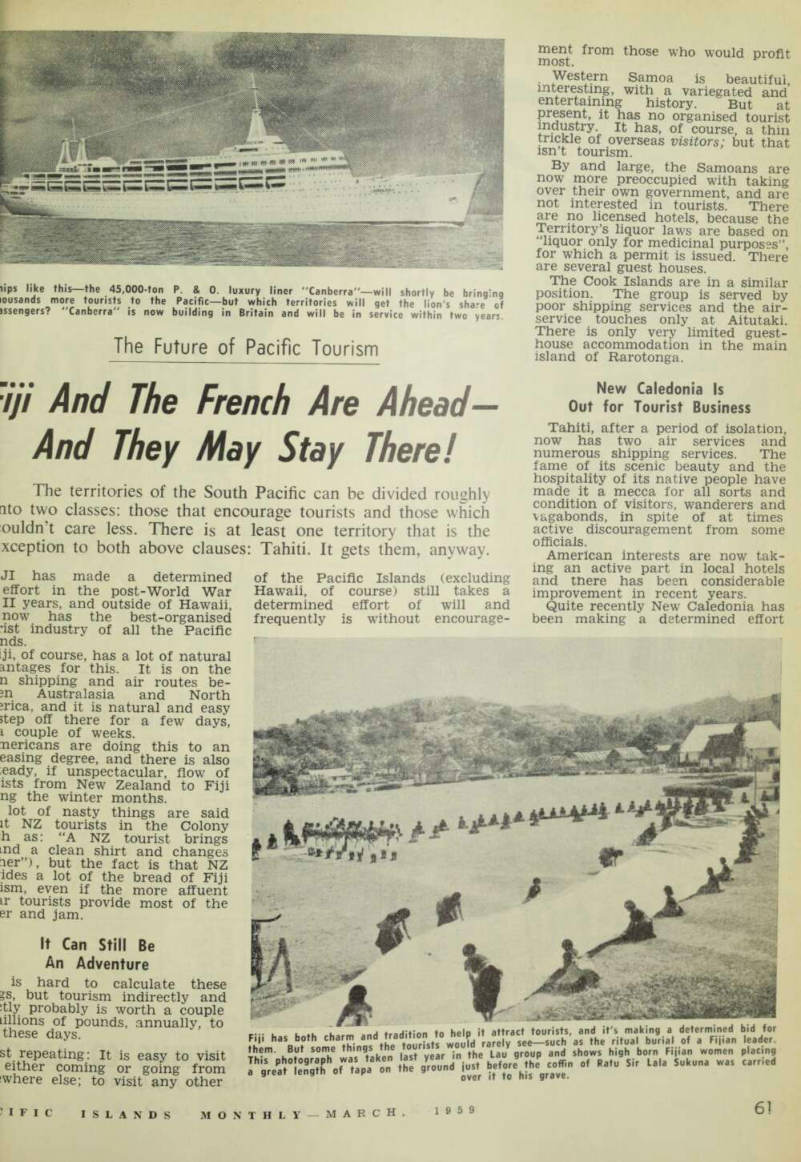
[?]ups like this—the 45,000-ton P. &0. luxury liner "Canberra"—will shortly be bringing [?]ousands more tourists to the Pacific—but which territories will get the lion's share of [?]ssengers? "Canberra" is now building in Britain and will be in service within two years.
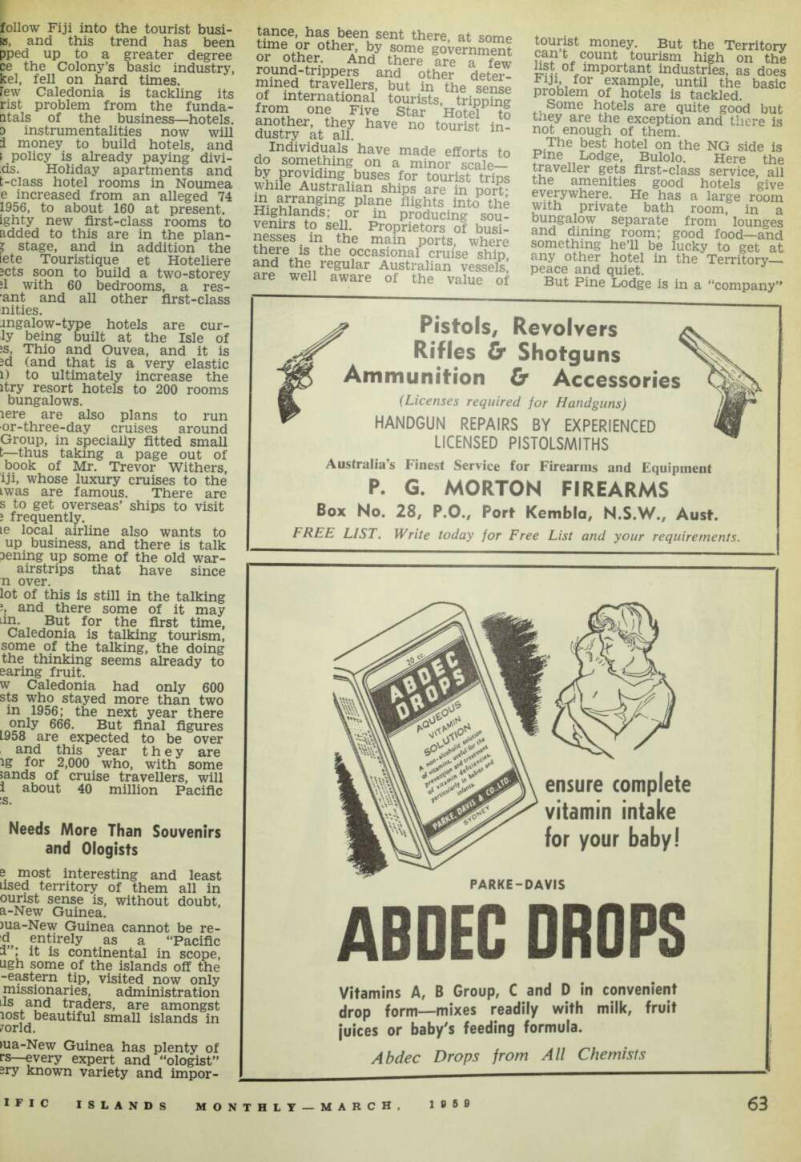
Fiji has both charm and tradition to help it attract tourists, and it's making a determined bid for them. But some things the tourists would rarely see-such as the ritual burial of a fijian leader.
This photograph was taken laken last year in the lau group and shows high born fijian women placing a great length of tapa on the ground just before the coffin of Ratu Sir Lala Sukuna was carried over it to his grave.
follow Fiji into the tourist busi is, and this trend has been pped up to a greater degree ce the Colony’s basic industry, kel, fell on hard times.
Few Caledonia is tackling its rist problem from the funda- Qtals of the business—hotels. 0 instrumentalities now will 1 money to build hotels, and i policy is already paying divi ds. Holiday apartments and t-class hotel rooms in Noumea e increased from an alleged 74 1956, to about 160 at present, ighty new first-class rooms to added to this are in the plan l stage, and in addition the iete Touristique et Hoteliere jets soon to build a two-storey ;1 with 60 bedrooms, a res •ant and all other first-class nities. angalow-type hotels are cur ly being built at the Isle of ;s, Thio and Ouvea, and it is ?d (and that is a very elastic i) to ultimately increase the itry resort hotels to 200 rooms bungalows. lere are also plans to run ■or-three-day cruises around Group, in specially fitted small fc—thus taking a page out of book of Mr. Trevor Withers, iji, whose luxury cruises to the iwas are famous. There are s to get overseas’ ships to visit i frequently. le local airline also wants to up business, and there is talk pening up some of the old war airstrips that have since n over. lot of this is still in the talking 3, and there some of it may Li n. , But for the first time, Caledonia is talking tourism, some of the talking, the doing the thinking seems already to earing fruit. w Caledonia had only 600 sts who stayed more than two in 1956; the next year there only 666. But final figures 1958 are expected to be over and this year they are ig for 2,000 who, with some >ands of cruise travellers, will 1 about 40 million Pacific :s.
Needs More Than Souvenirs
and Ologists
e most interesting and least lised territory of them all in ounst sense is, without doubt, a-New Guinea. )ua-New Guinea cannot be re 5, entirely as a “Pacific a ; it is continental in scope, ugh some of the islands off the -eastern tip, visited now only missionaries, administration us and traders, are amongst lost beautiful small islands in /orld. »ua-New Guinea has plenty of rs— every expert and “ologist” sry known variety and impor
tance, has been sent there, at some time or other, by some government or other. And there are a few round-trippers and other deter “lnfA travellers, but in the sense of international tourists, tripping from one Five Star Hotel to assrvar have no tourist in - Individuals have made efforts to do something on a minor scale— -5L? r T d l ng . buses for Jurist trips while Australian ships are in port m arranging plane flights into the Highlands; or in producing sou venirs to sell. Proprietors of busi nesses in the main ports, where there is the occasional cruise ship and the regular Australian vessels are well aware of the value of
tourist money. But the Territory cant count tourism high on the hst of important industries, as does Fiji for example, until the basic problem of hotels is tackled.
Some hotels are quite good but tney are the exception and there is not enough of them.
The best hotel on the NG side is Pine Lodge, Bulolo. Here the traveller gets first-class service, all the amenities good hotels give everywhere. He has a large room with private bath room, in a bungalow separate from lounges and dining room; good food—and something he’ll be lucky to get at any other hotel in the Territory peace and quiet.
But Pine Lodge is in a “company’"
n, in a huge valley devoted rely to mining and timber, and lout indigenous inhabitants, hout friends in the town, the nary tourist will exhaust the sibilities in a day or two.
You Might Have to Share
; some of the rest of New lea’s hotels the tourist will get 1 food; he can always be certain getting sufficient to drink; in e he will get reasonable service; Imost all cases he will get great Iness and help from the lagement. some he will do well to get sthing better than a ceiling : of 30 watts; or a mirror bigger i a foot square; or anything 3 substantial than a curtained >oard to hang his clothes. He be luckly if he doesn’t have to e his room with a stranger, is a land where such refine ts as bedside lights are rare ed, and where it is apparently med that one will retire at t in either a drunken stupor ivith the aid of a brace of )ing pills. No effort is made rotect the traveller from noise. ’ the time an individual has bed the status of international ist, he (or she) has also reached stage of wanting a “good quiet . He doesn’t want to horse d in the bar half the night; d listen to locals telling their stories on the verandah directly de his room; or to be brought all-standing while someone ’ses his jeep or Land Rover (or » at times, sounds like his rpillar tractor) out of the ing area.
Effect of Clubs on PuLs ie state of affairs in Territory Is is not altogether the fault the proprietors or owners, ely it is a matter of hotel
f^°r> OI Sr^ s ’ anc * tlle hote l business m v?* G seems to have got itself revolving around a vicious circle; There is unlikely to be much improvement in the hotels until there are more tourists, and there ar^i U ?i lkely to be man y tourists until there is an improvement in the hotels.
In the meantime, the hotels must depend on local patronage, and there they are immediately up against the competition of the clubs. As soon as any settlement in the Territory reaches six-house level, the residents set up a club At last count there were 16 hotels in P-NG; and there were about 50
clubs. That is formidable opposition m any language.
Papua-New Guinea at present does not need a tourist industry— it is doing very nicely without.
And in some respects it probably would be a great pity if it ever develops differently, it is one of the few remaining frontiers of civilisation, and such visitors as it does have are more interested in that than in rooms-with-bath and plush cocktail-bars.
It seems, therefore, that for a long time to come, Fiji and the French Pacific are going to have the South Pacific tourist business pretty much to themselves.