Polynesia’s Snakes
pp. 59-61 · Read in the full issue

Doing it the Hard Way
On The Search For Polynesia’s Snakes
Prom An Apia Correspondent
A young Hungarian zoologist,
r. Janos G. V. Varga, who s studied in Germany and re itly visited Australia and New
aland, is at present studying
ikes in Samoa.
HERE is a popular opinion that there are no snakes in Polynesia except in Western Samoa, i Mr. Varga hopes to find out v far this is true. He will later it other territories.
A. Buxton, in Insects of noa, says, “No land snakes are nd to the east of Samoa. How r, on Hawaii there is found a id worm snake, Thyphlops minus, which is rarely seen, luxton also mentions that there a terrestrial snake, a boa, 7 yrus bibroni, to be found in iga.
Hiring a short stay in Tonga u, Mr. Varga questioned Tongans remote villages and found no >wledge of snakes anywhere, he Samoans distinguish four es of snakes—gata’ula (black ke), gatamumu (red snake), asina (white snake) and in one a of Savai’i island, around the age of Safune, a gata’oso mping snake) is mentioned. ) latter name is applied by some either the red snake or white ke.
Plenty of Proof here are plenty of references makes in W. Samoa’s past, and ity of proof that snakes were lady well known before Euro n discovery of the islands, uring Mr. Varga’s stay in ai’i, in the vicinity of Asau, small village situated amongst lava fields, the people of the 'ounding villages told how the pie of the district used to eat kes, using coconut oil as a servative. is interesting to note that the pie of Asau itself denied this, hey apparently are ashamed of alleged eating of snakes by nous generations, r. Varga believes, however, that people of Savai’i used to eat meat until about 70 years fter three weeks of exploration the bush of North Savai’i, in districts of Safune and pquli, Mr. Varga succeeded in hing twelve snakes ranging in from 13 inches to 51 inches.
He also caught two snakes near Poutasi, in the Falealili district of Upolu island, which measured 36 and 49 inches in length.
On the small rocky island of Apolima, one dark brown snake 33 in. long was found.
Up to 40 years ago much larger snakes were here and Mr. Varga has in his possession a snake skin 12 ft in length, found in the Palauli district of Savai’i. But the skin was stretched and the original length may have approxi mated only nine feet.
The reason the larger snakes are dying out may have something to do with the cultivation of the land. , .
Generally the colouring of W.
Samoan snakes varies from light grey red brown to a dark brown, almost black. The colour varies according to the surroundings m which the snakes are found.
They can all be identified as one type—boas, sub-family Boinae.
All Harmless
The Pacific boas ( Enygrus ) are small snakes with small triangular heads and angular snquts which can be seen when viewing the snake from the side, and with wedge shaped scales on the back.
They are completely harmless and are found on the Pacific Islands, from the Celebes eastwards through New Guinea to Samoa.
Little is recorded habits of the three species. (Over)
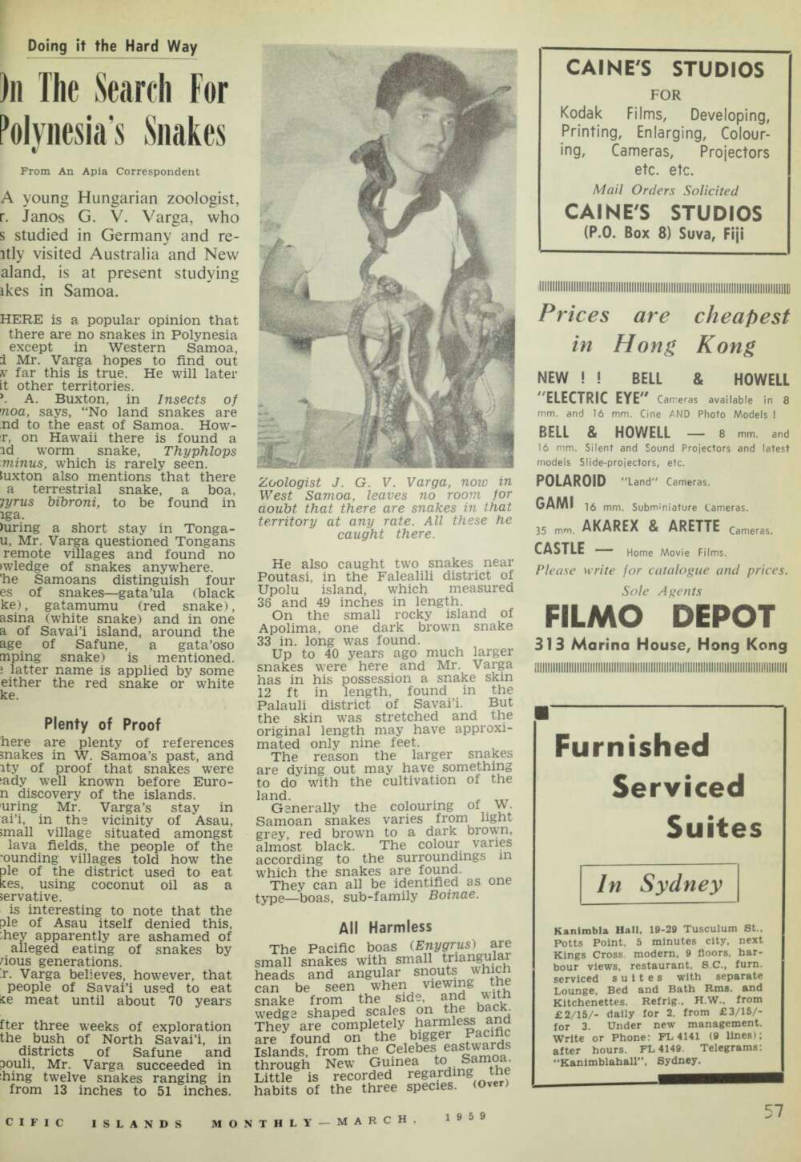
Zoologist J. G. V. Varga, now in West Samoa, leaves no room for doubt that there are snakes in that territory at any rate. All these he caught there.
lie one found in Western Samoa, ygrus, feeds on rats and lizards, len conducting a post mortem on dead snake, Mr. Varga found the stomach a banded rail, a i which lives and feeds entirely the ground.
Then Mr, Vagra first heard of iumping snake in Samoa, he ught that it was identical witn Enygrus asper. This snake is Qd in the Bismark Arcnipelago. ; is possible that during the iod when labourers and cargo e brought in ships from New nea to Western Samoa the lies E. asper might have been jght to Samoa. i captivity the W. Samoan kes are difficult to feed and have fie forced to accept food. Mr. ga has not succeeded in get any of his captive snakes to p.
A Crowing Snake i Samoa the story is told of a se which crows like a rooster :a vivini). The Samoans claim ; a very large red coloured ce makes this noise. Probably ! roosters or rats attacked by les may have made these es, which Samoans believed nated from the snakes. But :es have no vocal chords, owever, the Dhaman snake of . makes a noise like the deep id of a large male cat—the only ce known to make a real loud e. imoa has four species of sea :es, three species of Laticuda one species of Pelamis. These also found in Niue and Tonga, jople believe they are non onous, but this is not absolutely ain. > far as is known there are no :es in Tutuila and Manua, ;ern Samoa.