Belong
p. 22 · Read in the full issue
Death Of Paramount Lululai
Golpaik
A Friend Belong Australia
Paramount Lululai Golpaik,
MBE, of New Britain, leader of
his people in war and peace, and a true friend of Australia, died
at his home village in February.
A S far as anybody could tell, he was 74. Born in cannibal days, Golpaik came to be appointed paramount chief of nearly 4,000 New Britain coastal natives of the Mengen census division. His own village, Sali, was a half-hour’s walk from Pomio patrol post in Jacquinot Bay.
Dressed, as he mostly was, in a white lap-lap and white long sleeved shirt, he was a leader before the war—a quiet, slow speaker, a man with obvious intelligence and able to think ahead. But it was the war which brought him public recognition.
Underground Movement
When the Japanese invaded New Britain, Golpaik was on the side of the Australians. He used his local knowledge and influence to help Coastwatching parties who had been landed by submarine, to rescue
Allied airmen who had been shot down, and to confuse the Japs.
Group Captain (then Wing Commander) W. E. Townsend and his observer, Flying Officer, D.
McClymont, were two of those he saved. Shot down over Jacquinot Bay, in November, 1943, they were in the jungle for three months be fore their final escape.
Both Gol p a i k’s underground movement and the Japanese had gone looking for them after the crash, but Golpaik’s men luckily found them first and hid them safely, despite pressure from the Japs who were suspicious of Golpaik’s story that they had perished.
When the two airmen first got sight of Golpaik, the chief was “sit ting up in the bow of a canoe, wearing an Australian Army cap, an Australian Army sweater and a red lap-lap, with a .44 Winchester across his knees. He came ashore, shook hands with us and told us he was a “friend belong Australia true”.
Believed in Progress
Golpaik was awarded the MBE for this war-time work, yet he would have earned it equally as well for peace-time activities.
He planted cocoa and encouraged others to do the same. He was largely responsible for getting a hospital and school in his district,
and impressed upon his follL the need for progress.
There were some envious peans who suggested that Goi could afford to talk big, becam had more money than his f© And it was true that the pic speaking Golpaik could writ! cwn name to a reasonably cheque and have it cashed, anoj he owned a boat and a jeep: a hat for every occasion (he ; hats and bought one whenew visited Rabaul —old felt hats, n covered hats, baseball caps).
He Was No Stint But as the most advanced r in that area, Golpaik could H help share in the progress thr was urging upon his people. A:i was no stint with hospitality organised—which meant car, out most of the work hims« recent sing sing to celebrate harvest, which was attended bye of his coastal followers.
He worked hard and wasj hausted at the end of it. It bo that the old man pushed self a little too hard and hi hasten his own death.
But if he did, he wouldn’t : begrudged it. For Param Lululai Golpaik, life was wi while, but he must have known he had already done more than expected of him.
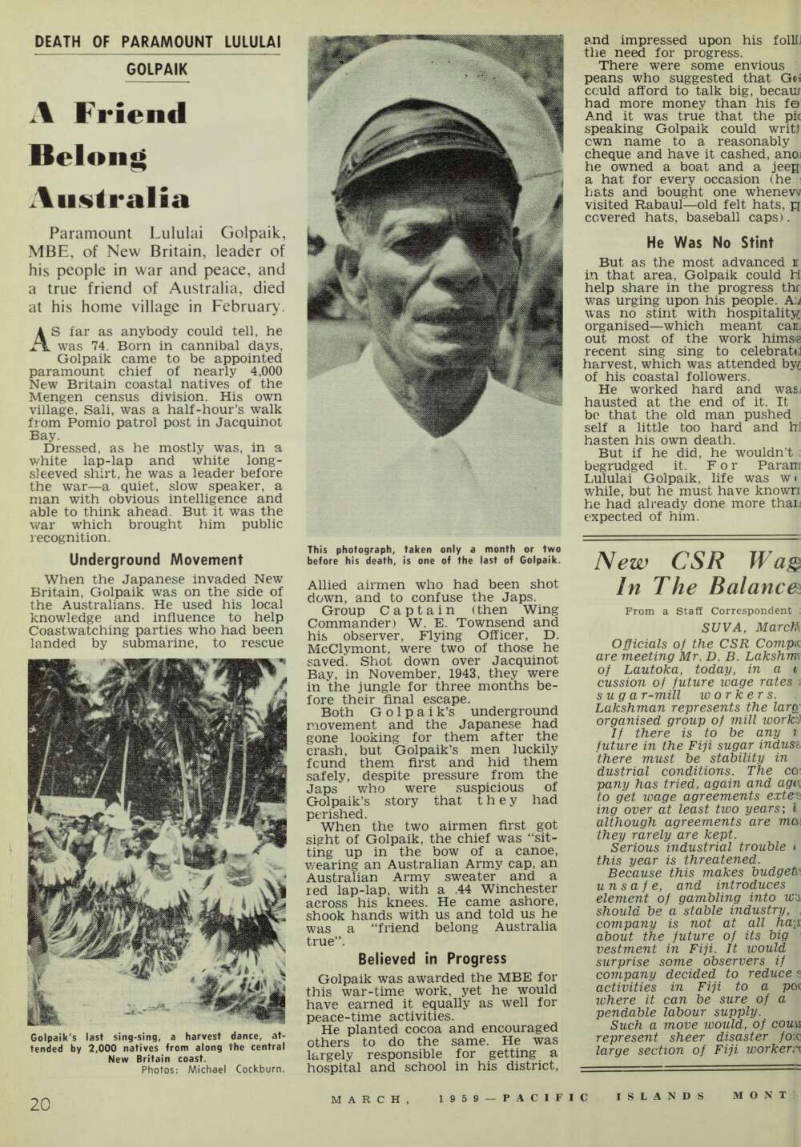
Golpaik's last sing-sing, a harvest dance, at tended by 2,000 natives from along the central New Britain coast.
Photos: Michael Cockburn.
This photograph, taken only a month or two before his death, is one of the last of Golpaik.