Fourth SPC Meeting?
pp. 19-153 · Read in the full issue
Rabaul Prepares to Play Host to the Pacific
What Will Come Out Of Fourth SPC Meeting?
In March, Rabaul folk were not very aware of it. but hind the scenes locally, in Sydney, in Noumea, and in more note places, preparations were in hand for what is prob ly Rabaul’s first international conference.
OUTH Pacific conference will 3 held in Rabaul between April I and May 13, the fourth in sries that have been held in last nine years under the ;es of the South Pacific Com m, and designed to get the ; peoples of the South Pacific s together to discuss common sts and problems, first, was at Naisinu, Fiji, in the second in Noumea, in the third, again at Naisinu, □w it is considered that Rabaul ifficiently recovered from the and the long rehabilitation that followed it, to be host e 1959 conference, total number of people who ave to be catered for, trans there from as far north as and as far east as Tahiti, xommodated and fed for two or more, will number well 00. There will be 70 delegates j conference, most of them s, and in addition there will risers, the Commissioners of .ember Governments of the ission, observers and repre ives of the press.
Major Organisation
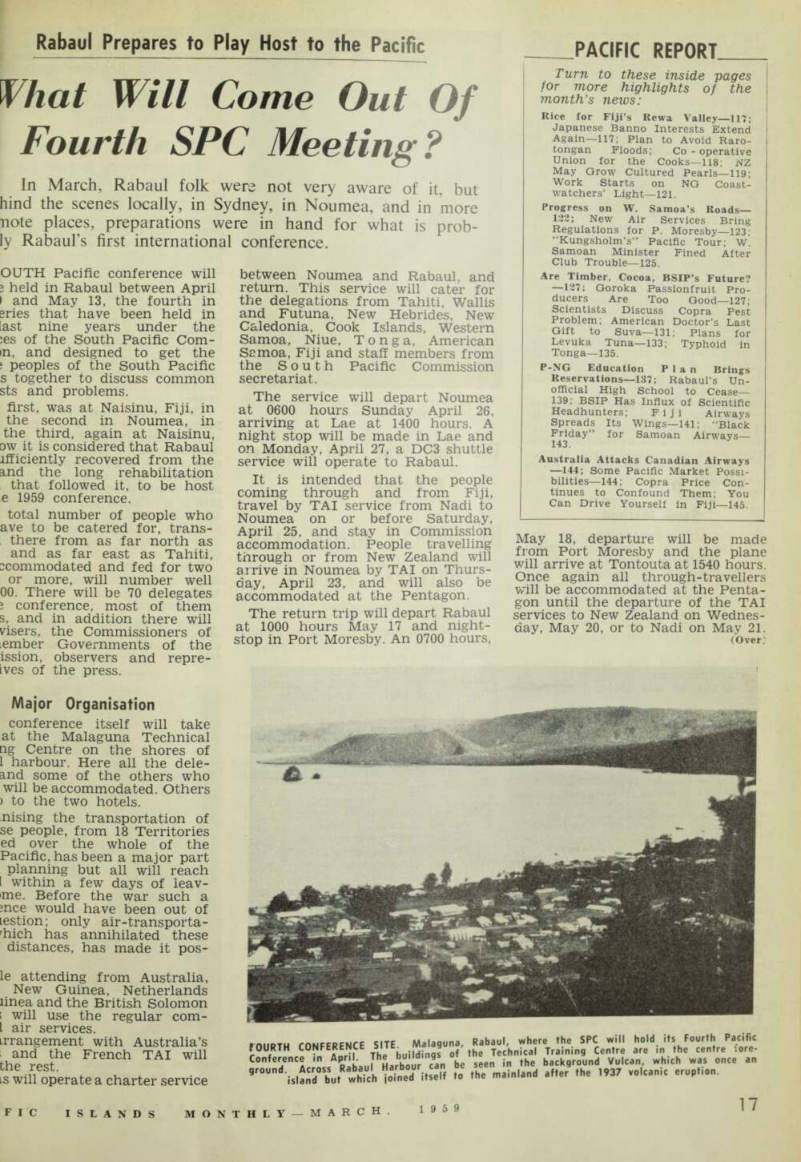
conference itself will take at the Malaguna Technical ng Centre on the shores of 1 harbour. Here all the dele and some of the others who will be accommodated. Others ) to the two hotels, nising the transportation of se people, from 18 Territories ed over the whole of the Pacific, has been a major part planning but all will reach i within a few days of leav me. Before the war such a mce would have been out of lestion; only air-transporta rhich has annihilated these distances, has made it pos le attending from Australia, New Guinea, Netherlands linea and the British Solomon ; will use the regular com l air services. irrangement with Australia’s and the French TAI will the rest. ls will operate a charter service
between Noumea and Rabaul, and return. This service will cater for the delegations from Tahiti, Wallis and Futuna, New Hebrides. New Caledonia, Cook Islands, Western Samoa, Niue, Tonga, American Samoa, Fiji and staff members from the South Pacific Commission secretariat.
The service will depart Noumea at 0600 hours Sunday April 26, arriving at Lae at 1400 hours. A night stop will be made in Lae and on Monday, April 27, a DC3 shuttle service will operate to Rabaul.
It is intended that the people coming through and from Fiji, travel by TAI service from Nadi to Noumea on or before Saturday, April 25, and stay in Commission accommodation. People travelling through or from New Zealand will arrive in Noumea by TAI on Thurs day, April 23, and will also be accommodated at the Pentagon.
The return trip will depart Rabaul at 1000 hours May 17 and night stop in Port Moresby. An 0700 hours,
May 18, departure will be made from Port Moresby and the plane will arrive at Tontouta at 1540 hours.
Once again all through-travellers will be accommodated at the Penta gon until the departure of the TAI services to New Zealand on Wednes day, May 20, or to Nadi on May 21. (Over'
rmiDTu rnwFFRFNf E SITE Malaguna, Rabaul, where the SPC will hold its Fourth Pacific f OURTH CONFERENCE SIT . Ma ag Technica Training Centre are in the centre vore- Conference m April. The o fhe background Vulcan, which was once an ,,0U i!lJ““hut which joined itself to the mainleed efle. the 1937 .olcn.c eruption.
The number of press represent atives who will attend are as yet not known. But Melbourne journalist, C. E. Sayers, who has attended two of the other conferences, will be at Rabaul as press liaison officer.
Mr. J. R. Halligan, Senior Com missioner for Australia on the South Pacific Commission will be chairman of the conference, but largely it will be left to the dele gates themselves to conduct the business as they think fit.
The first conference in 1950, shortly after the SPC itself had come into being, was a tentative sort of affair with, as one com mentator put it, the organisers even more nervous than the delegates.
But by the second conference, seme of this nervousness on both sides was disappearing and by the third, the delegates were really get ting the hang of it, making sug gestions as to how the thing could be simplified to fit more into the Islander’s scheme of things, and with less emphasis on more academic affairs.
In the first two conferences, each item on the agenda was discussed in full conference, which meant that delegates from less advanced terri tories were over-awed into silence by the practised oratory of dele gates from parts of the Eastern Pacific.
Same Method
In the third conference, for the first time, the delegates formed smaller standing committees and in that way larger numbers were able tc join in the discussions. When the standing committees had thrashed out a subject and formed conclusions on it, the conclusions were then taken to the full conference.
It is expected that this method of standing-committees will be used again at the Rabaul confer ence.
The agenda for the fourth con ference is:
Agenda
Opening by Chairman.
Election of General Committee and Ap pointment of Standing Committees.
Report by the Secretary-General on the work of the Commission.
Resolutions of previous Conference — Review of action taken.
Problems resulting from the impact of participation in economic development with reference to land tenure and the growing of permanent crops.
The extension of tourism in the Pacific region and the economic and social im plications for the people.
The study of the role and function of custom and beliefs in relation to infant and maternal welfare.
Broadcasting in the life of Pacific peoples.
The training of local leaders for par ticipation in aided self-help projects.
The place of recreation, including sport and youth activities, in the community.
The impact of the modern technical and industrial world on the life and culture of South Pacific peoples.
(Continued on page 149)
oposals for the Fifth South Pacific terence. sport to the South Pacific Commission, osing Addresses, osing by Chairman, le Commission has invited introductory ;rs on the following topics from a tory within the jurisdiction of the rnment indicated: JSTRALIA: Problems resulting from the ict of participation in economic de jment with reference to land tenure the growing of permanent crops.
LANCE: The extension of tourism in Pacific region and the economic and ,1 implications for the people.
LTHERLANDS: The study of the role function of custom and beliefs in re n to infant and maternal welfare.
W ZEALAND: Broadcasting in the life acific peoples. fITED KINGDOM: The place of sation, including sport and youth ities, in the community.
Tted States Of America: The
ct of the modern technical and in ■ial world on the life and culture of South Pacific peoples, e Commission has invited a dele from the Kingdom of Tonga to pre the introductory paper on: e training of local leaders for par ition in aided self-help projects.
Self-Contained Centre
ie Malaguna School is in a sant setting and will provide a contained centre for the con nce. •ovision has been made for a slation service, while close to conference hall will be a press
i for visiting journalists, a post
e, and banks. Recreation facil include an area for dancing
other entertainments, playing
s for football, baseball and ;etball and a swimming beach, re will be a native arts and ;s exhibition near the conference
Delegates to Conference
3 until March 6, delegates from
m and American Samoa had been announced but it was vn that the following would at-
British Solomon Islands
Protectorate
Silas Sitai, BEM, delegate; Mr. a G’aa, BEM, delegate; Mr. V. J. rsen, MBE, adviser.
Papua And New Guinea
Mr. Kai Kai Ivasi, delegate; Miss Nancy Gire delegate; Mr. Raymon. delegate; h-V ° A .\ Kassi> de le&atc; Brother Peter Hilary alternate; Mr. Tovin Tobaining. aternate; Mr. Kondon -Akau'undo! alternate; Miss Philo Gamauri, alternate; McCarthy, MBE, adviser; Mr.
Elliott-Elijah, adviser; Mrs. Lila Matelau, adviser; Mr. Reuben Taureka. adviser.
Trust Territory Of The
Pacific Islands
Mr. Napoleon D. Fang, delegate; Mr.
Kasiano F. Joseph, delegate; Mr. Olvmpio T Borja. delegate; Mr. Elias P. Sablan alternate; Mr. George F. Fleming, alternate; Mr. Frank J. Mahoney, adviser; IVliss Myrtle Holmstad, adviser,
Nauru
Head Chief Hammer de Roburt, delegate- Councillor Raymond Gadabu, alternate- Mr. G. A. Pittman, adviser.
Fiji
The Hon. H. B. Gibson, OBE, delegate; The Hon. Semesa Siki Vou, delegate; The Hon. Dr. Sahu Khan, delegate.
Netherlands New Guinea
Mr. Marcus Kaisino, delegate; Mr. Toon Meset, delegate; Mr. Eliezer Wettebossy, alternate: Mr. Martinus Janam, alternate; Mr. Dick Sarwon, alternate; Mr. Pieter Merkelijn, adviser.
Gilbert And Ellice Islands
Te Tabunawati Takoa, delegate; Te Reuben K. Uatioa, delegate; Henry Faati Naisali, delegate; lupasi Kaisala, delegate; Mr. G. Bristow, adviser.
Wallis And Futuna Islands
Rev. Father Vittolio, delegate; Mr.
Sosefo Makape, delegate.
New Caledonia
Mr. Pierre Isamatro, delegate; Mr. Pierre Ketiwan, delegate.
French Polynesia
Mme. Jacquemin, delegate; one more delegate to be nominated.
Cook Islands
Mrs. Teupokoina Morgan, delegate; Mrs.
Makea Karika Tabau Margaret Ariki, dele gate; Mr. Tuakeu Puna may be nominated as an alternate and Mr. L. K. Pitt as an adviser.
Western Samoa
Miss Tiresa Hunter, BA, delegate; Mr.
Ipu Soscne Faegai, delegate; Hon. Taulau lelei Mauri, alternate/adviser.
Niue
Mr. Leslie Rex, delegate: Mr. Robert Rex may be appointed as an alternate.
Tonga
HRH Prince Tupouto’a-Tungi, KBE delegate; HRH Prince Fatafehi Tu’ipele hake, delegate; Mahe ’Uli’uli Tupouniua adviser.
New Hebrides
Mr. John Kalsakau, delegate; Chief Thompson Tangarasi, delegate; Mr.
Richard Angeloni, MBE, adviser; Monsieur Fernand Lamodiere, adviser.
In addition, the commissioners, secretariat staff and observers will attend. An in complete list of observers is as follows: The Rev G. G. Carter, Commission on Overseas Missions and Inter-Church Aid of the National Missionery Council of New Zealand; Dr. J. M. Cruickshank, World Health Organisation; Professor J A Barnes, Australian National University;’
Very Rev. James Dwyer, the Apostolic Delegation, Australia; Mr. Basil Atkinson, Pacific Area Travel Association; Dr H Coolidge. Bernice P. Bishop Museum and Pacific Science Board; Dean Knowles A.
Ryerson, Pacific Association; Dr. A. Capell, National Missionary Council of Australia!
Conference and Commission Meet
After the Conference ends, the Commissioners will hold a meeting to discuss how recommendations of the meeting can be given effect to.
It was the Commissioners’ delibera tions after the Third Conference which brought down the wrath of commentators on the SPC.
Said a PIM commentator (June
Pim, 1956) :
“The Conference has outgrown the Commission. . . The Conference members spoke haltingly at times.
They were hampered to begin with
by the unfamiliar trappings of an international conference.
“But their feet were on the
ground. They knew what they
ited. They knew the things of ificance to them. And so, shorn he verbal wrappings which were irently considered necessary, the lutions got down to funda tals. . . lie Commissioners sat down to ider the Conference’s recom dations. It was not an edifying ormance. They really didn’t k they could do anything about ping standards. Some resolu -5 were referred to Governments jonsideration. Others were to be issed at the Commission’s next :ing. . .” e Pacific peoples have advanced further between that confer and this. It should be interest therefore, to see what confer and Commission make of each r in 1959.
Villagers Pay Up
villages on Buka, Bougain which had refused repeated jsts by the P-NG Administra te pay their head tax for 1958 f, Feb., p. 14) have now paid, wever, village leaders pointed 0 the Administration that they ;ted the Government to honour ous promises that they would ove roads in the area, and they 1 give more assistance in the sal of native cash crops. The ;e people have not yet paid year’s taxes.