Pacific Commerce and Produce
pp. 175-176 · Read in the full issue
aspects Of NG
Id fie Ids Ltd.
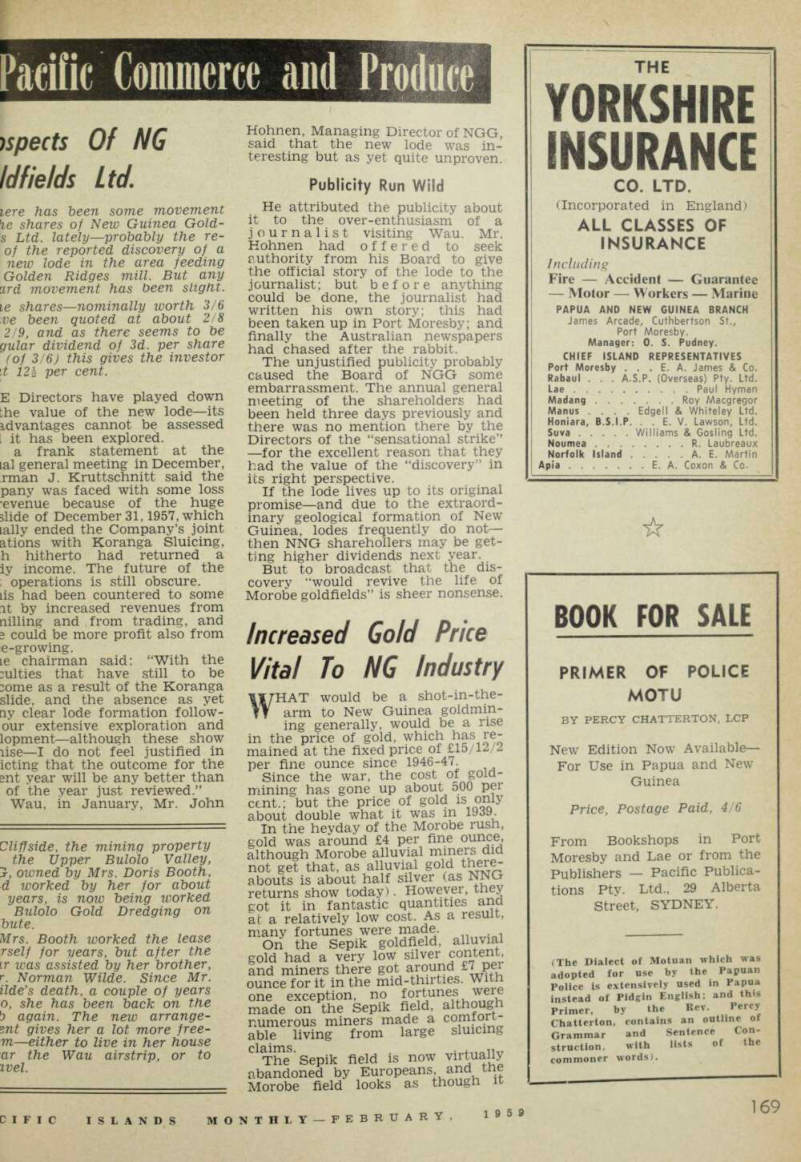
tere has been some movement i.e shares of New Guinea Gold s Ltd. lately—probably the re of the reported discovery of a new lode in the area feeding Golden Ridges mill. But any ard movement has been slight. le shares —nominally worth 3/6 ve been quoted at about 2/8 2/9, and as there seems to be gular dividend of 3d. per share (of 3/6) this gives the investor it 12h per cent.
E Directors have played down the value of the new lode —its advantages cannot be assessed [ it has been explored. a frank statement at the lal general meeting in December, rman J. Kruttschnitt said the pany was faced with some loss •evenue because of the huge slide of December 31,1957, which lally ended the Company’s joint ations with Koranga Sluicing, h hitherto had returned a iy income. The future of the ; operations is still obscure, tis had been countered to some it by increased revenues from nilling and from trading, and 3 could be more profit also from e-growing. le chairman said: “With the mlties that have still to be gome as a result of the Koranga slide, and the absence as yet ay clear lode formation follow our extensive exploration and lopment—although these show rise—l do not feel justified in icting that the outcome for the snt year will be any better than of the year just reviewed.”
Wau, in January, Mr. John
Cliffside, the mining property the Upper Bulolo Valley, owned by Mrs. Doris Booth, d worked hy her for about years, is now being worked Bulolo Gold Dredging on bute.
Mrs. Booth worked the lease rself for years, hut after the ir was assisted by her brother, r. Norman Wilde. Since Mr. tide’s death, a couple of years o, she has been back on the b again. The new arrange ment gives her a lot more free m—either to live in her house ar the Wau airstrip, or to ivel.
Hohnen, Managing Director of NGG, said that the new lode was in teresting but as yet quite unproven.
Publicity Run Wild
He attributed the publicity about it to the over-enthusiasm of a journalist visiting Wau. Mr, Kohnen had offered to seek authority from his Board to give the official story of the lode to the journalist; but before anything could be done, the journalist had written his own story; this had been taken up in Port Moresby; and finally the Australian newspapers had chased after the rabbit.
The unjustified publicity probably caused the Board of NGG some embarrassment. The annual general meeting of the shareholders had been held three days previously and there was no mention there by the Directors of the “sensational strike” —for the excellent reason that they had the value of the “discovery” in its right perspective.
If the lode lives up to its original promise—and due to the extraord inary geological formation of New Guinea, lodes frequently do not — then NNG sharehollers may be get ting higher dividends next year.
But to broadcast that the dis covery “would revive the life of Morobe goldfields” is sheer nonsense.
Increased Gold Price
Vita! To NG Industry
WHAT would be a shot-in-the arm to New Guinea goldmin ing generally, would be a rise in the price of gold, which has re mained at the fixed price of £l5/12/2 per fine ounce since 1946-47.
Since the war, the cost of gold mining has gone up about 500 per cent.; but the price of gold is only about double what it was in 1939.
In the heyday of the Morobe rush, gold was around £4 per fine ounce, although Morobe alluvial miners did not get that, as alluvial gold there abouts is about half silver (as NNG returns show today). However, they got it in fantastic quantities and at a relatively low cost. As a result, many fortunes were made.
On the Sepik goldfield, alluvial gold had a very low silver content and miners there got around £7 per ounce for it in the mid-thirties. With one exception, no fortunes were made on the Sepik field, although numerous miners made a able living from large sluicing Cl The'Sepik field is now virtually abandoned by Europeans, and tne Morobe field looks as though
could soon follow suit. Apart from native mining (mostly in the New Guinea Eastern Highlands) there can be no real future for the in dustry without a rise in gold price.
A rise of even a few pounds per ounce would make “fringe areas” immediately workable and would permit big concerns like New Guinea Goldfields and Bulolo Gold Dredg ing to work large areas that are now completely uneconomic.
The fixed price of gold is com pletely unreal in relation to the price to which other basic com modities have soared since the end of World War 11. If gold had kept pace with other commodities, It would now be at least £6O per ounce.
It needs little imagination to see what a transformation would come over the industry in New Guinea if anything remotely like that price were possible.
The United States —into which is sunk most gold from the Western world —has, up to date, remained adamant that gold should remain at its present fixed price.
The only factor that mitigates against the New Guinea gold in dustry sinking completely out of sight is the Australian Common wealth Government’s gold subsidy.
This has kept the industry alive in spite of all the Papua-New Guinea Administration could do in the reverse direction.
During the war, gold-mining in stallations were virtually wiped out and companies and individuals had to start again from scratch. Re habilitation was assisted by war damage compensation, but for some it was an uphill battle to get started again.
The Administration, from the re commencement of goldmining, in sisted on its 5 per cent, royalty on each ounce of gold exported. This does not sound excessive; but, In the immediate post-war years, in companies like New Guinea Gold fields, the gold royalty actually ate up 75 per cent, of net profit of the company.
In the last couple of years gold royalty has been reduced to £1.5 per cent.
Enterprise Gets Its Oil Permit Back Enterprise of New Guinea Gold and Petroleum Development, which has been trying since the middle of last year to get an explanation as to why Its permit to search for oil in the Sepik District of New Guinea, first issued in 1954, was not renewed; and (b) to have it renewed, were informed in January that subject to certain conditions, the permit has been approved from March 1, 1959.
The conditions are that the company has sufficient funds to conduct an aerial photographic survey of a portion of the permit area; to complete the gravity traverses from the eastern to the western edge of the sedimentary basin and the proposed core drilling programme planned for 1957.
In order to do this the directors pro pose to immediately offer the unissued shares in the hands of the company at
par (1/- per share) to sharholders who may apply on the basis of one share for each two shares at present held, or for any such greater or lesser number of shares they desire. (The whole of the amount subscribed for these schares is now an allowable deduction for Income Tax purposes).
On the goldmining side, the mine manager in the Territory reports that a parallel lode has been located 40 feet west of the No. 1 lode, and that a cross cut is being driven in from the No. 1 level (75 ft. from surface), to try to inter cept the lode. Values in the new lode have tested at 10 to 15 dwt. to the ton.
A new adit has been commenced below No. 2 level to find out how the lode be haves between No. 2 and No. 3 levels.
NGG January Production
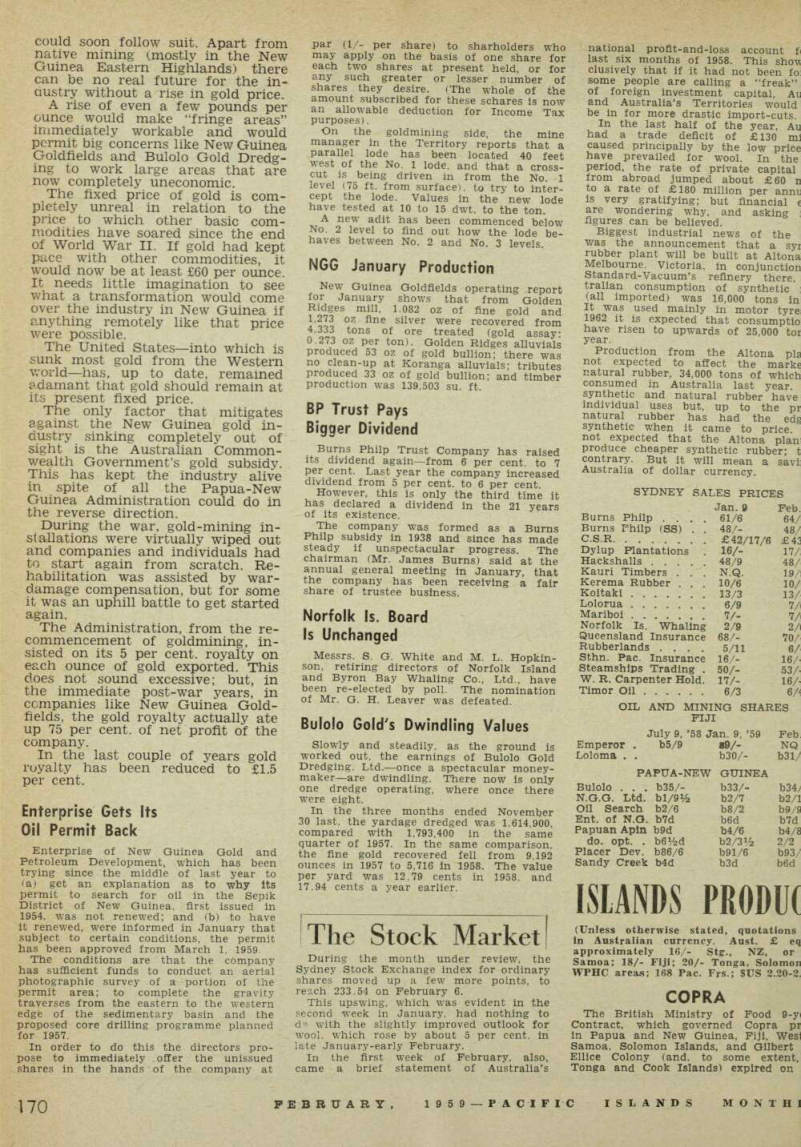
New Guinea Goldfields operating report for January shows that from Golden Ridges mill, 1.082 oz of fine gold and 1,273 oz fine silver were recovered from 4,333 tons of ore treated (gold assay: 0.273 oz per ton). Golden Ridges alluvials produced 53 oz of gold bullion; there was no clean-up at Koranga alluvials; tributes produced 33 oz of gold bullion; and timber production was 139,503 su. ft.
BP Trust Pays
Bigger Dividend
Burns Philp Trust Company has raised its dividend again—from 6 per cent, to 7 per cent. Last year the company increased dividend from 5 per cent, to 6 per cent.
However, this is only the third time it has declared a dividend in the 21 years of its existence.
The company was formed as a Burns Philp subsidy in 1938 and since has made steady if unspectacular progress. The chairman (Mr. James Burns) said at the annual general meeting in January, that the company has been receiving a fair share of trustee business.
Norfolk Is. Board
Is Unchanged
Messrs. S. G. White and M. L. Hopkin son, retiring directors of Norfolk Island and Byron Bay Whaling Co., Ltd., have been re-elected by poll. The nomination of Mr. G. H. Leaver was defeated.
Bulolo Gold's Dwindling Values
Slowly and steadily, as the ground is worked out, the earnings of Bulolo Gold Dredging. Ltd.—once a spectacular money maker—are dwindling. There now is only one dredge operating, where once there were eight.
In the three months ended November 30 last, the yardage dredged was 1,614,900, compared with 1,793,400 in the same quarter of 1957. In the same comparison, the fine gold recovered fell from 9,192 ounces in 1957 to 5,716 in 1958. The value per yard was 12.79 cents in 1958, and 17.94 cents a year earlier.