Pacific Report
pp. 121-154 · Read in the full issue


The month’s round-up of news and pictures of people and mts, from PIM correspondents in the South Pacific.
Dtnic Survey
. Hebrides
revenues of the New Hebrides minium, to the extent of 80 nt., depend upon copra pro 1, said the Joint Presidents of dvisory Council (Mr. J. S.
British Commissioner, and A. Bijon, acting for the i Commissioner), when re l the Condominium’s financial onomic conditions at an Ad- Council meeting in Vila. They the following points: production of copra was ris adily, and an interesting ex nt was being made in the ex )f consignments to United for dollars. export of fish, from the new Pacific Fishery at Santo, was d to total 3,000 tons for 1958. ive the beds a chance of re after over-fishing, all fishing Jhus and greensnail had been led and there would be no ' therefrom. 900 prospecting licenses had sued and it was hoped that ible deposits of minerals be found, so that the Con im s economy might be led. istoms expert had been en -0 advise the Joint Adminiss r< Tariff ng & revision of the mmittee was set up to ex the present laws regarding ply of liquor to natives and recommendations for any considered necessary, is decided to increase the membership of the New s Advisory Council to eight.
eeze Plane
on Palmyra
►. Navy DC3 supply aircraft ation Deepfreeze in the Ant nade a forced landing at 1 Island 900 miles south of u on January 22. d by Major James F. Foster, the aircraft was north -00 miles from Canton Island, ngine trouble developed. A nding was made on the i ally used war-time-built of the atoll, which is now to be uninhabited since the le IGY scientific programme r as under way there. ’ent years the interests of
the Honolulu owners have been taken care of at Palmyra by Mr Otto Hornung, who died some months ago, while doing IGY work at Jarvis Island.
New Caledonia's TRANSPAC
Is Thriving
Not all Islands air services show a profit, but one that is exceeding the brightest hopes of its founders and shareholders is New Caledonia’s
Transpac.
Established in 1955, the company operates services from Magenta Airfield near Noumea to Lifou, Mare, and Ouvea in the Loyalties, to Isle of Pines, and also to the north of New Caledonia. A few flights were also made to the New Hebrides until that service was taken over by
Tai.
The service was commenced with one 8-passenger de Havilland “Dragon Rapide” aircraft and now has three of these and a four engined de Havilland “Heron”.
In 1955, the company carried
1,038 passengers, 823 kilos of mail, « nc Lx 2,66B tons of freight in 113 flights out of Magenta. In 1956, 505 flights were made and the loadings had risen to 5,464 passengers, 3.772 tens of mail, and 18.332 tons of freight.
In 1957, the figures were: 737 flights, 7.243 passengers, 7.158 tons of mail, and 71,615 tons of freight.
The figures for 1958 are not available but the latest annual re port on the economy of New Caledonia says that the traffic of the company has surpassed the most optimistic prognostications and plans had to be completely modified to meet the situation. Ninety per cent, of the passengers carried have been natives.
Fiji's Reluctant Goodbye
To Mr. Dave Butler
Fiji will miss Mr. David A. C.
Butler, about to retire from the managership of the Union SS Co.
Ltd., at Suva, after serving the Co. for 20 years in Fiji. He has done a fine job for the Union Co., often under difficult and harassing con ditions; he has taken a prominent and useful part in public affairs; and he and his charming wife have made for themselves a place in the social life of the Colony that will not be easily filled by others.
In the course of 20 years, an army
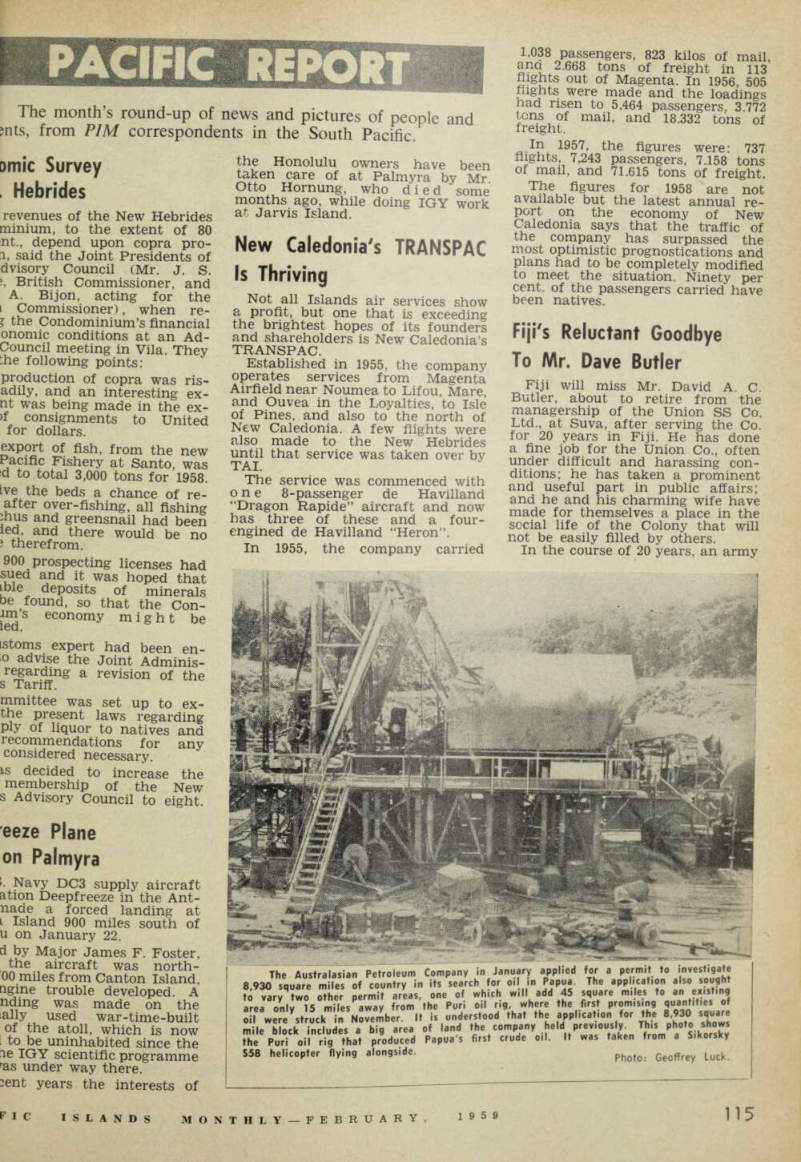
The Australasian Petroleum Company in January applied for a permit to investigate 8,930 square miles of country in its search for Oil in Papua The application also sought to vary two other permit areas, one of which will add 45 square miles to an exisiting area only 15 miles away from the Puri oil rig, where the first promising quantities of oil were struck in November. It is understood that the application for the 8,930 square mile block includes a big area of land the company h eld a Sikorsky. This photo shows the Puri oil rig that produced Papua's first crude oil. It was taken from a Sikorsky 558 helicopter flying alongside.
Pho to: Geoffrey Luck.
wtential enemies have marched igerently into the Union Co.’s a office eager to fight someone something because of shipping dules missed, or passenger re ations upset. evitably, after a soothing ■ter-hour in Dave Butler’s office, came away (often without the ;ed reservations) convinced that Union Co. was their friend, and all was for the best in the best 11 shipping worlds, rupulous attention to details— r send away an enemy when can turn him into a friend — i seem to have been the Inal points of Mr. Butler’s 20 > of successful service; and they off. i usually has been singularly r in the quality of the men by the big Australian and New md corporations to guard their tments in Fiji. Mr. Butler is ;e in point.
Butler will be succeeded in h by Mr. A. E. McPherson, now :h manager for the Union SS t New Plymouth, NZ.
isands Fly to
ham Is.
February flight to the lams by the specially fitted out iF passenger Sunderland fly- Dat had a very large passenger L 50,000 honey bees, mies of bees are taken to these is regularly—usually by sea— they are essential to the rs for the transpollination of s and crops. /ever, they appear to be in le of acclimatising themselves and invariably the colonies die ithin a year or so, when more to be imported. Failure to latise is apparently due to :e of sufficient suitable honey ig plants.
sra Imports Them, Too
Santas airfreighter left Sydney lew Guinea on February 3 ng (amongst other cargo) honey bees for Netherlands Guinea. The bees will be shipped at Lae to the weekly s service to Hollandia. so it is stated, has no bees, and such vegetables as fins and fruit as paw-paw ;o be hand-pollinated, rue, this is remarkable. The than side of the Territory ds in native bees, which look like black house-flies than san bees, don’t sting but are it pest to people on patrol I bush as they seem to be ted by human perspiration. / do not do such a good job llination as European bees, ey appear to do it sufficiently 3r the natives to be relieved e task of “marrying” the
paw-pa ws° f th6ir pumpkins an d
Honiara a More
Popular Port
Popularity of Honiara as a port of ca ll is on the increase. In 1954, ?i? ly^30 vessels called, and in 1958 the figure was 59, latest figures from the Port Authority reveal.
Some of the reasons; The Bank Line vessels now call more regularly and Burns Philp’s monoply of the Australian export trade to the Solomons was broken in late 1957 when the Australia-New Guinea Line included Honiara in its north bound schedule to New Guinea.
And now the China Navigation Company has announced that, sub ject to inducement, Honiara will be a port of call on its new schedule Japan, Hongkong to the New Hebrides and Fiji. However, with imports and exports probably near to saturation point now, induce ments might not be easy to offer. But it’s encouraging.
Bananas Boost
Business in W. Samoa
The end of 1958 found Western Samoa in a much better economic position than could reasonably have been expected at the beginning of the year.
The Improvement was due mainly to the greatly increased production and export of bananas to New Zealand; but higher prices for cocoa beans and copra at the end of 1958 also contributed greatly.
According to official figures, the export of bananas increased in 1958 /005% 084 cases valu ed at £1,016,700 (328,700 cases valued at £370,840 in 1957). Before Xmas banana growers on the island of Upolu were paid a bonus of £17,000, while Savai’i pro ducers will be paid a bonus in
January.
The Department of Agriculture expects that banana production in 1958 should reach over one million cases.
This startling increase in pro duction of bananas may be attribu ted to an energetic production campaign by the Department of Agriculture, to the availability of more shipping space to the New Zealand market and to better reading facilities on Upolu and Savai’i providing transport for bananas in outside districts.
The banana marketing division of the Department of Agriculture which handles banana exports has a permanent staff of 16 and 150 casual labourers for loading bananas.
Prospects for banana exports from Western Samoa have lately improved as a result of recent storms in the Fijian banana pro ducing area which may be felt right through 1958 and make New
and even more dependent on ;ern Samoa for requirements, •wever, it is certain that New and cannot absorb more than illion cases of bananas from ern Samoa and with consider new planting going on and expected further large increase reduction, it will be necessary look for additional overseas :ets for Samoan bananas, ative enquiries are being made le USA and Canada, though, Fiji’s experience, prospects to be discouraging, lile copra production in 1958 rery low, with 8,697 tons shipped 902 tons on hand at the end he year, the minimum 1958 act obligations with the !yer concern could just about ilfilled. the end of the year, due to increased rates paid to pro 's, copra production increased derably and December, 1958, iction, with 1,278 tons, was the ;st for any one month since st, 1957. yery good cocoa crop has just harvested and sold at good 5. Another good cocoa crop, favourable weather con- I s ’ may be expected beginning 59. The present prices offered m the basis of £8275-285 per t.o.b. for first grade.
Jed on a production of about tons in 1959, the 1959 contracts de for 4,000 tons of copra to upplied to Unilever, London; tons go to Abels Ltd., New nd and 2,000 tons to be sold ie open market. ight rates with the present ir T s . of copra to England, the Line, have been reduced from
£l3/10/- per ton to £8 per ton. This reduction should benefit producers appreciably.
Aircraft Carrier
Visits Honiara
V 15115 Honiara
assn
evasion ° f gala aWay fr ° m the Extremely rough seas prevented launches from making the journey K or the iocals to visit them had to be can- , Contact between ship and Si nPQnitp s tho helicopter.
Despite the bleak weather, the town oval was cnpwded with sightseers as the helicopters made regular trips for stores.
Sir John and Lady Gutch, together with a number of VlP’s, were entertained on board the Albion by Rear-Admiral Begg, who is secondm-command of the Far Eastern oquadron.
»S a Kind of
Red Plot
Russia has been asked several a^ 65 ? b 7 * he p apua-New Guinea Administration for information
fsrir
, T he Assistant Administrator, Dr. and to the Russian Government for f? etails of the machine nothing had been heard from Russia.
The success of a tea industry in Fapua-New Guinea depends on the development of a successful tea plucking machine. At present the Administration has been experi menting with one but it weighs more than a hundredweight and is too heavy to operate Dr. Gunther said it was hoped to build a tea factory at Garaina this year—a statement which may or may not be realised, for that factory
been part of Administration for a good many years now, jortions of the actual factory been in storage for some time, tainly all the delays can’t be d on the Russians.
And What The
■ Will See
PI M’s tame poet, Tui, pre in January, Prince Philip, : his forthcoming tour of the and the Gilbert and Ellice rch-April, will meet the local and thus, break some old traditions, se there ain’t no politicians. the detailed itinerary for his rart from the missing politici las a terribly familiar ring it, nevertheless. ;e Philip is obviously not going allowed to get too far away recognised protocol—-not on anyhow.
Resident Commissioner’s office' ,rawa was announcing de f dress in its HQ Notes even y as December 12, eg: ss—On first arrival at i, His Royal Highness will be ? Naval uniform. For remain ns, His Royal Highness will l suit except for dinner at sidency on March 25. Dress •n this occasion will be an d later.” the chances are that the visitor will get into shorts dw a beard for some part of ir, which starts at Gizo on 18 and ends at Christmas on April s. And Tarawa, at te, has selected some of its t island belles for a batere riki. The girls have been ng their dances for some parts of the itinerary are: h 18: Prince Philip lands eminent wharf, Gizo, from r acht Britannia . at 9.45 a.m., et by High Commissioner, lew hospital, entertained by school display, gives a re aboard Britannia, later is ashore in a canoe to see mces, and receive gifts. 1 19: At Honiara, makes in is, drives about the local is given a native welcome, :ption at Government House, I by dinner party aboard the matches fireworks display at ruz. 1 20: Arrives Laulasi, ' 9.30 a.m., watches demon s, including making of shell r < visits Auki for more ■S and inspections, and re fer all races at District sioner’s residence, before I Britannia that evening.
' 22 ■ Reaches Graciosa Bay, Miz, and after being wel ae walks through villages, native feast and Eastern *
Solomons dancing display, and may go for a sale in a large sailing canoe, before embarking on the Bnttama in the afternoon for the CjtEIC.
March 25: Arrives Tarawa, lands at Bainki and carried in a cere monal chair to parade ground to meet VIPs and island people, at tends official dinner at Residency, followed by batere.
March 26: Tour of Bairiki, visits to Bikenibeu, Eita, Betio on in spections, followed by big evening reception on board Britannia.
March 27: Leaves Tarawa for Ocean Island.
March 28: Arrives at Ocean and leaves same afternoon for Vaitupu.
March 30: Arrives Vaitupu and leaves same afternoon for Christmas Island.
At christm as Island, where the itinerary at the moment appears to be top secret.
Doing a Spot of
Public Relations
MEMBERS of Fiji’s Legislative Council and the heads of several Government depart ments visited Savusavu, and Levuka 111 January “ in Q uest of knowledge”.
The visit was sponsored by Mr.
W. G. Johnson, a nominated mem ber of Legislative Council, who is also managing director of W. R.
Carpenter and Co. (Fiji) Ltc Mr. Johnson placed the Cart motor ship Tovata at the dij of the party, and the main pu of the visit was to inspect th< road out of Savusavu, which hoped one day, will link the with Labasa in the north.
The work on the road had abandoned after about two had been cut.
There was a well justified ( from the Vanua Levu area the Standing Committee on FL cut the estimates by £50,000 visitors inspected the two mi completed road and saw some < country the road would have t< through.
The Financial Secretary E R. Bevington), asked if the ernment had come to any elusions as a result of the vi the Government members, sai< members now had “a much c picture of the problems anc plications involved.” But just this might mean is, of course body’s guess.
BSI Copra Production
Up Only 16 Tons
The annual accounts of the Copra Board for the year ( September 30, reveal a h enough state of affairs, final speaking anyhow.
A net profit of £19,760 transferred to accumulated account which now stanc £199,022. Of this amount £75 on interest-bearing deposit.
Total output in the Solomo the year was £20,287 tons of 15,988 tons were purchased t Board —the remainder being I copra shipped direct to Aus However, the total prod showed only a slight incres 16 tons over the previous yea the high export duty impoi looked upon by some as a det to increased production.
The Board paid £155,600 in duty on copra purchased by i in January negotiations we progress with the Governme: a reduction in the current i One interesting point: Copn duced throughout the Sol (excluding Lever’s) is divided £ equally between European native producers. The figun 50.9 per cent, for native; 49 cent, for European.
The Rossers Will Try
More Desiccated
Planters in Papua are wa with interest the efforts of B Tommy and Harry Rosse Sibigolo Plantation, Rigo D to begin again the product] desiccated coconut.
s Rossers’ was one of half a desiccated coconut factories down in the Territory in following a typhoid scare in alia. In 1952-53, about £332,000 . of desiccated was exported the combined Territory, but it has shrunk to nothing, vas never conclusively proved P-NG coconut was the cause e typhoid outbreak —but the stion was enough to break idustry. t desiccated sold in Australia is from Ceylon and any ct from P-NG will have quite tie to break into the field. 7er, the Rossers are deter desiccators; they have their luipment intact and have in l new steam sterilising and improved plant, er planters—who are satisfied he price plain copra is bring lese days—take their hats off se brothers who are prepared ve the Australian market sr go, even when they know lew health regulations in the ory and prejudice in Aus will not make it easy. f
us Floods
arotonga
ost 12 inches of rain in 36 flooded parts of Rarotonga, le Cooks, on January 12, g evacuation of many homes me drowning—and a severe ge of taro which is likely t for the next six months, s the staple in the Cooks, so tuation is not good, drowning occurred at Tupapa, a 19-year-old Tupapa boy, Keu, was found dead in nine ■ water. Another boy had a r escape when he was sucked i concrete pipe that passes the main road at the airstrip, nions had given him up for 'hen he reappeared at the md, suffering from shock but ise all right. floods were not as serious as
those of 1936, when almost the same amount of rain fell in 24 hours, instead of 36, but they were serious enough.
Worst-affected area was Tuta kimoa settlement in the main town of Avarua, which is always liable to flood, and as a consequence its houses are on high foundations.
But they weren’t high enough this time, and almost every house was flooded, including a fairly new Administration house occupied by the Chief Surveyor, Mr. A. Bailey.
Trucks were sent to evacuate Tutakimoa residents to temporary accommodation at Avarua’s two picture theatres, but many preferred to make their own arrangements.
They hurriedly stored their possessions in house ceilings or carted them away in canoes and all manner of smallcraft, which turned the roads into canals.
The main road around the island was blocked in many places, and at one point a stream found a new course which promises to be per manent, leaving the PWD faced with the problem of a new bridgeless river and an old riverless bridge.
Blocked intakes and broken mains caused a failure of water supplies, but PWD teams did a smart job on repairs and saved the diesel ower station from packing up be cause of lack of water cooling.
The flooded rivers carried silt into Avatiu and Avarua harbours, making them shallower than when dragline operations started a year ago. The draglines have been operating day and night since the flood.
And Honiara
Follows On
While Rarotonga was still clean ing up after its flood, parts of Honiara, in the BSIP, were fighting one of their own. It was caused by the tail-end of the New Caledonia cyclone, and Honiara flew the cyclone flag, an unusual sight, for two days.
With a rainfall estimated at any thing up to fifty inches in the hills
IT' S WETTER THAN USUAL AT RAROTONGA. Headmaster of Avarua School, Mana Strickland, with his wife, found during the Junuary floods that the best way of leaving their new home was by canoe. And above, European resident Mrs. E. Dive, with Rima Nicholas, chose to walk out of their flooded home -umbrellas up, of course although it doesn't appear that they could get much wetter!
\ the coast, the Lunga River 20 feet within two days, break its banks and causing the lation of a native village; also ;ing Henderson Airfield and •egular Qantas DCS from New ea, which had landed there, s Lunga Bridge—a Bailey e—set on two concrete piers, recently been moved further stream to provide a more direct to the airfield. But the bridge w a write-off as the decking wisted, and the piers are at a rious angle. Access to the Id, now that Lunga bridge is is by smallship down the to Lever’s Lunga Plantation, one stage the airfield was letely flooded and the DCS was nger of being swept away by current. The water rose to eight of the main wheels. ;re was great excitement at ler stage when a floating tree led a bend, with two men e it. iy were swept past the site of d bridge to the airstrip, with nswering shouts of onlookers, bly because of the roar of the . One of the two was believed ied later, and police made a i. elief plane arrived on Satur- January 17, and after an aul the flooded plane took off lukum airfield (much nearer ra, and in use up to the time ;rson was recommissioned), it picked up passengers and or Rabaul—five days behind ale. h the Lunga bridge likely, to se into the Lunga River at moment, the Public Works tment, with finance short as is faced with a ticklish m of repair or replacement.
! Islanders Fear
Taxation Axe
3n the New Zealand Govern late in 1958, found its over balances shrinking fast, it ced and, to prevent money g New Zealand, took measures caused a lot of inconveni ind injustice. t have heard of the con it threat to the Fiji banana and of the difficulties en ured by visiting Australian ants, who had to fight off a for tax on that portion of income they had received or :redited to them while they in New Zealand.
November, PIM described the of New Zealanders who were ; from New Zealand for a , engaged in profitable activ in other Pacific countries, ally, they thought they would e of NZ taxation on income i by them while away from nd obtained from other than urces. the NZ tax-collector could not
see it that way at all—when the unhappy fellow returned to his home-land, he was pounced upon and wrung dry of tax, just as if he had earned that income while re siding in NZ.
That comment caught the at tention of Mr. A. H. Nordmeyer NZ’s Finance Minister and he has written to say that the taxpayer re ferred to had not transferred his residence from NZ—that in fact he had a business and a home in NZ. and therefore he was taxable on the income he had earned in New Hebrides.
“It woulcj be unusual to treat a person who has been absent from NZ for a humber of years, and who does not maintain a home in NZ, as a resident for taxation pur poses,” said the Minister. “The fact that a person was not called upon to pay tax in the country where he has taken up residence does not alter the position. No action would be taken on a subsequent return to NZ to collect tax on income derived while a person was resident over seas.”
This seems to indicate a modi fication of NZ taxation laws; but the assurance still is vague, and does not fit in with the known tax collection facts reported from NZ in recent months.
For example, we know a New Zealander who resides in New Guinea, while doing a special, highly-paid job. He, of course, has paid no income tax, for there is none in NG yet—but he has paid the very high cost of living im posed by the NG system of taxing imports.
He wishes to return to NZ shortly, but he very much fears NZ’s new tax machinery, and plans to remain in the Islands a while longer, until the NZ political horizon clears a little.
W. Samoa's Own
Bank Soon Functioning
Preparatory to its attainment of self-government, Western Samoa is to have a banking institution of its own. The Bank of Western Samoa
Bill was before the Legislative As sembly at the session which com menced at end of January and it is likely that the bank will com mence operations at the beginning of April.
The initial capital of the new bank is to be set at £lOO,OOO divided into 1,000 shares each of £lOO, of which 450 will be owned by the Government of Western Samoa and 550 by the Bank of New Zealand.
Shares will not be transferable.
No goodwill is to be paid to the Bank of New Zealand and land, buildings and other assets are to be transferred at fair valuation.
Apart from the normal business of banking, the new bank will have two additional functions —the estab lishment of a Savings Bank Depart ment (which at present is admin istered by the Apia Post Office); and a special Development Depart ment, The bank will also be authorised to issue notes if deemed necessary.
The Board of Directors is to con sist of five persons, two to be appointed by the Government of Western Samoa and three by the Bank of New Zealand. The Directors will elect their own Chairman. A joint management committee is also to be formed, the members of which will reside in Western Samoa.
The controlling interest in man agement will be placed in the hands of the Bank of New Zealand, which is considered a very desirable feature. This will provide general
advice, facilitate the handing overseas funds and provide necessary trained staff.
The High Commissioner, Mr. ( Powles has expressed the than! the Government of Western Sa to the Directors of the Ban!
New Zealand, particularly to General Manager, Mr. R. D. Mi and to the bank’s Apia mam Mr. N. O. Maitland, for their £ help and co-operation in settini the new bank.
Mr. R. D. Moore, General Man of the Bank of New Zealand, statement issued in Wellington, Zealand, pointed out, that the es hshment of the Bank of Wes Samoa would mean that the pre Apia branch of the Bank of Zealand would be closed afte: years service to the people Western Samoa.
However, the Bank of New land would have a substantial terest in the new institution am trained officers would be avail to staff the new bank. The bank would provide the same vices as those provided at pre by the Bank of New Zealand.
Fish Want The
Mod. Cons.
South Pacific fishermen will interested to learn that if they not having any luck with the then there are new ways of fi it,
ISLANDS ROMANCE. When Sydney boat-builder Paul Jones was in Port Moresby, Papua, re[?] he met visiting Samoan nurse Luania Fa'agau, of Pago Pago. Romance blossomed. In Pag[?] month, at Luania's village, Matu'u, the couple were married by Rev. Neems, of the IMS M[?] In attendance (on the right) were Nurse Merapi, bridesmaid, and Dr. Fiafia, the best ma[?] Fiafia was in Port Moresby attending a World Health Organisation meeting at the ti[?] couple met. —Pan American
jnt research on the Californi ist and in Japan waters shows the present-day fish is de ng good housing, soft lights, erhaps sweet music, and that these things he’s prepared to down in your particular area, erhaps even take a hook once vhile. eriments carried out by the rnia Department of Fish and along a piece of coastline arly devoid of bottom-feeding las conclusively proved the for housing. sea-bottom in this area is md devoid of plant life and r. In the experiment 20 old -car bodies were dumped in lace and a shipload of large in another. Fish and many of marine organisms moved nediately , and later last year ton tram-cars were dumped bird area in about 10 fathoms ter. d is now being transplanted hese dumps and there is every tion that they will become *ite sport fishing spots, nwhile a technical paper on Tect of coloured lights as an n crayfishing has recently mblished in Japan, and seems )w that the commercial fish f this kind of shell-fish can :atly aided by the use of blue :en floodlights. lous methods were tried. The Japanese method is to em-
Sees" 1 * 8 not W ‘ re ° r basket ° . .. , Best results were obtained by designing a floodlamp which could be attached to the bottom edge of the net and which shone into the belly of the net as it trailed along the bottom. The method can be employed equally as well with cage traps.
A line of such lights along the bottom and leading into a trap was also found highly effective. Results with green and blue lights were about the same. These colours appeared to attract plankton and other small fry as well as crayfish and crabs.
° ther overseas experiments have shown that certain kinds of fish can be attracted by certain sounds produced electronically The whinnies and grunts of many kinds of fish have been successfully re corded, proving that fish are by nc means dumb, Some researchers now believe that the fisherman of tomorrow will have his tape recorder with loud speaker on end of fishing line, Depending on whether plump bass or old-man groper are desired, the correct tape will be selected from the bait kit, and very soon the plump females or the tasty males will come running.
Coffee—Who
s the Eight Bob?
ie of the things discussed at Goroka coffee conference in Guinea in January (see special le on page 37), was the omics of having small private ;es as opposed to large, com r estates as in other parts of world. owers agreed with buyer rep itatives at the conference that, an economic point of view, big es have an advantage, but, they ted out, the existing land laws le Territory and the Adminis on’s obligation to the native, does not permit of large estates ?t in a very few instances, is estimated that 40 acres of ted coffee, averaging a produc of I a ton of coffee per acre -nnum are needed to adequately ort one individual planter. It Decause of this factor that local :ers were sceptical of famous bi being able to support a com , when its planted area mted to only about twice that ige. ne will see who is right. :gest item in recurring expendi for planters in the Highlands e cost of air transport to the al shipping point for dried 3, and the cost of bringing in > and equipment from the same . Even when the road from highlands to Lae is completed 1-weather standard—and that >e some time yet—it is doubtful nmercial road haulage will be to compete with air freight to Madang, which average out sen 3d and 4d per lb for charter s. ight adds fantastically to the of commodities in the High . Cement is about £5B per ton; fertiliser £9B per ton. ■ly in the piece, planters ;ht they could do without iser but following advice from than coffee expert Professor i Goto, that trees could do with every other month, they tried
it out and even at a landed cost of alrrupst £lOO per ton, find that it pays dividends.
One the mysteries not solved a* the Goroka conference was whv the retail price of coffee in Sydney’s fancy coffee shops differs very little now when NG planters can get only 3/8 for their coffee, from what it was a couple of years ago when pianters were getting twice as much.
Coffee that brings no more than 4 - a pound to planters, c.i.f. Syd ney, sells for anything up to 12 6 retail. Who gets that eight bob?
Planters would certainly like to know.
Samoa Clears Way
For Self-Government
With the ceremony which attends openings of all Parliaments in British countries, the third session of the Fourth Legislative Assembly of Western Samoa opened at the Fono House, Mulinu’u, Apia, on January 27.
As the New Zealand High Com missioner, Mr. G. R. Powles opened proceedings in the big, open fale v/here the destiny of the new State of Samoa is soon to be decided, a brass band blared out the National Anthem, the Flag of Freedom (Western Samoa’s aggressively notional anthem) and a guard of honour of police, clad in khaki lava lavas and pith helmets with green bands, paraded.
There was much, bowing between Mr. Speaker, the Honourable Luafatasaga Kalapu, members of the Assembly and the High Com missioner.
Big issues lie before the Assembly, which hopes to complete its delib erations by April—after a short adjournment before the departure of the United Nations special in vestigating mission due in Apia in March.
The Assembly will consider the Bank of Western Samoa Bill, which will give the Territory a partnership in the operations in Samoa of the Bank of New Zealand. Then it is to discuss a Road Traffic Ordinance Amendment Bill —traffic control as Western countries know it hardly exists in Samoa.
But most of all it will make nom inations for the Working Commit tee on Self-Government. And on the filling of positions on this com mittee, will depend much of the future course of Samoa.
The broad task of the committee will be to discuss and make pro visional decisions on all matters concerning the attainment of self government. There will be a con stitutional adviser both for Samoa and New Zealand, which administers the Territory as a trusteeship of the United Nations.
Constitutional matters to be con sidered by the Committee include issues associated with the transition, by 1960, to Cabinet Government, to
ter with the selection of the le Minister, the Ministers, the ers or functions of the Council State, the position of official ibers and the circumstances in :h the Prime Minister or Min s should resign. ley will also include the means nsuring a truly representative rnment. That is, what improve ts can be made in the electoral m within the principles already ed upon. her constitutional matters to iiscussed are the method of intment and the future role of joint Heads of State, questions nationality, citizenship and ;s, the protection of sectional ests (land and electoral rights), Judiciary (questions of appoint independence and appeal ;dure) and the means of ensur n impartial non-political Public ce. -tters then arise under the ing of Samoa’s future relation with New Zealand and whether : should be a formal agreement le lines of that between Tonga the United Kingdom. Practical ers for consideration include ing and currency, the possibility nancial assistance from New ,nd for the Western Samoa De ment Plan, the field and terms chnical and administrative as ice, the entry of Samoans into Zealand and of New Zealanders Samoa, the formulation of New nd’s responsibilities for ex -1 affairs and defence, the inery for New Zealand repre tion in Samoa and Samoan sentation in New Zealand, and •an participation in the work ternational organisations, ore agreeing to the termina of the trusteeship agreement, Jnited Nations would probably re to be satisfied on most of matters. v Zealand thinks that when ommittees in Western Samoa New Zealand have completed deliberations there should be iations between the Samoan littee and representatives of Few Zealand Government, dur hich the provisions of the draft itution would be discussed and erms of the final relationship mined. The United Nations Dn will have to decide what 3d of ratification is to be ed for the Samoan committee’s ons. ? committee held its first meet i early February.
000 Library for
oan Capital
: clearance has been corn ed and the foundation work tegun adjacent to Apia’s RSA for a new £15,000 library. : finance is being provided by of £5,000 by the Nelson family, by the New Zealand Govern
and a grant of £5,000 from the Western Samoa Trust Estates Corporation.
'T° rk = is , ex P“ ted to be com pleted in September, 1959. The building will be of white concrete smgle storey and with an area of 4,000 SQ. ft.
Apia has a good collection of books in its existing library. These a suitable home and the basis of bigger Pacific collection in the future.
And another indication that the Territory is growing up; Western Samoa’s traffic problems have grown to the extent that a
temporary bus-parking area—to be
used until a proper bus terminal can be built—has been established on a site near the police station in
Apia.
There are 66 buses in Apia and when not on their runs they have been parked anywhere there is space.
Hawaii Can Teach
Us Diversification
Expanding populations and im proved living standards of South Pacific communities must inevitably encourage diversification of agri culture and industry in Pacific territories and in this, Hawaii can teach us a great deal.
What is surprising is that so little interest appears to be shown, in South Pacific territories, in the agriculture and industries of that
by tropical territory. i doubt there is some slight est at government level, but as as the average South Pacific less man or plantation is con 3d, Hawaii could be on another st. en the South Pacific Corn ion’s interesting Quarterly 3S little if any use of that :e of ideas —which is surprising ew of the spate of instructive, esting, and well produced pub ons covering this field in lii. table amongst these are the cations of the University of lii’s Agricultural Experiment in, and the week-end editions e Honolulu newspapers which special articles in the agri ral and industrial fields of (St. its search for diversification ii has tried its hand at many crops and industries and in irocess has recorded its ex ice, its failures and successes, production, handling, and 3ting problems. this costly time-consuming imentation is there for the ig. Much of it might show vay to some profitable new ;ry for south of the Line and fears in getting it established, er British tropical territories, e the Pacific, have experience ter, too, but it is doubtful er any of them have it ble in such well-produced lentary form, or whether they :ompare with Hawaii in the r of mechanisation and mentation in up-to-date ds in so many fields, laps more than anything else, outh Pacific territories need stirred into a realisation that are other crops, other ds of production or use, and untapped markets, and that has been done for the past irs need not be done for the 30. For anyone prepared to along these lines, Hawaii has i deal to offer.
a-Samoa Air
ne Gets A Start
two Samoas—American n and NZ Western—had not ’ly February been connected the mooted twice daily air ; irom Pago Pago to Apia IM January), but there was action. mrtered DCS of Samoan Air a company controlled by Mr. rice Coleman—was sent on I*** sui ! ve y flight, loaded down /IPs, including the Governor nencan Samoa, Mr. Peter an.
“formalities” have yet been between the two territories irove the service for regular
Samoan Airways new DCS, with which it is hoped to inaugurate the new Pago-Apia air service. The aircraft will take 32 passengers. — Pan American Prints. flights, nor have the details been fully considered by Western Samoa.
But W. Samoa High Com missioner, Mr. G. R. Powles, said prospects for a regular service appeared “quite favourable”.
The Samoan plane on the survey flight remained only an hour at Faleolo, Apia’s airport.
If the two-way service goes into operation, it will be allied with plans for a new two-million dollars, five-storey, 150-bedroom hotel which it is hoped will be started in Pago Pago about April 1, and completed in 1960—according, anyway, to announcements by Mr.
Lawrence Coleman, who is behind the scheme. Mr. Coleman also wants to inaugurate a regular air service between Honolulu and Pago.
So many announcements have been made in the last few years about planned new hotels and air services in the South Pacific that most people can be forgiven for believing nothing until it happens.
But they are wishing all the schemes the best of luck.
Pago Will Have
Naval Visitors
Advice has been received by the Governor of American Samoa at Pago Pago that the Commander, Service Force, US Pacific Fleet, may conduct a survey this month at Pago Pago to determine the feasibility of removing the sunken tanker Chehalis, which has been lying at the bottom of the harbour since 1949.
Plans are also to remove the fuel remaining in the tanks of this vessel.
A United States destroyer division will visit Amercian Samoa on February 12 and 13. In March two Canadian Communication vessels. The Sussexvale and the St. Therese are scheduled to call for three days, commencing on March 14. They will bring 350 officers and men.
N. Cal. Hasn't Had a
Happy New Year
The New Year was received glumly in New Caledonia, chiefly because the economic position of the country promises little.
The recent economic upheaval in France, resulting in the change over to the Common Market, means considerable to the island.
As with all French colonies. New Caledonia was included in the Common Market bloc. However, ris ing prices on such items as wine, oil, etc., on the French market will be reflected there. In addition, the 17 per cent, devaluation of the French franc also means extra hardship.
All food imported from Australia, and most perishables come from there, will go up at least 20 per cent, shortly.
In an endeavour to halt the rise of land prices, the Assembly has double the tax on unimproved land not only in Noumea, but also on the outskirts. Extra taxation is also to be levied on unproductive large
ierties in country districts, ost of the best land in New donia is in the hands of about indlords.
Ided to all this, is the intro ion of new social services levies inciple one being accident “in nce” for workers. Already exist n France for some considerable , the system started in New donia in January. This system ists of a central fund adminis -1 by a semi-government body, to which every employer in New donia has to subscribe —to the it of 15 per cent, of the salary iays each employee. ie employee is thus insured for lent to him whilst at work whilst on his way to and from :. These extra expenses, of se, will be passed on to the inner. This can mean a hefty in the cost of living. Some late that in the next few ths cost of living there will rise last 40 per cent.
Nickel Troubles
Solved Yet
certain quantity of New Cale an nickel ore was sold to nese buyers towards the end 1958, and this was supplied stock. It leaves present nickel stocks at about 80,000 tons, e quantity to be bought by n this year is not yet known ie financial year in this latter try ends in March, that stage the quantity which be permitted to enter Japan be established. wever, certain indications give miners hope that between 00 to 300,000 tons will be ht. This will permit certain s which have retained skeleton 3 to re-open. ring the month of December officials from the International si Co. controllers of world lies of nickel (also controllers e Nickel Co. at Noumea) visited d installations in New Cale i. They expressed themselves Red with what they saw.
New Caledonia s
f. * .
One-and-threepenny Eaas
r ' New Caledonia is a nation of poultry eaters—imported poultry, at that. The fact that in 1958 something like £50,000 worth of frozen pouitry from France, Holland and Denmark was imported to incensed local thP extent that a bill was recently introduced into the local Council to put an end to it.
The opinion is that New Caledonia should be able to raise all the poultry and eggs that it requires, and if not, New Caledonians should do without.
There should be a great future in poultry raising (a small-time farming industry that has been done to death in most countries) in New Caledonia. Local eggs are currently selling in New Caledonia for the equivalent of 15/- per dozen -
Panua Has Native
Cadet Units Now
v.duer umis HOW Although without uniforms and equipment until the end of this month, the first group of native school cadets in Papua-New Guinea has been receiving training at Sogeri, near Port Moresby.
Lieutenant-Colonel K. Murdock,
commanding officer of Area Com mand said in Part Moresby on January 20 that the boys received the same basic drill and training as similar school cadet units in Australia.
They would be drilled with rifles and receive instruction in weapon training, map and air-photograph reading and field work.
The c ° mmand h °P es to establish WaL^f laBUna tra ' n - Iscnooi1 scnooi at Kaoaui. un Jts will consist of 30 cadets each, with European school teachers acting as officers,
Some NeWS From
. 1 r,um
An E icp k
The mission ship John Williams brought a Christmas present to Funafuti, Ellice Group, in the form of a new LMS missionary, with his wife and children, a correspondent on the island reports that a vigorous building programme is now changing the old, dull look of the mission station, which is near the outskirts of the settlement area and near the weather side of the island. A NZ construction team is building the cement foundations of the buildings, Local inhabitants are now taking a keen interest in the cultivation of the new banana plots which are growing well. Clearing land for more plots continues.
Canberra Expert to
Advise W. Samoa
Arrangements have been c pleted for the appointment c Constitutional Adviser to Western Samoan Working C mittee on self-government seven members of which are t( nominated at the current ses of the Legislative Assembly).
Contitutional Adviser will also after Samoan interests at the c ing negotiations between New : land and the United Nat Trusteeship visiting mission.
The appointment as Consl tional Adviser has been offeree Dr. J. W. Davidson, of the i tralian National University, C berra, and in early February he on his way to Samoa for pre! inary discussions. At that date, mission for him to act in capacity had not been grantee the University, but it was expe that it would ultimately be give The Samoan appointment w> not mean that Dr. Davidson w sever his connection with the 1 versity. He would be required t( to Western Samoa only occasion Dr. Davidson is well knowr Samoa where in 1949-50 he Trusteeship Officer in the Sarr Government and in this caps was a member of the then Le lative Assembly. He was chain of the Special Committee on L Government, which made an tensive investigation and prese: a most important report.
Dr. Davidson is a recogr authority on the history and velopment of the Pacific peo and is well versed in constitute matters.
Here's More Recorded Mi
From the S. Pacific
About six months ago, PIM asked by a reader where he c purchase gramophone records authentic Islands music, but a from putting him on to a few \ known discs that are sold c mercially in Fiji, the staff c not help him much.
But following the publicatim an article in December (“They’re Looking for More M from the South Pacific”) w! told how Wattle Recordings Sydney had released a LP dis New Guinea music and noises, struck real pay dirt.
And from the South Pa Commission, no less —an ir tution that probably will go d in history as the best hidei lights under bushels in the century.
The SPC, through its S( Development department, has at eight discs available for pure!
One is a microgroove recording the others 78’s, but all are
lingly modest prices ranging 10/- for the cheapest of the irds, to 14/- for the micro i disc. ive understand it, if the Com n were encouraged, it would more of its recordings of s music on disc. At present lave a great wealth of material pe—most of it gathered with dea of supplying authentic for various of the Islands 3asting stations. > hoped, says the Commission tly, that this experiment of ing on disc for general sale, ead to a wider appreciation land music and ultimately t the interest of commercial ing companies, t of the items already ribed onto disc are modern songs which show the in e of European popular songs »erforming styles. But they nonetheless, retained a :tive local character which them attractive to both eans and Islanders. 3rs for the recordings listed should be addressed to: Development Section, South “ Commission, Box 5254 GPO,
Y, Nsw.
: is what is available now— few notes about each;
Mon Dokei And Hts Solomon
ERS. PRS 55 7 in., 45 rpm, Ex- Play, 14/- Aust. 1: Walk about long Chinatown; a buloqu—Sad heart. Side 2: Aukl g; Puni munu munu—Morning dew. is probably the first microgroove g ever made of Solomon Islands The songs have all been composed nt years, two of them being in English and two in Roviana, one
of the languages of the Western Solomons.
The singers are three young nursing trainees, and the band consists of steel guitar, guitars, ukulele and slap bass.
Western Boys’ String Band Pr
2791. 10 in.. 78 rpm. 10/- Aust.
Side 1: Koa kuliusu pa qua kinoa—Deep in Sorrow. Side 2: Kare ka chaqo—There is nothing to worry about.
These are Roviana love songs, performed in modern style by a string band in Honiara.
Group Of Solomon Islands Songs.
PRX 4048, 12 in., 78 rpm, 12/- Aust.
Side I: Two songs by the people of Sasavaie village, New Georgia. Side 2- Four songs by the girls of Bunana Mela nesian Mission School.
The original tapes from which this and the following disc were made were re corded in the field by Mr. N. K. Wallis of Sydney. The songs on Side 2 are from Gela, Guadalcanal. San Cristobal, and Sikaiana, and are sung unaccompanied: details of the Sasavaie songs are not available.
Simbo Island Bomboo Band. Prx
4049, 12 in., 78 rpm. 12/- Aust.
Side 1; Beautiful body. Side 2: Living alone in the sunset.
This is one of the most interesting of the Solomon Islands recordings, because the rhythm is provided by bamboos and guitars. The bamboos are of different sizes, each with its own note, and are either pounded on the ground or hit with a slapper. The guitars are tuned to the bamboos. The words of the songs are modern, but the melodies are based on traditional rhythms.
Four Cook Islands Songs. Prx
4135, 12 in., 78 rpm, 12/- Aust.
Side 1: To moemoea—Your dreams; Maine e tangi mai iaku—Dearest have pity on me. Side 2: Mama e, e vaka—Mother, I see a canoe; O mai taku ei e mama— Give me my ei mother.
These are all modern Cook Islands songs, with guitar or ukulele accompaniment.
Two of the items are sung by a young woman schoolteacher, who has a very pleasant singing style.
Cook Islands Rhythms And
CHANTS. PRX 4136, 12 in.. 78 rpm. 12/- Aust.
Side 1; Manihiki drums; Kua ao ote po —Nigh* and day. Side 2: Ute; Atiu chant. first item is rhythmic drumming bv the Manihiki islanders, using wooden pates (hollowed logs of varying sizes), a goatskin-covered drum and a' kerosene tin.
The second item is a modern love song, performed by Katai’s Avatiu Band. The ute, or traditional ballad type chant, tells of copra shipments to Tahiti from Atiu.
The rhythm of the ute is usually the same, but new words are composed from time to time to commemorate important events.
The chant from Atiu Island is a traditional one, so old that the young people do not know the meaning of many of the words. (Over)
:r cook islands songs, prx 12 in., 78 rpm, 12/- Aust. 1: Tiare ora varu—The eight i flower; Maai nga maroro maoa— owns these two cooked flying fish? 2: Marama; Te oriori nei au i te aiai—l was strolling in the shadows evening. se four songs are performed ia n style, with guitar and ukulele ac niment. The first item on Side 1 ig by a group of Atiu boys, and ma” (a girl’s name) is sung by a )loist. with chorus by the pupils of ki School.
) Cook Islands Songs. Pr 2893,
78 rpm, 10/-, Aust. 1: Kua kamo mai koe kiaku e ou winked your eyes at me. my love. !: Moe mai ra e taku roti—Go to my love. roup of Sanatorium patients sings two modern love songs, with guitar kulele accompaniment.
>ka Holdings of New
lea, and a Writ
tie months ago, a writ was I out of the Supreme Court of
, by Lionel Dare, Reed and
n, solicitors, acting for Goroka
ngs Ltd., of New Guinea,
ing from the newspaper •ver, of Sydney, and from
alist Michael Baume, £5,000
;d damages in respect of an
e published in the Observer on 26, 1958. ; NSW Supreme Court is over -1 with actions awaiting at m and it is considered unlikely
the hearing of this particular
action will be reached at an early date. Nevertheless the defendants were busily assembling evidence for their defence last month.
In 1957, a concern called Arabica Coffee Ltd., of New Guinea issued a writ against the Publisher of Pacific Islands Monthly claiming £lOO,OOO damages. The cause was not stated—but it subsequently was learned that the claim was based on a telephone conversation between the Publisher and Mr. Frank Powell, who was directing the sale of “share units” in a coffee-planting enterprise in New Guinea. The action was not proceeded with.
Documents recently issued by Goroka Holdings Ltd. which is in terested in coffee planting in New Guinea describe Mr. Frank Powell as “general manager”, and “field superintendent”.
More for the NG
Party Fund
The New Guinea Women’s Club cf Sydney, which has been in recess since its Christmas parties, began the new year with its February meeting.
The Club has issued a list of donations to the children's Christmas Tree Party fund, additional to those which appeared in January PIM.
They are: Mrs. J. Dunbar-Reid, £2/2/-; Mrs. U. Adams, £5/5/-; T.
Prince, Esq., £3/3/-; Mrs. K. Robins, £1; Pacific Publications, £2/2/-; Mr. and Mrs. V. B. Pennefather, £5/5/-: Mrs. G. Sturgeon, £1; Mrs. M.
Normoyle, £l.
W. Samoa Thinks
About Desiccated, Too
Because of the need for diversify ing industry in W. Samoa, Mr. P.
Kelly, general manager of the Western Samoan Trust Estates Cor poration, has left on a mission to the United States to investigate methods of processing the coconut.
He is expected to leave Los Angeles again on February 23 and to be back in Apia by March 3.
Opened during the war years to supply anything up to 800 tons to the New Zealand market, a desic cated coconut plant was operated for five or six years about 20 miles from Apia, but it was forced to close down some years ago through undercutting of prices by Ceylon, which dumped a Government sub sidised product on the New Zealand market.
There are a lot of traps in the production of desiccated coconut. It is subject to moisture troubles and deterioration. And at present, copra is bringing a high price, with less trouble.
Cost of rehabilitating and modern nising the desiccating plant in Samoa would be £lO,OOO and it is doubtful if the market potential in NZ warrants this outlay.
He Found Port
Moresby Hard Going
Things are not what they seem in Papua-New Guinea—and the Australian Boilermakers’ Union is right on the war-path. (Over)
In March 1957, this Junkers, tri-motored plane slewed off the runway at Wau New Cuinea, when a motor failed on take-off, sliced through the Qantas waiting room, ripped off a wing and broke its back. Almost years and £8,000 later it was ready for operation agin when this photo was taken at Goroka, Eastern NG Highlands. When the plane crshed, the Civil Aviation authorities said the owners could write it off-but Gibbes had brough it out from sweden only a month or two previously, and decided to try to repair it. They dismantled it and took it by road to Wau. Parts of it were taken over the land route to the Highlands; other Pieces were flown in to Goroka. Spare parts and tools come from the United Kingdom and Sweden. The plane was then completely re built ny Gibbes' engineers, of whom three were Germans who had worked on similar
aircraft at home.
Just before Christmas, a boilermaker from Wollongong, NSW, took a job in Port Moresby cutting down war-time fuel storage tanks and reerecting them six miles from Port Moresby. These are some of the things he said he found: • He had been told his wage would be £22 a week plus one shift overtime each week ... , When he got to the job he found that the £22 included £1 for living in the Territory and £2 for messing allowance. He had to pay £5/10/- a week for board, £1 a week for washing and 2 6 a week for soap, leaving his pay at £l5/17/6. , , , . , . , • The food was deplorable and no meals were provided on Christmas Day or public holidays.
No fresh milk or water were proviQOQ.
Powdered milk had to be mixed Sl£mr W nf had * Str ° ng flavour of chlorine. • German sausage and frozen meat were provided but this was
very unpalatable after the Papuan boys had cooked it. . •The sleeping huts were filthy, with holes m the bare boards on the floor.
The ma ttresses were damp and mildewed, and had an unpleasant smell. • No mesh was provided on the windows, and the mosquitoes “had to be seen to be be iieved.” • The boilermaker said that no medical attention was available on the job, and if a man became sick cr was injured he had to find his own way in his own time to Port Moresby, six miles away, That was on the domestic side: be bad a lot complaints on the tcclmicsl side £tlso Probably he’s got something but to get at the real truth it would be * ecessary to add it all up and take away the number you first thought of.
It is a fact, however, that i of the living conditions, away ; private homes, like the boilerr er’s mosquitoes, have to be see be believed. Territorians appes have become used to them, but are a shock to newcomers. ] some of the hotels, where he w have had to pay nearer £3 a than £3 .a week, would not tolerated in any other commu The piece about a poor be maker finding himself sick or six miles from Port Moresby pathetic touch. Being abandone the jungle is a terrible thing it would be pretty difficult to act it within three times that dist of sprawling suburban Moresl
Help for N. Cal's
Slumping Chrome Industr
The elected Assembly measures recently to aid chrome mining industry in Caledonia. The export tax chrome has been reduced seven per cent, to five per cen The chrome industry has in the doldrums for the last years but now shows some sig improving.
More than 200 empk have been dismissed from the American-controlled Tiebaghi i at Paagoumene. This company an export programme of 32,000 to be exported to the USA there is some hope that the fi may be raised later in the ye To encourage the opening small mines, the Assembly decided to make export tax 3 1 cent, up to the first 5,000 ton chrome ore exported.
France's High-Cost
Overseas Territories
New Caledonia’s share tow the expenses of Metropolitan ernment services in New Caled this year is to be nearly £1,00( This sum which is imposed the Metropolitan government the same as last year but at same time, the sum expendec the Metropolitan government New Caledonia has increased five per cent.
The imposition of this sum aroused considerable criticism the local Assembly, but it shoul noted that the amount of monej vested by France each year in island is collossal. The total is known, but it runs into mil] of pounds with Army, IS police, civil aviation, radio c munications, etc.
Actually, New Caledonia is a drain on the French taxpayer.
The notice stating the surr be paid by New Caledonia, ri tioned also that the French ( ernment paid a subsidy of r
£2 million, to the Nickel Co. 58 to permit this company to ts product on a competitive
I Meat For
esby and Goroka
last they are getting close to ig their own fresh meat ies in Papua-New Guinea — it has been quite a time since talking stage just after the of the war. Things move y in the Territory—particularly each imported beast costs ling up to £lOO landed.
January, Mr. Jim Leahy, of ka, said that his herd, from lally imported stock, had now up sufficiently and he proposed ng a butchery business. He s that he will be slaughtering two beasts a week. Mr.
Leahy raises pigs and poultry as well as cattle.
He has all his butchery equip ment ready, including a freezer.
In Port Moresby in early February local housewives for the first time could buy beef killed locally. The cattle are being killed by the Fairfax Cattle Company which has a 11,000 acre property outside Port Moresby. The com pany expects to be able to kill about five beasts a week. Most o f these had been brought from North Queensland and fattened locally.
Eventually the company hopes to be breeding enough cattle for local purposes.
W. Samoans at
South Pacific Conference
Two Western Samoan delegates are to attend the next South Pacific Commission Conference to be held at Rabaul, New Guinea, from April 29.
They are Miss Theresa Hunter, BA, lecturer at Apia Teachers’
Training College, and Mr. Sosene Feagai, Samoan medical practitioner of Fagamalo, Savaii.
The Hon. Tualaulelei, Minister of Lands, is accompanying the delega tion as Adviser. A paper entitled “Broadcasting in the Life of Pacific Peoples”, prepared by the Director
of Broadcasting (Mr. C. H. Turner'. will be presented to the Conference by the Samoan delegation.
Over Quarter-Million
Back Payment to Planters
Approximately £A270,000 will be paid out to Papua-New Guinea copra planters this month, as back payment on copra that they de livered to the Papua-New Guinea Copra Marketing Board during 1958.
This means that £ASB per ton is the amount that has now been paid out for top grade (Hot Air) copra in that year. (With £AS7 per ton for FMS and £AS6/7/6 for smoked dried) .
This is still not the final price for 1958. This will be arrived at only after the Board has closed its 1958 accounts. Planters are “guess ing” that they will get around £A6S per ton when everything is averaged out over the whole of 1958.
That is an agreeably long way from the “tentative” f.o.b. price of £A47 per ton fixed by the Board in January, 1958.
Nearly All-Maori
Radio Staff
The Radio Department of the Cook Islands Administration now
Mr. Lloyd Hurrell, one of the [?]ost successful farmers of the [?] au district, New Guinea, [?]plains a point about coffee [?]ocessing to a party of visit [?]g pressmen in January. Mr. [?]urrell was an Assistant Dis [?]ct Officer at Wau when he [?]t the Administration about [?]e years ago to take up land the area. What he and his [?]fe have accomplished since a minor miracle—of the [?]nd accomplished only by [?]terprise and hard work. [?]ey have some of the best [?]ffee trees in the Territory, a [?]mfortable homestead, model [?]our houses. They raise [?]ultry, pigs and vegetables, [?]. Hurrell says they would [?]ve been much better off if [?]ey hadn’t given up extensive [?]getable production early in [?]der to plant permanent crop coffee. But that’s just the [?]ck of the game—coffee was high price when Hurrell [?]nted up. He still has a lot faith in the future of mixed [?]rming in the Territory—and [?]e Territory has a lot of faith people like the Hurrells.
ily two Europeans on its staff, uperintendent and a super - All senior operators are now s. ipite of this, difficulty is being enced in persuading young Islanders leaving school to as radio operators and tech s.
Cook Islands radio com ations system includes a t station at Rarotonga, which ains contact with Wellington rincipal Pacific centres as well h 12 sub-stations in the outer s. Last year the parent station ed more than 48,000 radio for a revenue of £8,400.
ght Affects
Exports
ruse of the nine-m on t h nt on Niue in 1957-58, exports duce last year were disappoint y 580 cases of bananas were jd, compared with 6,124 in ind 4,070 in 1956. orts of kumera rose to 6,835 compared with 1,377 bags the before, but fell far short of 953 and 1954 figures, 19,192 3,537 bags respectively, ra exports began well, but fell the last four months of 1958. igh the total, 815 tons, was : than 1957’s 740 tons, extra ;ds did not make up for de nes in other trade figures, kets and plaited ware to a of £5,200 were exported, com with £5,498 during 1957. available land is now being ;d in bananas and kumera to ? good exports for 1959, and hoped to organise much :r copra production to take tage of recent rises in price.
This Pub's Got
As Well
Honiara, BSIP, they seem to wersing the usual order of > —a local correspondent says
there is a drift away from the local club to the pub. „ , „ o The pub is the New Mendana Hotel, owned by Mr. Ken Dalrymple-Hay, and under me management of Kay and Tommy says our correspondent, claim that it is the best hotel in the islands.
Much use has been made of local bamboo in the hotel to give a tropical touch throughout the building which contains two large
dfnfng S and^fflee^ 0 A juke'-box
S: at the
fiafef
lnd a f shark a pryf o W—g pool t 0 (The C ™ew™Mendana. we presume
Mendana hld-but our Torres-
pondent evidently forgot to men tlon ltK
y\Zh ere the Fathom IS
Treated SeriOUSly
There is in Tonga a curious survival of the old days w^en sailor-men more or less ruled the pacific Islands, a common standard of measuie ment is the fathom (two h J ar ’ which is the span of the out l?a'
h r 7o» t?Ue» ten
rf^^f^no^S
tt 81 acres of land-whlch measuring 100 fathoms, each way.
CTYIFS IN CHURCHES. The ecclesiastical architecture in Rabaul, New Guinea, ranges from the near conventional to the ultra modern. These three photographs show the new Roman catholic cathedral (conventional) in course of erection; the not-quite-completed United Church -Methodist, Presbyterian and Congregational-Which is in pleasing modern design; and (below) the Seventh Day Adventist Church (very modern).
P-NG Missions Must
Teach English—or Else
There was criticism from mi bodies—particularly from the con Missionary Society—when i announced by Brigadier D.
Cleland, Administrator of Pa New Guinea, recently that gn in-aid to mission schools in I which did not teach Fnglish v cease at the end of this Brigadier Cleland’s announce: outlined a plan laid down by Department of Education for versal literacy in English.
He said that grants-in-aid v cease at the end of this yea: schools not complying with the
and that mission schools teacl a “foreign” native tongue to prir schools would be closed in 196( Brigadier Cleland said, howi tnat the use of local native dial would be permitted in lo' standard, as a medium of inst tion while children were being troduced to oral English.
The London Mission Society on February 5 that it would pi to bring up children so they 1 proficient in their mother tong The Rev. P. Chatterton, of LMS, said children above noi intelligence could continue to terrnediate and secondary set and develop their English.
However, other children who school early had neither a i knowledge of English nor of t mother tongue. “The society’s pi is that for the first two years seek to establish basic literac;
vernacular, side by side with ruction in oral English”, Mr. tterton said.
Hiring subsequent years we seek istablish and maintain English acy side by side with vernacular acy.” r. Chatterton said, “The mission ;eply concerned about the large ber of pupils in our primary ols who never reach the levels intermediate and secondary ation. Under the system ad ted by the administration they nothing but a knowledge of ish, too rudimentary to be of real use to them, and they leave d 1 bewildered and disillusioned, his system is education for racy, and creation of this army menage illiterates is education a confession of failure, and, lly, an invitation to unrest, politically, a prelude to dis- Director of Education, Mr. oscoe, said an Ordinance which wered the Director to deter the language to be used in »ls had been brought down said there was a definite need ach English in schools in the tory. was something that had to be ;ht in quickly and not in 25 . “The position is changing .pidly all the time but I do think some of the missions e it,” he said. ?re had to be a universal age in the Territory, ny of the missions were in cing vernaculars foreign to parts of the Territory, the natives were to be taught :eign language it should be sh,” he said.
faki Selected For
ien's Interest Project
: SPC’s recently appointed m’s Interests Officer Miss )ne E. Stewart, of London, will her work on Aitutaki, in the s Stewart will be assisted by v Zealand “counterpart”, to be nted through New Zealand’s i Territories Department, and Cook Islands secretary-inter ’, Miss Ina Robati, Rarotonga, mer head prefect of Tereora * ;e, the secondary school for ook Islands. 1 second South Pacific Confer in 1953, recommended the ission to consider ways in ■> by personal contact and ex mg information, the various n’s organisations in the South c could be helped to co te. commission made a survey 'ganisations connected with o’s interests, and the type of they did.
Commission has now been id to establish its project by
ant of funds from United ;h Women of the United States nerica. i SPC hopes that, though the ct will initially be located on aki, it may be possible during srm of Miss Stewart’s appoint to extend the work to the ;h Solomon Islands Protect and also to have her make visits to other territories, i principal aims of the pro ire listed as; :o promote the interests of n, in partnership with exist gencies and village and com :y authorities: ?o develop women’s groups as f the means of furthering the ss of adult education toward y and community betterment; :o assess the need for, and re iend the lines on which terri governments might develop, 3r vocational opportunities for n; and ’o prepare for the work to con rafter the end of the project
Fighting
d War II
least two Japanese service are still fighting World War
II in the Philippines, despite a number of efforts to convince them that the war has ended.
At the end of January there was a report from Manila that one of a pair of known Japanese stragglers on Lubang Island had recently shot and wounded a local villager. The circumstances of the shooting were not given. Last year attempts were made by the Philippines Army and by Japanese Embassy officials; using loud-hailers and other means, to pdrsuade the men —known to be Second-Lieutenant Onada Hiroo and Sergeant Kotosuka Kischichi —to give themselves up. They had been spotted while raiding native gardens and their identity was established through other Japanese who had surrendered at about that time.
In some quarters in Japan it is still believed that there are Japanese servicemen at liberty in New Guinea. Four Japanese air men, flushed from Aitape when the Americans landed there in 1944, surrendered to Dutch New Guinea authorities in August, 1954, and were later returned home in the Japanese merchant-marine training ship Taisei Maru which called at Rabaul and other New Guinea ports to uplift the ashes of
Japanese servicemen at that time.
Those four men said that they believed there were other Japanese servicemen still in hiding.
No Home Leave if
They Can Help it
Presumably as a consequence of New Caledonia’s altered status in the French Union, a rumour was circulating in Noumea in February to the effect that under the French labour-code, colonial employers of French metropolitan labour must provide employees with a paid holiday to France, and fares each way, every three to five years.
This is usual, of course, in Aus tralian and British Territories —but employers were not taking kindly to the notion in New Caledonia.
Our Noumea correspondent says that questions on the subject have been asked in the Assembly Terri toriale, but the only information the vice-president (Mr. Lenormand) could offer was that a test case had been made in an African territory and that the case had been upheld.
Both political parties agree that the clause is completely inapplic able in New Caledonia, but it re mains to be seen whether the clause needs the assent of the Assembly to become law.
If employers were under this sort of obligation, says our corres pondent, then none would employ a Metropolitan Frenchman, and those now employed would be un loaded.
Noumean's Water Supply
Comes Plain or Flavoured
Noumea’s water supply authori ties had a mystery on their hands in early February.
For more than a week piped water in the town developed a strong medicinal odour and taste, very similar to iodine.
Head of the water supply, in vestigating the problem found no solution.
Water leaving the reservoir at Dumbea River some 20 miles from Noumea, was found to be fresh and sweet, whilst at its arrival at Noumea it had developed what was described as a “noxious odour and taste”.
New Broadcast Station
For Tarawa
The Gilberts will have a new and improved broadcasting service next year if present plants are realised.
Under a Colonial Development and Welfare Grant of £ A 13,000 a new transmitter has been ordered in Australia for delivery in Sep tember, 1959.
It will be capable of operating on any assigned frequency in the 3
to 15 megacycles short-wave range and will have an output power of 21 kilowatts and the entire equip ment will be duplicated in accord ance with standard broadcasting practice.
Unlike the present transmitters, which are not designed for music broadcasts, the new equipment will comply with full broadcasting re quirements.
At present station VTW, at Betio, Tarawa, broadcasts a very restricted programme on 844 kc/s in the broadcast band —from 7.30 p.m. to 8.30 p.m. on Fridays only, and also from VSZ-10 on the shortwave frequency of 6050 kc/s from 4.30 to 5.30 p.m. on Sundays.