Pacific Shipping And Crubintg Yachis
pp. 107-119 · Read in the full issue
The Norwegian flag is familiar enough in the South Pacific and phosphate trades but rarely is a general cargo carrier small as the 606-ton Slevik seen in these waters, least so inter-island trade. Slevik loaded at Suva for Tarawa and was urning from there to Australia during January.
IFIC cargo shippers are apt to »rget that for a great many )ars the Norwegians have been ng and supplying ships for all of trades on fixed runs in all of the world. ly such ships, once despatched e service of the chartering my, never again return to ;gian waters—if they ever there. They are manned by )gian officers, and often by ;gian crews, sent out from iy. such ships are seen in the c Islands trade but one pro it example is the vessels of Dahl operated by the Pacific is Transport Line, the well i Thorisle and Thorshall. ik is on charter to the Eriama itions Co. of Papua (which has—or had—the Australian -ship Natone on charter— Isewhere) and was presumably ed for the Tarawa trip dur n interval in the charterer’s
l 1 cargo operations between
ilian ports and New Guinea. ; there were no Suva or r a-based vessels available at me, it can only be assumed :he sub-charterer was offered more favourable than could t by local ships which norm lift such cargoes, t Slevik’s owners, Karlander ing Co., or managers Egil :n Co., of Fredrikstad, can find
plenty of pickings for similar small ships in distant waters is seen in the fact that they have four, each of about 500 tons gross, based at Singa pore.
It j s interesting to speculate whether the New Zealand Depart ment of Island Territories has fully explored the comparitive cost of building a replacement for the Maui Pomare as against letting a long-term charter to an overseas shipping company to provide a specified service to the Cook Islands.
Such a service mi S ht be less costly ?wn vessel - Certainly, with world freight rates at their P resent level there could scarcely be a better time for f*SSL ,nto on SUCh a sui oyeci.
There is little doubt that Nor wegian or other overseas snip operators could P ro j?P^ y r cluce a Passenger-and-refrigerated ca fg° vessel of a type sultaDle lor s trade.
. • Suva Launching: Launch
jngs in Suva and other Island ports have been rather few over the past several years, so the launching ,ol f 4 lP f a t n x A r,inrn rt^fwi£e| The vessel was built by *iji
Public Works Department’s Suva yard and launched by Lady Maddocks, wife of the Governor.
Powered by twin 48 hp Gardner diesels, Cagimaira takes up a name last held by a 39-ton privately pwned craft which was condemned m Suva in 1953.
The new Cagimaira will be operated by the District Commis sioner, Western, and will operate to the Yasawas and other islands in that district. She will carry a four man crew and has accommodation for four cabin passengers. She is equipped with echo sounder, radio telephone, and all controls are led to bridge from engine room. She made about nine knots on trials at Suva in mid-January. The cost was given as £FIB,OOO (£A20,000). • WHAT GOES ON: One of the various activities of the unidentified submarines seen from time to time was suggested by an American news columnist as a somewhat off-key note during the tour of America by Mr. Mikoyan in January. The columnist said that the US Navy had located over 20 radio-active steel marker devices on the ocean bed along the Atlantic and Pacific coasts of the United States and Canada, in some cases within the three-mile limit, and in depths of up to 70 fathoms.
According to the columnist, the Navy was convinced that these markers were intended as precise underwater navigational aids for the launching of missiles onto American targets in the event of war.
He said that the Navy was also convinced that many other similar markers still remained unlocated.
It was suggested that the location and removal of these markers has been given a high priority by the US military authorities. The devices brought up were said to be un mistakably of Russian make.
These markers were reported in an American technical journal about a year ago, but so far as is known, have never been the subject of any official announcement. (Over)
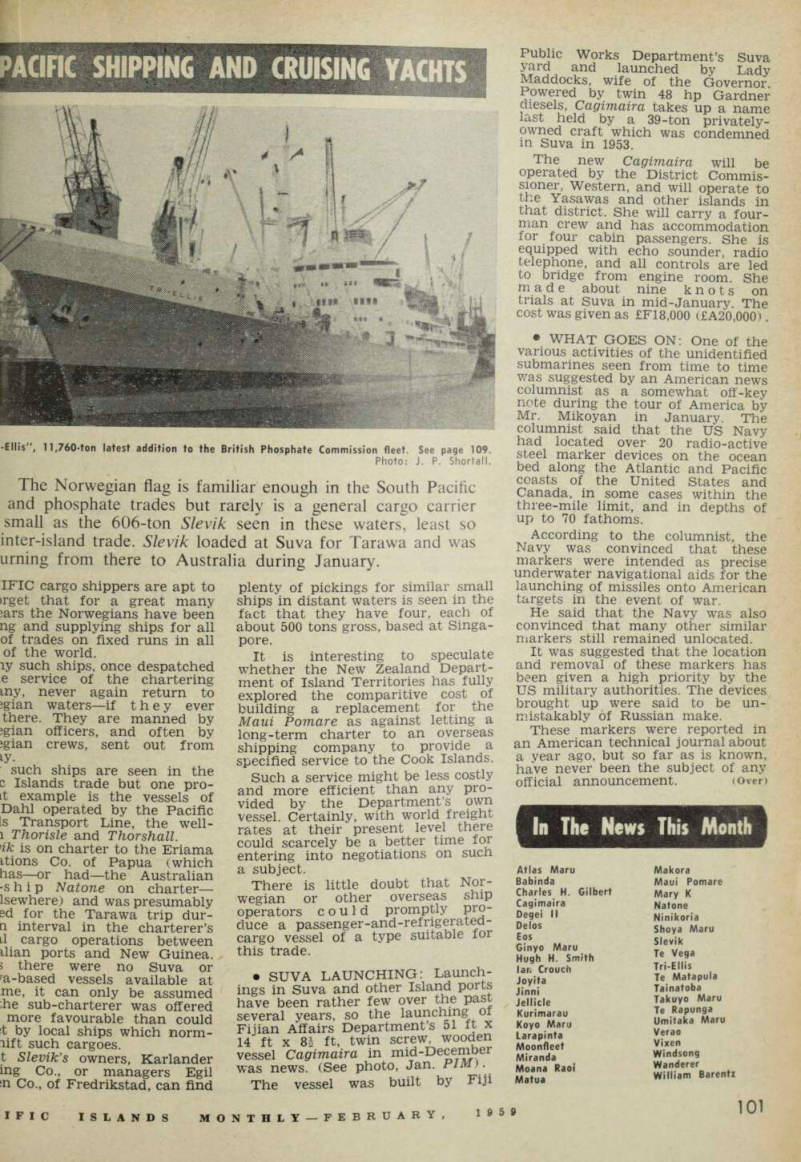
[?]-Ellis", 11,760-ton latest addition to the British Phosphate Commission fleet. See page 109 Photo: J. P. Shortall.
[N There Rooting For
Cable Companies; While
)lame for radio active markers be pinned on the Russians it s that the blame for sabotage :ean cables can be attributed lother unlikely source—sperm ;s. ording to a recent report, cable any records show that there it least 14 recorded cases of sea cable damage by sperm ‘s, which are capable of div ;o over 600 fathoms. Ten of cases occurred in the Pacific pths of between 500 and 620 ms. It is not necessary for a aph cable to be broken to put it of action. The slightest ge to the insulation is suf t. In the cases cited, the sperm which has a long narrow jaw and feeds on cuttle fish, >een hauled up with the cable i round its jaw, flukes, or fins.
LANDED OVER: The two id steel 242-ton passenger • oner Te Vega, which has ted in Polynesian waters in t years, was handed over to iperators at English Harbour, ua, British West Indies, in De ;r. voyage from Papeete to na took 34 days, and from on to Antigua another 14 The crew were then flown to nique, where they boarded the iner Tahitien for repatriation hiti.
Vega, which was registered in ame of a Liberian company, perated in the Pacific by Cap onier Darr, of Honolulu. It is nown whether the vessel has sold or merely re-chartered to interests. She is probably now more lucrative area for the Df luxury cruise business for she is fitted.
JNK—OR SEIZED?: Although ig has been heard of the 500mstralian auxiliary schooner 'vouch since she made radio ;t with Hongkong at 8.50 a.m. eptember 27, the day after I from there on her delivery e to Adelaide, it is possible something will be heard some Lhe possibility that the vessel eized by Chinese pirates, or by Chinese Communist naval seems by no means improbable, w of the fact that there were phoons in the area. the ship was evidently iled to call at Manila it must ssumed that the incident
■ed between Hongkong and
port, and that she was never d near New Guinea, n had she by-passed Manila is evidently a very definite r at present of a small ship seized by well organised s in the Sulu Sea-Celebes Sea vhere the Philippines govern has just increased its anti
piracy and anti-smuggling patrol force to twelve naval craft The British also maintain patrols round Borneo, where there are many cases of piracy.
It was proved conclusively that the men sighted on an atoll 280 miles north of Labuan, Borneo were Chinese fishermen from Malaya and had no connection with I °n Crouch. The fishing vessel which landed the men on the reef later picked them up and returned to her home base. (See p. 113).
• Drowned—Or Kidnapped
BY SPACE MEN?: The flying saucer protagonists in New Zealand were all of a-dither in January,
when an Australian wine bottle con taining a note, allegedly from a per son who had been aboard the American vessel Joyita when she went missing October-November, 1955, was found by some Auck landers on Whirtoa beach, eight miles north of the town of Waihi on the east coast of the North Island of New Zealand on January 8 i Z 1 ? 6 note ’ which included a sketch of a flying saucer, read as follows: “Abandoning ship. Strange circular metallic object forcing us aboard it. Help us. Stewart. Joyita.
Apart from the fact that there is no record of anyone with the sur name or first name of Stewart hav ing been aboard Joyita when all
s went missing, the possibility bottle drifting from the area of Samoa-Fiji to where this ound seems slight, though not >sible.
J drift would be southwestward ?h the Solomons-New Hebrides l into the East Australian it, which would carry it first past Lord Howe Island, then -east across the Tasman past i Cape, where an eddy current ; carry it down to where it was larine biologist who examined •ottle judged from its heavy station of barnacles that it have been in the water at least ears —but the only people who taking the matter at all seri were the local flying saucer nists.
George Adamski, American r of some of th 6 more sensa space literature, arriving in Zealand to commence a lecture shortly after the bottle was , overlooked the silliness of the ng of the message, and ex id the opinion to an Auckland )aper that the event described e note was quite feasible. 1 line of reasoning taken by Adamski, who claims to have led in space ships and spoken Venusians, was that the space -he assumed they would be Venus—would realise that the 2 aboard Joyita would be 1 on as insane if they went and said that they had been ig to Venusians. They would been confined in mental urns. Therefore, said Mr. iski, out of the goodness of hearts the Venusians probably the crew off to a happier fate.
All of which was no doubt lapped up by the Adamski Correspondence Groups in New Zealand and Aus tralia, who have financed the costly lecture tour.
• Reported For Sale: South
Pacific Shipping Company’s Suva registered Babinda and Southern Cross Shipping Company’s Suva registered Verao are reported for sale through disagreements as to operating policy. Though the com panies are separate, certain share holders have interests in each.
Babinda recently made a voyage
from Australia to Fiji and the Gilberts but normally both vessels are on the trans-Tasman trade where they have been operating successfully. The 655-ton Babinda carried timber and molasses in drums after purchase by her pre sent owners in 1955. Last year the 469-ton tanker Ransdorp was pur chased and renamed Verao and commenced a new trade in bulk shipment of molasses from Queens land to Onehunga, NZ.
To speed handling at Onehunga it was recently decided that a pipe line and bulk tanks be established there. In January, Babinda brought a cargo of bitumen from Whangarei to Australia for the first time. It is possible that any sale of these vessels will be merely a reshuffling of shares, with some shareholders con tinuing their interest.
There were also reports that the Suva-b as e d Hongkong-registered Kurimarau, owned by Berg & Co.
Ltd., of Sydney, is for sale. This 297ton vessel has been operating in the Pacific Islands petroleum trade since late 1956, transporting oil in drums to the Gilberts, Tonga, Samoa and the Cooks and operating charter voyages to the Tokelaus from Apia for the New Zealand Government.
The fact that she is for sale may have little significance as a large number of Islands craft are reported for sale —at a price.
• Longer Than Planned:
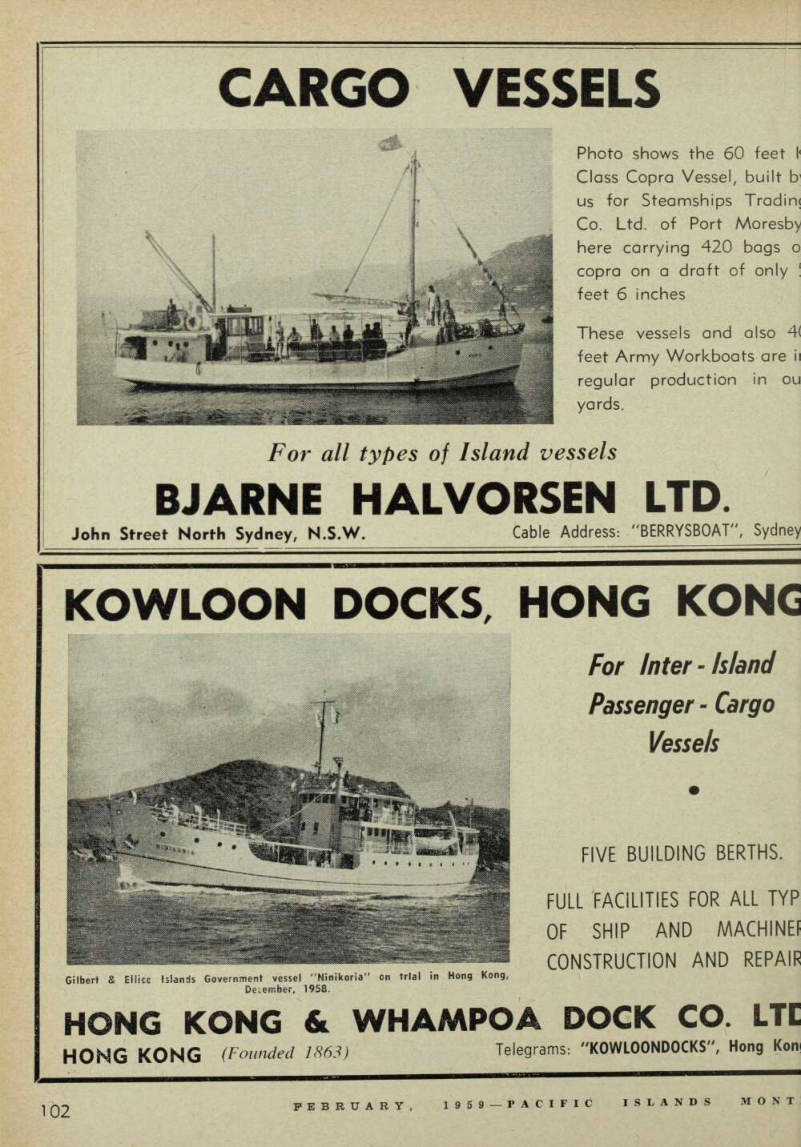
Following trials at Hongkong of the GEIC Government vessel Ninikoria, which was launched there last Sep tember 3, it was decided to lengthen the vessel by 8 ft 9 in. from her original 118 ft 2 in., reportedly to improve stability. The beam is 26 ft and moulded depth 8 ft. The gross tonnage was one-inally to be approx
[?]ew that took the "Ninikoria” to her new owners, the Gilbert and Ellice Islands Colony, photographed as the vessel left Hongkong. See below, right.
itely 240 tons but will now larently be nearer 260 tons, he original design was very ilar to that of the BSIP Gov tnent’s Melanesian, which was with all hands last July while present vessel was building, ire was never any suggestion t Melanesian was of unstable de i in the subsequent marine in ■y, but the cause of her loss never ascertained.
Tien this appears, Ninikoria will e arrived at Tarawa, as she left igkong on December 26.
Office Closed: The Union
,mship Co. has closed its Papeete :e after many years of opera s. Its business has declined ifcly since the days of the trans ific “mail boats” prior to the i’s, when the Papeete office died many passenger bookings, company continues, however, to 3 representation at Papeete. The ; busy British and American mlates have also both been 3d there in recent years.
The Trade Ships; The
fic saw the birth of a new mari i phenomena in 1958—the Trade ). Prior to the recent Eastern 5e of the Australian trade ship •s, Japanese business men had e a similar cruise to South East ports, and in December the •-ton Atlas Maru, of OSK Line, d for Callao, Valparaiso, and r South American ports. A lar cruise may be made later to ;ralia and New Zealand.
• Oceanography And Fish
ERIES: Another technically in teresting maritime event of 1958 was the appearance of several Russian and Japanese oceano graphic and/or fishery research vessels in South Pacific waters, and more such Japanese vessels are likely to be seen in the future.
Umitaka Maru, of the Tokyo Fisheries University, which did a few chores for the New Zealand Oceanographic Institute and the University while at Wellington in December, later took aboard some
CSIRO oceanographers at Sydney and with them cruised along a line from a point about 250 miles off Brisbane, northwards towards Port Moresby, taking soundings and sea water samplings to check deep currents in the Coral Sea. The vessel left Sydney January 5 and arrived at Port Moresby, where the CSIRO men were landed, on January 15.
Two other Japanese fishery re search vessels are known to be scheduled for South Pacific cruises.
The first of these is the 1,200-ton Koyo Maru, of the Shimonosekl Fisheries Institute, launched last October at a cost of £5tg.417,000.
This 218-ft vessel, with 45 fishery students, plus her normal crew and instructors, was to make a tuna survey of the Australian Bight, Tasman Sea, and waters southeast of Hawaii this summer.
She was to be followed by the 600-ton Shoyo Maru, of the Jap anese Government Fishery Agency, which was also scheduled to in vestigate Australian Bight and Tas man Sea waters between January and March —followed by a cruise to the Caribbean via Honolulu and Panama.
These are but two of the fishery research vessels operated by various organisations, and which are con stantly reaching further afield in the search for new fishing grounds.
A recent survey of Japanese fish ing shows that the industry provides a livelihood for about three million fishermen, who harvest about 17 per cent of the annual world catch.
Fish' exports yield about $167 million in foreign exchange and only about 9 per cent, of the annual s^-million ton catch is exported. The J*e mainder provides 70 per cent, of the Japanese animal-protein diet m taAbout 87 per cent, of the fish used in Japan is for human consumption
The yawl, "Mary K", at Suva in January. See Yachting Notes, page 113. -stinsons.
The new RCS "Coral Queen", personal vessel for the Western Pacific High Commissioner, dresses up on her arrival at Honiara in December. For details see January "PIM".
13 per cent, is converted to lal fodder and fertiliser. Of the ►,OOO gross tons of vessels en d in the industry some 230,000 are small craft without motor ;r. the total annual catch, about »er cent, is brought in from nt waters by the far-ranging fleets. e figures given above do not de whaling operations and are idication of the importance of fishing industry to Japan and fiy so much money is put into rch and training. fHEY’RE AT IT: The Ant : whaling season opened on ary 7. On the way south gh the tropics the six Japanese ry ships and their 69 chasers taken 1,780 sperm whales up cember 27. They hoped to take Blue Whale Units of the total issible catch .-)f 14,500 Blue e Units during the controlled i for the non-sperm varieties, all there were to be 20 factory and about 240 chasers en jn the Antarctic, assuming the Russians used the same er of chasers—2s, this year as Pear. All other nations had 1 on specific numbers of :’S. addition, the Japanese have grated supply vessels running hale meat back to Japan and le fleets will be served by 's. There is also the Japanese ;on fish meal factory ship.
Maru —formerly the Finnish ;er Vassa— which is working in iction with the Netherlands i| factory ship William whale meat is being pur l by the Japanese, who have i aboard the Netherlands ship ng it. The processed meal will i in Europe. The Ginyo Maru ' first vessel of her type ed by the Japanese since the Commissioned last year she st completed a season of fish sing in the Bering Sea, where s fed by a fleet of 20 trawlers, his is being read there are ly about 20,000 men occupied e short Antarctic whaling 's non-s top operation. By the Japanese fleets will be hunting the sperms in the as they head back home se of this great annual event, ler fleets will head for Europe idian Ocean and South c waters.
3 Met The Queen: Second
.Willie Schutz, of Tarawa, in a British tramp, received rprise of his life while in lam some months ago. We from a somewhat delayed “I mentioned that I was to have a close look at Queen th II on her State visit to lam.
FlZf Mls^on th wherrHer
Majesty was to pay a visit and hi very good luck I was one of’ the few
hamfs* gff
tSfffa questions
about the Gilberts. q
cracking 6 jokes''?n The Xft
Princess fex- by the cess Beatrix. • FIFTH pot? pop t7> t T7iT7rn
Tri Bp P 1 Fleet -
l n-ELLis, the fifth and largest vessel of the British Phosphate
g*Z I B ta, H fl P et ' ? aid her first to Auckland m mid-January. Like Hfnip2? m r Janion ®^- this one h as the tf » f & thP tfhnfnhaL d?e i P ‘ S^ a moorin S s at “
pow?sS wmdfasses
and sturdy bow-sheaves for this though these are not visible from the wharf in the case of Tri-Ellis Of 11,760 tons gross as compared
the 9,994 tons of Tri-Aster— last addition — Tri-Ellis has mger accommodation for only ; compared with 48 in the other She is fully air conditioned, six holds, and has 60 tons of jerated cargo space, e BPC ships— Trienza, Triona, lie (ex Levuka ), Triaster, and lllis —in addition to their well n phosphate duties, also pro the only really regular nger shipping connection be i the Gilbert Islands and the ie world, via Ocean Island. -Ellis, named for the late Sir t Ellis, discoverer of the Ocean i deposits and long-time New nd member of the British )hate Commission, was wel -1 in Auckland by the mayor 1 large gathering of prominent is and shipping people at a ion held on board. The vessel mmanded by Captain G. G. ing.
R Atone Ex Wyatt Earp
': The 40-year-old wooden -rigged cattle ship Natone, ting under charter to Eriama itions Ltd., Papua, went ashore Double Island Point, Queens on January 24, and was a total 5 430-ton sturdily built craft 2 best remembered in the out /orld as the Arctic and Ant expedition supply ship Wyatt purchased in Australia by e interests after the war and ied Wongala. er that name she traded to Guinea and across the Tasman. 7 in the explosives trade. Two ago she was sold and renamed e, and replaced in the ex 's trade by the new Hongkong three-masted steel schooner ila— a similar vessel to the g lan Crouch, built at the yard. me’s purchasers fitted the out especially for the carriage • cattle—she could carry just one hundred—between Aus and Port Moresby. The ing occurred in bad weather.
ITCH AGROUND: The ketch oha, about 50 tons, went id in shallow water off the of Kadavu, Fiji, on January e ketch, operated by Hurley’s ng Agency of Suva, was un \ empty banana cases along kadavu coast. After being id all night the crew hoisted i the morning and managed the Tainatoha off. But the changed direction and the vent up on the sand a second She remained there till the ide that night, after being d (with the exception of a mutes when she was tem- Y refloated) for about 24 Fijian captain stated in his tnat he had gone to sleep the discharge of banana
SSS SS* and th at the mate had started the engines and had attempted to navigate the ketch without his permission. • SUVA POPULAR: Suva’s ship repairing and marine engineering facilities seem to be gaining in popularity with overseas shipowners with vessels up to the 500-ton mark The Japanese tuna fleet at Pago Pago has decided to send units of the fleet to Suva for slipping and overhaul when they become due.
The Takuyo Maru arrived in Suva in November with a damaged pro peller shaft, and the Koei Maru was slipped shortly before Christmas A third ship, the Koei Maru 6
sailed on January 12 after slipping and overhaul. • S E ,9. EI 11 AT WORK: The new Fiji Public Works Department vessel Degei 11, which arrived from Hongkong in November, has started her service round the Fiji Group, i eplacmg the 18-year-old Degei, which has been retired. The new ship, which will carry Government cargoes and maintain lighthouses and beacons in Fiji waters, has not earned the criticism which was dealt out to the Ra Marama. The public is probably satisfied that the Degei 11, with her cargo capacity and passenger accommodation, will “earn her keep”. (o ver>
TAIL CHASING: So far only ship, the Union Company’s -island vessel Matua has ged her timetable so as to i the burden of the increased charges now applying at Fiji’s : the Port Line has got some s own back by announcing r freight rates between the d Kingdom and Fiji, s was to be expected. Higher rates to ensure that the y’s ports are made self-sup tg and not incumbent on the yer, naturally means that ng companies will be tempted :rease freight rates—which in means a rise in the price of ner goods. ch ever way you look at it, Citizen still pays, anyhow.
ISITORS: the Gilbert and Islands Government auxiliary Te Matapula, arrived in Suva muary 18 for slipping and 'UI her first visit since she ransferred from the Colony sale Society’s fleet to the r Government’s establishment, n J. E. Kenny said that the apula’s duties include voyages the Gilberts on Government >s and frequent trips to the nd Phoenix Groups. fine new £90,000 sterling Raoi, which arrived in i last September from Hong vhere she was built, is soon ) make her second visit to where she will load general or Tarawa.
W HOME BASE: The United Fish & Wildlife Service has 7 opened a new terminal for sels engaged in the Pacific ’ Fishery Investigations pro roject POFI. Formerly, these -Charles H. Gilbert and M. Smith—were based at [arbour. Now a $70,000 head s has been established on a peninsula on the Diamond ide of the channel entrance Kewalo Basin yacht and aft harbour at Honolulu, ock-side building includes laboratory, equipment store The base is shared with the Hawaiian Territory 1 °f Fish & Game, who the research vessel The joint base will assist *i? a^on of research work the two organisations.
of Cruising Yachts
:E UNLIKELY: The Auckland trans-Tasman Race seemed un eventuate as these notes were ite In January. Five sure entries nred and un to January 23 the entrants were Mr. H. E. Dood tOßA—which he brought out from a couple of years ago—and jeorge Dibbern’s TE RAPUNGA. hers showed interest, but their
interest appeared to be subject to a good number of other entries being received.
Entries were to close January 31 and the race was to commence from Auckland on February 21. • EOS, 33-ft. Sydney sloop, manned by Tom and Kevin Flower, Michael Glosking horne, and Davis Linton. arrived at Whangaroa, NZ, on January 20, 16 days from Sydney. The yacht was to continue on to Auckland later in the month. Future plans unknown, but this yacht was said to be one of the “possibles” for the trans- Tasman Race. e JELLICLE, which Lieut.-Commander Michael Bailes, RN, sailed to Auckland from England in 1955-56 and sold, is to have a successor. Bailes, soon to be dis charged from the Navy, is preparing a similar 25-ft. sloop-rigged Folk Boat for a repeat cruise. The voyage should com mence from England about June. • WINDSONG, the 48-foot Melbourne ketch in which Captain Jack Walker, re tired Port Philip pilot, has been cruising the Pacific since last May, left Auckland for Sydney via Lord Howe on January 17.
Bing Copeland and Rick Stoner, the two American professional life guards ex the Honolulu yacht JINNI, who had joined the Australian yacht at Borabora after JINNI sprang a mast at Moorea, went ashore in Auckland and will return to the US from there.
Still aboard with Captain Walker are the three Australian crew members and there was a possibility that another man might be picked up at Whangaroa where the yacht was to call before clearing New Zealand. • JINNI, after springing her mast at Moorea some time ago, had her plans in terrupted. Owners Bill and Jean Schallen berg intend remaining now in French Polynesian waters until the end of the hurricane season. • MOONFLEET, ex-KONA, well known in these columns, was being advertised in Suva in January at £ F 1 ,600 (SUS4,OOO). • VIXEN, of Miami, Fla., which cruised the islands 1957-58 and was last reported
at Brisbane last May, reached Durban November 15 and was to sail from there for Capetown and home about March. The Starks called at Thursday Island, Cocos, Rodriguez and Mauritius in the 35-footer.
Sailing almost in company with them across the Indian Ocean, and calling at the same ports en route, was the Australian 38ft. ketch LARAPINTA, west-bound around the world. • UNIDENTIFIED so far is a junk yacht manned by a group of young Spaniards which cleared Hongkong for Spain on January 17. They have been preparing for the cruise for some time and the junk was built for them at Hongkong. Details of route are not known, but in view of the unsettled state in South-East Asia waters it seems possible that the voyage may be a trans-Pacific one. • MIRANDA, which John O’Donnell, of Australia, recently brought back to Auck land from a Polynesia cruise, was sold to Bill McQueen, of Wellington, and sailed there late December. Boat-builder Mc- Queen formerly owned CHRISTINA which made a trans-Tasman cruise some time ago. • MARY-K. ex-WAYWARD, purchased by Melbournite Geoffrey Rawson at Whan garei, NZ, over a year ago, and which sailed for Fiji in November, was the source of inquiries from Melbourne in December —through the yacht entering Fiji by the back door. She was located in the Yasa was. With the owner on the cruise is- Graeme Tait, also of Melbourne.
The 34-ft. Islander-type ketch was offered for sale in Fiji, but when unsold departed for Tonga, Samoa, and the Coo* Islands from Suva on January 13, hurri cane season not-withstanding. • WANDERER, a 98-ft. schooner owned by the film star Sterling Hayden—who formerly sailed round the w r orld in the Johnson’s YANKEE —cleared a California port on January 16 for Papeete. Some days later the event received publicity when .t was alleged that Hayden, recently divorced, had defied a court order not to take his four children along.