The Month's New Reading
pp. 94-105 · Read in the full issue

With Judy Tudor
Most Australians would vigorously deny that thsy have anything so pretentious as a mystique —although there probably is no better word for what goes to make up national charac teristics.
IN a full length book on the sub ject—The Australian Legend — Russel Ward sets out to show what makes the essential Australian-ness of Australians, and although it is somewhat academic in its approach (it is, in fact, a revised version of a doctoral thesis) it is sufficiently interesting to hold the attention of even the modest-brow layman.
In the first page, Ward says that according to the “myth”, the typi cal Australian is a practical man, rough and ready in manner, quick to decry affectation in others; a great improvisor, willing to “have a go” at anything, but at the same time ready to leave off when he thinks things are “good enough”.
He is not naturally given to hard and long work, without cause; swears hard, gambles heavily; drinks deeply. He is sceptical of religion and culture; hates authority, especially police and military officers; is very hospi table and will stick to his mates through thick and thin.
Having thus propounded the myth, Mr. Ward then proceeds to prove in the next 200-odd pages that it is not such a myth after all.
What Makes
An Australian
r appears that even after 170 years, Australians have not really grown out of their early be ginnings—the convict system, and at a slightly later date, the cult of the bushman.
The bushmen of the early 19th century were often convicts or ex convicts, and added to the fact that they had small respect for law and order and an acute class hostility, they lived in considerable isolation, and by force of circumstance were forced to develop many of the ad mired characteristics indepen dence, talent for improvisation— mentioned aforesaid.
A surprising degree of cohesion early developed amongst this bush man group of wandering shearers, drovers, station hands, bullock drivers and stockmen.
Up to about 1900, when the cities started to out-distance the rest of the counry in the matter of popu lation, the prestige of the bushman was higher than that of the towns man—it was regarded as romantic to be a “man from up country”.
The bushman played up to the
part—wore a cabbage-tree hat and a coiled stockwhip as a badge of office, and was soon copied by new, free-immigrants, or the Australian born.
To be considered truly “Currency” or colonial, involved the aping of up-country manners, for a bushman was “more Australian”, and in spite of the much derided, ever-deplored convict system, the great majority of convicts were quick to see that there in Australia was a chance they would have never had had in Britain: a country and a way of life that was ideally suited to their own peculiar personalities.
Some composed and others sang sentimental ditties about leaving old England—or more likely, old Ireland: but few really wanted to go back to the conditions they had left and many persuaded their rela tives to follow them to the new land as free settlers.
One factor that had a profound influence on the early Australian outlook, was the preponderance of Irish amongst the early convicts — and later, amongst the floods of free immigrants that followed the convicts—and the very few Scots.
The reason was the difference be tween the English, Irish and Scot tish legal systems. The English, it was said, were deported for small crimes; the Scots for big crimes— and the Irish for no crimes at all.
When free immigration was en
couraged, those Scots who came fused to take jobs and set up themselves. Soon, instead of sup] ing the labour market as had t hoped, they were making dema on it themselves.
Because the Scottish educa system was even then superioi the English and far superior to Irish, which was almost non-e tent, the few Scots convicts, the migrants who came after, an initial advantage. Most beci wealthy—and therefore Austra “upper class”—and thus, s Ward, left few marks on country’s folk lore and ballads The Irish, on the other hs although mostly illiterate, m contented settlers in the lo orders of occupation, and even convicts frequently found coi tions no worse than those they endured in a free state at he They brought with them a res made hatred of English autho —and probably a great deal of antipathy to things English, served in such states as NSW day, can be traced right back this predominantly Irish influe in the first decades of colonisat Another aspect of national ( look that sets the Australian aj from most, was his fervid acc tance of the principles of Union: “It burgeoned in Britain, I Zealand and the United States the same time as in Australia,” s Ward. But in Australia it had essential difference: Although n workers in most Western count are conservative, in Australia it the bush workers, shearers and like, who in the 1880-1890 pe; formed the most numerous gr and bore the brunt of the ba for the new concepts of socialis “The phenomenally rapid gro of the Union probably sprang n from the bushmen’s already ex ing ethos, than from the organis genius and missionary zeal
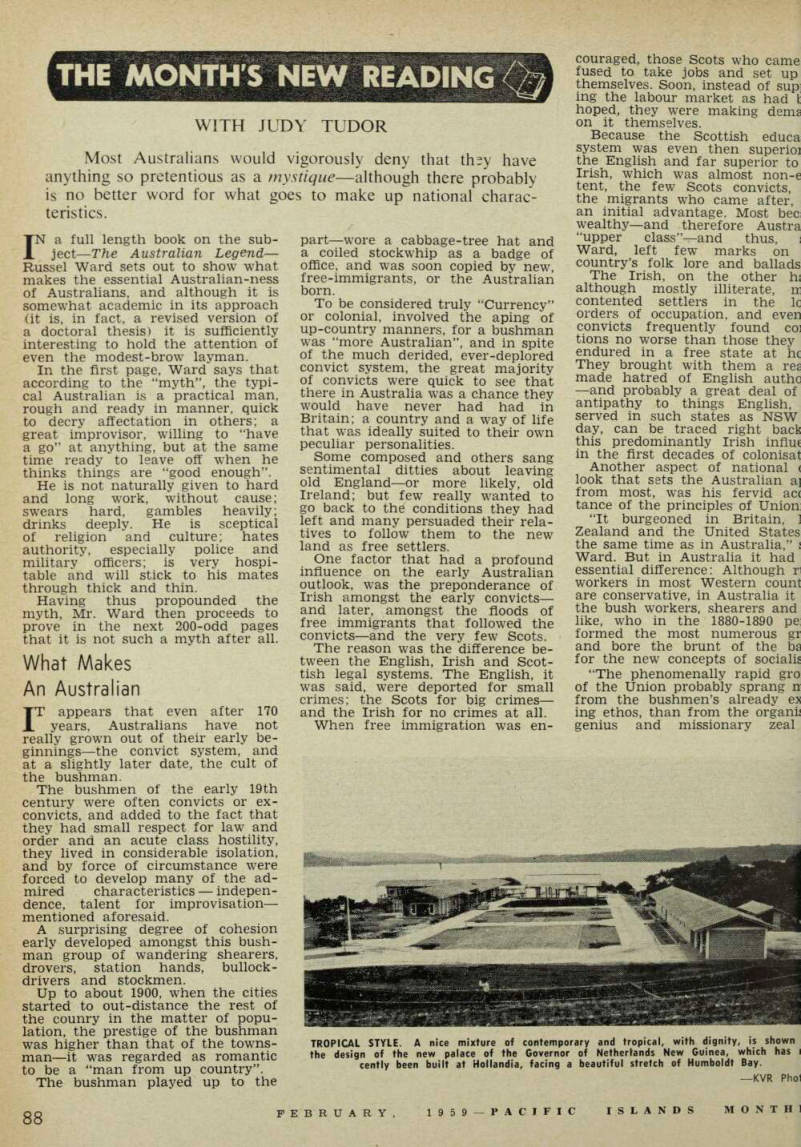
TROPICAL STYLE. A nice mixture of contemporary and tropical, with dignity, is shown the design of the new palace of the Governor of Netherlands New Guinea, which has [?] cently been built at Hollandia, facing a beautiful stretch of Humboldt Bay.
KVR Photo.
minent leaders. Once the idea of de union combination was put are them, it seemed to most hmen merely a natural exten i of the non-political but rished and familiar sentiments jciated with the concept of keship. i 1914, of course, the Australian hman can be said to have come age. The characteristics long rished of the “typical bushman” e easily transferred to the “typi- Digger”, and the cabbage-tree exchanged for the slouch hat. rom this point on most Austra s have given up thinking of nselves as men from “up itry”. The national mystique, as Ward calls it, now is more ly based on the casual but hard ting soldier. Nonetheless, the c characteristics and outlook ain the same.
He Australian Legend. Published
Dxford University Press. Australian . 45/-.)
ogenarian Looks
k and Forth
’ the age of 82 and with about 90 “works” behind him, one would imagine that Sir Philip )s might, with honour, retire, ever, having been writing since vas sixteen he is evidently de lined to give us the benefit of lotted advice and comments for bile longer. no Now, England? is not so b an Angry Old Man speaking, determined effort to be abso y liberal minded and fair about whole thing, England is not the i as it was in his youth—which says was before electricity in home, before motor cars, es, radio, telephones, refrigera and even bicycles—but in some sets he admits the change has for the better. times, however, his determined npt to see everything with pulous fairness, wears a bit and he comes close to telling and what he really thinks. In j passages he is more like p Gibbs and less like what he mtly fears might sound like an fogey speaking out of turn. one of the few famous war jspondents of World War I, and erary editor of famous dailies re that, he has devoted a whole ter to the London Press. Lon evening papers, like most of Sunday papers, he thinks, have turned into nothing more or than women’s magazines, for h they are rewarded with ad sements for female underwear, tetics and household goods. The ■ of the species has no defence, pt to fall back on the cross i puzzle. ditors of the popular press,” ays, “seem afraid of facing their ers with anything but snippets
and gossipy paragraphs, lest they should suffer from mental fatigue”
This is paradoxical, because we live in an age when greater num bers are being educated.
He blushes for some of the Sun day papers—and records how an other literary man of austere morality deplores the vulgar tone of some of them, yet if he finds them lying around a friend’s house buries his nose in them for hours— just to see how deep they go in degredation.
It causes no surprise, at the end of the chapter on the Press, to find that Sir Philip’s favourite news papers are The Times and Daily Telegraph, the Sunday Times and Observer.
Most people will agree with Sir Philip’s opinion on the modern newspaper; but neither he nor they can give any real reason for this modern phenomenon, which no one likes but every one buys. There must be a great many “literary men of austere morality” buying the rags just for purposes of scientific investigation.
Gibbes might have done better with this book if he had gone for straight-out criticism of the present generation—because what he has to say cannot be confined to Eng lishmen and English institutions.
A summary of this sort is in teresting enough; but it is very much an inconclusive document. (HOW NOW, ENGLAND? Published by Angus and Robertson, Ltd., Australian price, 21/-.)
Homme Fatal
ALTHOUGH Pamela Frankau has kept her name before the pub lic with only a modest number of novels, all her writing has the same stamp of technical skill, meti culously executed —but warmed by a rare understanding of character.
He latest story, Ask Me No More, is a full-scale document in which the characters themselves provide all the complications, the theme and the twist of a sophisticated novel.
It covers the lives of two women, Alex and Perdita, over a 20-years period; and the beginnings and ends and portion of the lives of several men—particularly Geoffrey whose passion for collecting women had a dedicated quality.
Alex, the strong character, privately despises herself for loving, too well, two men who are fundamentally unworthy. Perdita, a latter day versitpn of the lady who sat on a satin cushion and lived upon strawberries and cream, indulged in little soul-searching.
The same men provided conflicting influences in both their lives, yet circumstances drew the two women together, into an outwardly ill assorted but lasting friendship.
This is a story of London, with excursions to Europe and the United States. But primarily it is
a story of people, not places; of weak men and enduring women, of tragedy and comedv; a story told with wit and in good writing.
This is not a particularly conventional novel, although it still could be said to have a moral in it. (ask me no more. Published by Wm.
Heinemann. Ltd. Australian price, 20/-.)
18 Months With
Red Women
ANY resemblance between Dymphna Cusack’s excellent novel of war-time Sydney (Come in Spinner) and her latest piece of writing, Chinese Women Speak, is purely coincidental. The latter is not, of course, a novel, but re-
portage; and in the former she was accompanied by Florence James.
For some reason not explained, Miss Cusack recently spent 18 months in China (Red), and her book is the result of interviews with Chinese women of the new regime wom en from all ranks of life. One must suppose that in going to China in the first place, the author is a woman of advanced thought, and that she was following the well-worn path of most intellectuals who today find food for their souls in Red China where a previous generation got the same sort of satisfaction from Russia, Miss Cusack proves conclusively —and she could scarcely be wrong, anyhow—how much better off the
women of China are today thi the pre-revolutional times they were little more than j in their husband’s establishn In telling the stories of women—such as that of Teng ' chao, wife of Chou En-lai—a £ what sketchy outline of the cesses that led to the presen is also given, and, probably i tentionally, some inkling of world force that this united China will have in the futun The writer gets in early denies any political affiliation bias, yet it is impossible to e the conclusion that throughou 18 months in China, she perpel used her rose-coloured spect The inference continually is Red China is doing so much 1 than the West; that its thought is so much bigger brighter and superior to any osophy ever conceived by us.
There is no space here to di just how free the individual Chinese is. But doubtless an a with the opposite view-poir Miss Cusack could prove equa] well that he has simply sold a servitude to buy himself a master.
No one of intelligence can to be impressed by the mirac Red China; and in so far as China is composed of the viduals about whom Cusack m her book has merit, although more entertaining and intere book about the contemporary in China was Mandarin R( small Comet Book reviewed h month or so ago.
James Cameron, the ai although fathered in China b; same crop of guides and i prefers as Dymphna Cusack, also sympathetic (or, at any € with no antipathy) to the re produced a far more realistic —probably because he is a mar thinks with his head and not his emotions.
(Chinese Women Speak. Pul
by Angus and Robertson, Ltd. Aust price, 25/-.)
Bony's Most
Famous Case
ABOUT 30 years ago A: Upheld was riding a sectic the longest fence in the y —it stretches 1,130 miles south of Broome to the south of Western Australia. The id( the fence was to keep rabbits the State’s best agricultural £ and Upfield’s section was 170 : north from the Kalgoorlie ra: to a camel-breeding station c Dromedary, where young ce were trained to draw covered-< for the patrol men.
Maintaining the fence wa* particular problem, and Upheld usually hnished by noon. Di the rest of the day and in the e ing he got into the dray away
mts, to read, or at the old table he had built, to write, was in these circumstances he produced The Sands of ee. It was his fourth novel, the second adventure of part ?inal Detective Inspector leon Bonaparte. Upheld had he idea for this now world is character, when in the NSW ck he had met Leon, an edu black-tracker. He had used first in Barrakee Mystery. the last 30 years, Bony and •eator have both gone a long but although Bony is still g “cases”, Upfield no longer fences and writes in camel original edition of The Sands ndee, was published in Eng and only just recently, after xs, has it had Australian pub n—an interesting event for vho joined the Upfield band n only somewhere along the iough written in the 20’s and ps less polished and more than later Upfield stories, it he original ingredient that his writer completely apart other thriller writers; The f getting the Australian out authentically onto paper, ough numerous thrillers have based on real crimes, The of Windee reverses the pro md had the distinction of used as the basis of a series I murders, and its writer being i the witness-box at a real :n Upfield was writing the ind searching for the perfect •f. completely disposing of a vith what is at hand on any k station, he was presented he method by a visitor to the tending camp, for a £1 bet. victim was to be lured into ish, shot and burned on the rhe remains of the fire were to be sifted, all metal rem such as buttons, boot sprigs ) forth, were to be dissolved sulphuric acid; the burnt were then to be pulverised in specter’s dolly-pot and the Dssed for the wind to scatter, n case some busy-body had nl around the fire analysed aces of organic matter, the ses of a couple of kangaroos to be burned over the spot the body had been destroyed, “fool-proof” method of dis of the body, and Upfield’s generally, were discussed I camp fires on many occa md one man stowed the in i°n in the back of his mind ture reference. weeks ran into months; The of Windee had been pub and had been a mild success, the Government Inspector pfield that his old camp ac ance, Snowy Rowles, was in trouble. Rowles had been g with a man named Carron
hunt was on fo? RowFes d ' Th With the devil-may-care Snowv emerging as something of a S monthought P thi d hlTad b me e t d him at 2 000 S£S tSTd in wit°h tb i? C RoS’ h 0 ™ Xt out With the mystery of the missing u^ scdv cd, the police began to look for Rowles’ two previous mates, Ryan and Lloyd, who Au°fv? e f meci to h * ve disa PPeared. eV6r oUn .d 9 f any of rom several big fires in d b ® e burned, and together the clues did not fill
a one-ounce cooking essence bottle. aniH 6XpeC JS d and . overlook ed was from afi ng ’ recovered mitl T h aliaS Snow y h-nged’ in g been foF n t d he gU utmt 0 y f
Sss Fs^Hj^Ssss 8
That he had put into effect the method of body disposal used bv Upfield in the Sands of Windee was certain, although had not been as careful in carrying out the recipe to exact requirements as had the fictitious killer, ultimately tracked down in the story by De
ive Inspector Napoleon Bona be.
HE SANDS OP WINDEE. Published Lngus and Robertson, Ltd. Australian i, 17/6.)
ertainment by
iham Greene
tAHAM GREENE divides his writings into “novels” and “en tertainments”. Our Man in ana is an entertainment, the for 17-odd years, as all his ;r-day pieces have been novels. ; an entertainment it lives up ts name, being an airy-fairy 3 of satire, mostly; with a few :er overtones. It is a change i Mr. Greene grappling with 5 and Roman Catholicism, r. Wormold became British et Service agent No. 59200 5, our man in Havana, in the tory at Sloppy Joes. He was ered into the fold in the Gents a perfect stranger, before he v , what had happened, what he liked about it was the lar money, because his amazing : age daughter Milly was an ex ive item. ladquarters in London soon thinking of 59200 5 as their lan of the Caribbean network; Mr. Wormold, of course, knew ' r - In order to keep the pay ues coming, he obligingly in ert some sub-agents, 59200/5 1, )/5/2, etc. He even invented a ;t weapon, which was being m the mountains of Cuba of imaginary agents, ) 5/3. at great risk to himself. 3 a drawing of this—copied one of the more complicated um cleaners for which Mr. nold in his more private capa was agent. ings began to get lively when
ion headquarters, impressed by
magnificent effort being made heir man in Havana, shipped um one secretary, trained to )est pattern of Ml 5, and a radio itor. , e ra dio operator remained a igure; but Beatrice, the secre is as zany and eccentric in way as her new boss, when, unfortunately for Mr nold, the figments of his imag on are taken seriously by ' s and it leads to a couple of rea * deaths, and a lot of )le. t as this is a fairy story, Mr. ne allows himself a happy end ;wr lth a job in England, for Wormold, training other secret ce agents how to run foreign ms, and the QBE. is is a delightful and whim piece of writing: Entertain as promised, on the surface, vith a barb in its tail.
IR MAN IN HAVANA. Published by Hememann, Ltd. Australian price,
The Man With
rU rt z
Ihe 6 tt 6 in. Appetite
Presumart V
in b o ni ~,6 18 some sale the collected^w UStralia , for Thnrrmc .] etters of a Uttle ' bUt must be ver y Let us confess: Your reviewer must still have been eradnntw from Hopalong Capsid v Grant BruSe and Edgar S the time Wolfe wafThterar^cha?- 4 oftL^O’f^nd^ffs^nri rf meriCa heard of him umn ?h?» ne T 'acted letters aS^ar^VcX 001 '
e Thomas Wolfe was, we are told, ® in. tall and weighed over 17 ston e. Hi s appetites and senses wer , e scale d to this size, and he could out-eat, out-drink out-love 2? d out i alk several ordinary men His one fear was of death.
Perhaps it was premonition; but thls put-eating and out wl- {j a d something to do with it. ? e dled of a bram infection, fol- V ne ? monia > following a chill, ber th l938 arly 386 ° f 37 ’ ln Septem ‘ fl Loofc Homeward, Angel, was his and acc <? r <llng to critics!
ith, he produced nine others ich he apparently wrote more for own satisfaction than to make ney or please his publishers. He ; of the generation that believed t the world is well lost for art. st authors today cannot allow h soul-satisfying reason to inter - ! with the regular pay cheque. !is collected letters (edited by ;abeth Nowell who was on the f of Scribner’s until he quit n, and who then was his literary nt until he died), begin in 1908 m Wolfe was seven, and con ic until within a few weeks of death. They can, in a way, be aded as a somewhat disjointed )biography, and discuss in great ill every aspect of life and busi ; as he found it. iteresting enough in their way )ut meeting an author, long 1, through his “selected letters” bviously a poor substitute for ting him through his novels, criticisms of critics, his feuds 1 publishers, just lack the point might, with longer acquain e, have had.
Ie Selected Letters Of Thomas
PE. Published by Wm. Heinemann, Australian price, 31/-.)
:inating Formosan
ht for Frank
E printers of Sydney town nust be working nights of late ihurnmg out books by Frank e * Hardly have we recovered Tale of Tahiti, than Frank is igmn this time to, of all on (he sa ys so elf), A Holiday and Fact Find- Tour of Nationalist China’s ■ess of Freedom and the Ports ongkong and Macao. is gives Mr. Clune opportunity scuss everything including the m Wars of long ago; the cor- Manchu rulers; Hongkong, present and future; the per lon of Catholics in Red China -3 da Gama’s great voyage (to o), and sundry other fascin- Onental subjects. len this is sprinkled with s Confucius and photo is of the Generalissimo flanked ir. and Mrs. Clune, it gets, in iterary sense, just about as far from the selected letters of ms Wolfe as you could hope ivel in a month’s reading. 2 only thing that makes this ent from all the other Clune that we have read is that ustomary plug for the airline appens to be travelling by, is bough he devotes (as usual) 1^ S 4.v. foui i pa Se.s to a descrip pf the plane (it was a “Super ie with radar in its nose”); iileage flown, the mph and the Stic details of high flying, 1958
iirl I fne n ge t t.° ne mention does the It appears that between Svdnev anti Dm™ the P lane ran into a lot of rough air and Frank confines his remarks on this occasion to S h °w much better off ar?
W i th sl f epin § berths in anc J. c ° mfor table cabins in ships, and how dull all airline waiting-rooms are, anyhow It sounds so unlike Frank that we are tempted to urge him to send in the old stamped addressed en- JJSSf f ? r u 0 ° wn recommended brand of high-flying, bump level ling travel pill. (PLIGHT TO FORMOSA. Published by Angus and Robertson. Ltd. Australian price. 25/-.)
Tots Department
AFTER some of the things we have been reading this month, a little number called Little Red Fox and the Magic Moon, which t® lls i. °J a Badger family that adopted an odd fox as foster child is just about our dish. The adven tures of Rufus, the Little Red Fox, began when he decided that green nettle soup and herb pudding were for cissies (or Badgers) and went fishing for something he could really get his teeth into.
Although warned by Mrs. Badger that he would likely meet a man or a foxhound, or even a crocodile off he went and before long was
sd with water nymphs, edu fish and a moon that shone ,t of the stream instead of from the sky. ell-written (by Alison Uttley) veil-produced story in the h manner for very small tots.
Xe Red Fox And The Magic
Published by Wm. Heinemann. an price, 15/6.) sthing with an Australian •, though, is Dumper and the by Evelyn Bartlett, who has / introduced Dumper to lots mg readers in Dumper the roo. Dumper decides to join ight lights of the circus, and lappens after that is the ex or a readable storybook of iges, clearly illustrated by vlaher. Angus and Robertson i it, at 15/- Aust. tifully produced picture in English are not confined ish and American publishers, nt productions are also
from Europe—particularly
folland and Italy. The Cow ell in the Canal is printed land for World’s Work, in The reason for this is far lear as the Australian price (13/3), in comparison with cheaper productions in this
es Tahiti
cano!
Devil at Four O’clock is a i novel by Max Catto. It a fast-moving, colourful, itten story of how the in □f a hospital were rescued, le midst of a volcanic erup \ a missionary priest and ahiti convicts. Mr. Catto’s ave been successfully filmed;
and there is material for a film in
this sulphurous story.
The story shows Mr. Catto’s craftsmanship, but a sad lack of
geography. The exploding volcano
is called Taluha. Not only is there no Taluha island anywhere near Tahiti, but there is no semblance of volcanic activity anywhere in
French Polynesia.
Why could not the setting have been Samoa or New Hebrides or New Guinea, where there are vol
canoes a-plenty? Because (presum
ably) the kind of people who buy these books like to read about Ta hiti. The really volcanic islands haven’s enough glamour and sin.
(The Devil At Four O’Clock. Pub
lished by William Heinemann, Ltd. Aus tralian price 18/9.)
What's New in Paper Jackets
DYING WE LIVE: A collection of letters written by political prisoners in Germany while awaiting execution during the latter end of the Nazi regime. As this small book is one in the Fontana religious series, the emphasis is on the Faith with which the people concerned committed themselves to the hands of the executioner and God.
The testimonies come from all manner of people—farm boy, cabin-boy, aristocrat, soldier, priest—all of whom had been found wanting by their Nazi masters; or whose consciences rebelled against National Socialism.
All—according to their letters—went to their deaths with prayers on their lips and believing that what awaited them was no “cause for sorrow but rather great joy”.
These people were probably the lucky ones. Doubtless there were thousands of others who were executed by the Nazis but whose letters do not appear in the book for the simple reason that they did not get any particular joy out of the hangman’s noose.
Some people, of course, may find this sort of religious emotionalism, inspiring.
A great many others might ask why God who, according to the old Sunday School hymn, “watches each sparrow fall” coulrt have been so unconcerned over the fate of such obvious saints. (Fontana, yeilovv spine).
HUNT THE TORTISE. by Elizabeth Ferrars. A whole collection of interesting people gather at the Hotel Bienvenue, in the small French fishing village of La Merette—including Cecilia Kent who had been there before the war. She found that the war had changed the Hotel Bienvenue and other things. But in addition to the emotional currents that were evident amongst proprietors and clientele, there were shortly several violent deaths to help things along. (Fontana, yellow spine), HARRY BLACK, by David Walker: This somewhat unimaginative title hides an exciting adventure story of India and the tracking down of a man-eating tiger.
This writer has other best selling novels to his credit, including “Geordie”, which was based partly on the Melbourne Olympic Games before they happened.
“Geordie” was made into a motion picture.
“Harry Black” has also been filmed —with Stewart Granger in the star role. (Fon tana, yellow spine).
STONE COLD DEAD IN THE MARKET, by Christopher Landon: An ingenious thriller woven around the nasty end of a nasty stockbroker, Hubert Greezley, right on his
own stamping ground—the London Stock Exchange. No one touched him; everyone saw it happen—and a lot of people had good reasons for bumping off Mr. Greezley. (Great Pan).
PETER ABELARD, by Helen Waddell: A romance based on fragments of legend and history and set in Paris of the early 12th century. This story of Heloise and Abelard is claimed to be one of the great love stories of the Middle Ages. It is written with great charm by Miss Waddell who is an acknowledged authority on Medieval History. (Fontana, yellow spine).
Death And The Dancing Footman;
An early war-time novel from Ngaio Marsh, which bears reading again by fans who get all too little from this Whodunit writer these days. Miss Marsh, a New Zealander, is alleged to have gone into the mystery writing business because she could do as well as Agatha Christie.
Having proved her point, she seems now content to rest on her laurels. Christie still produces far more books than Marsh, although she has been at the game much longer. (Fontana, yellow spine).
The Journals Of Kierkegaard: A
translation of the diaries of Soren Kierke gaard, an accepted genius of Denmark, 1813-1855, in an era when being an intellectual giant was an end in itself.
The journals—which he kept from his days at the University until near his death —are a combination of diary and philo sophical essays. Kierkegaard was an early 19th century poor-mixed-up-kid, and no doubt today the psychologists would have a word—and a cure—for it.
Most of his trouble (apart from being a genius) appears to have stemmed from his home environment which was com pounded of gloom, melancholy and an un enlightened belief in the wrath of God. (Fontana, yellow spine).
Skeleton In The Clock; Carter
Dickson has his famous Sir Henry Merri vale romping through this fear-clutching murder mystery in which the skeleton is in the grandfather clock instead of the -closet. (Great Pan). (Our copies from Wm. Collins (Over seas), Ltd. Australian prices; Pan, 3/-; Great Pan, 3/6; Pan Giant, 5/-; Fontana, yellow spine, 3/6.)