[?] In Pokes
p. 81 · Read in the full issue
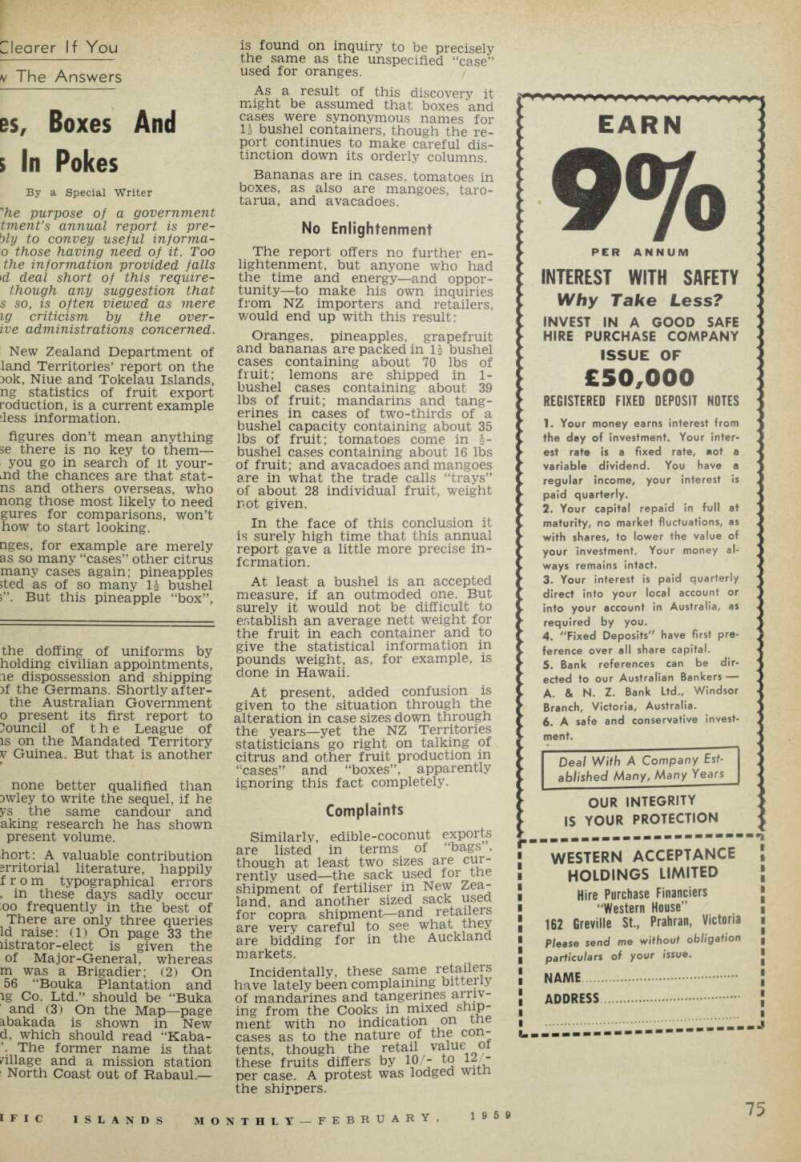
Clearer If You [?] The Answers [?]es, Boxes And [?] In Pokes
By a Special Writer
'he purpose of a government tment’s annual report is pre bly to convey useful in forma o those having need of it. Too the information provided falls id deal short of this require though any suggestion that s so, is often viewed as mere ig criticism by the over ive administrations concerned.
New Zealand Department of land Territories’ report on the Dok, Niue and Tokelau Islands, ng statistics of fruit export reduction, is a current example ;less information. figures don’t mean anything se there is no key to them — you go in search of it your md the chances are that stat ns and others overseas, who nong those most likely to need gures for comparisons, won’t how to start looking. nges, for example are merely as so many “cases” other citrus many cases again; pineapples >ted as of so many li bushel But this pineapple “box”,
IS found on inquiry to be precisely the same as the unspecified “case” used for oranges.
As a result of this discovery it might be assumed that boxes and cases were synonymous names for 11 bushel containers, though the re port continues to make careful dis tinction down its orderly columns.
Bananas are in cases, tomatoes in boxes, as also are mangoes, taro tarua, and avacadoes.
No Enlightenment
The report offers no further en lightenment, but anyone who had the time and energy—and oppor tunity—to make his own inquiries from NZ importers and retailers, would end up with this result: Oranges, pineapples, grapefruit and bananas are packed in 1 1 bushel cases containing about 70 lbs of fruit; lemons are shipped in 1bushel cases containing about 39 lbs of fruit; mandarins and tang erines in cases of two-thirds of a bushel capacity containing about 35 lbs of fruit; tomatoes come in h bushel cases containing about 16 lbs of fruit; and avacadoes and mangoes are in what the trade calls “trays” of about 28 individual fruit, weight not given.
In the face of this conclusion it is surely high time that this annual report gave a little more precise in formation.
At least a bushel is an accepted measure, if an outmoded one. But surely it would not be difficult to establish an average nett weight for the fruit in each container and to give the statistical information in pounds weight, as, for example, is done in Hawaii.
At present, added confusion is given to the situation through the alteration in case sizes down through the years—yet the NZ Territories statisticians go right on talking of citrus and other fruit production in “cases” and “boxes”, apparently ignoring this fact completely.
Complaints
Similarly, edible-coconut exports are listed in terms of “bags , though at least two sizes are cur rently used —the sack used for the shipment of fertiliser in New Zea land, and another sized sack used for copra shipment—and retailers are very careful to see what they are bidding for in the Auckland markets.
Incidentally, these same retailers have lately been complaining bitterly of mandarines and tangerines arriv ing from the Cooks in mixed ship ment with no indication on tne cases as to the nature of the con tents, though the retail value of these fruits differs by 10/- to 12/per case. A protest was lodged with the shippers.