Fiji's North-West
pp. 67-69 · Read in the full issue
How B. D. Lakshman Can Call a Strike On and Off The Problem Child Of Fiji's North-West
By R. W. Robson
I put down some reports I had been reading about in strial restlessness in Fiji’s sugar belt, especially at Lautoka exactly is B. D. Lakshman?” I asked.
\ friends made haste to answer. pain in the neck,” said a an with investments in the west. “Thinks he’s God!” said er. seems to have a lot of in e with these sugar-mill work- I said. “Why does he keep ig them up like this, and ening strikes?” their answers were not ex :ory. ouple of days later, in No r, I was in Lautoka. Mr. man had called a public meet ) protest against higher tax -obviously an attempt to ride general surge of public in ion. r as not a successful meeting. 120 silent men—mostly s—listened to Mr. Lakshman’s y. The only noise came, in y and silly interjections, from e group who had partaken usly of malted hops.
I was impressed by Mr. nan —a big, goodlooking man, r, fluent speaker in English industani; forceful enough to s audience (if it had been i of response) but not virulent. : there on the Sportsground istened to the useless ebb and f talk, and wondered what Ir. Lakshman tick. He seemed r; his audience was so bored; ne of Fiji’s community lead iropean, Indian or Fijian— ly notice of him. Yet his con ?r the sugar-mill workers was plete he could dislocate Fiji’s iy at will. •emagogue or Patriot? y of people around that little new the Lakshman history. 3 born in Fiji, but he was d and politically trained in lose to Gandhi. Back in Fiji,, been a school teacher, prin ind owner of a training merchant, button-factory he is a notable demagogue. )ves to talk—and he talks y and well, emphasising to lerprivileged masses the in of many of the inequalities the poor and the not-so ?he organised mill-workers bourers of the Northwest lim blindly. He is the well
paid organising secretary (virtually the boss) of their union.
Was this merely a man holding a paid job as a rabble-rouser, ignorant of the economic laws which govern such situations, and which certainly cannot be altered or im proved by rabble-rousing? Or was
economic problem as I see it—a cruel maladjustment as between over-population, community needs and land usage, which must cause poor living conditions among the Indian working masses until all Fijis communities, by a united enort, can so re-arrange the country’s economy that the pro duction of more wealth, and better hying standards may become pos sible.
We each acknowledged the merit of the other’s viewpoint.
“I believe that you are sincere in your wish to help in improving the lot of these people of the North west,” I said. “But how can you help them when you dislocate the country’s earning power by irre sponsible strikes?”
“But they will not meet me,” he cried. (By “they” I guessed he meant the CSR Co. managers.) “I want to discuss the welfare of our
he a man with a deeper and perhaps more dangerous purpose? He did not seem to me to be a fool.
Next morning, early, I telephoned and asked him to see me. I sat in his house, and took a cold drink with him and his adult son, who is his father’s capable under-study.
They were courteous and quite ready to talk.
Two Sides of a Subject He told me about the bitter poverty and social injustice under which so many of the Nadi-Lautoka- Ba Indians and Fijians worked and li\ed, and of his determination to help them to better standards of life.
I told him of Fiji’s politico
people—more food, better housing, more sanitation. They ignore me.
We use the only weapon we’ve got —the organised union.”
“But you must take the long view,” I said. “Wage rates are not things which can be altered at a week’s notice. No industry, even if it sells its product locally, can carry on that way.
“These CSR Co. managers sell their products in a highly com petitive world market. They make
™3f be° equaHy g lon|-range Other
thev ennnot carrv on and Y everyone suiters.
Mr. Lakshman showed quite a clear understanding of national
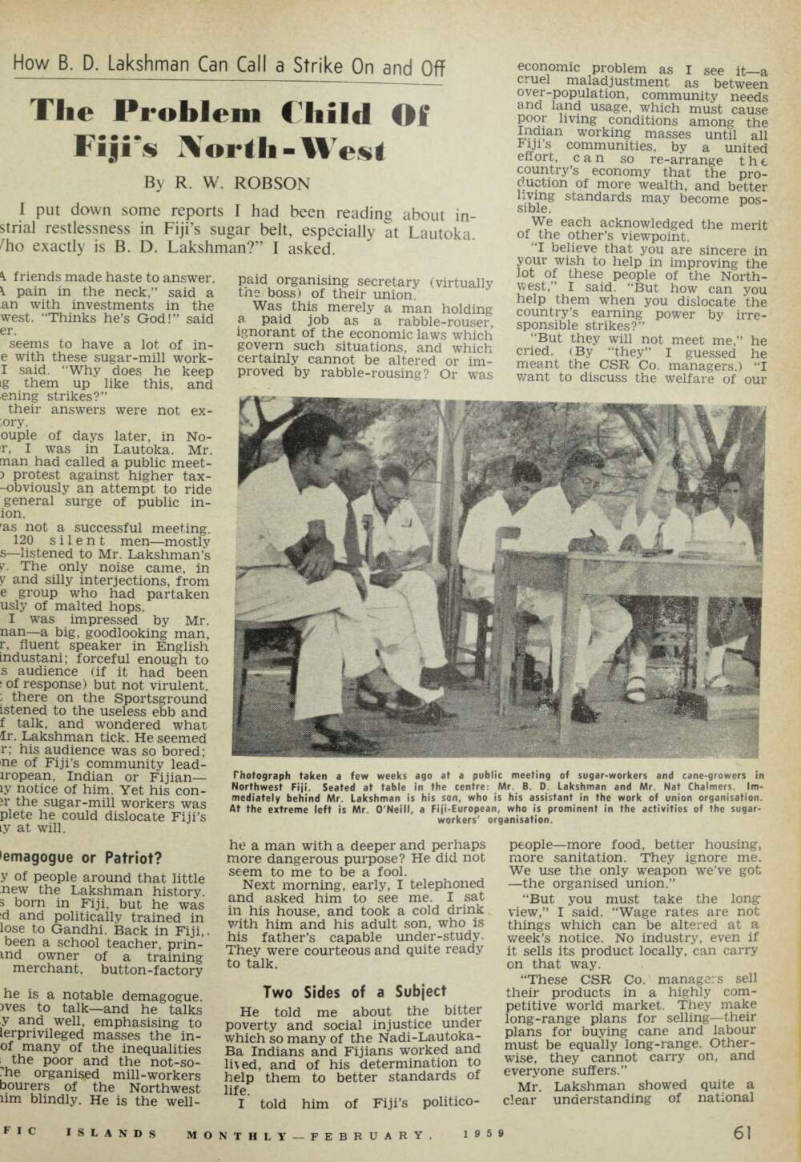
Photograph taken a few weeks ago at a public meeting of sugar-workers and cane-growers in Northwest Fiji. Seated at table in the centre: Mr. B. D. Lakshman and Mr. Nat Chalmers. Im mediately behind Mr. Lakshman is his son, who is his assistant in the work of union organisation.
At the extreme left is Mr. O'Neill, a Fiji-European, who is prominent in the activities of the sugar workers' organisation.
omics, and the points I tried to e. ut,” he said, “the biggest factor leir production costs is labour, the biggest factor in the social dit i o n of all the people he Northwest is the wages pay that labour. You would z that they would work closely us, in getting the best con ns for all these workers. But try to ignore us, altogether.” hink he was trying to say that, le economics of the Northwest, i is more to it than just wage lining—that there is the life uture of a big Fiji-Indian com ty.
hat About That Contract?"
ell,” I said, as Len Usher came cart me off to Nadi airfield, hdian leader in the Northwest do a great deal today in an >mmunities effort to solve some iji’s financial and economic ems. You should be with the Indian leaders in Suva, get a wider focus on this thing.”
Usher broke in: “But, Mr. iman, what about this mill ' you have called for Tues tared at the Indian leader in ishment. He had said nothing, j, of an impending strike, jailed it on, last week, because would not meet me to discuss roubles,” said Mr. Lakshman. t what about your wage agree )” Mr. Usher almost howled ords. “Have you no regard for tract! The Company accepted assurances, and made all their accordingly. Don’t you know a breach of that contract en ere will be no strike on Tues said Mr. Lakshman. “I now tiling it off. . .” smile was charming and dis g. He gave me another cold D. Lakshman probably is the nfluential Indian in that area, clever man. If he would, he do very much to help the i folk, and to help Fiji. But e?