They Need Birth Control
p. 59 · Read in the full issue
An Indian View On The Indian Problem They Need Birth Control And More Tilled Land
9 The future —and effect —of Fiji’s big Indian population is a object that is being discussed increasingly in the British Colony, dvocacy of birth control as a solution to one of the problems is ot new. But here, Mr. S. M. Mudaliar. an Indian resident of Suva, ibmits that where once most Indians looked on the practice of birth ontrol with disfavour, the outlook of many Indians in Fiji today as changed.
By S. M. Mudaliar
Of Fiji’s population of 357,880, Indians provide the largest
ommunity—some 172,000. This population, increasing rapidly,
5 said by the pundits inside and outside the councils, to be sopardising the living standards of Fiji’s peoples of all races.
Itrong measures are urged to safeguard the people, and the Colony as a whole, from deterioration in living standards and
conomic potentiality.
IE Fiji Indians, mostly the descendants of immigrants brought here from India, under indenture system, between 1879 1916 to work the bushclad my, are conscious of the ever easing number of inhabitants the problems created by the ex ding population. cceptional increase in the Indian illation has been partly due to sracy and ignorance of the prin bs of family planning (or birth :rol) and partly because of their [itional way of life, i the view of an Indian of the school, it is a sin to escape the sequences of one’s own act. To e children is to receive the bless ; of God. ut the outlook of many Indians Fiji today has changed, in the t of living problems caused by appearance of more children a can be properly maintained trained. here are many under-privileged lilies, Indian as well as Fijian ) are known to lack sufficient i at times. Others cannot give r children the essentials of life, i as good clothes, schooling, etc.
See the Need
avoid economic catastrophe the ians are awakening to the need family planning—for a popula i that can take care of itself Drding to the available means, ut although the Indians were scious of the need for reform, re has been no birth control ic or family planning bureau liable —an institution advocated the Fiji Legislative Council by Indian member some years ago. t long last an institution has a set up recently in Suva—but existence is kept so hidden that
hardly any anxious parent knows of it.
I believe that, to avoid social trouble, family planning measures should be widely established in Fiji, and their existence given full publicity; and such services should be available either free, or at a moderate fee. I am sure the Indians would take full advantage of these services, if well established and directed.
Suitable publicity is necessary, to
meet the natural reluctance of Indian women towards a new kind of thinking, in relation to their families.
I confidently believe that birth control, properly directed, would take care of the increasing problem of over-population in the Colony, particularly among the Indians.
The pressing problem in Fiji now, as in many other countries, is how to feed the people adequately while providing a rising standard of life.
Fiji is already facing unemploy ment, and more jobs will have to be found. This could be done, in Fiji, if we had more schemes for develop ing and expanding the local in dustries, secondary and primary.
New Industries There are avenues for opening up new industries in our urban aieas; but for this large capital must be found, local or foreign Without the backing of large ii vestments, and the encouragement, of the Government, new industries will be out of the question.
To overcome the rapidly increas ing pressure of population on land resources, more new and fertile areas will have to be opened, de veloped and cultivated.
In Fiji there are still virgin areas unexploited; and to meet the problem of settling or spreading the increas ing population from the over crowded centres, these areas must be made accessible instead of being kept in reserve.
The Burns Commission, which is to visit Fiji late this year, perhaps will help in achieving this.
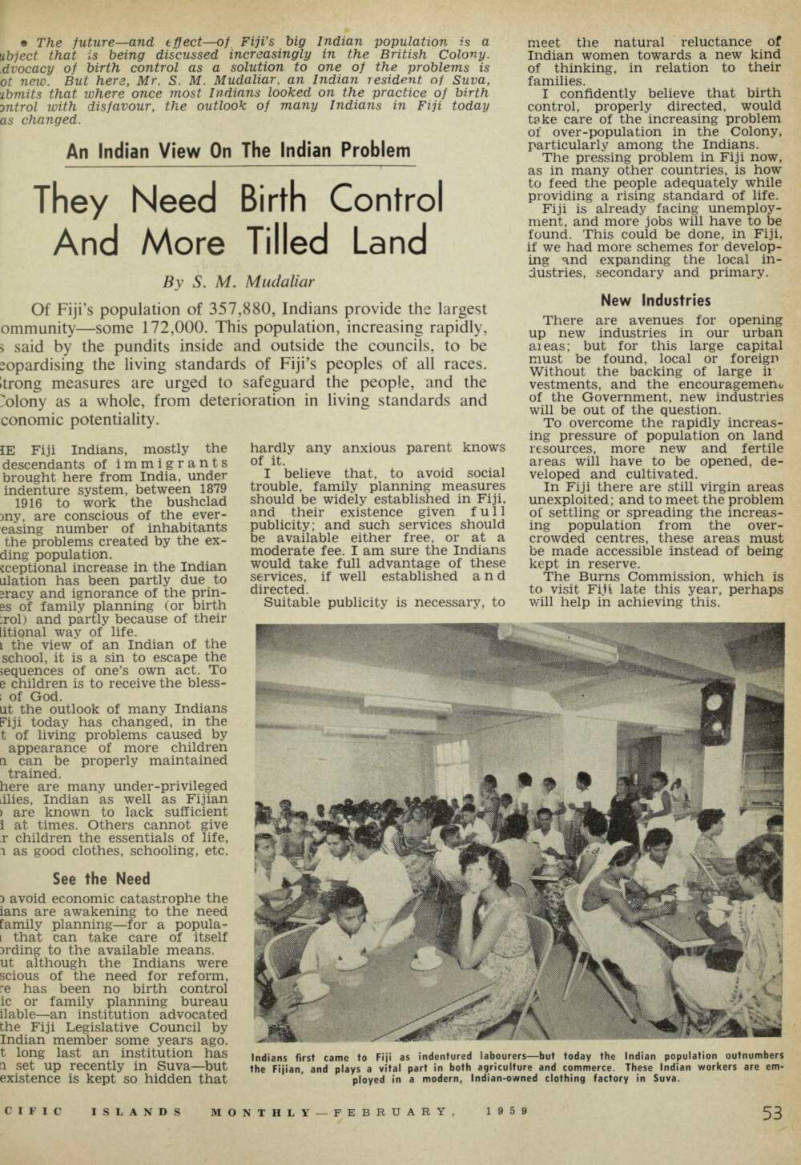
Indians first came to Fiji as indentured labourers—but today the Indian population outnumbers the Fijian, and plays a vital part in both agriculture and commerce. These Indian workers are em ployed in a modern, Indian-owned clothing factory in Suva.