te a 6 donated from Japan gives
p. 55 · Read in the full issue
If Anybody Wants A Tuna Industry
Now’S The
Time
By a Special Writer • South Pacific interests and gov ernments which have been toying vith the idea of establishing a tuna ,’shing industry based on Japanese mow-how may never know a more \pportune time than the present— )t least in as far as Japanese co \peration is concerned. lIIHE Japanese Fishery Agency— L the government department promoting the fishing industry -is eagerly seeking outlets for its ushing vessels in the joint opera ions type of enterprise now functioning at Pago Pago and Palli i-ulo.
The 1959 Japanese budget makes revision for a sum of 200 million en (£Stg.2oo,ooo) for the promotion f such joint enterprises anywhere a the world.
Plenty of Money
This sum is an increase by 40 limes of the funds allocated for this jurpose last year. The Japanese Government, through the Overseas fisheries Co-operation Association, ’ill assist in the financing of Jap anese fishing companies who are :ble to establish such contacts overseas and not able to raise the necessary finance.
At present, such joint companies re operating at Recife (Brazil), Jaiti and the Dominican Republic, :nd a joint Japanese-Swiss com lany will soon be operating at Haifa ■lsrael). Other companies are segotiating with Singapore and ]lalay interests for the establish ment of tuna fisheries or other fish-
ing enterprises, and a big joint fi&fiery project is expected soon to be established at Tarutau Island, Thailand According to a recent report from Japan, the production target for the Pallikulo station in the New Hebrides is at present 1 about 3,000 tons per annum with 60 per cent. °for'^the te pago aC pago
“ fhe^apiteffn P ?L a pallTkulo
station is heved to be little if any. Japanese capital in the Pago Pagfo p ’ wnere there is now a PF° p ° s giJ? engage some Hawaiian tuna boats to supply the fish.
Present indications are tha P anse fishing companies are ready to supply fish, on a straight P e nage basis, either with or without a capital interest in the enterprise, to who ever cares to make use of tneir services. The Japanese government organisers mentioned here can supply full details.
Rin Tuna Harvest From Big luna na Near rl|l tto -cnov. sir wildlife Service, te a 6 donated from Japan gives
“n a intS report
achieved by JSPXring the
fleets which operated during
whose failed 58 afluST
One of these fleets, consisting of the 3,732-ton motor-ship Tenyo Maru No 3 and 45 fishing vessels, had taken 5,334 tons of fish of a total planned catch of 6,200 tons^ by August 28. Albacore, the top quality kind of tuna accounted for 30 per cent, of this catch and yellowfin accounted for a further first part of the
stftioneT at**. ?o°STI| P miles
durtag W August to^a point g about 70 miles due west of Nadi, the fishing vessels operat ing o ver a wide area round these ce^tral points full planned catch was expected easily to be ac hieved during September, Palmvra Fleet raimyra neer The fleet, consisting of the 2,940-ton motor-ship Kaiko Maru and lg fishing vessels, stationed at a ce ntral point 300 miles ENE of Palmyra, had taken 2,522 tons of fish to the end of August, but only 5h per cent, of the fish taken were albacore, 57 per cent, being yellow fin, ig per cent, big-eye, and the remainder other kinds of fish with swordfish and similar types pre fleets were owned by different companies. They had no connection with the fishing opera- Pag ° OT PalllkUl °'
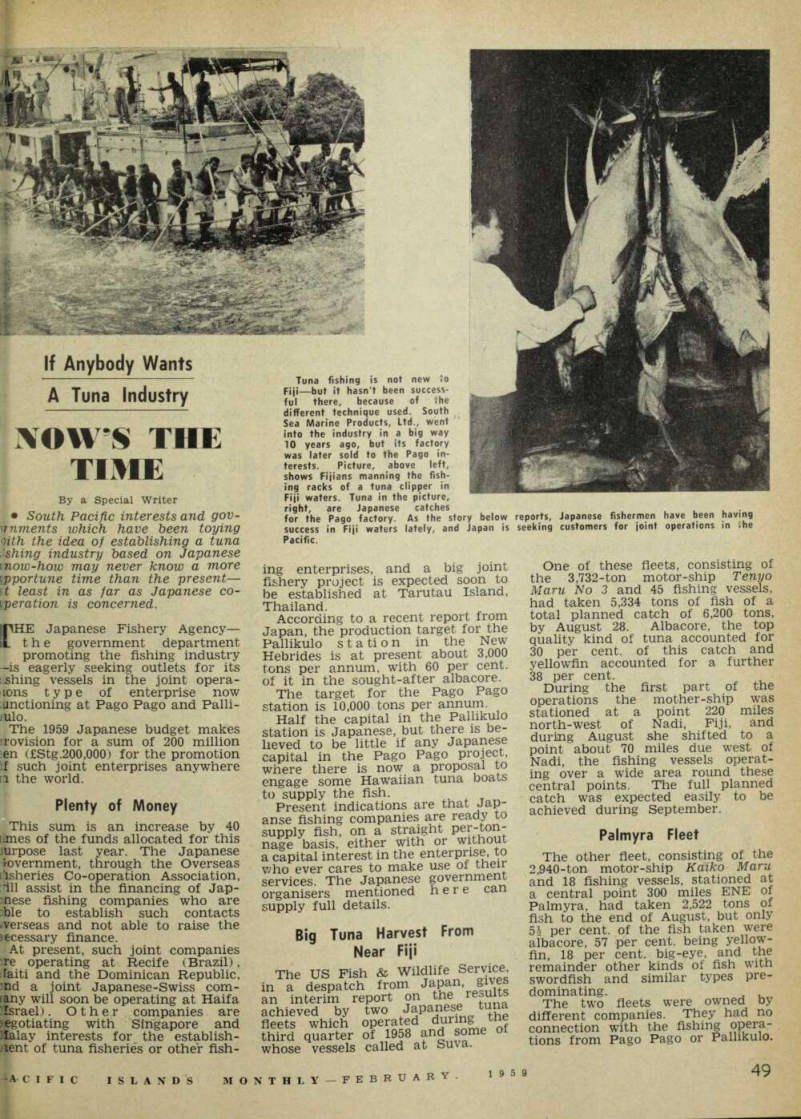
Tuna fishing is not new to Fiji—but it hasn't been success ful there, because of the different technique used. South Sea Marine Products, Ltd., went into the industry in a big way 10 years ago, but its factory was later sold to the Pago in terests. Picture, above left, shows Fijians manning the fish ing racks of a tuna clipper in Fiji waters. Tuna in the picture,
right, are Japanese catches . for the Pago factory. As the story below reports, Japanese fishermen have been having success in Fiji waters lately, and Japan is seeking customers for joint operations in the Pacific.