fiji talanoa
pp. 49-51 · Read in the full issue
Vakatawa Talks Of This And That
Following the publication of a new Suva street map, with the “phonetic” spelling customary in maps issued by the Gov ernment of Fiji, the spelling of Fijian place names has popped up again for local newspaper discussion. It is a hardy perennial.
THE local form of spelling, usually known as the “Fijian”, is, oddly enough, more truly phonetic ;than the “phonetic”, the letters * ;< b”, “c”, “d”, “g” and “q” being used ;tc represent specific Fijian sounds.
In the Fijian language, the sound represented in English by the letter “b” does not exist. The Fijian says “mb”.
In similar fashion, the “d” sound m English is automatically, on Fijian tips, “nd”.
The hard “g” sound is “ng”.
The “th” sound, as in “then”, occurs frequently in Fijian, but it is not the sound of “t” followed by “h”, so is not represented phonetic ally by “th”.
In most logical fashion, the early missionaries adopted five conven tions, to which the Fijian people, and ;hose who are willing to spend a ;ew minutes of study of the prin ciples involved, have become entirely accustomed.
The letters “b”, “d” and “g” are used for the Fijian sounds “mb”, ‘nd”, and “ng”. The letter “c” is used for the hard “th” sound, and
“q” is used for the “ng-g” sound as in finger.
In this spelling, the Fijian people easily recognise and pronounce their own names, and the names of their provinces and towns, and Fijian words drop naturally into the syllables which are characteristic of the language.
But in comparatively recent years, certain well-meaning Europeans, with a former Secretary for Fijian Affairs, G. K. Roth, prominent among them, have led a movement to complicate the conventions by spelling out the abbreviations for the benefit of overseas readers and map-users.
So Nadi becomes Nandi, Cakobau becomes Thakombau, Beqa becomes Mbengga and Qaraniqio becomes Nggaraninggio.
The casual visitor or the overseas map-reader pronounces the names wrongly anyhow (or not as a Fijian pronounces them), just as the Englishman’s Paris is quite different from the Frenchman’s.
But the Englishman recognises the name and the place just the
same, and pronunciation is a matter of lesser importance.
The visitor to Fiji finds the local spelling conventions intriguing, en joys working out pronunciations and is very proud of himself when he is able to demonstrate his skill to' locals and to the folks back home when he is showing those coloured slides or movies of his trip.
It certainly seems silly to have two methods in Fiji of spelling the same names.
The Suva street map says “Thakombau Road”. The sign on the road itself reads “Cakobau”, and the visitor can hardly be blamed if he finds it bewildering.
The Fijian people themselves have never liked or wanted the so-called “phonetic” spelling.
And whose language is it, any how?
Odd Angles On
Fiji Immigration
A committee has geen set up to look at Fiji’s immigration laws, which were drawn up in 1947, after the results of the 1946 census had made clear the necessity for doing something about Fiji’s No. 1 problem —a population that is growing too fast and is racially too much out of balance.
But events in the past few months have led to a suspicion that popula tion problems have not been the only considerations behind certain police action.
The law gives wide authority to the Commissioner of Police in his role of principal Immigration Officer. This authority has been guided by a directive issued in 1947 by the Governor-in-Council.
Generally speaking, this divided newcomers, apart from the traveller
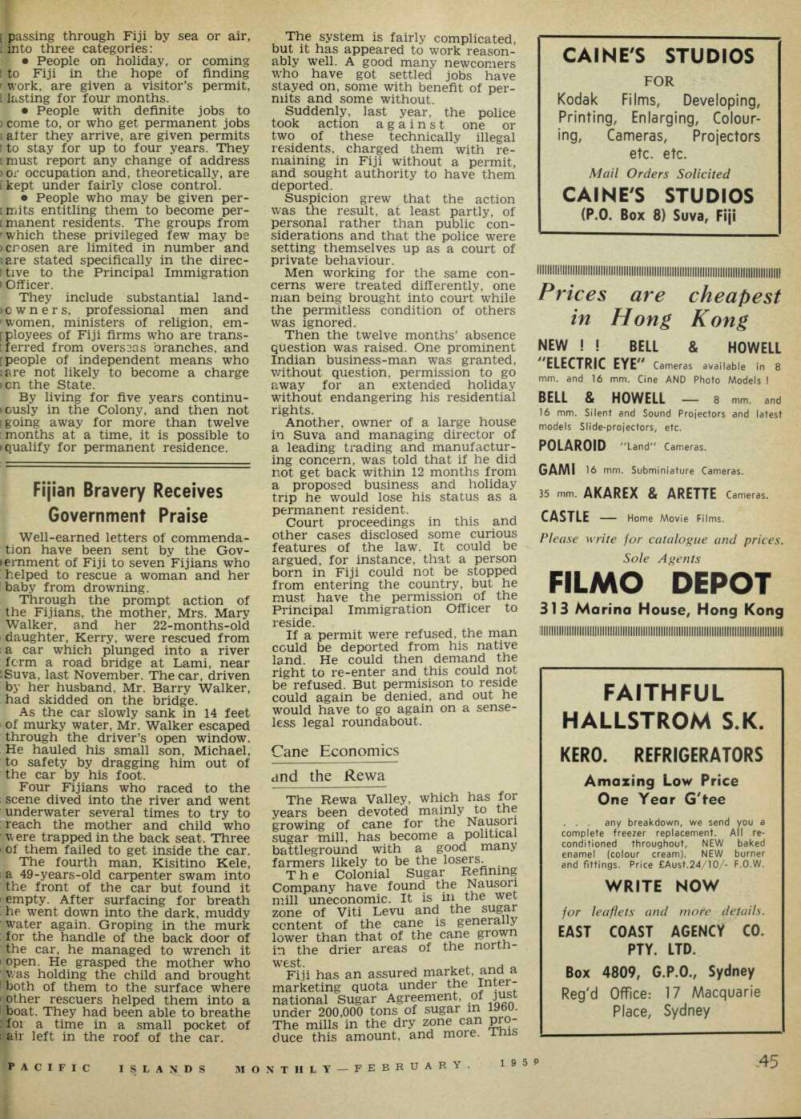
The Rewa Valley, with its big [?]ndian population, has for years [?]een devoted to the growing of [?]ugar cane. But it has now become political battleground, and a good [?]any Indian farmers could well be [?]he losers, says "Vakatawa".
[ passing through Fiji by sea or air, i into three categories: • People on holiday, or coming rto Fiji in the hope of finding r work, are given a visitor’s permit, I lasting for four months. • People with definite jobs to > come to, or who get permanent jobs 5 after they arrive, are given permits rto stay for up to four years. They [must report any change of address >or occupation and, theoretically, are ikept under fairly close control. o People who may be given per imits entitling them to become per cmanent residents. The groups from r which these privileged few may be (cnosen are limited in number and 5 are stated specifically in the direc tive to the Principal Immigration »Officer.
They include substantial land icwners, professional men and r women, ministers of religion, em [ployees of Fiji firms who are trans ferred from overseas branches, and [people of independent means who sare not likely to become a charge >cn the State.
By living for five years continu ously in the Colony, and then not i going away for more than twelve : months at a time, it is possible to • qualify for permanent residence.