Savusavu-Netewa Wants Share in Tourism
p. 41 · Read in the full issue
It's Fiji's Neglected Paradise Savusavu-Netewa Wants Share in Tourism
Savusavu-Natewa area of Fiji has everything for tourism except propaganda. The little Savusavu community is now looking hopefully towards Fiji Airways to rectify the position.
P:e Qantas executives who now are the managers of Fiji Air ways, are showing a lively nterest in the tourist possibilities tf southern Vanua Levu. They in jected the area on November 22.
Fiji Airways now have daily service between Viti Levu and iavusavu airstrip; and at last it ;> possible to go, in an hour, from Iji’s sophisticated capital to iavusavu, and thence spend a holi ;ay on the beautiful coast between iavusavu Bay and Natewa Bay.
There is scenery as attractive, rom the tourist viewpoint, as any i any of the South Sea islands.
The coastal road (Savusavu- Tatewa) is as beautiful and iistinctive as the famous coastal Dad in Samoa, from Malifanua to .pia. But the Vanua Levu road stains its original charm, while the (polu (Samoan) road has changed i character, because now it is Tactically a continuous line of Ullages.
Under Qantas drive, something worthwhile may now be done to pen up this Savusavu area to jurists. Hitherto, it has suffered nder (a) lack of easy access and 3) public indifference.
lot Springs are a Rubbish Dump
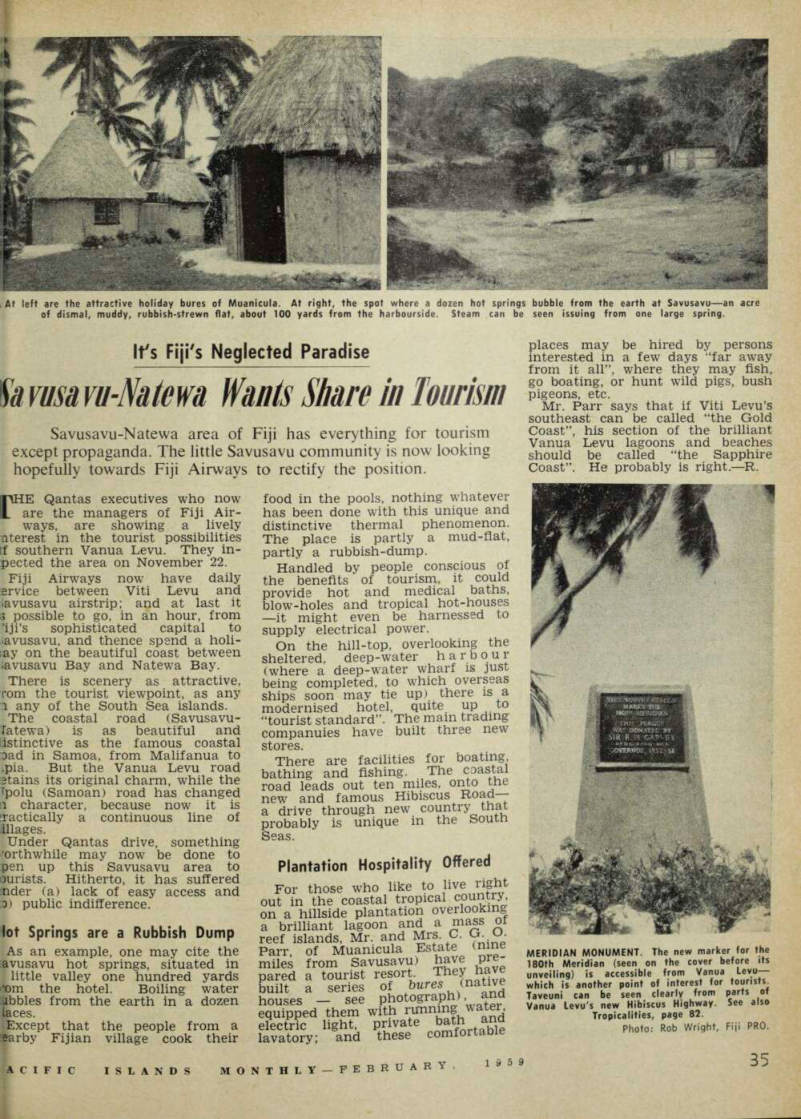
As an example, one may cite the iavusavu hot springs, situated in little valley one hundred yards •om the hotel. Boiling water abbles from the earth in a dozen iaces.
Except that the people from a :earby Fijian village cook their
food in the pools, nothing whatever has been done with this unique and distinctive thermal phenomenon, The place is partly a mud-flat, partly a rubbish-dump, Handled by people conscious of the benefits of tourism, it could provide hot and medical baths, blow-holes and tropical hot-houses —it might even be harnessed to supply electrical power.
Qn the hill-top overlooking the shpltered deep-water harbour ®where a deep-water wharf is just being completed, to which overseas ships soon may tie up) there is a modernised hotel, quite up to “tourist standard”. The main trading companuies have built three new stores m.' nrp facilities for boating, b ® fishing. The coastal ?oad teads out ten miles, onto the a nd famous Hibiscus Road through new country that p r o bably is unique in the South qooo ° , , „ ...
Plantation Hospitality unereo n , ... 11vp rieht For those who like to
reef islands, 1 ™G.O.
Parr, of Muanicula Estate ume miles from Savusavu) nave y pared a tourist resort. L o ne y rl f 1 tivp built a series of bwres (na . houses see photograph), equipped them with running water, electric light, private oaxn lavatory; and these comior
places may be hired by persons interested in a few days “far away from it all”, where they may fish, go boating, or hunt wild pigs, bush pigeons, etc.
Mr. Parr says that if Viti Levu’s southeast can be called “the Gold Coast”, his section of the brilliant Vanua Levu lagoons and beaches should be called “the Sapphire Coast”. He probably is right.—R.
At left are the attractive holiday bures of Muanicula. At right, the spot where a dozen hot springs bubble from the earth at Savusavu —an acre of dismal, muddy, rubbish-strewn flat, about 100 yards from the harbourside. Steam can be seen issuing from one large spring.
MERIDIAN MONUMENT. The new marker for the 180th Meridian (seen on the cover before its unveiling) is accessible from Vanua Levu— which is another point of interest for tourists.
Taveuni can be seen clearly from parts of Vanua Levu's new Hibiscus Highway. See also Tropicalities, page 82.
Photo: Rob Wright, Fiji PRO.