Buyers Are Grabbing
pp. 25-155 · Read in the full issue
At Every Ton
Copra Price Should
Remain High
By a Staff Writer
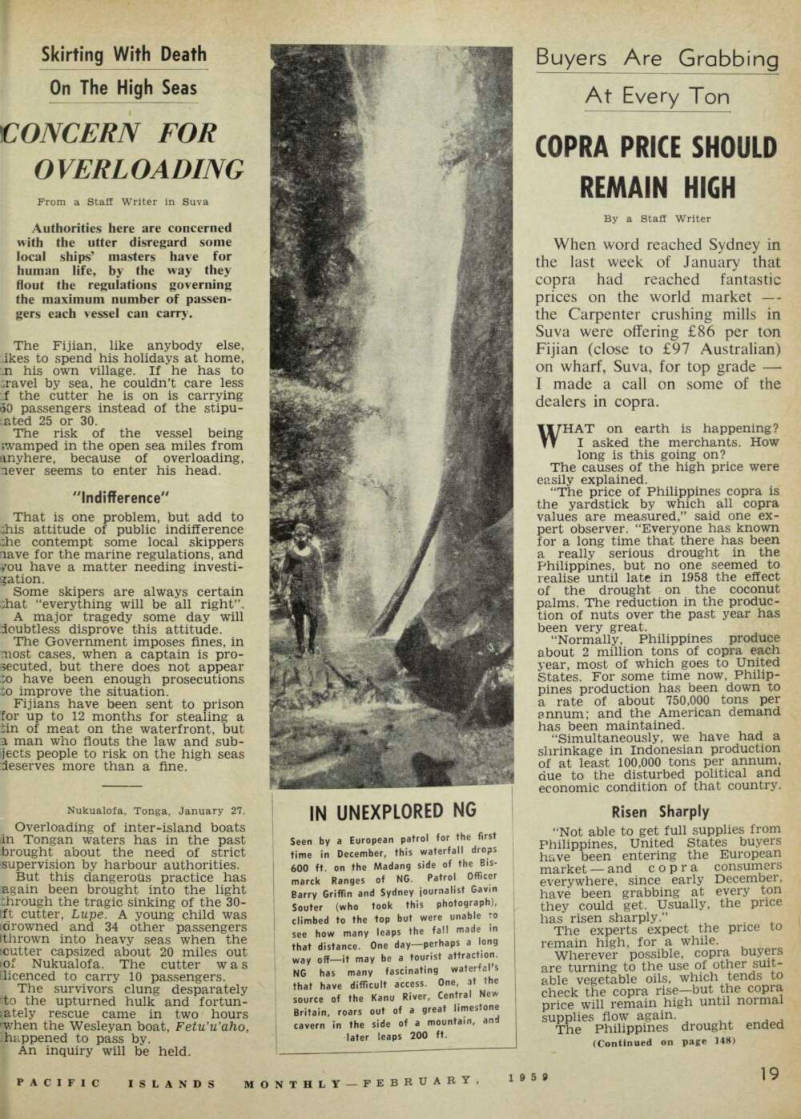
When word reached Sydney in the last week of January that copra had reached fantastic prices on the world market the Carpenter crushing mills in Suva were offering £B6 per ton
Fijian (close to £97 Australian)
on wharf, Suva, for top grade
I made a call on some of the dealers in copra.
WHAT on earth is happening?
I asked the merchants. How long is this going on?
The causes of the high price were easily explained.
“The price of Philippines copra is the yardstick by which all copra values are measured,” said one ex pert observer. “Everyone has known for a long time that there has been a really serious drought in the Philippines, but no one seemed to realise until late in 1958 the effect of the drought on the coconut palms. The reduction in the produc tion of nuts over the past year has been very great.
“Normally, Philippines produce about 2 million tons of copra each year, most of which goes to United States. For some time now, Philip pines production has been down to a rate of about 750,000 tons per annum; and the American demand has been maintained.
“Simultaneously, we have had a shrinkage in Indonesian production of at least 100,000 tons per annum, due to the disturbed political and economic condition of that country.
Risen Sharply
“Not able to get full supplies from Philippines, United States buyers have been entering the European market and copra consumers everywhere, since early December, have been grabbing at every ton they could get. Usually, the price has risen sharply.”
The experts expect the price to remain high, for a while.
Wherever possible, copra buyers are turning to the use of other suit able vegetable oils, which tends to check the copra rise —but the copra price will remain high until normal supplies flow again. , The Philippines drought ended
(Continued on page 148)
some months ago, and there have been heavy rains throughout the archipelago. This, eventually, will fully restore coconut palm produc tion; but many months will elapse before this is reflected in normal copra production.
Meanwhile, the high prices are encouraging increased production in
Indonesia, Malaya and the Ps Islands.
The Sydney commentators e: that the copra price will j rapidly back towards normal di 1959 —but no catastrophic fall ii pected, because the world der for copra shows no sign of sh: ing. On the contrary, it tenc rise.
Happy Copra World
Buoyant prices carried right February, planters and Goa ments who levy export-tax res a harvest much greater than could have imagined at this in 1958.
In the last week in Jam planters delivering to the , crushing mill were being pai( stated, £FB6 per ton for grade. The following week, price had fallen to £FB4/7/6, bi one was grumbling.
The average spot market price for Philippine FM copra ing January was £Stg.92/ c.1.f., UK Continental port. Di the same period, the Papua- Guinea Administration declarec tentative f.o.b. price of New Gv tcp grade as £A93/10/- per ton This is the price on which ei duty is paid (although it is adji later when the actual price th received is known).
On our calculations this m that every ton of copra that out of Papua-New Guinea at period was netting the F Treasury £lO/8/-.
In addition to this planters another £1 per ton which is crei to the Copra Industry Stabilisi Fund.
If this rate of duty were lected on the whole of the y production this would about £1 million in revenue.
It is interesting to note that a the new rates of export duty announced in P-NG about / 1958, the sample duties that issued at the time, and set oi a long list of graduated f.o.b. vi per ton and the duty payable tl on, ended with “When the value is £65 per ton, the duty w: £4/16/- and Stabilisation Fund i tribution, £1”.
Evidently the experts could see copra rising about a f.o.b. a of £65. They must since have agreeably surprised.
What the Experts Think
The following is taken from January Copra Market Re issued by the Papua-New Gi Copra Marketing Board:
i Philippines Copra (the basis ie Unilever contract with Pacific a producers) is quoted in US irs, recent International etary developments following inception of the long-planned ipean Common Market have of interest to the Board. The pean Common Market forges ice, West Germany, Italy, and Benelux Nations into a single omic unit. llowing the ECM move, which not include the UK, the British sury lifted all restrictions on 'ree transfer of sterling held by le living outside the sterling change control is freely con ble into gold or dollars at the al rates of exchange, spite this “external” convert y the rate against the dollar been well maintained which is ,tter of some importance as far ir copra is concerned.
Chinese Soyabean
m so, the dollar rate of ex ge has moved from 2.804 on mber 30 to 2.801 on January 30, 3 copra at 260 dollars on De er 30 was worth £Stg.92/15/6 ;ainst an equivalent 260 dollars muary 30 being slightly less at 92/11/4. avy consignments of soyabeans jresently coming out of China are much delayed owing to 5 and railing difficulties. Ship s of groundnuts are in default ise large quantities reached “se ports in a very moist and iorated condition and were mined. is expected that exports of idnuts from China will be ly increased later this year, and Idition there are rumours that n groundnut oil will soon be ;d for export. On the other , in the two most important Ties exporting groundnuts, ;h West Africa and Nigeria, f decrease in this year’s out las been officially reported, the t generally quoted being 13 per down on last year’s produc-
Prefer Coconuts
hough much has been said time to time on the subject nterchangeable oils—coconut, groundnut and whale —it is us that certain big margarine ifacturers always prefer to use tut oil in the manufacture of arine, because of its stability, iteresting example of this was irly January when Unilevers ed in to buy all that was then ible on the market (15,000 at $265, when it was thought supplies might become lighter I to a hold-up in copra from i pore. has been noted that the 1959 e Catch quota has been in ed by 500 units to 15,000 (blue e basis) for the current season, whaling season opened on
January 7, with the official close of the season on April 7. Twenty factory ships will be engaged nine Norwegian, six Japanese, three British, and one each from Russia and Holland.
There is considerable unrest in the whaling is against any scheme to fix quotas; Russia appears to be increasing her whaling activities irrespective of quotas and Norway is threatening to withdraw from the International Convention on July 1, although no doubt she would not avoid any reasonable ruling on quotas.
With no restrictions on whaling, coconut and other sirqilar type oils could be up against heavy competi tion.