P-NG Gets New Aircraft
pp. 23-31 · Read in the full issue
But It Still Hankers After a Competitor P-NG Gets New Aircraft And A New Air Route
In probably the biggest social doings of the century, Qantas launched its new Sydney-Port Moresby Super Con stellation service with three days of festivities, January 21-23, and so shifted the gravity centre of Papua-New Guinea airlines activity from Lae, where it has been for 30 years.
JACKSON’S (Port Moresby inter national airport) now has a new jet-length runway; a new ‘temporary” overseas terminal, run up by Works Department in a matter of 10 days; and the promise, sometime, of a real £85,000 terminal uuilding and a new £98,000 control lower.
From January 20, there are four services per week from Sydney to Port Moresby by Super Constella tion, flying northwards during [light-time, and southwards in late afternoon and evening.
Inauguration!
It will become an international airport in fact on March 3, when :he first Qantas Super Constellation on the weekly Sydney-Hongkong (service is routed through Port (Moresby instead of Darwin.
This will give a Sydney-Port /Moresby service five times per week.
The inaugural festivities began at •rejuvenated Jackson’s at 8 a.m. on Uanuary 21 (the Super Constellation was Is hours late, having had to
outflaiik a coiipic aircraft by the band PJ pe 4. off p^fl r a islands Regiment; of the P ac r \?fL S n MCleland, and ended when wife of P N sent Southern Mfs? ff away southbound to Sydney onda ™ary 2 3. there had been a * r t v at Government cocktail P a y d buffet dinner House a treme d 200 and courtesy flights ft above Papua for local folk t« cnifp nf the fact that it an toS p?ace in the middle of the "wet”, with the tail-end of yueexis land’s cyclone lashing the area, operation went off with no . and got full marks for p
organisation. cnrial
There probably h a .f events as big in md i vld^ al v 3 vpd the centres. But none had in uplifting of so many repres of commercial, Administra trans planting communities ana porting them to one centre
days of gaiety. Port Moresby’s hotels were bursting at the seams in an effort to cope with the influx of VIP Territorians.
Only Territory Big Names notably absent were those from the New Guinea Highlands. The Coffee Con ference at Goroka overlapped the Qantas celebrations and kept a lot of people at home attending to business.
Second Operator Wanted But—on the good old Territory principle that if it’s good there must be something wrong with it—the last glass of beer had scarcely been sunk, and the last VIP sent happily home wards, when the drawbacks of the new service were being trotted out for general discussion.
Mainly, they settled around the fact that, due to the bigger carrying capacity of the Super Constellations, there will be only four services from Australia to the Territory per week, instead of the half-dozen that has been usual practice with the Sky masters, which the Super Constella tions displace.
This will mean less frequent mail, newspapers and air-freighted cargo.
Even when it was announced that a weekly flight from Sydney to Hongkong would be routed through Port Moresby, giving in effect a fifth service, the complaints continued, because what Territorians really hanker for is another operator on the Australia-New Guinea service.
Director-General Looked
Things Over
They hanker on the principle that competition is good, particularly for the customer.
It was probably no accident that on the first Super Constellation ser vice out of Sydney went Mr. D. G. (Over)
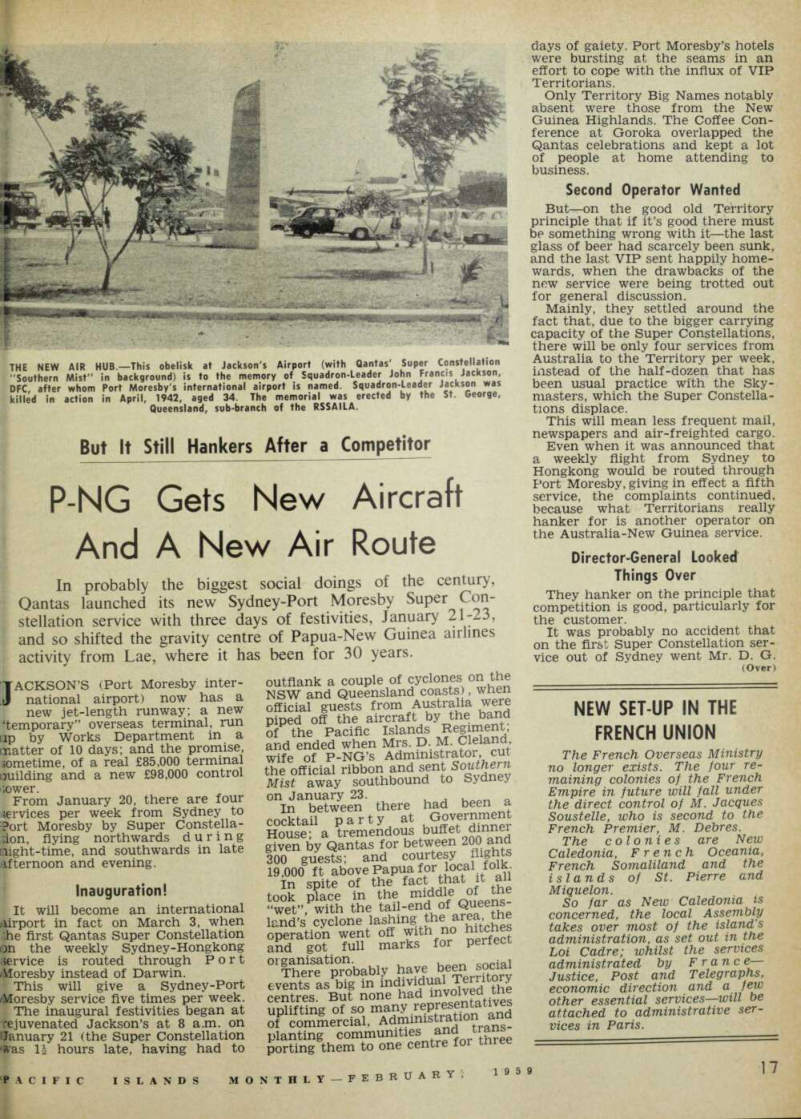
THE NEW AIR HUB. —This obelisk at Jackson's Airport (with Qantas' Super Constellation "Southern Mist" in background) is to the memory of Squadron-Leader John Francis Jackson, DFC, after whom Port Moresby's international airport is named. Squadron-Leader Jackson was killed in action in April, 1942, aged 34. The memorial was erected by the St. George, Queensland, sub-branch of the RSSAILA.
Anderson, Australian Director-General of Civil Aviation, for an inspection tour of all Territory airstrips, and those on the route to Honiara,
Bsip.
In addition, he looked at Territory air-services generally, met representative citizens, and listened to their ideas on how services could be improved.
It is believed that, on Mr. Anderson’s findings, and his yea or nay to the Minister for Civil Aviation, will rest the decision whether or not Qantas will have a rival on the Australia-New Guinea service. And it seems to be generally expected that sooner or later, Qantas will have a competitor—probably one of the mainland operators.
But if Qantas is to have competition on the Australian service, it is logical to expect some rationalisation of existing services within the Territory.
At present, private operators there nnJrlt n thlT™l«^ StriCte< ?-, righ ) t 0 nnentlv as f re : Vh P v Sn resul • of th A t 0 he S A rvi + es muh leaving Qantas
rmftpfwhfeh °£ erate tho . se
routes which can never be economic. nrve Arp Ctiil Racir 3 Das c If the only thing that mattered in Papua-New Guinea airline operations was straight-out competition between rival operators and profits, it is obvious that some areas which now get a service once a week, or once every two weeks, would have Icng ago found themselves without any air service at all.
Before he left Port Moresby at the end of January, Mr. Anderson
made it clear that Territorians could not yet expect to see the last of their old DC3 work-horses, on which major internal operations are based, because the 42 airstrips in the Terri tory capable of taking DC3’s must continue for some time to be the basic factor in operational plan ning.
Although Territorians are natur ally anxious for faster, more corn fortable modern aircraft, most of the turbo-prop types which have re placed DC3’s on overseas domestic routes would be uneconomic in many of the Territory services where not much more than 15 minutes to 30 minutes flying-time separate land ings. Newer type aircraft that reach their maximum economical cruising levels above 10,000 feet would be useless on the milk-run type of New Guinea services, Getting There Faster on snmp other Territorv routes aircraft Ukethe Fokker Friendship would be suitable; but here agalh it is doubtful if the outlay on ex pensive aircraft for restricted use £ ould be warranted, Qantas now has one Skymaster ba s 6 d in the Territory. It provides the feeder service between the Super Constellation calling at Port Moresby, and Lae; and once a week it operates the Port Moresby-Cairns service.
The rest of the Qantas fleet con sists of DC3’s, with Otters for the airstrips not up to DCS standard, Super Constellations on the Syd ney-Brisbane-Moresby service carry about 60 passengers, which means that each has a little more space (Continued on page 25)
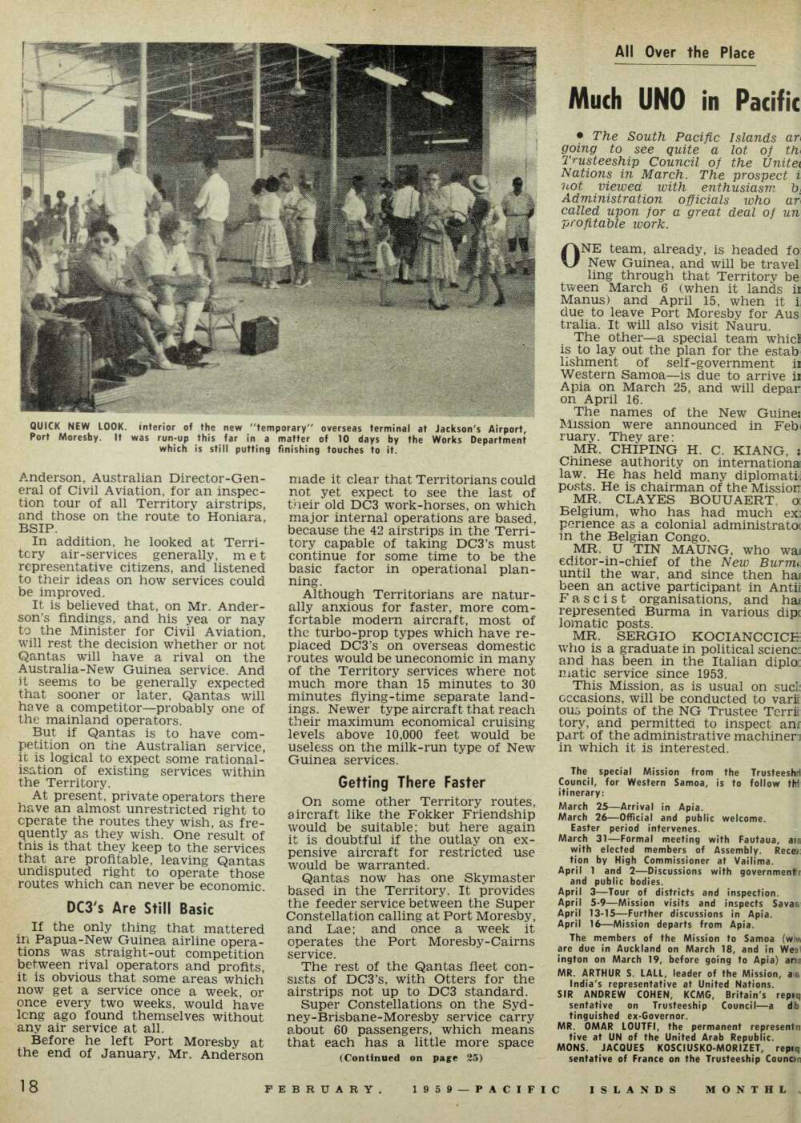
QUICK NEW LOOK, interior of the new "temporary" overseas terminal at Jackson's Airport, Port Moresby. It was run-up this far in a matter of 10 days by the Works Department which is still putting finishing touches to it.
ian on the old Skymasters—but ot much.
The reduction of 21 hours in fly ig time is noticed most on the mthbound journey, when scheduled me of arrival in Sydney is 7.30 .m. This is a considerable im -ovement on the midnight to 1 a.m. rrivals of the Skymasters.
But Customs and immigration in jections for Sydney passengers are ow performed in Sydney, Instead in Brisbane. Therefore, the hour’s ait at Brisbane with passengers erded into a “holding room”, and Irmitted no contact with the out de world, is a dead loss as far as ley are concerned. If this wait mid be whittled down by half it ould be a good thing.
The improved comfort of ressurised flight was evident in ie first weeks of the new service, hich operated in bad flying con ations. The big plane was able to de over the worst of the bumps hich, in the unpressurised Sky tester, can make flying around
cyclones un-nerymg.
• apparently as a result of the introduction of Super Constellations, the “on flights from Port Moresby to centres like Rabaul, have improved to the extent of having standard forward-facing seats—not yet up to DC3 airliner standard in Australia, but a distinct improvement on the tin benches along the sides of the fuselage which used to be normal equipment.
Features of New Hormkonn Spruirp rediures or ivew nongKong service The prize in flying comfort, however, will go to the fortunate few who can get themselves to Port Moresby on the weekly Hongkong service, when it begins in early March. This will allow travellers to fly direct from Sydney to Port Moresby in seven hours.
Moreover, the flight will be made in daylight, with a 9 a.m. departure from Sydney and a 4 p.m. arrival in Port Moresby; and, on the southbound flight, a scheduled 9.30 a.m. departure from Port Moresby and a 4.15 p.m. arrival in Sydney.
First-class passengers will have all the room afforded this class of
traveller on international flights, and fully reclining sleeper-chairs with foot stools.
It is not yet certain how many seats will be made available to Terri tory passengers on this service, The number of Sydney-Moresby travellers in luck will depend, of course, on what is considered the fair average number of potential travellers onwards from the Terri tory to the Far East.
The average Territorian expects about three months - leave every couple of years, and is already Far East minded; but when this is broken down into airline seats per week it may still not be very many, The routing of the weekly Hong kong service through Port Moresby is no new thought. It was proposed a couple of years ago, when ex tensions to Jackson's were first dis cussed. At that time it was stated that it would be of no direct benefit to Territory travellers, as Hongkong flights were “always fully booked from Sydney”.
Someone appears to have had further thoughts about it since then.