Pacific Report
pp. 119-151 · Read in the full issue

The month’s round-up of news and pictures of people and j events, from PIM correspondents in the South Pacific.
“.link Fights Poverty,
disease in Suva
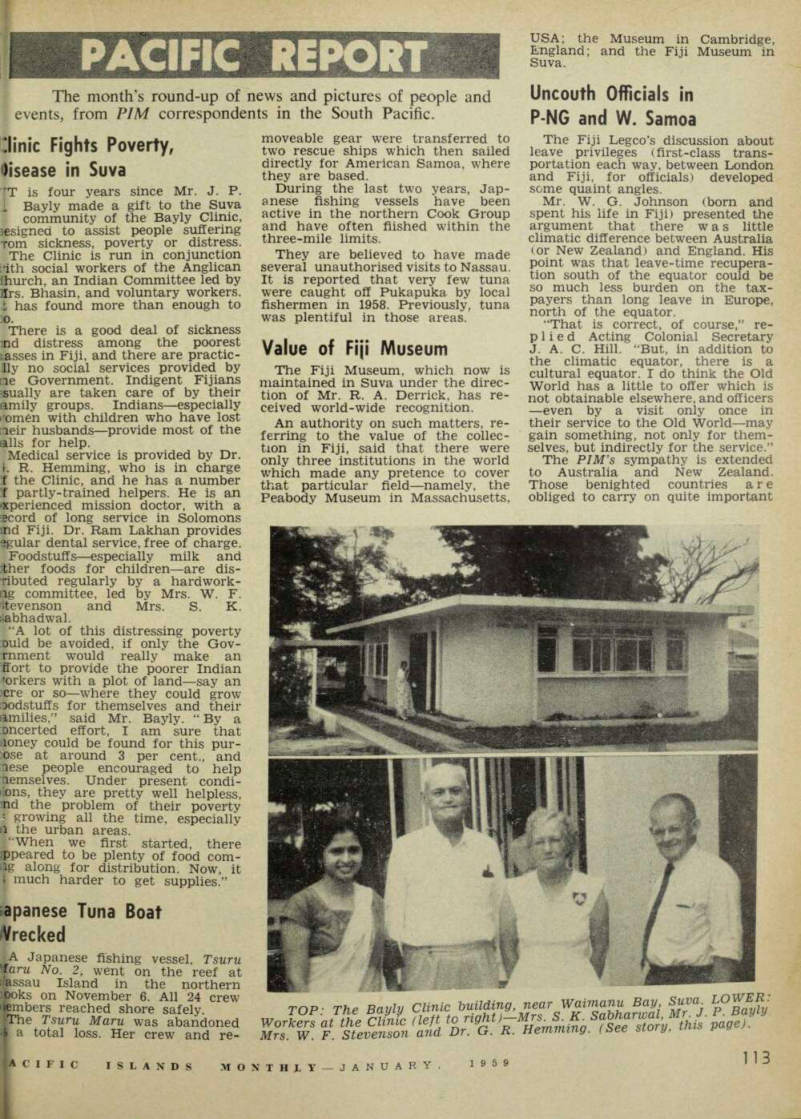
TT is four years since Mr. J. P. i Bayly made a gift to the Suva community of the Bayly Clinic, lesigned to assist people suffering Tom sickness, poverty or distress.
The Clinic is run in conjunction iith social workers of the Anglican ihurch, an Indian Committee led by llrs. Bhasin, and voluntary workers, has found more than enough to :o.
There is a good deal of sickness md distress among the poorest masses in Fiji, and there are practic- Jlly no social services provided by ne Government. Indigent Fijians usually are taken care of by their family groups. Indians —especially romen with children who have lost ;ieir husbands —provide most of the falls for help.
Medical service is provided by Dr. f. R. Hemming, who is in charge f the Clinic, and he has a number 3f partly-trained helpers. He is an «perienced mission doctor, with a record of long service in Solomons md Fiji. Dr. Ram Lakhan provides sgular dental service, free of charge.
Foodstuffs—especially milk and :ther foods for children—are dis ributed regularly by a hardwork ng committee, led by Mrs. W. F. itevenson and Mrs. S. K. ;iabhadwal.
“A lot of this distressing poverty ;ould be avoided, if only the Gov rnment would really make an ffort to provide the poorer Indian workers with a plot of land —say an icre or so—where they could grow [jodstuffs for themselves and their (unifies,” said Mr. Bayly. “By a :oncerted effort, I am sure that iioney could be found for this pur :ose at around 3 per cent., and lese people encouraged to help iiemselves. Under present condi tions, they are pretty well helpless, :nd the problem of their poverty ? growing all the time, especially n the urban areas.
“When we first started, there jppeared to be plenty of food com ng along for distribution. Now, it » much harder to get supplies.”
iapanese Tuna Boat
Wrecked
A Japanese fishing vessel, Tsuru 'laru No. 2, went on the reef at ifassau Island in the northern :jooks on November 6. All 24 crew itembers reached shore safely. •The Tsuru Maru was abandoned 1 a total loss. Her crew and re
moveable gear were transferred to two rescue ships which then sailed directly for American Samoa, where they are based.
During the last two years, Japanese fishing vessels have been active in the northern Cook Group and have often fiished within the three-mile limits.
They are believed to have made several unauthorised visits to Nassau.
It is reported that very few tuna were caught off Pukapuka by local fishermen in 1958. Previously, tuna was plentiful in those areas. ...
Value of Fiji Museum
, . , The Fiji Museum, which now is maintained in Suva under the direction of Mr R. A. Derrick, has received world-wide recognition.
An authority on such matters, referring to the value of the collection in Fiji, said that there were only three institutions in the world which made any pretence to cover that particular field—namely, the Peabody Museum in Massachusetts,
USA; the Museum in Cambridge, England; and the Fiji Museum in Suva.
Uncouth Officials in
P NG and W. Samoa
The Fiji Legco’s discussion about leave privileges (first-class trans portation each way, between London and Fiji, for officials) developed some quaint angles.
Mr. W. G. Johnson (born and spent his life in Fiji) presented the argument that there was little climatic difference between Australia (or New Zealand) and England. His point was that leave-time recupera tion south of the equator could be so much less burden on the tax payers than long leave in Europe, north of the equator.
“That is correct, of course,” re plied Acting Colonial Secretary J. A. C. Hill. “But, in addition to the climatic equator, there is a cultural equator. I do think the Old World has a little to offer which is not obtainable elsewhere, and officers —even by a visit only once in their service to the Old World —may gain something, not only for them selves, but indirectly for the service.”
The PlM’s sympathy is extended to Australia and New Zealand.
Those benighted countries are obliged to carry on quite important
TOP- The Bayly0 Clinic building, near Waimanu Bay, Suva LOWER: Worers at the Clinic j(left to right)- Mrs. S. K. Sabharwal, Mr. J. P. Bayly
islands Administrations with the products of their own lands, most lif whom never have had a chance 0 acquire the cultures of the Old World.
lustenance for the
Aged in Niue
The Niue Island Council has approved the levying of a tax of \/6 per annum, payable by all males between 18 and 60, for the establish ment of a fund for the care of the eland’s aged.
A number of old people have been iving under conditions of poverty, necause no one seems prepared to aare for them. The matter has re ceived some local publicity in recent months and the Council decided hat something must be done about t.
Officials Cracking Down
On BOP Trade Revival
! There have been reports that the niquitous Bird-of-Paradise trade ias become active again in Papua :md New Guinea; and the Admini stration is taking extraordinary pleasures to stop it. : In the years between 1870 and 1.910, these unique and beautiful lirds were slaughtered in thousands 4y natives working for traders, and »y professional BOP shooters, and »ent to eager markets in North America and Europe—mostly as .lecorations for women’s hats, and ilso to meet the demands of iiuseums.
The Governments of Papua and Wew Guinea finally stopped the traffic, by providing heavy penalties.
There was much illicit trade, how-
ever, until the fashions changed.
By 1920 it was stamped out. But the BOP population had been greately reduced the creatures now are found only in the more remote interior.
Officialdam is revising laws, to better protect the BOP sanctuaries.
A person trading in BOP plumes can be fined £lOO, or gaoled for six months.
At the same time, steps are being taken to more strictly protect the Goura pigeon—an edible bird which, because of its poor flying qualities, is easily taken. The Goura has disappeared from most settled areas.
Fifty years ago, it could be found all over New Guinea.
The resurgence of BOP trade is
a result of the pacification of the Territory. The plumes are not for export—but for the decoration of natives.
At one time, a native stayed in his own restricted area, and did little damage to the native bird population with his primitive weapons. Now he can safely wander over a large area without fear of being knocked-off by his traditional enemies.
At the same time, publicity has made eloborate feathered head dresses more desirable. Some natives employ other natives to hunt BOP for them.
It is suspected, also, that some Europeans trade BOP skins with the natives. (Over)
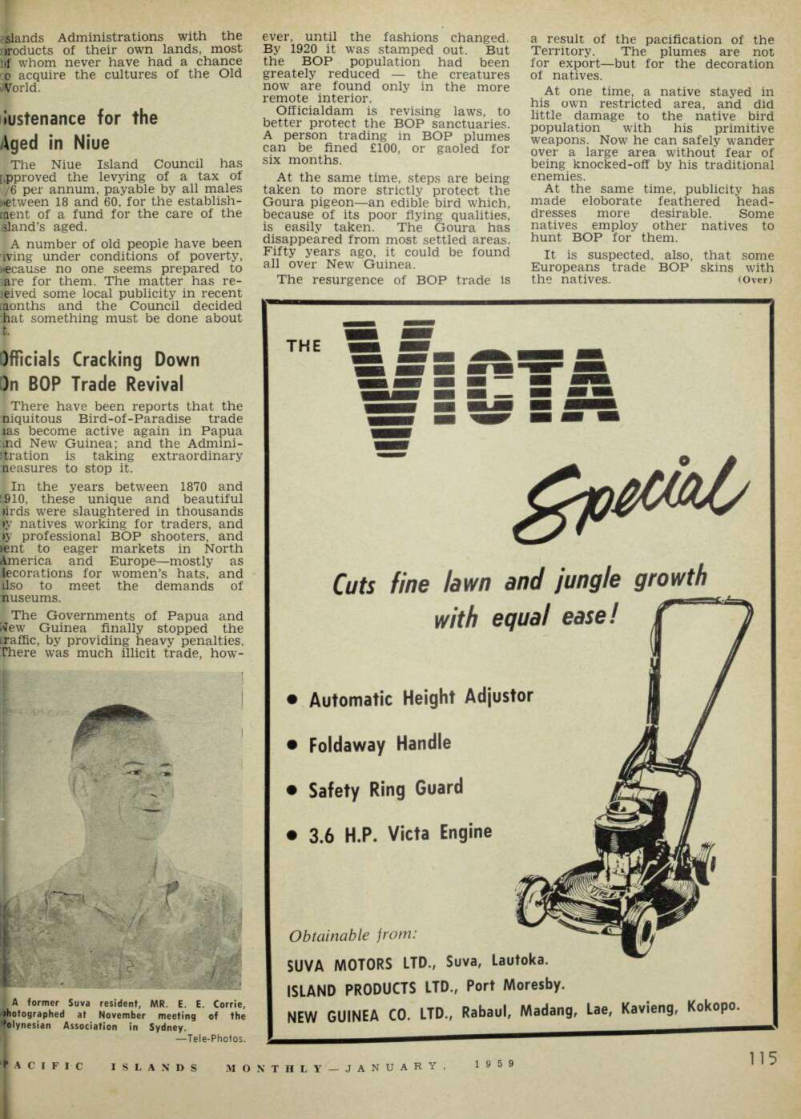
A former Suva resident, MR. E. E. Corrie, [?]hotographed at November meeting of the Polynesian Association in Sydney. —Tele-Photos.
'Tin Can' Island
ißeing Resettled
Niuafo’ou, once known as “the Tin Can Mail Island”, and later Abandoned because of volcanic eruptions, is being resettled. It is the most northerly part of Tonga, and near Fiji and Samoa. * In late September, over 200 people, mainly ex-inhabitants, returned on l;he Aoniu after 12 years’ absence, md started to rebuild their homes md villages.
“Following the last big eruption in i. 946, when a couple of villages were levastated, all the people were re no ved by the Tongan Government, md settled in Tongatabu and Eua. - Shortages of garden land, and of coconuts have led to poverty and liscontent among some of them. :)thers seem happy and show no de lire to return to their former isle md live literally on the edge of a I'olcano.
Periodically, work teams went back o Niuafo’ou to make copra, and ihe money from this was divided imong the evacuees, according to |eed. by the Niuafo’ou Welfare Hoard, a semi-Government body.
However, the intervening years lave been difficult and some 'fvacuees decided that, even with its iery dangers, their own island had more attractions. The Tongan Gov ernment, after receiving their as surances that they would go at their " Wn risk, gave them permission to »:o. [During the last 100 years there nave been nine big eruptions on Niua o’ou. On a number of occasions, linages were destroyed and, in one iruption, 25 lives were lost.
Wallis Islanders Feud
, , . reUO
MDOUt Their Kina
y Wallis Islands (a French Territory north of Fiji, which is governed from Noumea) has been having Royal Family troubles.
Under socio-political pressure, the queen—a member of the Briale family—resigned the office. -rv,o woiiic .
The Wallis people find their monarch by popular vote. They elected a king. The new king was not generally approved. Partisans came to blows.
There are a considerable number of Wallis Islanders in Noumea.
They have s P ut into partisan groups over the qualities of the king, and B °,. a - fe uding; and the Noumea police have to be called occasionally to restore peace,
Wpird Wpathor in
vve,ra VVeamer m
Fiji's Capital
m -r . llke , mos t of , th< r Pacfllc Territories, has been having some phenomenal weather, On one day, November 13, no less than 81 inches of rain fell in Suva Every river and stream and getaway gutter was choked with the amaz ing volume of water, November rainfall for the previ
ous 14 years averaged 8.76 inches.
In November, 1958, it was 20 inches.
On November 2, Suva had the coldest November day (55 degrees) ever recorded in the Fiji capital.
TAl's Paris Connection
Now Once Per Week
The French Air Line, TAI, which increased its South Pacific service in 1958, has decided to reduce the service, somewhat, as from January 1.
Henceforth, only one plane, in stead of two, will arrive each week in Noumea from Paris, via South east Asia and Brisbane.
The plane will go on from Noumea to New Zealand: return to Noumea;
fly from Noumea to Tahiti; and then fly from Tahiti to Noumea and make the return journey to Paris.
The French South Pacific air fields are steadily improving.
Lancasters of the air arm of the French fleet now regularly use the new airfield at Santo, in the New Hebrides.
Islanders at
NZ Jamboree
Twenty scouts from Fiji flew to New Zealand on December 31 to represent the Colony’s scouting organisations at the Pan-Pacific jamboree held in Auckland from January 3-10.
The contingent—a jamboree in it self —was made up of scouts of all races, including Europeans, Fijians: Indians, a Chinese, a Samoan and a Gilbertese.
Eliki Seru, MBE, was in charge of the contingent and Ilaisa Cavu was his deputy.
The most significant thing about the visit to New Zealand was that each scout raised his own monev to make the trip, about £lOO each. "
The contingent, the Fijian mem bers particularly, made an impressive picture as they boarded their TEAIJ DC-6 airliner at Nadi airport. AIJ the scouts wore scarves of a mas; or tapa design, with the wore “Fiji” at the back. The Fijians wore their traditional sulus and the resi; of the party wore shorts.
The Fijians aroused much interest and enthusiasm in the Dominion v/ it h their natural charm ano friendliness.
Ten thousand scouts from all ovei; the Pacific, as well as from England! attended the Auckland jamborees which was held at One Tree Hill..
Matua Misses Suva
As Port Rates Rise
It was announced on New YearV Eve that the Union Steamship Co.’:' Matua would now call at Suva fronr Auckland, on the northbound voyage only. The reason given for cutd ting out the southbound call, aftee visiting Polynesia, was recent heavy increase in port charges.
Waterfront opinion, however, ii that the charges are only a conr tributing factor, and the real cause is the falling off of the banana tradl since Fiji production was hit b;c droughts, hurricanes and threatened quota cuts in New Zealand.
Matua —Fiji’s only link with thrl outside world during the Pacific wac years—has been making two calls as Suva on each of its round trips foo about 20 years. Obviously, say thd experts, the company wouldn’t sa;r direct to NZ from Apia if there wen: good banana cargoes to be picket up.
The new port charges have noi been popular with shipping comrr panics operating in and out of and their howls have for once beee heeded by government so far as thd proposed pilotage rates are corrn cerned. They will be only half o what was originally announced. Thi' maximum pilotage will now be £Tj each way, in an out of port, instead of the proposed £150; the minimum, rate will be £3 instead of £5, am the intermediate rates 3d per too instead of 6d per ton.
However, this is still a great dess more than it was before January 1 1959. The old maximum was £l5.
The increased wharfage, light anrr port dues, announced in Novembesc were not given second thoughts, amj came into effect on January 1, Thesr
are expected to increase Colony revenue by about £40,000.
Even critics admit some reason for the increases, in that Fiji’s port charges have not been increased to any degree since 1924, while cost of port services has risen by 400 per cent.
Shipping companies argue that Suva does not possess facilities found at overseas ports and that there is no basis for the comparison made by the government between NZ ports like Lyttleton and New Plymouth.
It remains now to be seen whether, as the shipping companies predict, Suva will be by-passed by some of the big overseas passenger ships.
Island Clothing Works:
And Some NZ Howling
The establishment of small manu facturing industries in the Islands Territories, to provide an income for growing populations which can not subsist on primary products like coconuts, is the ambition and aim of most Administrators. But a recent experience of Cook Islands, as disclosed in newspaper dis cussions in New Zealand, shows what the Islands Governments can get up against.
Rarotonga (Cook Islands) estab lished a clothing factory and a kind of synthetic jewellery factory; and wages distributed among the native workers there were between £20,000 and £30,000 per annum—not much, but a distinct help to the island’s economy. Value of clothing and jewellery exported was between £BO,OOO and £90,000 per annum.
Some time in 1957 a Mr. R. A. Hill visited Rarotonga and, from the manifestations of distress which he exhibited on his return to NZ, it appeared that he represented the NZ Clothing Trade, and that he was upset by “shockingly low wages”. (The female workers in these factories were getting about 8/4 per day—since raised by 10 per cent.) Hill, various union bosses, repre sentatives of employers, and Gov ernment officials joined in the argu ment. Union bosses declared that these poor islanders were being ex ploited to allow certain employers to under-cut the clothing trade in New Zealand. The employers retali ated that, while there was some ad vantage in establishing Islands factories —otherwise they would not do it —the gain was small, because of the islanders’ lack of skill.
Officialdom, anxious to retain the alternative industries for the Islands, defended the set-up, and pointed to the absurdity of these union bosses trying to draw economic and in dustrial parallels between the well endowed workers of NZ, and the Rarotonga workers, whose standard of living was entirely different.
They said that the importation of Rarotongan goods to NZ had no
effect whatever on the clothing trade; but it did help the Cook Islands economy.
This sort of thing has happened
rv,cnv times in Islands history. A J union organiser, who knows nothing of living standards outside his own country, will always find social and industrial evils in the
tropical Islands. We can remember the furore in New Guinea in the ’Thirties when a gentleman named Arthur Blaikeley (formerly a
Socialist Minister in Australia) visited the goldfields and demanded that the native labourers get the same wages and privileges as AWU workers in Australia. (Over)
P NG Preparing For
South Pacific Conference
As part of its preparations for the Fourth South Pacific Conference organised by the South Pacific Commission, the Administration of Papua and New Guinea has pub lished its list of Advisers and Delegates to the Conference.
The Conference will open in Malaguna, Rabaul, on April 29 next.
All South Pacific Territories, and Micronesia, will be represented.
P-Ng Advisers
Mr. J. K. McCarthy, Executive Officer for Districts in the Depart ment of the Administrator, Port Moresby.
Mr. Elliott-Elijah, senior in structor at the Co-operative Train ing Centre, Port Moresby.
Mrs. Lila Matelau, teacher, Buin, Bougainville District.
Mr. Reuben Taureka, who has served in various parts of the Terri tory since graduating as an Assist ant Medical Practitioner in 1952.
P-Ng Delegates
Mr. Kai Kai Ivasi, Papua (Ex tension Officer with Department of Agriculture).
Mr. Raymon, New Guinea (secre tary of New Ireland Native Societies Association).
Mr. George A. Kassi, New Guinea Kmember of Rabaul Town Advisory 'Council and vice-president of the Kambiu Community Society).
Miss Nancy Gire, Papua (in •charge of Hanuabada Infant Wel fare Clinic).
Brother Peter Hilary, Papua (of the De La Salle Teaching Order now teaching on Yule Island).
I Mr. Tovin Tobaining, New Guinea
(president of the Vunamami Native Local Government Council).
Mr. Kondon-Akau’undo, New Guinea (Luluai of the Naregu com munity since 1938).
Miss Philo Gamauri, New Guinea (midwifery assistant graduate of Koki (Papua) Maternity Hospital).
Shangri-La Gives
Up its Victims
The remains of the 21 victims of the 1945 US plane crash in the Baliem Valley, NNG (Dec. PIM, p. 19) have now been recovered.
The huge valley (which, of course, got the tag of Shangri-La), was dis covered by the Archbold Expedition in 1938 but was virtually unknown
when the American plane crashed in the mountains surrounding it during a joy-ride flight. Of the 24 occupants, 5 survived the crash but two WAC’s subsequently died. The three survivors, including WAC Margaret Hastings, were got out some weeks later by glider.
A mission station was established on the floor of the valley in 1955 and in 1956 the NNG Administration established a patrol post at Wamena.
In October, 1958, a patrol went to the scene of the crash but discovered only a couple of human bones near the wreck but could not locate the remains of the 21 who were said to be buried near the crashed plane.
The US Government sent two men.
Lieutenant Frank J. Riley and Sergeant Hank Paolille, to Hollandia
in December. They flew to the valley to join the second patrol, but Lieut.
Riley sustained a knee injury and it was Sergeant Paolille who accom panied Controleur Gonsalves to the wreck.
Just before they left Wamena, a Cessna of the Missionary Aviation Fellowship flew over and dropped a cable from Hawaii, indicating the approximate location of the graves.
With this the remains of all 21 victims were recovered in a matter of hours from graves situated in three spots—a mass-grave for 13 victims, the grave of the only officer amongst the 1945 party, and finally
ABOVE; The forward part of the fuselage of the American plane that crashed into the Baliem Valley, NNG, at the end of the war and caused the death of 21 Americans.
A member of the Netherlands Administration patrol which visited the area in October is seen examining the wreck. LEFT: The Baliem Valley and the patrol post, marked X, from which the two patrols, in October and De cember, set out and eventually recovered the remains of the 21 victims. See story this page. KVR Photos.
that of the two WACs who died after the crash.
The plane itself was broken in three parts. The front, from which the cockpit had entirely gone, was lying on a small plateau. Molten aluminium indicated that a fire had raged there after the crash. This part of the fuselage was split in two.
The rear end of the fuselage was intact and it was probably from this that the original five survivors escaped. It was lying below the forward portion, on a level piece of ground. Fifty feet below that again were the remains of one engine and the tail of the aircraft.
Personal gear, such as rings, watches, etc., were also recovered.
The party returned to Wamena after
an absence of a week.
Another patrol, which had set out to locate the Short Sealand aircraft, which crashed in 1955, had to turn back without reaching its objective owing to bad weather and inability to locate the spot. This aircraft, which was owned by the American Christian Missionary Alliance, crashed at the north-eastern entrance to the valley and lies in very difficult country of naked cliffs and steep ravines, 10,000 feet above sea level.
Tai And Teal
Raise Fares
The two Pacific Islands airways operators, Tasman Empire Airways,
of New Zealand, and Transports Aeriens Intercontinental, of France, have agreed to raise the airways re turn fares between Fiji and Tahiti, as follows (the old fares being shown in parentheses) : Auckland-Western Samoa: First class, £lll/12/- (£99/18/-) ; tourist class, £B9 6 - (£79/19/-).
Auckland-Cook Islands: First class, £l6B/6/- (£154/6/-); tourist class, £134/13/- (£123/10/-).
Auckland-Tahiti: First-class, £206/2/- (£193/10/-); tourist-class. £164 18/- (£154/16/).
Even with the higher rates, the services will be run at a loss. There is not enough population in the widely separated archipelagoes of Polynesia to provide sufficient air traffic to cover the heavy cost of running planes and providing safe equipment and airports.
Tasman Empire Airways recently published the results of its trading in the year ended March 31, 1958.
It showed a net profit of £286,775 — more than £20,000 better than the previous year.
TEAL operates in three fields — between Australia and New Zealand; between New Zealand and Fiji; and: between Fiji and Tahiti. The first; two sections are generally profitable t —the third (Fiji-Tahiti) always— despite subsidies —shows a 1055£47,943 £47,943 in 1957 and £16,773 in 1958.
TEAL is owned by New Zealand! and Australia, and is regarded as aj very good investment, and profitably managed. A Min isterial statement from NZ says: ; “TEAL is in a high state of vigour,, fully ready for the traffic expansion! which re-equipment will bring. Itsg finances are buoyant.”
TEAL is paying a dividend of 4f per cent., transferring £200,000 toe general reserve, and has repaid (twoc years before due date) the £450,0000 loaned it some years ago by thee State Advances Corporation of NZ.
That Low-Grade Phosphate
On Bellona, BSI
A Ministerial statement in Can berra recently said there were am estimated 8,000,000 tons of phos-; phatic rock on Bellona Island, one?; of the British Solomons group: andb there was a suggestion that this de posit might be of great benefit tco Australia and New Zealand, whose; foreseeable supplies of fertiliser om Nauru, Ocean and Christmas (Indiam.
Ocean) islands are steadily dwind-1 ling.
A couple of recent pamphlets by/( Geologist J. C. Grover, of the BSIc Administration staff, indicate that£ the Bellona Island deposits are note of high grade, and are not readily! accessible The two southerly islands of Ren-r. nell and Bellona were closely ex-x amined in recent years by Mn] Glover. He found phosphate de-9 posits on both.
Bellona, in uplifted coral atolKL
about 100 miles south of Guadal canal, is six miles long and two miles wide. After a scientific in vestigation, Mr. Grover wrote of it; “All of these factors, together with the size of the island, suggest that the chances are good that an economic deposit of phosphate will be found on Bellona.”
Reports, since that was written, suggest that the Bellona deposits, which have been known for 30 or 40 years, are so low grade as to be of doubtful value.
But phosphatic deposits are being increasingly sought by agricultural countries, and recovery techniques are constantly improving; so it is possible that Bellona yet may give to the Solomons Islands economy the mineral shot-in-the-arm that it so desperately needs —and for which J C. Grover has worked so hard.
NTs Problem of
Domestic Help
The problem of domestic help is proving just as much a headache to Norfolk Island Administrator R. S.
Leydin and Mrs. Leydin as it was to their predecessors.
Government House, an Norfolk Island, is a beautiful stone building, set beside a fine swimming beach, with good fishing spots. The staff quarters are commodious; there is a minimum of entertaining: and no one could have more consideration for staff than Mrs. Norman and Mrs.
Leydin. Ideal jobs, one would say— but the right people do not seem to want them.
Fiji Crayfish As
Planned Industry
A proposal to establish a crayfish industry in Fiji has been put forward by an American company.
The company says that it is pre pared to advance capital for equip ment, to teach the Fijian people modern methods of catching cray fish, and to purchase the fish for processing and shipment to the United States.
The company estimate that there is a market in America for more than 1,000,000 lbs of crayfish a year.
To buy this quantity, and to process, pack and ship it would cost 400,000 dollars a year. (Over)
HE LIKES TO FILL UP THE CRACKS Strolling through the main street of Nukualofa, Tonga's capital, I stopped in a busy little shop for a word with Tali Palavi, who proved to be an alert trader and planter.
"I grow bananas for New Zealand," he said. "Under the regulations, I must not pack bananas under a certain length. The cases are all of standard size.
"Often, the average size of the bananas, packed in two tiers in the case, leaves a space of an inch or more wide, between the ends of the tiers.
Why cannot I fill that space with bananas, put in lengthways? Those smaller bananas are of excellent quality, and would be gladly bought in New Zealand.
"What's the sense in a regulation like that? The "PIM" should Jake it up with the authorities. I buy two copies of the "PIM" every month," he added, cunningly.
I took his photograph and promised to publicise his plea for the admission of smaller bananas, to fill the spaces.—
Rwr.
The Fijians say that, many years ; ago, parties which used to go cray : fishing in Fiji used to average 100 » crayfish a night and sometimes, in (good conditions, they would get 200 f to 300 in a night.
Little is done now with Fiji cray tfish, even as a local article of food.
‘"Last Witness" For
IRLS of Samoa
When the American writer, Mrs. lEisie Noble Caldwell, returned from IFiji to California in 1950, after visit ing Samoa, she planned to write a :book about old-time Samoa; and when she called upon her friend “Teuila”, at Santa Barbara, she told her so.
“Teuila” was the old family name ;of Robert Louis Stevenson’s step daughter, Mrs. Isobel Strong, who was formerly Miss Osborne, and who dved with the Stevenson family in Samoa, and acted as amenuensis :or RLS. In 1950, she was about 90 years old, and bed-ridden, but alert iind interested.
Mrs. Caldwell told her that she Planned a long chapter about RLS md Vailima. She promptly reversed ihe plan. “I have much to tell you ibout my mother (Fanny Osborne) md Louis before I go,” she said, and you must speak for me.”
Elsie Noble Caldwell now has yntten the book, and it will be pub ished shortly by University of Oklahoma Press, on a foundation rant. It is called Last Witness For iobert Louis Stevenson —the “last witness, of course, being Mrs. Isobel
Strong.”
ndians Rush in Where
.SR Will Not Tread
The majority of people in Fiji who an’t see others succeeding where he mighty CSR has failed, have ooh-poohed the new company egistered at Suva in December with he aim of manufacturing and pre facing sugar from cane grown t Nausori.
Headed by the astute Mr. Vishnu Jeo. the oldest member of the olony’s Legislative Council, and ith 14 other Indian shareholders, le new company has a nominal apital of £F1,000,000.
Mr. Deo knows, of course, that Jf, Colonial Sugar Refining Co., ith its huge resources of money, Jchmcal staff and experience, has Hind it uneconomical to continue perating its mill at Nausori.
The comply announced in 1957 lat it would close Nausori mill iter the 1959 crushing season, is the CSR’s oldest mill in iji, but experience over the years as shown that the Rewa is too wet >r high yields of sugar. The com ity s other mills are all in the iry zones of Fiji. many Indians have -en inclined to treat the company’s
decision to close the Nausori mill, with a certain amount of scepticism.
These farmers have ignored the Company and the Government’s advice to discard cane after this season and plant other crops.
The Company and the Govern ment have started a large re orientation programme for the dis trict to equip the farmers for the time when the mill closes down.
But Mr. Vishnu Deo and his shareholders are certain that they can make a go of their venture in spite of what the CSR Co. thinks.
He says that a German firm has offered to seek sugar markets for his new company. Ceylon and Japan were interested in any surplus sugar the new company might have and the Japanese market looked promis ing. (Over)
Marked with letters that size, no one who seeks the United Island Trading Co.'s store in Rarotonga should have any difficulty in finding it. Opened in December by the managing director, Mr. Willie Watson (seen in the left-hand doorway), it replaces the store destroyed by fire a year earlier. It was built almost entirely by Cook Islands labour, and the 6,000 sq. ft building cost only a modest £lO,OOO. Although it is not likely to win any prizes for fcrchi tectural beauty, the interior is laid out on American super-market lines and has come in for a lot of admiration from Rarotonga shoppers. The U.I.T. has always catered for Maoris on low incomes and the Rarotongans regard the new super-market as "their" store. Photo: B. C. Berry.
/Most sugar is sold under agreeof one sort and another — ;d Fiji is party to these agree ents. There is no shortage of 'gar—to the contrary; and it might imagined that if there were new -enues to dispose of it they would rve been explored long ago by mntries that can produce sugar at cheaper price than Fiji has [iherto been able to.
ise of Inspector
xNaught, of P NG
Sharply differing points of view jarding the most effective way of ndling difficult classes of natives New Guinea—like the Tolais— ire expressed in New Guinea in sent months in relation to the > e of Police Inspector Randolph array McNaught.
The Inspector had to deal with a live crime, in the course of which interrogated a native named m, of Daio. Someone complained it his treatment of John had been necessarily harsh. His defenders listed that it was impossible to do ythmg with sophisticated natives less the police were really “tough”.
Anally. Konedobu put the matter :o the hands of one of its senior igistrates. Sir Colman O’Loghlen, inquire as a Commissioner and oort. The Commissioner, report ’ on December 20, said that In ictor McNaught “had not gone he ld the bounds of moral pro ety”. K Commissioner, however, said it John had been unlawfully de ned during the investigation. 3 , think McNaught was com ply genuine in his desire to solve serious and nasty crime,” Sir Iman O’Loghlan said.
He went beyond his legal powers dealing with a person in custody, 3 lost his case as a result.”
Ie found that Inspector McNaught 3 questioned John on eight sasions over four different days, er he was already imprisoned. ‘ Ine Commission’s report has gone the Commissioner of Police for isideration.
a-Water Distillation
uld be Valuable
'Vhy does not the South Pacific tnmission maintain, on behalf of cific Islands Governments, a tchmg brief on scientific develop ints which could affect the shape Islands life?
Vhat has the Commission done, example, in reporting to the lous member countries on efforts ng made, all over the world, to t sea-water distillation upon a icticable basis? i supply of fresh water, from .-water, could make large Islands las— especially in the south-east capable of carrying larger popula-
tions and establishing new in dustries.
In recent years, the New Zea land Government—and no doubt
other governments similarly placed —has spent many thousands of pounds on rainwater catchments and storage tanks in its atoll islands.
Mr. John Webb, relieving Resident Agent at Aitutaki, in the Cooks, in 1957-58, has now been appointed Agent at Mangaia. His attractive wife, Bonnie, is a Rarotongan.
A sea-water distillation system would make such expenditure un necessary.
A year ago a Sydney engineer named Reg Brunt, of Wycombe IRoad, Neutral Bay, invented a sea water distillation machine which gained some publicity. Mr. Brunt [claimed —and still claims —that his machine will turn out 1,000 gallons :Df fresh water per day and provide steam sufficient to drive a small turbine generator at a cost of 1/-, in an average sunny climate such as that of Sydney.
According to Mr. Brunt, the cap ital cost of the machine would be between £BOO and £9OO for the dis tillation plant, and an additional 21,000 if the turbine generator is added.
A small motor is used to get the distillation process started; after which, so long as the sunshine lasts, ;he motor is not required, unless diere is a prolonged break in the Tunshine.
Whence Came the Oranges
of Rarotonga?
Fifty years ago, in the valleys be nind Avarua, in Rarotonga, there vere groves of orange trees; and [he fermented juice of the oranges, :ept in a suitable place in the 'alleys until there was enough “kick” n the beverage, was the source of Ihe “bush beer” parties for which ilarotonga is still famous (or notorious).
Whence came the orange trees? [There were many theories to account for their presence on ilarotonga.
Mr. Harry E. Maude, fn his recent ustorical researches which have tow given us the details of the /anderings of the Bounty, between he mutiny and the arrival in Pit cairn, supplies the answer.
Seeking a home for the section of nutineers who followed Christian, Ihe Bounty called at several islands -and it now seems clear that ilarotonga was one of them. The all was very brief Christian /anted an uninhabited island, and Ilarotonga was well populated. While he ship lay off the reef, she was
visited by the natives, and one pur loined a box in which were some oranges.
A man named Gosset, who lived in the Cook Islands, 1899-1904, found among the natives a story which indicated that the Bounty had called there (confirming various material unearthed in Mr. Maude’s researches), and that “the first orange-trees grew from the seeds of the fruit found in the stolen box”.
The Bounty must have brought the oranges from Tahiti. How did oranges first get to Tahiti?
Diptheria Outbreak Kills
90 NNG Natives
In the Jafi district of Netherlands New Guinea, 60 miles south of Hollandia, and close to the Aus tralian border, a diphtheria epidemic has continued since mid-1958 and has cost about 90 native lives.
Several Dutch medical teams are now working in the area immunis ing the people.
As Jafi is almost shut off from the coast by mountains it is not ex pected that the epidemic will spread to Hollandia.
However, the Dutch authorities have informed the Papua-New Guinea Administration of the out break as natives on both sides of the border trade with one another.
To Subsidise Hotel
Building in Fiji
Giving effect to a promise made by Governor Sir Ronald Garvey in 1957, that Fiji Government would financially help in constructing
tourist hotels, the Fiji Legislative Council in December, passed a Bill under which hotel-building will be subsidised.
Builders will receive 10 per cent, on money spent on building materials, equipment, wages, etc., and will be allowed to write off (for taxation purposes) the whole of the cost (except land, and concessions in customs charges) against any five of the following seven years of opera tion.
To qualify for the subsidy, how ever, builders will have to spend £75,000 if within the Suva or Lautoka districts, or £60,000 elsewhere.
Mr. Gibson and Dr. Sahu Khan argued in favour of subsidy of a £50,000 expenditure instead of £75,000, as otherwise only big in vestors would be attracted, and monopolies could be created.
The Finance Secretary (Mr.
Bevington) said he did not think there was available capital in Fiji for hotel-building—they would have to look outside for investors. If they could make provision for another 200 beds in Fiji, he added, he was sure they could be filled with tourists.
Tonga Now Has
Radio Telephone
Although Tonga has not yet got a broadcasting service of its own, it now has a public radio-telephone service within the Tonga Group.
The service was officially in augurated by Queen Salote on No vember 24, and it is now possible for telephone subscribers in Tongatabu, Vava’u, Ha’apai, Niuatoputapu, Eua, Nomuka, Ha’afeva, Hunga, and Falevai to speak directly with one another at a cost of 5/- for the first
These six pretty debutantes were presented to the Minister for Territories, Mr. Paul Hasluck, at the Red Cross ball, held in Edinburgh Hall, Rabaul, in December. Shown here with their escorts (Messrs. Kevin Corox, David Leong, Bob Goldsmith, Len Seeto, Hal Matthies and Larry Chin), they are (I to r): Miss Wendy Fishwick, Miss Ann Peng, Miss Penny Green, Miss Lana Lee, Miss Jane Morgan and Miss Kathy Lam.
Photo: C. H. Meen
three minutes, and 1/6 per additional minute, A more limited service has been in operation for some time but it was necessary for callers to make their calls from the radio station building.
There is not yet a radio-telephone connection with overseas countries, but this will come before long.
In opening the new service, Queen Salote spoke to the Governor of Vavau from her palace, and re ception was reported as excellent at both ends.
More Cocoa Capital For
N. Guinea's Tolais
A request by the Tolai cocoa growers of New Britain for more capital, to finance their rapidly growing industry, is now receiving consideration.
No other native race in New Guinea has made the progress in production of cocoa that has been achieved by the Tolais of the Kokopo- Rabaul areas.
When they were induced to begin cocoa growing under the Tolai Cocoa Project, they were slow and suspicious. But, under direction, they produced good cocoa in what is probably the best cocoa country in the Territory.
Then they began to get the results
in hard money—and became really interested.
Now, between 4,000 and 5,000 native growers are engaged on cocoa —some as individual planters, but the majority through native village councils. In the five months ended November 30, their production, com pared with the similar period last year, nearly doubled. They now wish to plant up new areas, and they want fermentary equipment.
The Tolais, in Administration eyes, are the problem boys of New Guinea. Who has forgotten the Ralu a n a and Navuneram “in cidents”?
These natives already own 14 fermentaries which they financed with a loan of £BO,OOO from the Bank of New South Wales. Negotiations for a loan of another £40,000 has been going on for most of 1958.
Papua's Rubber Planters
Have Assured Market
The gentlemen’s agreement be tween the Papuan Rubber Pool and the Australian manufacturers is to be continued during 1959.
This means that the whole of the Papuan rubber output, which this year should be 4,400 tons, worth about £1,000,000 at current prices, will find an assured market.
It is a continuation of the tradin. arrangement that operated throng. 1958 and is based on the Australia: government’s 1957 concession to thi Papuan industry when duty wa fixed at 2d per lb for Papuan bu 4d per lb for all other —but wit. the proviso that some foreign rubbe could come in at 2d when all c Papua’s output was placed satis factorily. The manufacturers got tc gether with the producers’ repre sentatives and placed all the Papua, rubber so that all the foreign rubbe could also come in at 2d.
This arrangement continued eve; after September, 1958, when, follow ing a trade agreement with Malays all rubber was admitted duty free;
'Delos' Returns After
Successful Mission
Australia’s trade ship Delos, o the Australia West Pacific Line, re turned to Australia in early Januan with about £2,000,000 of busines; written up or in prospect, and menu bers of the trade mission enthusi; astic about the reception the travel; ling shop-window had got in thi Far East.
The vessel visited Islands port als© — Lae and Rabaul in Ne£ Guinea, and Honiara, in the BSIP C In Honiara there was a certaii
amount of disappointment that not more people were invited to see the exhibits, but those who did professed themselves most impressed.
At the official reception, Mr. R. S.
Colquhoun, Leader of the Mission, said that he regretted that all 12 members were not present to wel come Sir John and Lady Gutch to the exhibition (some had flown back to Australia). Mr. Colquhoun out lined the activities in the Far East and said that the outcome was be yond the organisers highest ex pectations.
Sir John, in reply, welcomed the Mission and its members to the Pro tectorate, but his speech had a sting in its tail. He said that although the Solomons could not offer a high market potential for Australian pro duce and metals, he had one ques tion for the Mission—Could freight rates be reduced between Sydney and Honiara?
New Road Traffic
Regulations for Tonga
The Traffic Act, 1958, under which there is a tightening up and modernising of traffic regulations to meet modern needs, came into force in Tonga on January 1.
One of the provisions of the new Act requires that a person selling or transferring ownership of a vehicle to another person, must notify the police in writing within seven days of the transaction.
They're Still
Chasing Scrap
Les Ellis, of Auckland, who flew to Papeete some months ago to supervise the loading of scrap metal at various Island ports, will be winging his way Tahitiward again m January to load another Japanese fship for the big Japanese metal
firm of Marubeni-lida Co. Ltd. who have imported a large part of the South Pacific scrap in recent years.
This time about 2,500 tons is to be picked up at Papeete and Noumea, and with that job over, Mr. Ellis will make a close survey of war-dumped scrap in New Caledoma to see whether it is economically recoverable.
Meanwhile discussions are proceeding on the possibility of reopening the Walpole Island-Auckland guano trade following a survey of the Walpole deposits made by Mr. Ellis and New Caledonia interests who hold the exploitation rights jointly with the New Caledonia Government.
Captain Emile Savoie, whose Del Mur ships have been a feature of the post-war scene, and who is now master of Daviodora del Mar, is f“ d with Cal6d ° nia
Why Not Federation
of SW Pacific Planters?
The possibility of arranging a con ference of the copra producers of the Southwest Pacific area is being investigated by the Council of the Planters’ Association of New Guinea, whose headquarters are in Rabaul.
In the world there are three areas to which the copra buyer looks for most of his supplies—namely, Philip pines; Indonesia and Malaya; and Ceylon. In addition, supplies come from some smaller tropical areas, of which the South Pacific is one.
It is thought that, if the majority of the coconut planters of New Guinea, Solomons, New Hebrides, Fiji, Gilbert and Ellice, Tonga and Samoa could be brought together in one organisation, they could not only exchange valuable information about processing, freights, taxes, planta tion conditions, husbandry, and so forth—but they might also discover some means of standing together when collective bargaining is called for in regard to copra marketing In other words, instead of the South or Southwest Pacific being
AT LEFT: Currently investigating the Walpole island guano deposits with a view to reopening the industry with New Zealand is Mr. Les Ellis, of Auckland, formerly of Tonga, here (left) with Mrs. Ellis, and with George Tsutsui, of Agence Tsutsui, Noumea, representing the Noumea interests involved.
With them here is Mr. Goro Nakagawa repre senting the Japanese metal firm of Marubeni lida Co. Ltd. which has purchased and arranged shipment of a lot of Islands scrap.
Mr. Ellis was to load a ship in Papeete and Noumea on behalf of this Japanese firm in January-February. (See story this page).
This photo was taken at Whenuapai Airport as Mr. Tsutsui returned to Noumea per TAI after visiting Auckland in December.
Photo: J. P. Shortall
;ist “another group of copra-grow iig districts” in the eyes of world jjyers, it might be established as definite copra-producing area, [ipresenting a definite standard of iiality, and expecting a better price. iAny South Pacific planter, or roup of planters, interested in the libject, should get into touch with ;.e Secretary, Planters’ Association New Guinea, PO Box 14, Rabaul, sw Guinea,
vicfion of Shirley Baker,
j<-Prime Minister
lln the possession of Mr. J. D. (hitcombe, in Auckland, is a diary, “itten apparently by his father in ;90. It gives some very interesting Jielights upon the Shirley Baker icident in Tonga, of nearly 70 iars ago.
Whitcombe, Senior, had been en :ged to take charge of the Tongan •liege, and he arrived in Nukualofa )th his family in fateful July, 1890, :actically on the very day that lUghty Sir John Thurston, Gov :ior of Fiji, had arrived in Tonga dethrone the Missionary-turned iime Minister.
The Tongans still were very well jposed towards the Rev. Shirley ,ker, but high officialdom would we none of the so-called Dictator, d the visiting British Governor iered him to depart by the Wainui i which Mr. Whitcombe had 'ived). Amid some lamenting, and monstrations that came within ;hes of civil war, the Baker family ired from the scene of their umphs. vlr. Baker himself had appointed I Whitcombe to the College job. the anti- Baker faction proceeded wnptly to sack Mr. Whitcombe, pre he even assumed office, iturally, Mr. Whitcombe fought ! 'k—and he confided his opinions
of Thurston, each day, to his diary in words that, in those Victorian times, slightly scorched the paper.
However, he apparently won the battle—there were Whitcombes in Nukualofa for many long years after 1890.
Mr. J. D. Whitcombe has been urged to send the little book to the Turnbull or Mitchell libraries, where so much Pacific Islands history is stored.
Two Dead in
Rubber Plantation War
Two natives were committed for trial for murder at the court of Petty Sessions, Port Moresby, on January 6. The charges arose out of the full-scale riot that took place at Itikinumu rubber plantation, Sogeri, on December 16, when 150 Chuave and Kainantu natives forgot that they were supposed to be civilised wards of the United Nations and had it out in good old fashioned style with bows, arrows and clubs.
As a result of the fight two natives were killed.
About 500 natives are employed on this big rubber estate (it is about 30 miles from Port Moresby)
but only the Chuaves and Kainantus (both -imported” labour from the NG Eastern Highlands) were in volved.
The incident that triggered the fight was an argument earlier that day between a Chuave labourer and a Kainantu boss-boy over washing a plate in working hours. The argu ment seemed to be settled. But just at dusk bows, arrows and spears appeared and the war was on in the western section of the planta tion.
It lasted an hour and the noise could be heard two miles away at the house of the manager, Mr. J.
Grimmer. Mr. Grimmer, who has been on Itikinumu since 1945, said that it had been quite impossible for the small European plantation staff to stop 150 natives fighting over a large area of plantation.
One of the dead men had been clubbed to death; another died from an arrow wound in his side. The most seriously wounded man had three arrows in his back, but will recover.
Those natives not involved in the fighting made themselves scarce and some locked themselves in their quarters and would not come out even the following morning. Quite a number —including both Chuaves and Kainantu s—fled to Port Moresby, but most of them were rounded up within a few days and returned to the plantation.
On December 17, Assistant District Officer James Humphries, accom panied by native police, went to the plantation and questioned about 200 natives. As a result, 16 natives were taken into Port Moresby. Some appeared before the Court and were charged the next day.
Since the riot, measures to be
Droughts and floods had already reduced the banana output of Fiji when along came the hurricane in early December, and although it was officially regarded as a minor one, this is what happened to the banana producing area. This photo graph was taken near Nausori which suffered badly.
Fiji has had a big struggle to get within 50,000 cases of its NZ quota this year, and next year it seems that the struggle will now be even harder.
Photo: Rob Wright, of PRO
taken in similar cases have been much discussed by Territorians.
Everything, from tear-gas to providing movies by way of diversion, has been suggested. The best idea of the lot is no doubt Mr. Grimmer’s —that these things are “best nipped in the bud”. When they cannot be nipped—and short of keeping a contingent of armed police on every plantation there appears to be nothing to do but let nature take its course The law, as it stands at present, gives no encouragement to planters —and no protection—who interfere in riots, even when it is physically possible for them to do so.
Most of the riots that have occurred amongst labour in P-NG, have occurred amongst labour on
rubber plantations—probably be cause of the huge gangs of labour that are used on this work, and the fact that for most of these natives it is their first job away from primitive native communities.
Father PaVS For
Speedster SOB
\ Last y ear an Army doctor, bath ing at Bai des Citrons, near Noumea, was run down and killed by a speed boat driven by a boy of 13.
A New Caledonian Court held the boy’s father responsible. The father was sentenced to six months’ im prisonment (s ente n c e suspended under certain conditions) and
ordered to pay compensation i 600,000 francs (about £3,600 A tralian).
New Factor in
Islands Flour Trade
The old-established Austras milling company, Messrs. White I Flour Milling Co. Pty. Ltd.,, Ultimo, Sydney, has been purcha in recent weeks by Messrs. WV Carpenter & Co. Ltd., or associi; interests and it now appears that Co.’s well-known brand of fii White Rose, may get a bigger slg of the Pacific Islands flour trsr Australian flour, worth mill!, of pounds annually, goes out W the South Pacific Territories, especially to Fiji.
Hitherto, three or four nrmn leading Australian flourmillea notably Gillespies, Bruntons, Mrl Scott, White Rose —have sharedbi trade pretty equally; but Carpenter interests—always stte in the Islands, and stronger that they control Morris Hedstg.
Ltd. (of Fiji, Tonga and Samooi may be expected to put on s pressure in favour of White E The other well known millers a not take it with folded hands! some lively flour-selling may be a in the Islands in 1959.
Papuan Air Transport put its DCS into service recently. P has a programme for three of [?] aircraft to go onto its Territ routes to centres with suito dromes, and will use smaller airc[?] such as Beavers for strips that C not take the DCSs.
On the first flight of the DC Kokoda, Popondetta, and En Chief Pilot Captain Hank Santen (above), stands proudly the cargo hatch as foodstuffs co out at Embi. P.A.T. had been w ing for a long time to be abl& unload goods from the side like t instead of putting them through doors of Ansons to share cabin s[?] with passengers.
Photo: Geoffrey
Nineteen tuberculosis and public valth officers from 13 Pacific 'erritories, attended the tuber miosis conference held under SPC uspices in American Samoa in No ember.
The Commission’s main purpose i arranging the conference was to ssemble a group of medical prac itioners specially qualified to con der and recommend the best means t controlling and possibly eradicat ig tuberculosis in the region.
The Conference report will be üblished this month.
The photograph (by Pan-Ameri in Prints) shows the delegates and ther officials of the conference.
Aelanesian Mission
Aartyrs' Church
The Martyrs’ Memorial Church of t. Andrews was dedicated at Cohimarama, Auckland, on No ember 30, as a memorial to the ine men who have suffered martyrs’ ‘eaths in the service of the Anglican lelanesian Mission and to 18 other ussion workers who have died pcmgh sickness or accident in the eriod since Bishop John Coleridge
Patteson was murdered at Nukapu, Solomons, in September, 1871.
The dedication ceremony was performed by the Rt. Rev. A. T.
Hill, Bishop of Melanesia, and the
chaplain was the Rev. Leonard Alufurai, rural dean of Malaita.
The Rt. Rev. S. G. Caulton, one time Bishop of Melanesia, now Bishop-assistant to the Bishop of Auckland, read the commemora tions and gave the benediction.
Included in the large gathering was Mr. H. W. Bullen, general secretary for the Mission, now stationed at the Auckland office, who was in the Solomons during the Japanese occupation and at the time when the Rev. John Barge, last of the martyrs, was killed by Jap rnese at Moewe Harbour, New Britain, in 1943.
Auckland Has Kava
The recently formed Auckland Samoan Community Organisation held a kava ceremony in honour of the Minister of Immigration, Mr.
Hackett, at Auckland in mid-De cember.
The Minister was accompanied by his wife, and other guests included Mr. E. Paul, Prime Minister of Western Samoa at present visiting New Zealand, and Mrs. Paul; Mr.
T. P. Paikea, MP, for Northern Maori, and the Auckland Town Clerk, Mr. F. G. Gwilliam and Mrs.
Gwilliam.
Pre-Christmas Fun
For Islands Assns.
Residents and ex-residents of Papua and New Guinea met to gether in the capitals of Eastern Australia for pre-Christmas festiv ities.
In Melbourne, about 100 attended the Christmas party of the New Guinea Women’s Association, held in Dennis’ Banquet Hall, Hawthorn,
nn December 16 and spent a happy /vening talking over old times.
The Queensland-New Guinea Association’s Christmas party in Brisbane in December brought to gether a couple of score of Terri tories old-timers, and all enjoyed a Measant evening. Among those pre- Eent were Senator Roy Kendall (be- Qg congratualted on re-election), i'at and Mrs. Holmes, Mrs. Hawnt, md Sydney Chance. Ex-Territorians ire invited to attend the Associa i.on’s first 1959 meeting—on the first Phursday in February, at Finneys ;:afe. Brisbane.
In Sydney, the Pacific Islands jociety which is growing and giv ng pleasure to more ex-islands folk mder the cheerful and enthusiastic ‘adership of President Foxcroft, save a cocktail partly on De ember 18.
In the previous week, the New tuinea Women’s Club (President: )Irs. N. H. Foxcroft) gave two parties—the cocktail party on De ember 12, and the children’s nnual party on the afternoon of :ie 15th. This latter, when about 50 children attended, was pro duced “even better than usual”.
Friends of the Club who helped mancially to make the children’s •eat a success, included the follow ig: Mrs. A. Innes, £5/5/-; Mrs. E.
'auchope. £2/2/-; Mrs. L. Northam, .2/-/-; Mrs. N. Parer, £l/-/-; Mrs. E. ood, £4/4/-; Mrs. P. Muller. 10/-; Mis. . G. Edgell, £3/3/-; Messrs. Burns Philp Company, £3/3/-; Mrs. F. Stewart, 5/- -; Mrs. R. Pye, £l/-/-; Mrs. K. ennie, £l/-/-; Mrs. N. Laws, £2/2/-; rs. B. Perriman, £5/5/-; Mrs. Hopkins. »/-: Mrs. A. Green. £2/2/-; Mrs. M. •stello, £3/3/-; Mrs, Nott, 8/-; Mrs.
McGennicken, 5/-; Mrs. Draffin, £i/-/-; Mrs. L. Roberts, £5/-/-; Mrs. J. Keenan, 18/-; Messrs. Robert Gillespie, £5/5/-: Mrs e cidand, £i/i/-; New Guinea ciub, £lO/10/-; Mrs. C. Haviland, £2/2/-; Messrs. W. R. Carpenter, £3/3/-; New Guinea Company Ltd., £5/5/-; Mrs. G.
Thomas. £5/-/-; Mrs. Symmington, io/-; Mrs. n. Lowe, £i/i/-: Mrs. j. Jones, £2/-/-; Mrs. and Mrs. h. r. Whiteman. 10/-; Mrs b. Meares, 8/-; Mrs. g.
Gmman, is/-.
Ciinor C rmnioc All
jUper-V-OnnicS MM
c n * *n (In t n Mft jei TO wO TO lw Papua-New Guinea’s long lookedfor Super-Constellation service to Sydney is all ready to go on January 20, when the first plane will leave Sydney northbound carrying a party which will be travelling as the guests of Qantas.
The first flight will not return from the territory on the same day as arrival, but will stay around Port Moresby for a couple of days to introduce the big plane to local residents.
Like most good things, the intro- Auction of the Super Constellations to this service has a couple of things about it that are not so ZT The chief one is that there will now be only (our flights per week to the Territory (and thus only four deliveries of mail, newsnaners and freight) instead of the ByS or She that has been normal in recent years Another demerit, so fir as the New Guinea side is concerned, will be that as the big plane cannot be accommodated at
Lae and will terminate its flight at p o rt Moresby, the Centre Of air transport gravity will tend to shift f La e, where it has been for 30 vp „ rt; ’ thp r a n itnl
t 0 t f ie Capital.
The rest Of New Guinea Will continue to enjoy the same kind 0 f service as it has in the past—a skymaster will be used for the shuttle service between Port Moresby and Lae, with DC3’s and lighter types of aircraft beyond.
On the credit side, New Guinea j S going to at last enjoy the kind of air travel that the rest of the world has had for years—quicker flight, above the weather and out of the bumps travel in the pressurised comfort that only a big plane can provide.
The flights ex-Sydney will be on Tuesdays, Saturdays, Thursdays and Sundays, with the southbound services leaving Port Moresby on the following day.
The Thursday and Sundays flights ex-Sydney, and southbound ex-Port Moresby on Fwday and Mondays, will carry Tourist class as well as first class passengers^ Tourist fares will be about 10 per cent, less than Ist class fares, The Super-Constellations will cut from 21 to 3 hours off flight time, Passengers (rom the north will now arrive in Sydney at about 830 p.m.. instead of in the small hours oi the morning.
A call once per week will be made at To wn s vil 1e but not any longer at Cairns which cannot accommodate the bigger plane, And this is only the beginning
Miss Nancy Seeto, of Rabaul, who has been siting relatives in Sydney in the last three tnths.
Photo: C. H. Meen
These young Chinese people of Rabaul were amongst a group who received their Australian citizenship at a ceremony conducted in Rabaul recently by Stipendiary Magistrate Hall (shown in centre). The new Australians are (I to r): Vincent Chan, Lucy Chow, Agnes Chow, Margaret Chue, Mrs. Simon Chow and Anthony Chan. The number of naturalisation certificates presented to New Guinea residents, up to the end of 1958, was 131. There are about 270 others who have applied for naturalisation, but whose applications are being considered by Canberra or who are passing through the six months waiting period between lodgment of application and issue of certificate Photo: C. H. Meen
for improved flying for Territorians.
Sometime next year the new turbo prop Electras will be flying the Bird of Paradise Service.
Easy Access to Australia
For Fijian Bananas
There is no legal reason why Fiji should not maintain and enjoy a good market for Fijian bananas in Australia except that at the moment Fiji, owing to droughts and hurricanes, has not got the bananas for sale, and is not likely to recover banana production for another year.
Even then, New Zealand will take 200,000 cases of Fiji bananas in 1959 —allowed by import quotas just announced —which represents more than all the bananas Fiji can pro duce in the coming year.
New Zealand is Fiji’s natural banana market. Last year, Fiji was fretting because it seemed likely that NZ could not take all Fiji’s produc tion —and Fijian merchants’ eyes were turning towards possible new markets in Australia and North America.
But the weather altered all that.
Fiji cannot supply NZ’s banana needs now; and Western Samoa and Tonga have stepped up their production and are trying to fill the demand.
Meanwhile, the Fiji-Australia banana position has been clarified by Australian Trade Commissioner H. C. Menzies. He says that, if Aus tralia is prepared to buy Fiji bananas, Fiji may send Australia up to 40,000 centals (4,000,000 lbs) in any one year, subject to an import duty of only Id. per pound (2/1 per cental), and any quantity over 40,000 centals subject to a duty of Id. per lb (8/4 per cental). There is no primage tax against Fiji bananas' any importer with a B Category quota may import them; and the quarantine regulations are simnle and easy. * “The Commonwealth Government does not restrict the importation of Fijmn bananas into Australia,’’ said ‘The annual quota (40,000 centals admitted on Id. per lb duty) is a special concession applying to Fiji only.”
Many times, over the years, the PIM has pointed out that provision existed for the sale of Fijian bananas in Australia; but this is the the situation has been
officially clarified.
The concession was arranged over 25 years ago, when Fiji was search ing for a wider banana market.
The fact that Australia sold Fiji millions of pounds worth of flour per annum, and bought nothing from Fiji in return, was publicised in PIM-, and the Fiji Government then took up the matter with Australia with a gentle hint that if Australia were not interested, a duty might be put on Australian flour. It was
then that the concession was arranged.
Some shipments of Fiji bananas were made —and were eagerly pur chased in Australia. Persons in NSW and the southern States, who are obliged to eat the produce of the NSW coastal banana plantations, do not know what a real banana tastes like. But the new trade was quickly killed by certain monopol istic interests in Sydney, acting for the NSW banana-growers; and it never has been revived.
A recent survey of banana marketing possibilities in North America’s west coast shows two dif ficulties —the high cost of freight from Fiji, and the hostility of the monopolistic United Fruit Company, which controls both the United States and Canadian markets.
However, the subject is not likely to be revived until the Fiji banana growers recover production and NZ cannot take all their produce. Then that Australian market should be worth attention, if shipping and other difficulties can be overcome.
N. Guinea Cattle-Owner
Claims Big Damages
Much public interest has been shown in the hearing of the case bi ought by Mr. Michael J. Leahy, of Zenag, in the Lae District of New Guinea, against the New Guinea Administration and its officers. He claims damages amounting to £18,625 for damages done to his herd of cattle, and losses suffered therefrom, as a result of careless or inefficient handling of an anti-tick campaign on his farm, conducted by officials of the Department of Agriculture in or about 1955.
The claim was presented, on be half of Mr. Leahy, by Mr. Dudley Jones, the Rabaul barrister, and was heard in Port Moresby in De cember by Chief Justice Mann.
Judgment was reserved.
The case for Mr. Leahy was that the Department forced him to
accept a tick eradication campaig which extended over ten month that the men to whom the Depar ment delegated the work had n done the work properly; and that a result he lost 53 head of cati from red-water fever, caused ticks.
Evidence was given in support Mr. Leahy’s claim by A. G. Howai who was employed as a stockman plaintiff at Zenag, and who kept; diary in which he noted the pn cedure followed by the officials; J Maunder, veterinary surgeon a:, a specialist in the treatment Queensland cattle tick; and othe Mr. Leahy said that he wanted carry out a tick eradication cai paign himself, so as to be sure get his herd cleared from an it festation that was the result muddling, for which he was not i sponsible; but the Department hr insisted on itself carrying out tf campaign—and ten months later tf cattle began to die from red-waj fever.
Mr. Leahy sued the Administr tion, claiming breach of contras and, alternatively, he sued thu prominent Departmental officii for breach of warranty of author!' The Department of Agriculture,, defence, through Crown Law Office O’Connell and McLachlan, claim that Mr. Leahy himself inoculatj a herd; that there never w a contract; that no payment w made to the Department and su a payment was needed to establl a contract; that the officials wv merely helping Mr. Leahy to era* cate tick; that the officials narrr had no authority to bind the Admr istration to a contract; and tl; there was frustration by weatli broken machinery and illness of servants.
Catching Beche-de-Mer
With Rabbit Traps
Australian rabbit-traps are bea used in Papua-New Guinea to cae
One of the first stages of the £2½ m. project for the reconstruction of Nadi Airport, was the provision of working and living quarters. Rapid assembly of Arcon prefabrini buildings speeded up the site development programme, for which the main contractors are TT Woodrow (Overseas) Ltd., London, in association with Messrs. D. B. Waite ,of Auckland, M The photograph shows some of the ten quarters provided for married staff.
>e slug-like beche-de-mer, in 40 :et of water.
Successful experiments have been rrried out of Porebada village, near art Moresby.
'With few modifications to the inverted rabbit trap, beche-de-mer sapping is likely to become a :gular industry along the Papuan sast.
The man behind the idea is the gistrar of Native Co-operatives, r G. Morris. He has been work g on it for several weeks, despite ;e ribald remarks of unbelievers.
IMr. Morris said some apparatus is needed to bring up the huge ■che-de-mere that live on the sandy •ttom of the sea. In most areas, e biggest beche-de-mere were und in water too deep for native vers. Sharks were also a danger some areas.
Although an unappetising sight lien dried, beche-de-mer is readily Id for Chinese consumption in ingkong and Singapore.
With a market price of 7/6 a lb, itive fishermen need catch only r e or six large beche-de-mer a day make a good living. Although e fat sloppy sea-slugs weigh metimes up to 10 lbs, they dry out only a fraction of that weight.
They live off plankton, which they Itch by eating sand and passing through their bodies. One 5 lb iche-de-mer disgorged 2 lbs of md.
To catch the beche-de-mer, the bbit trap is held upside down. On :ch jaw two 8-in. steel arms are Jlded, to increase the sweeping :ea of the paws when they close, ylon thread is tied to each jaw, to ep them open while the trap hangs •side down and is lowered over e side of the outrigger canoe.
IFive natives, swimming round a moe, sighted the beche-de-mer t Mr. Morris who, equipped with ce-mask and snorkle, floated over :e sea slugs and lowered the trap i to them. He could see through e clear greenish water.
soon as the plate of the rabbit trap struck the slug it slammed shut, scooping the slug up in its arms.
Five times Mr. Morris trapped beche-de-mer of all sizes. He said that with a few more modifications the trap should be completely cperative in water too deep for native divers.
N r.ninoa l*rJ
V7Oiq Liq.
FinHc a Mow Poof rmub d Mew l\eei There was a flare of excitement in mid-December, in New Guinea, and, in some degree, in the Australian Stock Exchanges, when it was reported that New Guinea Goldfields Ltd.’s miners, working 900 feet in from the mouth of a tunnel at Andersons Creek, over two miles from Wau, had struck a rich reef.
Some people proclaimed that this discovery would revive the life of this (Wau) section of the Morobe goldfield.
Mr. Roy McConnon, well-known
manager of the successful Koranga Sluicing Company, said the rich gold of Bulolo flats and of the Koranga, Edie and Anderson Creeks area, must have been washed down from rich reefs somewhere; and there was always a possibility that New Guinea Goldfields Ltd., con stantly drilling into the mountain sides of its leases thereabouts, would come upon an important lode.
But the excitement soon died down. Mr. John Hohnen, managing director of NGG Ltd., and Mr. F. J Leydin, the general manager, both said that there was a new reef, but it had no sensational values, and a great deal of expensive ex ploratory work still had to be done before its real or potential value was known.
At present, the revenues of NGG Ltd. come from several sources — deep mining in the tunnels of the mountain-sides, which feed the Golden Ridges mill; the sluicing of the ridges on the other side of the mill; receipts from various tributers; and receipts from timber-milling.
At St. John’s Church of England, rt Moresby, on November 7, Miss onie Watts married Mr. Jim ayton.
Papuan Prints Photo.
meral trading and coffee-planting.
After the war, the Co. spent a t of money in restoring the olden Ridges mill and planning Jep-level mining, but results were sappointing; and in the last year ■ two the tunnelling operations ere reduced to a minimum, while iiicing operations were considerably :creased.
There is a possibility that, as long NGG deep-drilling and ex oratory work go on, NGG Ltd. luld strike a mother lode which ouid change the whole goldfields cture around Wau.
Mr. Hohnen, when interviewed, Iprecated the excitement. He said e find of a new reef had been lamourised” by sensational news iper stories, IThe ordinary shares of NGG Ltd , i-mmally worth 3/6, had been oted in the vicinity of 2/- for a Jg time. They strengthened in •vember as the result of a 3d. per
share dividend; and, since the re port of the new reef, they had been quoted close to 3/-.
New Cocoa Production
In Dutch New Guinea
The shipment of nearly three tons of cocoa, from Hollandia to Rotterdam, in mid-December gave evidence of the establishment of an important new industry in Dutch New Guinea, and of an improving economic situation there.
The Dutch Administration, 3 1 years ago, began to instruct the people of Japen (a very large island in Geelvink Bay, south of Biak) in cocoa cultivation. At first, they were not helpful and progress was slow.
But now the natives are interested and co-operative. About 350 in dividual planters, from 22 separate villages, have planted 1,600 acres in cocoa—and the 3 tons just shipped are the result of their effort. It is first-class cocoa. It is expected that in ten years, Japen will have 3,200 acres under cocoa, producing 1,000 tons annually. Two other areas are interested in cocoa-growing.
On Japen Island the cocoa grows with remarkable rapidity and the beans are of outstanding quality.
Trade Between East
and West N. Guinea
The possibilities of trade between Dutch New Guinea and Australian New Guinea are being investigated by trade interests in both Terri tories. It is thought that potatoes and peanuts could be sent from the Wewak-Madang area to Hollandia and Sorong; commodities to be brought the other way are being sought. The Dutch say that trade possibilities are there, but are handicapped by the absence of a shipping service between, say, Hollandia and Madang.
The coaster Arfak, which was at Hollandia, has been chartered by a Dutch industrialist to go to the western end of the Territory for six months, to gather pearlshell and similar products.
Mr. Lotze and the BSI
'Trade Scheme'
Mr. Rupert Lotze, who some months ago resigned the important position of General Manager of the Solomon Islands Government’s Trading Corporation, which he had held for years, was offered—and accepted—a high executive position in the W. R. Carpenter & Co. Ltd. organisation, as soon as he returned to Sydney. Back before World War 11, he was a trusted executive of the Carpenter interests, which he represented in the Far East.
Sydney rumour has it that the parting in Honiara actually came when the Trading Corporation’s posses (mostly Departmental heads) tried to persuade the General Man ager that the prices at which he sold goods were too high; while the General Manager insisted that if he was to take responsibility for the solvency of the Corporation, he must be left alone to fix the price at which the goods he imported were distributed to the public.
The High Commissioner (Sir John Gutch) was absent from Honiara at the time. Mr. Lotze was gone when he returned. Rumour says that Sir John was not pleased.
The BSI Government, faced with the need to fill the job quickly, asked their Sydney agents (Burns Philp & Co. Ltd.) for a recom mendation. BP’s spoke highly of the qualifications of Mr. D. M. Eden, famous for the success he made of Western Samoa’s Reparations Estates, and idle in Sydney since he retired from Samoa three or four years ago. (Early in life, Mr. Eden was a BP manager in the Solomons).
Honiara offered the important job to Mr. Eden, and the latter was at work in Honiara a very short time after acceptance.
The attitude of the British Colonial Office (then under Socialist direction) towards private enter prise in the British Solomons after World War II was so unfriendly
Even though he is sitting on a beach in Hawaii—which should be easy to take —this handsome young man doesn't look too happy. He is Carl Ropati Hebenstreit, son of Johnny and Carl Hebenstreit, of Honolulu, and grandson of the late Robert Dean Frisbie, whose stories of the Cooks and other parts of Polynesia delighted thousands of fans from the 30's until his death a few years ago. Johnny has written the story of her father's life, and this will be published by Doubleday this year; and a movie company is showing interest in her first book, ' Miss Ulysses of Puka Puka".
that Burns Philp and Carpenters did not resume trading there; and the BSI Government filled the gap with a Government-owned “Trade Scheme” (now called the Trading Corporation), which buys goods wholesale and distributes them, wholesale and retail, within the Pro tectorate. It never has appeared that the BSI resident is any better off under the “Trade Scheme”.
While Australian Socialist Eddie V/ard was Minister for Territories after the war, he planned something similar for New Guinea —but he soon gave it away.
The official agents of the BSI Government in Australia are Burns Philp and Co. Ltd.; but the buying agents in Australia for the BSI Gov
ernment’s “Trade Scheme” always have been Morris Hedstrom Ltd., the big Fiji corporation—now owned by the Carpenter group.
Fijians' Benefit From
Fijian Production
The total amount in the Fiji De velopment Fund (administered by a Board of Trustees on behalf of the Government and the Fijian com munity) on September 30, 1958, was £607,567.
There was £614,800 in the Fund on July 31. During August and Sep tember the cess deductions from amounts earned (mostly by native Fijian planters) in the 14 Adminis
tration Provinces of Fiji totalled £23,063. In the same two months, the expenditure from the Fund, for the benefit of the Fijian communitiesi was £30,295.
Report on Tolai Shooting
At Navuneram, NG
The report of Mr. Justice Manri (acting under a special Commission) to the Australian Minister foj Territories, concerning the shooting of a number of Tolai natives in th« Rabaul district of New Guinea las: August, will be tabled in the Aus; tralian Parliament in February, anc then will become public.
Already, it is in the Minister" hands —eight volumes, seven repre; senting evidence and one thi Judge’s findings.
Because the shootings occurred in the course of native tax collec: tion, and there is much difference of opinion in the Territory com cerning the principle of the tax and the methods employed, the re port is awaited with much interest
These Are Nuns
With a Difference
In November, 39 sisters, most o them Papuan, took part in a* open-air profession ceremony ii the presence of His Lordship, Bishco Andre Sorin, MSC, Vicar ApostoliJ of Port Moresby.
The ceremony took place outsio the Mother House of the Handmaio of Our Lord at Nazareth, in thl Laloki Valley. Of the 39 Sisten four—including the Superior, Mothf.
Genevieve —are French. Two au from Melville Island, three froic Thursday Island. The remainder au Papuans from both coastal an mountain districts.
Thirteen of the younger Sistes took their vows for a period of oni
It was an all native affair when I) (left) married the very coy lanillie at Rabaul Methodist Church recently, ceremony was performed by a native mimsin the Rev. Kapiniar. That's the bestman, Paulu at the right of the photograph.
Photo: C. H. AM
year or three years. However, for [;he older Sisters, this was a unique occasion as it was the first time that any of them had been per mitted to make perpetual vows. It indicates that the Papuan order of [he Handmaid of Our Lord has now :cme of age. The senior Sister, Sister Annie from Thursday Island, had ilready been a member of the con jugation for 38 years, renewing her f ows each year.
Because it was a special occasion, ill the Sisters had been called in ;o Nazareth from Mission Stations throughout Papua, where their work xonsists of cooking, gardening, Icmestic work, teaching and the pare of the sick.
In some of the more remote areas heir work is not without hazard, lot only because of the rugged ravelling involved but also, on iccasion, because of the primitive nustoms of the people among whom hey work. Recently, at Jongai, in he far mountains of the North lastern District, Sister Germaine, me of the French nuns who has forked in Papua for many years, T as called out to attend a woman i childbirth. She had to clamber i own steep native tracks to a river ank as the women in this district ilways choose a site near running mter for their confinements.
The baby was an unwanted girl, ;nd the native women who had been ittending the mother tried to throw le infant into the river. She was ifescued by Sister Germaine, who in :irn was rescued from the hostile, touting women by a group of moolgirls who had helped her down ie mountain side.
It is interesting to note that, Ithough the school at Jongai was mly started in 1954 when the Little listers first arrived, their presence as attracted a large number of iris. In a school of over 200, they utnumber the boys—an unusual frcumstance among recently con
noted people.
When they returned home after the November ceremony, Sister Germaine and her company flew to Woitape, then made a two-day trek across the Neon Valley (10,000 ft) and Murray Pass (11,000 ft).
Several Little Sisters returned to coastal stations by boat. Others flew to Tapini to walk or ride to Kerau and Kamulai in the high in terior of the Goilala Sub-District.
Two remained at the new house, Noblet, at Koki, to continue a course in midwifery at 'the St. Marie- Therese Maternity Hospital.
In New Year
Honours List
The following New Year Honour awards were announced in Fiji by the Governor, Sir Leslie Maddocks:
Obe
(Officer of the Order of the British Empire) Mr. John Neil Falvey, MLC —a well known barrister, of Suva, who has given distinguished public ser vice.
Mbe
(Member of Order of British Empire) Mr. John Amputch—Senior Labour Officer in the Administration—for valuable public service.
Mr. Claude Samuel Israel, well known Suva businessman, for valu able public service given voluntarily over many years.
Ordinary Seaman Isimeli Racika, of the Fiji Royal Naval Volunteer Reserve, for special service on HMS Resolution at Christmas Island.
In Solomon Islands
The High Commissioner, Sir John Gutch, announced that niem bership of the Order of the British Empire had been conferred upon: OBE—Mr. John Hamilton Allan, Administrative Officer recently transferred as Assistant Resident Commissioner, New Hebrides.
OBE—Reverend Mother Marie Irenee, Roman Catholic missionary.
MBE—Stanley Gordon Jones, lately manager for Burns Philp Co.
Ltd. at Vila, New Hebrides. (Over)
Masta Ben . . .
. . . and Buka
lew Guinea's Peanut
Irowers Disturbed
The rapid-growth of the peanut Arming industry in the Markham 3 alley area of New Guinea was down in mid-December, when the nexpected announcement that Nut oods (Aust) Pty. Ltd. had decided ot to purchase any further New luinea peanuts until after June, )59, brought all the growers into : .ae, to discuss united action. There rere at least 30 growers present at meeting of the Morobe District jlanters’ and Farmers’ Association.
However, by the time the meeting issembled, a radiogram from Aus ralia announced that the buyers jould take all New Guinea’s bea uts ready for export up to Jan ary 31. It was stated that the ureatened close-down had been due 4 lack of storage space in Aus ralia.
It is expected that the Markham rowers will have 400 tons for ship lent by January 31. The market ontinues firm.
Territories Minister Paul Hasluck ias passing through the Territory i mid-December, and the meeting Tranged for a delegation (Messrs. . Jacobsen, T. L. Leonard and J.
TcHenry) to meet him, and seek iie help of the Department in pro ving this young industry.
It is estimated that in 1959 Aus ralia will require 30,000 tons of bea uts. Queensland (Kingaroy) pro uces about 17,000 tons, and the ustralian buyers seek the balance ■om overseas countries, including hina and South Africa.
On the facts as disclosed there lems no reason why Australia nould not buy all the peanuts that le Markham Valley can produce »r some considerable time.