The Month's New Reading
pp. 90-101 · Read in the full issue


With Judy Tudor
The great majority of Australians go through life without having come into personal contact with one aborigine or part aborigine. The “aborigine problem” is something that makes copy for newspaper editorials; forms the basis of statements for the Minister of Territories, the Protector of Aborigines, or missionaries. It is not a personal problem for most white Australians; and it is unlikely that it ever will be.
IF asked to search his soul, our Australian would probably admit that the aborigines have been badly done-by in the past—he has had the fact shoved down his throat often enough in recent years; and that his father and grandfather did to the blackfeller much the same as the early Americans did to the Indian: Pushed him off his tribal lands and destroyed his incentive to live.
But even if the private conscience remains pretty elastic on the subject, the public conscience has been aroused for a long time on the question of aborigine rights and conundrums. It has been nudged along by writers of fact and fiction but seldom as skilfully as Elizabeth Webb in one of the most interest ing, most entertaining and readable novels of the year —lnto the Morning.
She deals with a separate depart ment of the problem—the half-caste who usually belongs wholly to neither world and is forced by cir cumstance to inhabit the unhappy void between the two.
The Unhappy
Void
Elizabeth webb was bom on a cattle station in Western Queensland: she has written magazine stories, newspaper columns and produced her own programme for some years for the ABC. Although now living abroad, she still has an Australian radio programme, recorded on tape and sent back weekly.
She has written one other novel (Mine is the Kingdom), and if we have not happened to have heard of it, that does not detract from the excellence of the present one The moral in this story is, as it should be, of secondary importance to the story itself. There is no
tear-jerking, no wither-wringing;
none of the devices of the writer riding the hobby-horse of a dedi cated mission. It goes without saying, however, that Toddy Vine was no ordinary half-caste.
He was the son of an English station-hand and the station cook who was almost all black—there
was some white somewhere, but it was a long way back.
The first of many crises in Toddy’s life came in his 10th year, when the station changed hands and the new mistress could “not stand a black handling food”.
His mother went, and with her his father, Toddy, and his sister, back to the rail-head town. Toddy went to school but when his father died his mother took them back to her family in the black’s camp at Parala. Toddy might have been more content with that shiftless existence if he had remembered less of his father and his school teacher; if he had been more black and less white.
A kick on the head from an un broken filly landed him in hospital and started him reeling into the white world, but not all at once.
At the end of a droving trip, found himself marooned in tumbledown isolated station wi the owner and his crazy son. Scar out of his wits when the son trii to rape him, Toddy took to t: bush and got lost ... “I kept thinking in a kind of dazed par (says Toddy) : ‘lf I were a f blood, I wouldn’t be scared andl wouldn’t be dying in the bush’, could hear my father telling r blacks read the bush like a wh:. man reads a book, blacks find fot and water where white men peril . . . but I wasn’t a black. I w; a part-educated half-caste whc belly ached with hunger, and w 1 was scared to hell because he hj been reared in the white mai shadow. Knowing how to spe; properly and in what order kin and queens had sat on the throe of England wasn’t much help to n now. If I’d been a full blood I have been digging for grubs a;j ants to eat. The bush around n teemed with food and the gras roots under my feet would ha* eased by thirst. I only knew I w/ going to die for sure”.
Toddy didn’t die. He was fouu by Werrinalli, the child-wife of o Maritjimi. He lived with the trii for months, content at first only be alive, but his white-half finaj drove him back towards civiliss tion. After him went Werrinaj and after Werrinalli w e i Maritjimi, with a spear.
Before long Toddy found turns* involved in the intricacies British law, and at a later dai taken into the protection of ; ambitious and ignorant Member Parliament, whose idea was exhibit the young half-caste on tit coast as a living example of H own benevolence.
On the coast, Toddy meets An the white woman who, first as : interesting diversion and later ft other reasons, introduces the you:i man to her own society, and con pletes his assimilation.
As a novel this book stands * its own merits; as a piece of Am traliana it is equally excellent. (INTO THE MORNING. Published Wm. Heinemann, Ltd. Australian prir 20/-.)
Pacific
Interlude
READERS on the South Pacili: cruising yachtsmen’s rouli may remember meeting, a fei years ago, an unassuming youn.
American with the 18-carat name j Rockefeller. At the time he ww cruising in his yacht Mandalay.
Mandalay was eventually sold the New Hebrides, and James Rockefeller, Jr.—P ebb 1 e to Id friends —returned home by moot orthodox means, married (tIJ former wife of Thor Heyerdahl) am wrote a book about his experiencor —Man On His Island. (Ove?
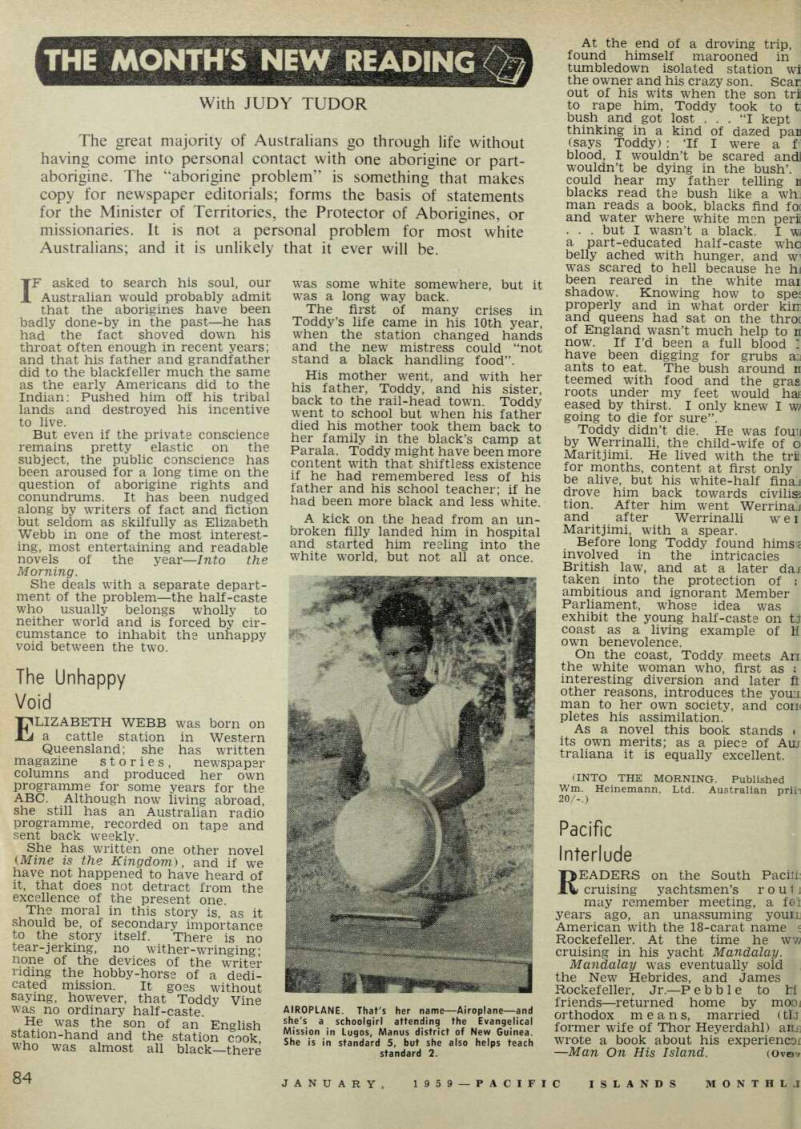
AIROPLANE. That's her name —Airoplane—and she's a schoolgirl attending the Evangelical Mission in Lugos, Manus district of New Guinea.
She is in standard 5, but she also helps teach standard 2.
■ In it Pebble does not tell all that happened on that cruise, but what is told he tells pleasantly. Missing from it are the passages that are Standard equipment in most sea jtories—frail craft pitted against the [Blight of the ocean, and the perils Suffered by the sailors. As the title ■suggests, it concerns men more than llements—and perhaps women more |han either. The title has a more subtle meaning as well —in the sense that each man has to find his own particular dunghill. [ The American edition was pub lished some time ago; the English edition more recently. Some extracts from the book—notably the visit of Mandalay to Suwarrow, where Tom Neale had voluntarily cast himself away—appeared over a year ago in the Australian magazine People. Between Maine and Panama, Rog and Bob succumbed; at Papeete, Tony left the ship; from Papeete until, the end, another Bob was Pebble’s sailing mate. This Bob, so VIM records show, was Bob Grant, who last year was badly burned in an explosion on Ve Tega, in the Hebrides. [ We seem to remember that after several months in hospital in Auck land, NZ, he married his nurse and they recently sailed away in the 16-ft Typee , bound for the Caribbean.
In his book Rockefeller romanticises the story of Bob, and fixes him up with a different happy ending.
This is a young man’s story of Pacific adventure, told by a young {nan who seems to have difficulty m divorcing himself from the role of observer and promoting himself to that of participant. ■ Technically it is a competent
piece of writing. It is amusing, entertaining—with a serious note in the minor key, based on the author’s belief that a man must move out of his environment to find what he wants—even if what he wants is back home, anyhow.
Presumably, Rockefeller was one of the poor, mixed-up Americans we hear about; if so, he didn’t let it get him down. (MAN ON HIS ISLAND. Published by Jarrolds.)
God-forsaken
r:E bush-pilots of northern Canada have much in common with the pilots of New Guinea.
The hazards are about the same; only the climate is different. In the one, sub-arctic cold, snow and
ice; in the other tropical heat, humidity, rain.
Hammon Innes’ new adventure story, The Land God Gave to Cain, is based on thg building of the 400 miles of railway from the St.
Lawrence River across the Labrador Plateau to the rich iron deposits at Knob Lake. But although the story is based on what might be North America’s last big rail roading effort, it concerns also the bush-pilots who hop from lake to lake in their small float-planes: the errand-boys of big development— the helicopters and their pilots; and, finally, ham-radio operators.
All play a part in this story of adventure and mystery in one of the grimmest countries in the world.
On impulse, lan Ferguson hitched a ride with a pilot friend, from
England across the Atlantic to find :out why his father, a ham operator, had received a radio message from the centre of Labrador long after the sender was supposed to be dead.
The receipt of this message had dulled Ferguson Snr., who was an Invalid.
The reception lan Ferguson got from the railroad men who wanted no mysteries solved, was calculated to deflate the diffident Britisher; Instead it got his dander up, with (Somewhat extraordinary results.
I (THE LAND GOD GAVE TO CAIN, published by Wm. Collins, Ltd. Australian irice. 18/9.)
Sugar, Spice, All
Things Nice
NOW in the atomic age more than ever, a good old-fashioned wallow in make-believe is a tonic and what more pleasant way to do it than with a Georgette Heyer, Regency romance.
I This writer is a veteran at her craft—it must be 30 years since These Old Shades gave readers of light literature a new kind of historical romance.
The 1958 model of the Heyer art, I Venetia, is as fresh and entertain ing as that first best-seller. This author, of course, also writes modern thrillers, which are as (excellent in their own way as her romances. Unfortunately, she does not produce these as often as readers would like.
Venetia was beautiful, of energetic wit and unconventional mind but she had not been more than a few miles from her Yorkshire home and at 25 seemed set to devote her life to her delicate brother. At that advanced age, in Regency England, one trembled on the brink of the shelf.
I This state of affairs was altered When the wicked Lord Damerel, who had begun his life as a rake many years previously by seducing
a lady of title and running away with her to the Continent, arrived to take up residence next door.
With anyone else but Heyer, this would be pure corn; instead it is an exotically decorated sugar-cake— delicious to nibble between heavier meals. (VENETIA. Published by Heinemann, Ltd. Australian price, 16/-.)
When the Shark
Alarm Goes
THESE days people certainly write popular books about the darndest things. One of the Christmas offerings is Shark Attack (opportune enough for the Southern Summer) by Dr. V. M. Coppleston, a well-known Sydney surgeon who is an adviser to the Surf Life Saving Association and has made a serious study of attacks by sharks. The oddest thing about the book on such an unhappy subject, is that it is exceedingly interesting.
Although the book primarily con cerns Australia, it covers the whole field of recent shark attacks on humans—the Pacific Islands, West Indies, Mediterranean, Africa, America. And from his vast cover age of the subject, Dr. Coppleston has been able to trace certain behaviour patterns of sharks until he has produced a calendar of highest attack periods for certain localities.
He also proves to his own satis faction, that it is frequently the rogue shark which causes the trouble; once having tasted human blood the man-eater waits deliber ately for further victims.
This certainly isn’t the book for timid migrants, such as those who recently have been frightened away from Australia and make big head lines in London newspapers with a chronicle of the perils of Down Under: Red-backed spiders, and paspalum grass. But it does prove how small the risk —considering the vast numbers who swim and surf in Australia —of ever being attacked by a shark.
Since 1919, 57 people have been victims of shark attacks in NSW —an infinitesimal number in com parison with the annual death roll on the roads. .
One of the most interesting sights on a Sydney metropolitan beach on a summer day is to see the reaction of swimmers when the shark bell goes. From far out beyond the breakers they come streaking in, in a mass demonstration of first class swimming. Within 20 minutes they are usually all back in the water again. „ . , There have been fewer shark alarms in recent years—a fact that is usually attributed to the practice of meshing off metropolitan beaches.
Meshing consists of setting sq ft nets at night, at an angle to tho surfing beach, and removing them by trawler in the nrnrnmg■ on the recommendation of the sun
Life Saving Association that this method of shark protection was tried—first in 1937.
In the 20 years since something like 3,200 sharks have been taken and as the years have passed the number has decreased showing that sharks are now tending to avoid these areas. (SHARK ATTACK, Published by Angus and Robertson, Ltd. Australian price 32/6.)
Idriess Again
AUSTRALIA’S marathon writer, lon Idriess, can be guaranteed co come up with yet anothe/ pioneering adventure at regular intervals —although after so many years, and so many books it might be imagined that he would have written himself out long since.
Latest of the “works” (Back O' Cairns ) can be regarded as a continuation of the usual process and should not be read with the hope that the author is going to strike any new notes, anywhere.
It has its points as a history of the development of Queensland’s tropical north, Townsville to Cook town; and narticularly of the development of the rich tablelands behind Cairns, Atherton, and the problem of getting access to it from the coast. (BACK O’ CAIRNS. Published by Angus and Robertson, Ltd. Australian price, 22/6.)
Jonahs and Jordan
HUMFREY JORDAN has pro duced a couple of scores of books since he began writing as a serious career in 1910.
He has become the unofficial scribe of the Merchant Navy, and nis customers probably come from
i amongst the less sophisticated arm :chair adventurers who think ships iromantic, and travel of any :dimension, wildly exciting.
For our meat, his writing seems distinctly schoolboyish; his characters are uncomplicated creatures, all nice or all nasty, wiin mo subtlety, and the pace of the l Story is set to that of a tramp ESteamer nosing around foreign }parts.
However, people who have been Heading Jordan since 1910 are un- Jlikely to give up now, and will no doubt welcome Spoiling For Mis chief, which concerns a voyage to Australia and back to the UK via !Malaya and Ceylon, with a couple of Jonahs on board.
B (Spoiling For Mischief. Published
;by Hodder and Sloughton, Ltd. Australian
:£rice, 15/6.)
Teddy-boyism
HAVE you a Bodgie in the family? If so, it is apparent that you are no worse off than the parents in Ancient Greece, who also suffered considerably from iSimilar social phenomena.
I This seems to be the opinion of A E. Manning, an Auckland psychologist who has given consider able study to the subject of bodgies
and their female counter-parts, widgies, on both sides of the Tasman.
In a small publication called The Bodgie, he discusses the cult of the poor-mixed-up kid and seems to settle the cause at social maladjust ment and a general feeling of “not belonging”.
Mr. Manning does not seem to suggest any real solution —nothing that has not been tried already, at all events.
These frustrated teenagers may have found an outlet in the Hitler Youth Movement of Kilter's Germany; but whether Totali tarianism is the solution is problematical as Russia, too, is re ported to have something akin to a bodgie cult. (THE BODGIE. Published by Angus and Robertson, Ltd. Australian price, 10/6.)
Christie Unlimited
WITH well over a quarter-century of crime fiction behind her, plays that run for years in the West End, and motion picture rights, it isn’t likely that Agatha Christie any longer writes for her bread-and-butter. Even the jam on the buttered-bread must be adequately taken care of. Pre sumably she keeps on producing^
From Wildest New Guinea
This Netherlands New Guinea native conies from the so-called Casuarin Coast (near the Cook River, on the Western coastline norm of Frederik-Hendrik Island, and Merauke). He and his fellows are supposed to have had virtually no contact with Europeans, out, remarks the sender of the photograph, fudging by the carving, mis one must have met up with a missionary at some time.
The NNG has recently set up a patrol post in this area.
ibooks only to please fans whose year would not be complete without a mew Christie.
In the latest of these Appease ments for Fans (Ordeal by Innocence ), we note that she has (formed herself into a company, Agatha Christie Ltd., and one un fortunately forms the impression [:hat the Ltd. part of the outfit nad more to do with this newest oook than Agatha.
It lacks entirely the old Agatha Christie style; missing also are both Miss Marple and Hercule Poirot. :ff this had been the first offering )f a newcomer it would have been :jood. As a Christie specimen it is liisappointing.
Jacko Argyle died in prison Hospital six months after he had <)egun to serve a life-sentence for [he murder of his mother. Eighteen months after that, a stranger [.Timed up and substantiated Jacko’s ilibi, leaving no possible chance lhat he could have committed the [Time.
The stranger had expected the family to be jubilant. They were far from it: They had accepted facko’s guilt as the most satis factory explanation of the murder, mt if he had not done it, then ibviously it must have been one of Ihe seven other members of the Household. Suspicion springs up in ill directions and wrecks the peace »f Sunny Point. [(ORDEAL BY INNOCENCE. Published y Wm. Collins, Ltd. Australian price, 1/6.)
luvenile Dept.
|T is an odd fact, upon which we 1 have remarked before, that most I of the adventure stories pub ished are for boys—which probably urns them into arm-chair adven- Urers at an early age. It is equally rue, that it is the girls, in late pens (and not the boys), who lerhaps maddened by the fact that ewer people are writing books for hem, set off across the world on forking holidays or to drive uperannuated taxi-cabs across [Europe into the by-ways of Greece «nd Turkey, It is the girls of this generation fho are the true adventurers. The "oys must just read about it.
River of No Return is a boy’s story; a true story of the Ipanish conquest of Peru and the iiutcome of a tussle with the imazon. j The author is Ronald Syme who ias a long string of juvenile books o his credit. Whether he is the ame Ronald Syme who lived in the 'Ook Islands for a few years, we ! o not know.
I(RIVER OF NO RETURN. Published by fodder and Stoughton. Australian price,
Novel With
History
r[E 10th item ( Robina ) in the E. V. Timms’ saga of Australia’s foundation concerns the settle ment of South Australia, which leaves only one other State to go —Tasmania—and then we will be finished with the business. We hope.
Mr. Timms is one of several Aus tralian writers who feel some sort of divine mission to get their country’s early history down on paper. There is nothing wrong with the idea; it is the execution that is so tedious.
The present novel concerns a couple of 1837 migrants, Charles and Robina Daventry, who, pre
paring to sail for the new colony of South Australia, find virtually at sailing time that they have mysteriously acquired amongst their luggage, a wicker basket. In the wicker basket is a six months’ old child. For the purposes of the novel, Robina decided to take the child with her and her obsession over the boy provides the motif of the story—against a background of early South Australia and its influx of German migrants.
As in all Timms novels—and the writings of some other Australians we could mention —the reader is forced to swallow large slabs of school-book history served up like slabs of mutton and boiled potatoes. (ROBINA. Published by Angus and Robertson, Ltd. Australian price, 17/6.) (Over)
What's New in Paper Jackets
THE PAN BOOK OF CATS and THE VAN BOOK OF DOGS by Rose Tenent and Catherine Fisher, respectively. Even Down [Jnders who know how besotted the English ire about their domestic animals, will get few surprises from these small books, iach excellent in its fashion.
From the Cat Book I read to Bill, my Id black tom, such bits as this: “Of «ourse. you will never in any circum ,lances turn your cat out at night. It jL strange that many people who would ‘ever dream of putting out a dog at night iill cheerfully put the cat out. even in ihe worst weather. Apart from the fact nat the cold and rain are a cat’s worst loemies, there is always the fear that it (ill be stolen or pick up a disease from a way.” ; Bill said that he couldn’t agree moro, nd that it is a wonder he hadn’t got lorse than a chewed ear from those inter nights in the laundry, or gazing I the summer stars from the front lirrace. [lt is obvious that being owned by a cat r a dog in England is a very different reposition to owning a domestic pet in iDstralasia: It sounds like a full-time icupation instead of an incidental
gnostic pleasure.
The little books tell you how to choose pet, how to train it, feed it, attend to ailments. They tell how to go about itering your dogs and cats in shows, and •ie business of breeding kittens and nups ir sale. However, it seems to me that •P books are best read after acquiring a :t. than before—they are inclined to lake the simple business sound as com icated as adopting an orphan.
FOOTNOTE; Registrations at the Kennel ub between 1954-57 show that in England nodles in each of the years topped the I most popular breeds—lB,34o in 1957, th Welsh Corgies coming a bad second 17.900. (Both books are GREAT PAN).
THE GOLDEN PRINCESS, by Alexander iron: A romanticised version of the ij*nish conquest for Mexico in the 16th ntury, founded partly on fact and partly j legend. The conquest and subjugation the Aztec empire and Hernan Cortes io led that conquest are real enough; ilinali, or Marina, the Indian girl who ilped him in his task and who gained eat personal power is probably based rfact, also—but interwoven with a great al of legend. A novel that combines, rtory, adventure and romance. (FON iNA, pink), THE ORACLE, by Edwin O’Connor: her was a mid-twentieth century enomenon: Every night his 5.000.000 tisfied listeners tuned into his news immentry where he put the world’s iders back in their places and sorted I the world’s problems to his entire tisfaction. Then he went out and led sordid little two-bit life of his own. aders who have had overmuch of radio »cles who know the lot, will probably i some savage satisfaction out of this ce of satire. (GREAT PAN).
THE FLOWERING THORN, by Margery arp: First published in 1948 but prob 1} written before that date as it con ■ns a 28-years-old sopisticate of the aring Twenties who adopted a five »rs-old orphan for a “new experience ’ found herself banished to the wilds Buckinghamshire. (FONTANA, yellow).
SCORPION REEF, by Charles Williams, ose people who have been overworking 9r brains trying to find solutions to Joyita” mystery and the “Melanesian ’ ■stery and sundry other mysteries of * South Seas in recent years, may get due or two from this Whodunit of the
A (Great Pan).
•ARTNERS IN CRIME, by Agatha nstie. Another vintage model from this
doyen of crime writers. Of pre-Poirot period. (FONTANT, blue).
BOWMAN AT A VENTURE, by Hartley Howard: Glen Bowman, in his own estima tion. was “A name on a door of a dingy office, a reputation for drink and women, a precarious bank balance, a restless urge that carried me from one case to another In short, an American private detective. There are numerous beautiful females, some with husband trouble, a body in a phone box and a sour taxi driver with this little lot. (FONTANA, yellow).
The Courting Of Susie Brown, By
Erskine Caldwell: The third in this series in three months—the others were “God’s Little Acre” and “Tobacco Road”. This Is a collection of short stories. (GREAT
Pan).
CHARMED CIRCLE, by Susan Ertz.
This writer, born of American parents, has lived in England since 1923, but still writes of America. This story, first pub lished in 1956, is of a New York family who had too much of everything. As usual Miss Ertz excels at characterisation and the interplay of family life. (FONTANA pink).
HMS “THULE” INTERCEPTS, by Alistair Mars; This is the second of Mars’ sub marine books (the first was “Unbroken”); and concerns the underwater war against the Japanese. It was after this service that Mars served for a while in the peace time Pacific and made numerous friends around Fiji and Samoa. At a later stage still he had an argument with the Lords of the Admiralty and left the Navy (he wrote about that, if we remember cor rectly, in “Court Martial”). Since then Mars appears to have spent a lot of his time writing—both fact and fiction. He is one of the few sailors who don’t write like one. (GREAT PAN).
The Bright Face Of Danger, By
Lawrence Meynell: This is big-time racketeering in the wilds of Mayfair and the less salubrious London around Soho.
A well-written thriller. (FONTANA, yellow),
The Passionate Summer, By Richard
Mason. When this first appeared in 1949, its title was “The Shadow and the Peak” —since then it has been made into a film with the same title as the Fontana edition. It was the writer’s second novel (the first, “The Wind Cannot Read”, has also been filmed, and in 1957, he pro duced “The World of Suzie Wong”). All three are equally excellent. The first book was about India; the third about Hong kong; “The Passionate Summer” takes place in Jamaica. (FONTANA, yellow). (Our copies are from W’m. Collins (Overseas), Ltd. Australian prices: FON TANA. yellow spine, 3/6; pink spine, 5/-.