'Jimmy Malay'
pp. 88-101 · Read in the full issue
Toaguba’s Memories of a Colourful Trader
They Tried. But They Couldn't Catch 'Jimmy Malay'
memories of my very good friend Jimmy are pungent. He was a much-loved man. In my day he had an open bungalow on one of the numerous tidal streams which feed into the sea via Galley Reach, north of Port Moresby—an open bungalow in the full sense because no matter at what hour you arrive at the house he was always pleased to see you.
AND there was always plenty of home-brewed “cratur” avail able, despite the fact that he did not drink or smoke himself, being a strict Mahommedan, He was an excellent cook and would prepare a first-class meal.
Jimmy had a fairly large family, all Roman Catholics, and the girls had been well trained at the Yule Island convent school.
They were clever, excellent house keepers, and very good-looking Handsome Harry,” who lost his me in a fracas in Moresby, was very “gone”’ on Wilhelmina. How ever, she did not return his affec
tion, and did not mourn his demise.
Jimmy was friendly with most of the hill tribes, especially those up on the main range. Each year he gave a big party, and upwards of 100 men and women would be his guests. They came from several villages, principally in the Mariboi area.
The women were among the finest of Papuans. Their legs were just one mass of muscle, and their general build was really mag nificent.
Jimmy explained why these hill women were such amazons. He told me they had in the past (this was
PIM in July published a colourful story of Papua Jimmy Solien (or “Jimmy Malay”) and his e ploits at the end of the last century, when 1 did a roaring trade in skulls and birds of paradi plumes. This has brought some reminiscena from Toaguba”, an old Islands hand who kne: Jimmy Malay.
the year 1911) been subject ■ attacks by other hill men, from across the dividing valley, and tb only prisoners taken were women.
Killed the Men
In the early days the village were on the slope of the hill an their gardens up above. Thu situated, it was apparently an eas matter for the raiders to swocc down on the workers, kill the me and carry off the women.
Later, some chief got the ide of havmg their gardens below ttr villages. This meant that tlr women went down the hill emptv handed, but had loads of up to 8 lbs to carry back. Those loam made stalwarts of the girls am women, and their legs and shoulden were very strong.
The principal dance, when thr hill people visited Jimmy’s kabun was given by the men. In thr centre of the padang was a huge pole about fifty feet high. Attache* to the pole, 10 to 15 feet from thr ground, were small bundles cn various commodities, such as ku-ku biscuits, matches, and lava-lavasj and even canned fish and meat.
To get these prizes, the men hau to run up the pole and, if they goa near one of the parcels, thee claimed it as a “something”
Among spectators of this exx hibition I remember Guy C 2 Manning, Archie McAlpine, Tom Nevitt, Surveyor McLean.
Money From Plumes
In addition to the skull tradimr activities (to which PI M’s articld; refers) Jimmy was a past master at the game of Reggiana plumes —as a mattter of fact, his incom.r was mostly from that source. It i;i not known how many traps wern laid for him. But it is not on. record that he was ever caught J and he was never without readvf cash.
Jimmy Malay was very open-r handed and, although he had only! one hand (the other was lost wheru he was dynamiting fish in ther Reach) he could handle a boah: with ease.
He had many agents in the Siren of Paradise business—some businessa men of Port Moresby were associa-£ ted with him in this.
One of his bush agents was as Malay-Chinaman who lived at as place named Sansineena, on anothena
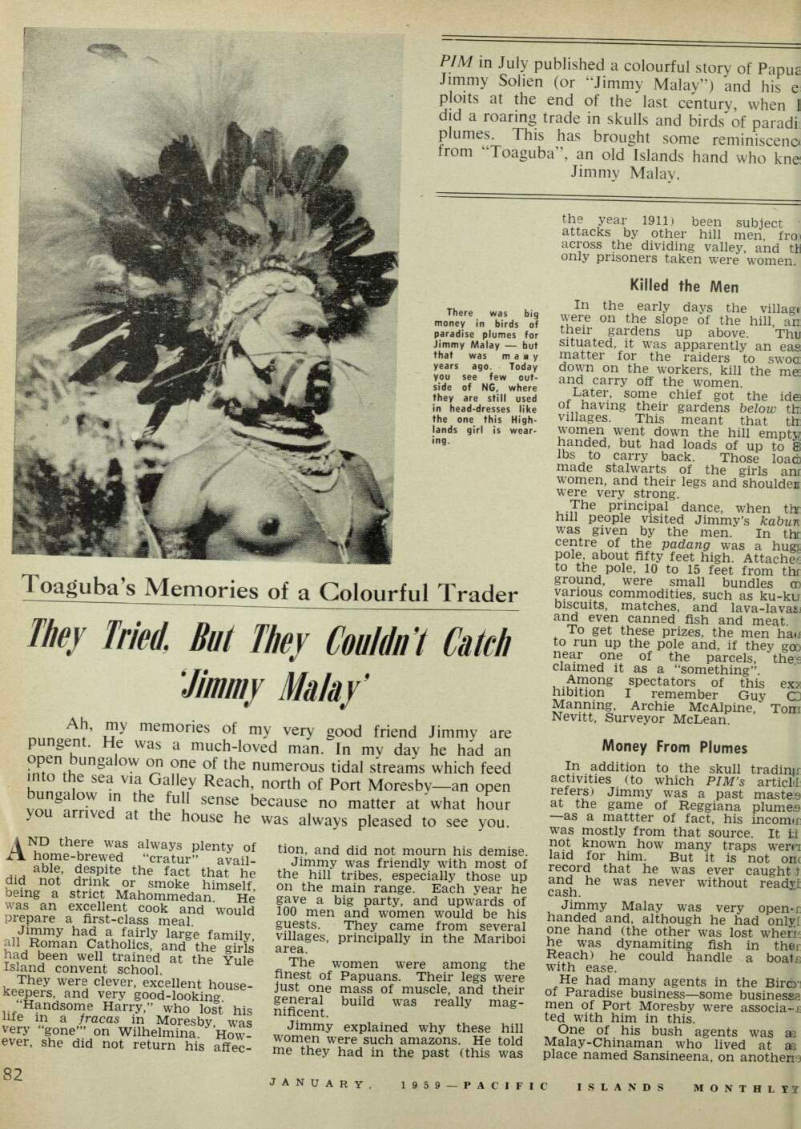
There was big money in birds of paradise plumes for Jimmy Malay but that was ma a y years ago. Today you see few out side of NG, where they are still used in head-dresses like the one this High lands girl is wear ing.
Branch of the Reach. Most of the natives were helpful, so he had ittle trouble in obtaining any lumber of plumes.
His method of getting rid of them was known to very few people; but when you saw Jimmy in Port, waiting for the Post Office to open, t was a hundred to one he was expecting a registered letter con saining a bank draft.
A Gentleman Jimmy was a gentleman. All the Sors brothers were good friends of lis —Walter and Arthur in particu far. Leo, being a respected official, would not appear too friendly, but le had a fair idea of what went IHowever, when Leo Gors retired, lis successor was determined to Batch Jimmy, and tried all sorts of stratagems. One shipment, for uondon via Batavia, was on board Ihe Van Linschoten (Captain Ichletter). Although a thorough search of Ihe freight loaded at Moresby was :nade, the cases containing the flumes were not discovered, and jver 2,000 reached the Paris market.
J One of the searching officers ictually sat on one of the cases containing the contraband, but was cither unaware or did not want to jive the show away The cases were ill marked “Natural History speci mens”, and were addressed to an appropriate organisation. This con signment, however, was about the fist of any size.
I The export of skulls was (ventually stopped by J. H. P.
Murray, the Lieut-Governor, after
•jeing carried on for years in a Inall way. The KPM ship Van (Continued on page 95)
Heemskerk had a few cases aboard in August, 1910. Like the ship ments of plumes, they were marked “Natural History Specimens”, and got past the Collector of Customs.
Not all the skulls were supplied by Jimmy. Some came from a village about five miles west of Arthur Gors’ plantation. It was said the shipper was able to send them away by a boat which never cleared at Moresby, but put into the creek, and then sailed away for Java or some other place in the Orient.
Such things did happen, because the coastal ports were a long way from Moresby or Daru and, as the natives were in those days not yet “civilised”, the appearance of a small vessel would arouse little official interest.
However, all good things come to an end, and, with the war of 1914-18, the trade in skulls and plumes disappeared and Jimmy Malay likewise passed on.