On Beef Liver And Baby Food
pp. 86-87 · Read in the full issue
Often Bitten, But Never Shy
His Poisonous Snakes Thrive On Beef Liver And Baby Food
From William Gasson, AAP-Reuter Correspondent in Port Moresby Babies, taipans and Papuan black snakes all thrive on thK same type of baby food in Port Moresby—tins of beef liver soup..
FEEDING the soup to a baby might be vexing, but to two of the world’s deadliest snakes it calls for a sharp eye, a quick and 8/ strong hand.
“Father” of the snakes at the Kila Kila Agricultural Station is Ken Slater who, for years, has been chief custodian of this poisonous brood. He milks them of their poison every two weeks.
This venom is sent to Australia to the Commonwealth Serum Laboratories, where it is used for making antivenene.
Although a dangerous occupation, it is quite a valuable one in the number of lives it might save and its monetary value. About £A4OO worth of venom was last year sent tn Australia to Australia.
Grab it by the Tail
Mr. Slater, who once spent four paralysed days in hospital as the result of a bite from a taipan which turned too quickly as he went to pick it up by its tail, treats these beautiful looking reptiles with an
air of casual confidence, To hook a six-foot taipan out) a box, grab its tail and swings clear, keep well away from tongue and the spitting, sensuti. weaving head before trapping it j the ground with a stick. It’s simn to watch, but a work of art.
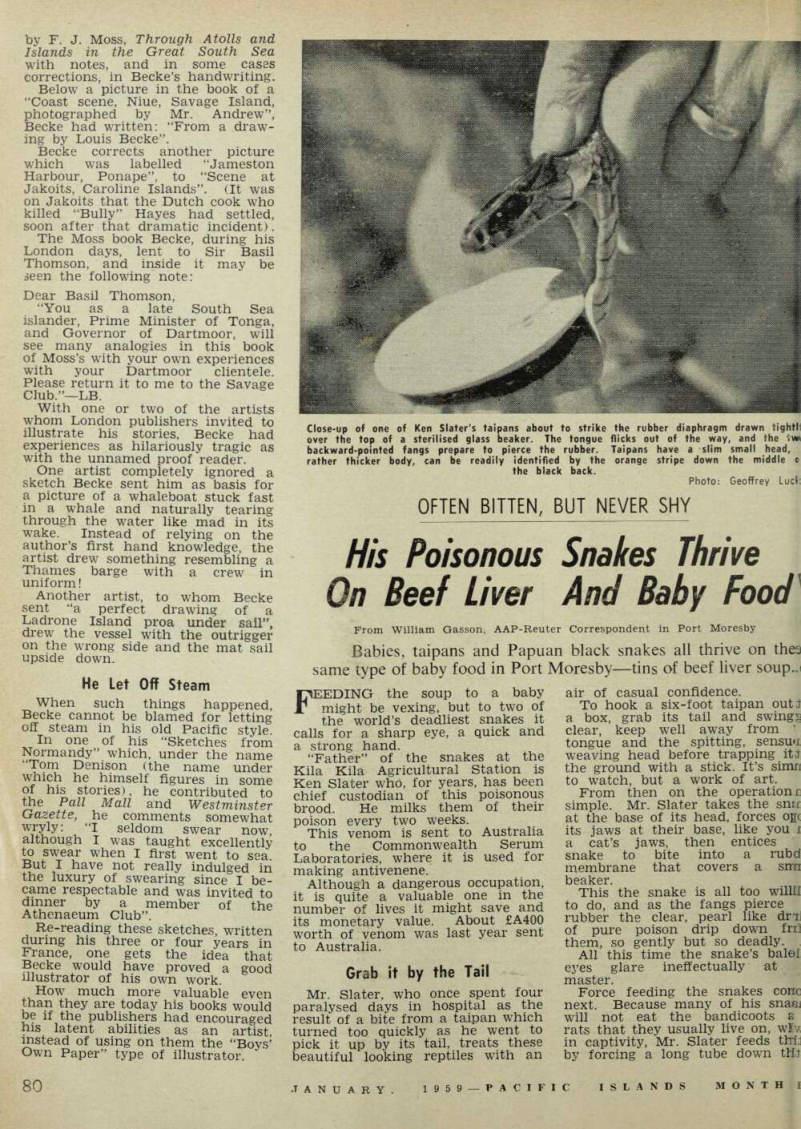
From then on the operations simple. Mr. Slater takes the snsr at the base of its head, forces one its jaws at their base, like you ; a cat’s jaws, then entices snake to bite into a rubd membrane that covers a smi beaker, This the snake is all too willll to do, and as the fangs pieice rubber the clear pearl like driJ of pure poison drip down frn them, so gently but so deadly, All this time the snake’s bale!
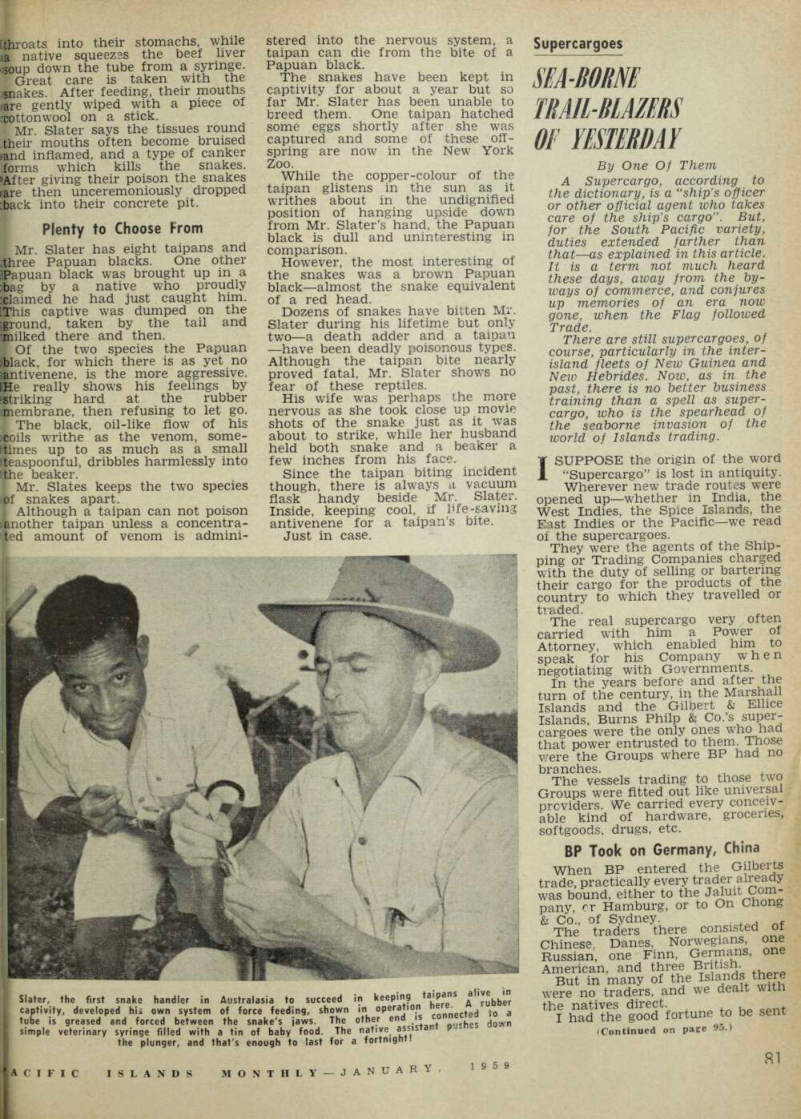
Salter 613 " lneffectually at Force feeding the snakes cone next. Because many of his snasi will not eat the bandicoots s rats that they usually live on, wHv. in captivity, Mr. Slater feeds thl: by forcing a long tube down thf
Close-up of one of Ken Slater's taipans about to strike the rubber diaphragm drawn tighl over the top of a sterilised glass beaker. The tongue flicks out of the way, and the [?] backward-pointed fangs prepare to pierce the rubber. Taipans have a slim small head, rather thicker body, can be readily identified by the orange stripe down the middle the black back.
Photo: Geoffrey Luc[?]
[throats into their stomachs, while ia native squeezes the beef liver ;soup down the tube from a syringe.
Great care is taken with the snakes. After feeding, their mouths fare gently wiped with a piece of cottonwool on a stick.
Mr. Slater says the tissues round ;their mouths often become bruised tand inflamed, and a type of canker [forms which kills the snakes.
After giving their poison the snakes tare then unceremoniously dropped :back into their concrete pit.
Plenty to Choose From Mr. Slater has eight taipans and ■three Papuan blacks. One other ]Papuan black was brought up in a :bag by a native who proudly claimed he had just caught him. [This captive was dumped pn the aground, taken by the tail and imilked there and then.
J Of the two species the Papuan Jblack, for which there is as yet no ;antivenene, is the more aggressive.
IHe really shows his feelings by •striking hard at the rubber imembrane, then refusing to let go.
I The black, oil-like flow of his icoils writhe as the venom, some- Itimes up to as much as a small Iteaspoonful, dribbles harmlessly into Ithe beaker. [ Mr. Slates keeps the two species iof snakes apart. Although a taipan can not poison ;another taipan unless a concentra ted amount of venom is admini
stered into the nervous system, a taipan can die from the bite of a Papuan black.
The snakes have been kept in captivity for about a year but so far Mr. Slater has been unable to breed them. One taipan hatched some eggs shortly after she was captured and some of these off spring are now in the New York Zoo.
While the copper-colour of the taipan glistens in the sun as it writhes about in the undignified position of hanging upside down from Mr. Slater’s hand, the Papuan black is dull and uninteresting in comparison.
However, the most interesting of the snakes was a brown Papuan black—almost the snake equivalent of a red head.
Dozens of snakes have bitten Mr.
Slater during his lifetime but only two—a death adder and a taipan —have been deadly poisonous types.
Although the taipan bite nearly proved fatal, Mr. Slater shows no fear of these reptiles.
His wife was perhaps the more nervous as she took close up movie shots of the snake just as it was about to strike, while her husband held both snake and a beaker a few inches from his face.
Since the taipan biting incident though, there is always a vacuum flask handy beside Mr. Slater.
Inside, keeping cool, if hfe-saving antivenene for a taipan’s bite.
Just in case.
Slater, the first snake handler in Australasia to succeed in keeping tai pans alive in captivity, developed his own system of force feeding, shown in operation here. A rubber tube is greased and forced between the snake's jaws. The other end is connected to a simple veterinary syringe filled with a tin of baby food. The native assistant pushes down the plunger, and that's enough to last for a fortnight!