when A Hermaphrodite
pp. 85-86 · Read in the full issue
Maiden Ladies And The Clergy Had Becke Under Fire
when A Hermaphrodite Brig Was A Naughty Word
By Lew Friday
Louis Becke, the most authentic of South Sea writers, was at one stage of his career under fire from elderly maiden ladies, clergymen and other admirable and highly respectable readers in Britain, for being too down-to-earth in describing the life he had lived, the things he had seen and the people he had associated with during his adventurous career as a supercargo, trader and labour recruiter.
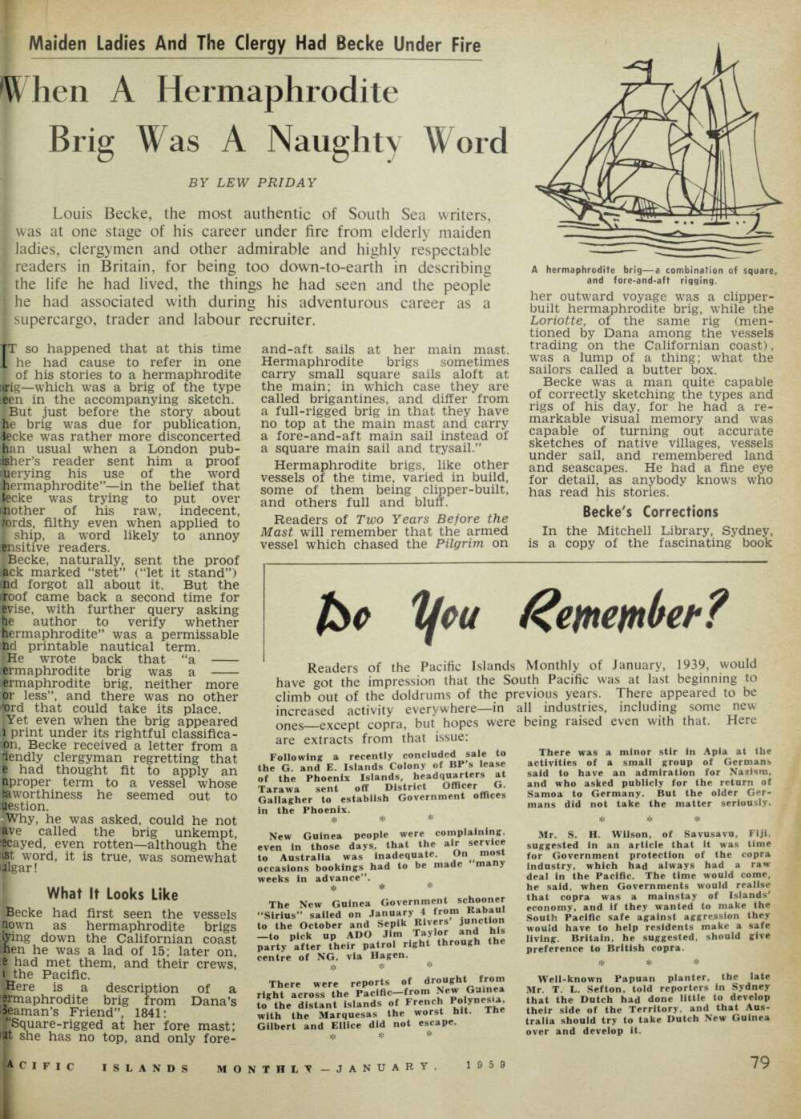
[T so happened that at this time he had cause to refer in one I of his stories to a hermaphrodite Brig—which was a brig of the type ;een in the accompanying sketch, i But just before the story about he brig was due for publication, iJecke was rather more disconcerted ban usual when a London pub lisher’s reader sent him a proof ruerying his use of the word ihermaphrodite”—in the belief that lecke was trying to put over mother of his raw, indecent, fords, filthy even when applied to I ship, a word likely to annoy sensitive readers. jßecke, naturally, sent the proof ack marked “stet” (“let it stand”) md forgot all about it. But the iroof came back a second time for wise, with further query asking he author to verify whether hermaphrodite” was a permissable nd printable nautical term.
He wrote back that “a iermaphrodite brig was a ;ermaphrodite brig, neither more or less”, and there was no other i*ord that could take its place. [Yet even when the brig appeared i print under its rightful classifica on, Becke received a letter from a hendly clergyman regretting that e had thought fit to apply an nproper term to a vessel whose he seemed out to :uestion.
Why, he was asked, could he not ;ave called the brig unkempt, decayed, even rotten—although the ist word, it is true, was somewhat i|lgar!
What It Looks Like Becke had first seen the vessels pown as hermaphrodite brigs Wing down the Californian coast men he was a lad of 15; later on, jb had met them, and their crews, l the Pacific. »Here is a description of a ■frmaphrodite brig from Dana’s iseaman’s Friend”, 1841; ‘‘Square-rigged at her fore mast; she has no top, and only fore
and-aft sails at her main mast.
Hermaphrodite brigs sometimes carry small square sails aloft at the main; in which case they are called brigantines, and differ from a full-rigged brig in that they have no top at the main mast and carry a fore-and-aft main sail instead of a square main sail and trysail.”
Hermaphrodite brigs, like other vessels of the time, varied in build, some of them being clipper-built, and others full and bluff.
Readers of Two Years Before the Mast will remember that the armed vessel which chased the Pilgrim on
her outward voyage was a chpper built hermaphrodite brig, while the Loriotte, of the same rig (men tioned by Dana among the vessels trading on the Californian coast), w *f a lump of a thing; what the sailors called a butter box.
Becke was a man quite capable °f correctly sketching the types and rigs of his day, for he had a re markable visual memory and was capable of turning out accurate sketches of native villages, vessels under sail, and remembered land and seascapes. He had a fine eye for detail, as anybody knows who has read his stories, _. . - Becke s Correct.ons In the Mitchell Library, Sydney, is a copy of the fascinating book
A hermaphrodite brig—a combination of square, and fore-and-aft rigging.
by F. J. Moss, Through Atolls and Islands in the Great South Sea with notes, and in some cases corrections, in Becke’s handwriting.
Below a picture in the book of a “Coast scene, Niue, Savage Island, photographed by Mr. Andrew”, Becke had written: “From a draw ing by Louis Becke”.
Becke corrects another picture which was labelled “Jameston Harbour, Ponape”, to “Scene at Jakoits, Caroline Islands”. (It was on Jakoits that the Dutch cook who killed “Bully” Hayes had settled, soon after that dramatic incident).
The Moss book Becke, during his London days, lent to Sir Basil Thomson, and inside it may be seen the following note: Dear Basil Thomson, “You as a late South Sea islander, Prime Minister of Tonga, and Governor of Dartmoor, will see many analogies in this book of Moss’s with your own experiences with your Dartmoor clientele.
Please return it to me to the Savage Club.”—Lß.
With one or two of the artists whom London publishers invited to illustrate his stories, Becke had experiences as hilariously tragic as with the unnamed proof reader.
One artist completely ignored a sketch Becke sent him as basis for a picture of a whaleboat stuck fast in a whale and naturally tearing through the water like mad in its wake. Instead of relying on the author’s first hand knowledge, the artist drew something resembling a Thames barge with a crew in uniform!
Another artist, to whom Becke sent “a perfect drawing of a Ladrone Island proa under sail”, drew the vessel with the outrigger on the wrong side and the mat sail upside down.
He Let Off Steam When such things happened, Becke cannot be blamed for letting off steam in his old Pacific style.
In one of his “Sketches from Normandy” which, under the name “Tom Denison (the name under which he himself figures in some of his stories), he contributed to the Pall Mall and Westminster Gazette, he comments somewhat wryly: “I seldom swear now, although I was taught excellently to swear when I first went to sea But I have not really indulged in the luxury of swearing since I be came respectable and was invited to dinner by a member of the Athenaeum Club”.
Re-reading these sketches, written during his three or four years in France, one gets the idea that Becke would have proved a good illustrator of his own work.
How much more valuable even than they are today his books would be if the publishers had encouraged his latent abilities as an artist instead of using on them the “Boys’
Own Paper” type of illustrator