Tropicalities
pp. 83-84 · Read in the full issue
Pacific Islands Monthly
Magazine Section
Courteous Minister and
Baffling Turtle
\ i s Mrs. Noakes, a Tofua round el. tripper, strolled through Apia’s I streets, she saw a small Samoan lierishing a small turtle. After much haggling—he did not wish to ell his pet—she purchased the reptile, for removal to Auckland.
She learned that a regulation overns transportation of such tings. There must be a “permit”. >So Mrs. Noakes called upon the new Minister for Agriculture, a lurtly Samoan, and made formal jpplication for permission to take Jherub, a small turtle, to NZ.
The Minister was staggered. He :ould deal with live stock, ranging torn horses to cats. But a turtle? ■;He consulted authorities —some written, some very vocal. It was [fine point, full of argument, and :he Samoans loved it. Finally they :ecided that Cherub was live stock, nd might be exported under permit.
The Minister beamed. A happy lerk began to fill in the form.
But the form wanted to know Whether the animal was male or ■anale. The argument was resumed.
I high official insisted that, failing iDmpletion of the form, no permit :ould be issued. A very unhappy Qnister tried to placate Mrs. Noakes. iTwo clerks were sure that Cherub 'as female. Minister and staff Jared at the tiny creature, and ipressed doubts. Finally, the Ayes ad it. Official permission to export {female turtle was issued.
Before she was landed in Auck md by her proud owner, Cherub iscame the pet of the ship. None I the round-trippers, apparently, ad read the dictum of the in imous Ogden Nash: The turtle lives ’neath plated decks Which practically conceal its sex — I find it clever of the turtle •In such a fix to be so fert’le.
And it Will Probably be the
Last, Too
'pHE following official hand-out, 1 released by the Papua-New J Guinea Administration on No !smber 27, is here published in full lit deserves:
I Internal Audit Of Admin
•TRATION financial activ-
ITIES. (Statement by the Treasurer — Mr. H. H. Reeve). In order to carry out approved Inspection pro grammes covering audit examina tion of all Administration financial procedures in the field, Treasury Inspectors must display a high de gree of drive and penetration.
As an example of this keenness, energy and drive the Treasurer, Mr.
Reeve, today instanced a recent visit by one of his Inspectors to the loma Sub-District, The journey of
the Inspector from Popondetta to loma included not only a consider able amount of travel by Land- Rover but a very difficult 13 hours swampT 6 ° f “ thr ° Ugh Wa ‘ St ' deep On the return trip the Inspector travelled by canoe for about 12 hours from loma down the Tamata P r ? e k anc * Mambari River, to Mam* ba £i tu ’ . on Mambaru Bay. * Tbe J° urn ?y from Mambaru Bay
workboat in'e^ht^oum—tbe'work
boat extr^melv
bad weather and Weh self V s ,° f “t.tAote tliat this particular audit inspection is be lieved to be the first at loma since the patrol post, then called Tamata, was opened by the British Admin istration in October, 1895.
The Officer-in-Charge of loma
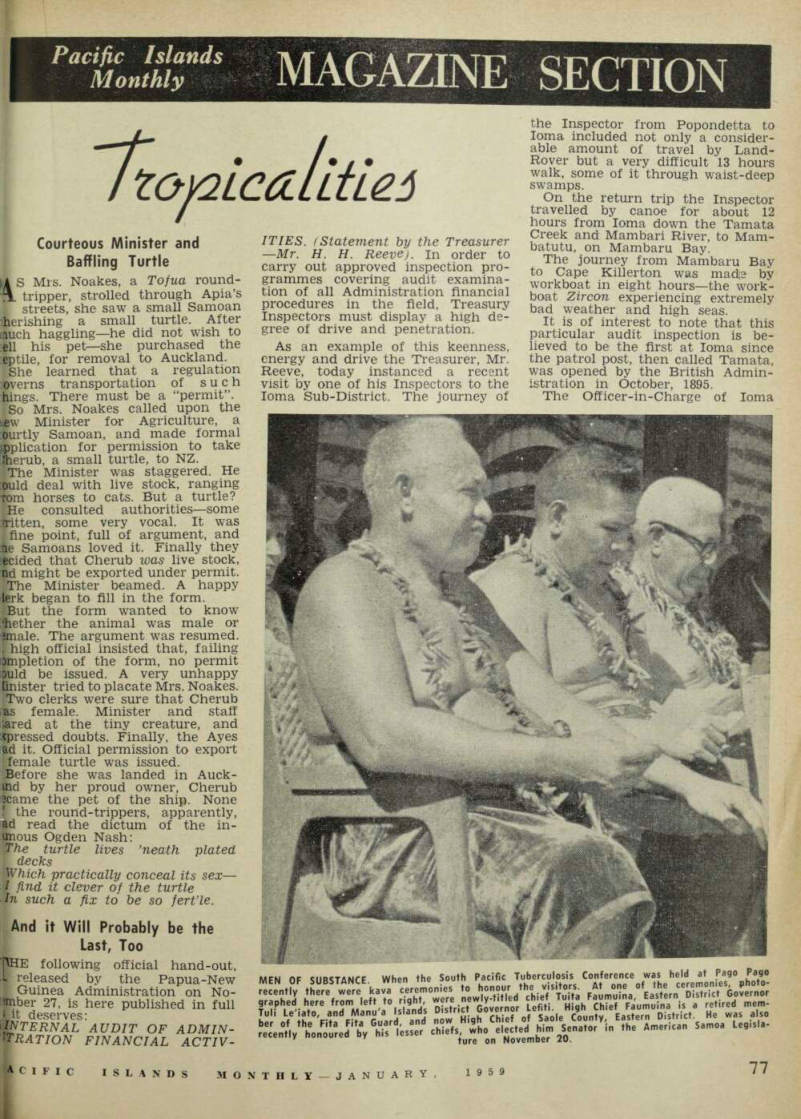
MEN OF SUBSTANCE When the South Pacific Tuberculosis Conference was held at Page Pago recently there were kava cermonies to hnour the visitors. At one of the ceremonies, photo graphed here from Ieft to right, were newky-titled chief Tuita Faumuina, Eastern District Governor Tuli Le'iato, and Manu'a Islands Kistrict Governor Lefiti. Kigh Chief Faumuina is a retired mem ber o f the fita Fita Guard, and now High Chief of Saole County, Eastern Dustrict. He was also recently honouted by his lesser chiefs, who elected him Senator in the American Samoa Legisla ture on Nvember 20.
Patrol Post has expressed his appreciation of the effort made by the Treasury Inspector to carry out this inspection and for his guidance and help in ensuring correct Treasury procedures at loma.
Just An Old Volcano WHAT was at first thought by officers of the MV Aros in No vember to be a rain squall, and then a burning ship, turned out to be the submarine volcano off Vangunu Island, Western Solomons, being active again. The last reports of activity there were in February.
Watching the Tuna's
Table Manners The US Fish & Wildlife Service has lately been taking a sort of below-the-table view of the tuna’s table manners.
It is all part of their Pacific Oceanic Fishery Investigations pro ject, designed mainly to assist American tuna fishermen—and par ticularly the Honolulu-based tuna fleet—to make better year-round
hauls using their traditional live bait surface-fishing methods.
PIM has reported experiments with Tilapia pond-fish, and with a variety of sardine found in Mar quesas waters as a suitable live-bait fish for this industry. Hawaii is short of such suitable bait, and the kind normally used, Nehu, will not remain alive in the bait tanks long enough to permit voyages as far south as the equator, where it has been proved that tuna are abundant at the time when they are absent from nearby waters of Hawaii.
F & WS research vessel Charles H. Gilbert took along a special observation diving bell on an Oc tober-November cruise to the Line Islands, and from it observers saw exactly how different varieties of tuna behave when their gastro nomic interest is stirred by dif ferent kinds of live bait—and also how the bait-fish themselves behave when tossed into the sea from the fishing vessel. Experiments were also made with dye in the water, simulating the disturbance normally caused by a shoal of bait-fish.
Very good observations we: obtained and are being analysed, preliminary report says that general skipjack tuna swam abc 10 feet below the yellowfin tu;j during surface feeding and mai dashes upwards to snatch a tilap or mullet. A movie camera was us underwater to record the feedii habits.
When is an Evil Not an Evil? rE printing factory of the F.
Times, in Suva, is a one-ston building, with a very high ro of corrugated iron. Mid-summ sun, playing on the iron roc created intolerable heat inside ti factory.
So the roof got a coating aluminium paint, and the facto* was perceptibly cooler.
But anew evil was created.
The top floor of the new Bari building, next door, is occupied the Commissioner of In 1 a i Revenue—which, in less refin language, means the Taxatd Department. The rays of the s’? deflected by the shining new pas from the Times roof, now liters blaze through the numerci windows of the Taxation office, 83 the industrious tax-gatherers hsi become somewhat vocal on ’ subject.
But is it an evil? The officic complain that the sun’s glare s making it difficult for them to rtn the complicated taxation return-
Such is Fame
AT least one New Guinea schd teacher has the doubtful saU faction of knowing that soo; of her words are heeded.
The particular teacher—an Territorian—has always emphasih to her classes that it does : matter whether a scholar cone first or last, so long as the studb tries. To make her point i picked up a pound note, poinn to one of the signatures on it, s said, “Now I went to school wj this man. He wasn’t particulsl brilliant, but he tried, and M where he is today”.
Later, two of the schoolchildb were shopping. Seen to be the pound note they were overhesi to say. “Miss so-and-so says went to school with that man. S said he was the biggest dill knew, yet look where he is todab Anyhow, some of the messas
had got across,