Cattle Industry
pp. 79-81 · Read in the full issue

Fiji Should Have A Better Cattle Industry
• Over 50 years ago, Mr. K. P. Wright, now a grazier of Quirindi, NSW. went to Fiji as a settler. He left there in 1917 and did not return until last wear when he made a short visit. The changes that he noticed after an \ibsence of 40 years, were naturally phenomenal—but not always on the \redit side. What he has to say here about the past and the present should make interesting reading for that section of the Fiji community which constantly, and with anguish, concerns itself about the future.
My interests, when in Fiji, were, at first, growing bananas, cocoa and rubber at Nai Koro Koro some 10 miles west of Suva, and later in rearing sheep and cattle on the Sigatoka River—the business to which I was reared, in Australia.
FOUND in 1957 that the Fiji 1 sheep industry appeared to be I extinct and that residents had orgotten that it was ever carried n.
I. with my father, imported 1,298 cheep in January, 1908, and the msiness was quite successful until e sold out and left in December, 017.
Nearly 2,000 of our she*ep were (horn at Sigatoka each year, and I told the surplus sheep to the > ! SR Co., and the wool in London. {Today the property has deterior ated beyond recognition. Homestead, (aeds, yards and paddocks have dis :ppeared and the land is a wilder ness.
Banana Bunches 4 ft. High The same, more or less, applies to iy once flourishing banana planta on at Nai Koro Koro and other lantations once known to me. )}iey are defunct, non-existent, here were several big, flourishing finana plantations on the Sigatoka, dipping magnificent bananas to :ew Zealand and Australia—bunches iur feet high and more. :At Korolevu, at that time, was Mr. Bucknell, producing sisal and attle; Yarawa, Quara-ni-Qio, omeri and Wai-ni-doi all grew ibber; there was also the big Van ouver-Fiji Sugar Mill at Navua. All fiese are gone.
In 1907, the late Mr. Mason mambers, of Hawkes Bay, New cealand, visited Fiji with the pur pose of investing £240,000 in graz ig, and erecting a meat works.
The Government of the day tifered him land on Vanua Levu the conditions and rent were : °t acceptable to him. He then en iged me to procure land from the tatives on long lease—a minimum r t 40,000 acres. I did this at Siga >ka, with frontages to the sea at Jjvi and Korotoga. I already held 000 acres at Rasikulu, on the
sfeatoka.
Governor in Council de ined to ratify my agreements, owever, and I then interviewed the
Governor himself, Sir Everard im Thurn, in August, 1907.
Sir Everard granted me 8,000 acres fronting Sovi, but the area was not sufficient for Chambers’ purposes and eventually, in June, 1909, under his instructions, I arranged to lapse the lease, and Chambers invested his funds in Malaya.
He did, however, finance me to import sheep and stud bulls, and I stocked my 4,000 acres at Sigatoka, then beautiful open country.
The undertaking was very sue-
cessful and Chambers would pos sibly have come back into the pic ture, but his only son was killed on Gallipoli so he told me to carry on, pay off what he had invested and then do as I wished.
This I accomplished and then sold out in 1917 to Messrs. Bryce and Howard, of Brisbane, who appear to have just faded out.
Strange Men in Strange Places The reason why I sold out was lack of Government co-operation.
When cattle men began to estab lish a market for cattle by shipping them alive to Sydney, which was very profitable, the Fiji Government prohibited their export for fear of raising meat prices locally. This happened during 1915 or 1916. I was in England at the time and obtained an interview with the late Mr. G. W. Johnson, CMG, at the Colonial Office, in April, 1916, and asked him to lift the embargo. He refused.
When I returned to Fiji I had no option but to sell my interests and leave the Colony.
The late Mr. Johnson’s obstructive tactics have been put on record by two prominent men: Sir Reginald St. Johnson, one time of Sigatoka and later of Lau, Fiji, and still later Governor of various Colonies, in his
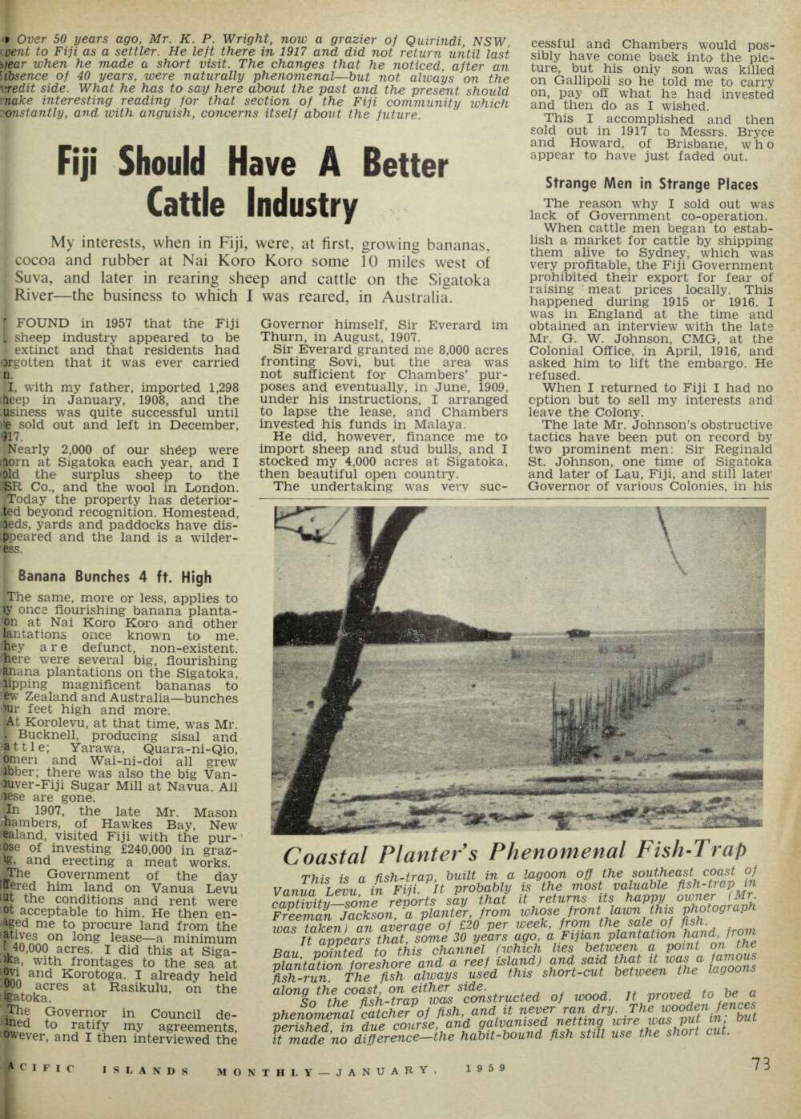
Coastal Planter's Phenomenal Fish-Trap
This is a fish-trap, built in a lagoon off the southeast coast of Vanua Levu in Fiji. It probably is the most valuable fish-trap m capHvitu—some reports say that it returns its happy owner (Mr Freeman Jackson,a planter, from whose front lawn this photograph was taken) an average of £ 2O per week, from the sale of fish.
It appears that, some 30 years ago, a Fijian plantation hand, from Bau pointed to this channel (which lies between a point on the plantation foreshore and a reef island) and said that it was a famous fish-run The fish always used this short-cut between the lagoons
along the coast, on either sibe.
So the fish-trap was constructed of wood. It proved to be a phenomenal catcher"of fish, and it never ran dry. The wooden fences a perushed, in due course, and galvanised netting wire was put in, but it made no difference-the habit-bound fish still use the short cut.
book, Strange Places and Strat Peoples, and Sir Arthur Grimblei A Pattern Of Islands.
The country which I operated now a huge Guava scrub, althou I had kept this under control.
Also, when I was in England d. ing World War I, I visited Everard im Thurn. He remarked,, I said good-bye: “I have alw: regretted that I and my Gove:; ment did not ratify those leases you and Chambers in 1907.”
The many excellent roads on t Levu were quite new to me, ano great credit to those who built th« Generally, they seem to follow tracks laid out by, I believe, the II A. B. Joske, 70 years ago.
New also to me were the ru dispensaries, which, under tc charge of Native District Nur: appear to be doing an excellent : But for some reason sanitation s cleanliness in villages have deteri ated. I visited several villages v known to me, where no atten appears to be made to keep gn cut and villages clean, as in past. Some of these are at Sigato and others on the south coasj including Nagaloko which was oc a delightful village but is now ■ a bog.
Trace Elements Work Miracll
Fifty years ago, the late C..
Knowles, who was then in chs of Agriculture, carried out so< pasture improvement experimej on my own banana plantationr Nai Koro Koro —where the land now reverted to sour bog. Neither us knew very much about this today the knowledge is availil and production could be lifted! as much as 300 per cent.
The future of Fiji must lies agriculture and grazing and soc as grazing is concerned, the prohJ does not lie so much in the quam of food but in the nutrition it o tains.
I say this with years of expj ence in raising sheep and ca: one mile up stream from Coco II 40 to 50 years ago, and my m recent experience in New So£ Wales, as a sheep farmer and S Hereford breeder, where lae otherwise of little value for site and cattle, can be made highly : ductive.
At Sigatoka the early grsi (when the land was virgin) T highly nutritious but deteriorates; other varieties crept in. In e years my cattle, 1,000 head, ' always fat and sheep “dressed"! to over 70 lbs weight.
During my rush 1957 tour roi Viti Levu I saw the CSR i Yaqara Estate which I knew in : j and had the luck to see their i Herefords —a branch of industfc carry on myself in NSW anon which, perhaps, I am qualifier speak.
There is a quantity of lush g pasture but the cattle, by Austrai
standards, are undernourished, ’fifty-four years ago cattle at Taqara were fat.
I feel quite certain this can be overcome by agricultural science.
There is a deficiency in Fiji [pastures which can no doubt be traced to “trial and error” methods. (Distributing superphosphate from rhe air at 1 cwt per acre may achieve what is required; or it may be necessary to add 1 or 2 oz per acre if zinc or molybdenum or some Jither “trace” elements.
If the soil lacks nitrogen, it can jie made good by sowing legumes, n Australia, clovers mixed with juperphosphate are sown from the :ir. The clear, mountainous land on Fiji’s northern slopes may be able o be treated similarly. In tropical Queensland, lucerne is grown on the lopes but I should like to see ex periments carried out with subter ranean clover in Fiji. [lf Fiji could achieve success in fusing good beef cattle, her :conomic difficulties would be largely solved, as it would be an fdustry suited to native village mterprise. Fiji imports about 400,000 bs of fresh beef per year and over 00,000 lbs of canned beef (as well is about 2,000,000 lbs of other meat [Q various forms). [So there should be plenty of :pope for growing more at home.