sgered£g “SSTi
pp. 71-73 · Read in the full issue

An Endless Chain of "Chicken of the Sea"
How Canned Tuna Saved American Samoa
By a Staff Writer
He never planned it that way—but it was the enterprise of the late Mr. Harold Gatty, famous navigator and founder of Fiji Airways, which saved the economic life of American Samoa.
TK)R over 50 years—from the l partition of the Samoan archipelago until after World War ll—American Samoa lived nostly on the American funds distributed through the American laval station at Pago Pago.
I Then the naval station was Closed, and no more Navy funds vere distributed therefrom. The Air Age deprived the sheltered, deep water harbour of much of its s'alue.
Suddenly, American Samoa had o live on its fat—and it had no at, only a little copra. Its plight, or a few years, was desperate.
Meantime, Harold Gatty had or ganised his huge tuna-fishing laiterprise, based on Suva and his ►relief that his fleet could catch the south Pacific’s tuna, and can and export them. ♦Everything went according to Jlan—except the tuna. For some “eason never yet explained, the tuna 'f the seas around Fiji will not be g-aught by the rod-and-line methods
which are effective with tuna else where.
Gatty’s company collapsed, and the assets were sold. The great American corporation of Van„ ?l P bought the canning f a ct°ry a sembled by Gatty, and put it advantage that it is a safe
sgered£g “SSTi
e erl Jf n el ffi t ow so that Its pro diSe when offered for sale in USA, carries no tariff penalty. ,
Jap Deep-Line Technique
The exper ienced Van Camp or ganisation did something that Harold Gatty presumably never thought of. It brought in the Japanese deep-line tuna fishers.
When Gatty made his plans, the Japanese deep-line technique had scarcely been heard of. Now, it keeps the huge Van Camp canning factory going in Pago Pago.
A fleet of 40 small, diesel-enginea Jap fishing-boats, based on Pago
Pago, ranges over the whole of the South Pacific, from the Equator to 24 degrees South, and from the Australian coast to the other side of French Polynesia.
Pago Pago people say the Japs have “a sixth sense”—they seem to know just where to go, at any time, to put out their tens of miles of lines.
The surface lines are buoyed.
Fastened to them, at intervals, are lightly-weighted lines not less than 300 fathoms (one mile) long, baited with a special fish bait brought from Japan by the fishermen.
When they get onto the schools, every hook captures a big fish — usually tuna.
The little ships carry masses of crushed ice, and special equipment to retard the melting of the ice.
The fish are gutted, and placed among the ice. The ships remain out until they get a load. Travel ling time and fishing time often involve an absence of several weeks.
Living conditions on the fishing ships are primitive. The handling of those lines represents ceaseless labour. The crew-fishermen have no amenities —they just lie down and sleep on the hard decks. But those I saw in Pago Pago in November seemed well and happy.
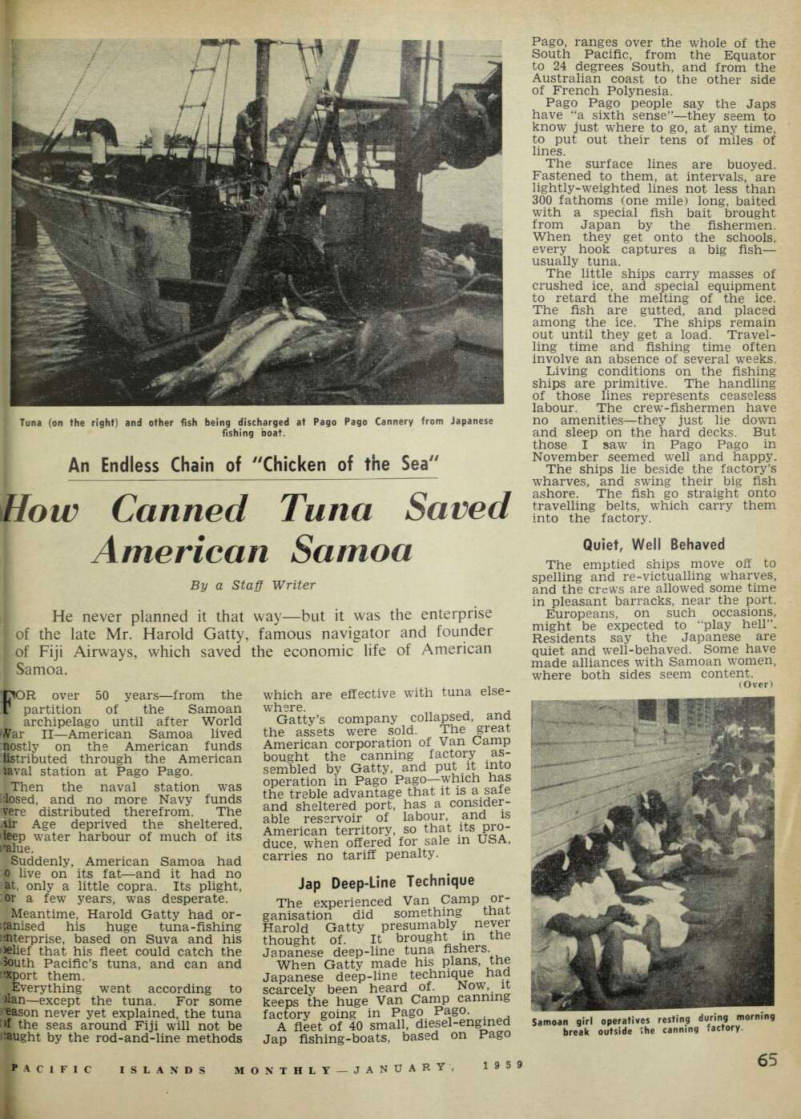
The ships lie beside the factory’s wharves, and swing their big fish ashore. The fish go straight onto travelling belts, which carry them into the factory.
Quiet, Well Behaved The emptied ships move off to spelling and re-victualling wharves, and the crews are allowed some time in pleasant barracks, near the port.
Europeans, on such occasions, might be expected to “play hell”.
Residents say the Japanese are quiet and well-behaved. Some have made alliances with Samoan women, where both sides seem content. (Over)
Tuna (on the right) and other fish being discharged at Pago Pago Cannery from Japanese fishing boat.
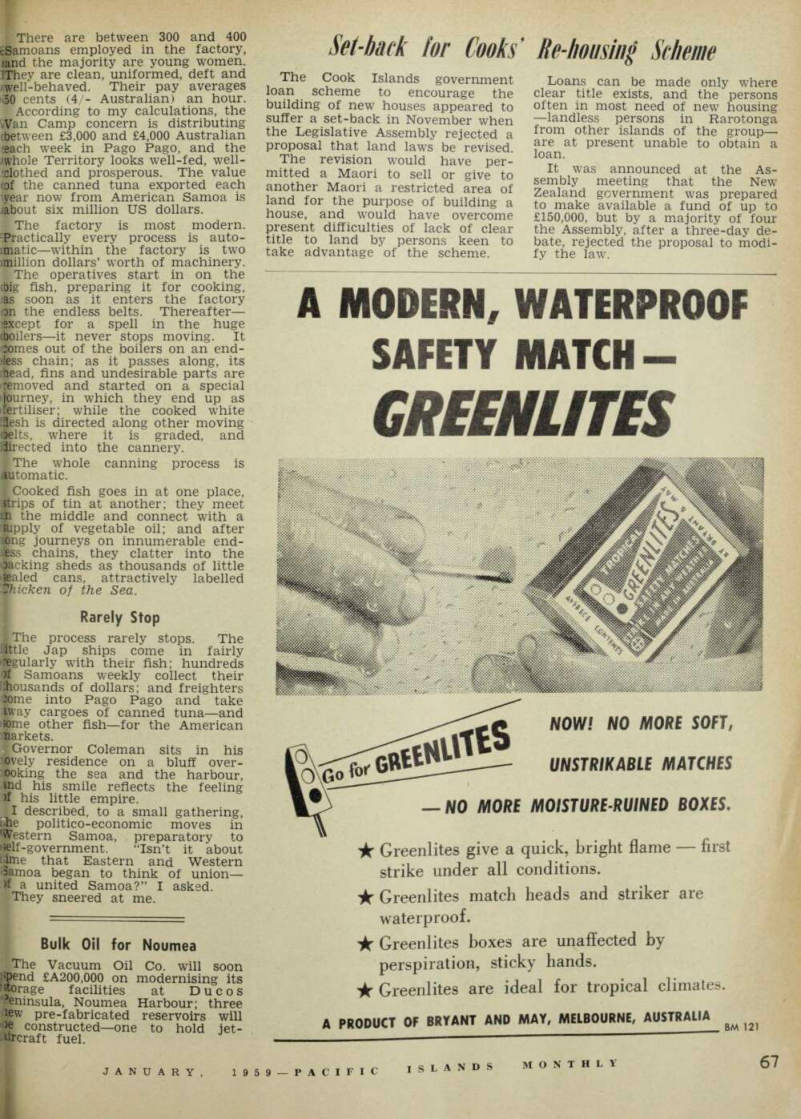
Samoan girl operatives resting during morning break outside the canning factory.
There are between 300 and 400 cSamoans employed in the factory, land the majority are young women.
IThey are clean, uniformed, deft and /well-behaved. Their pay averages (50 cents (4/- Australian) an hour.
According to my calculations, the Wan Camp concern is distributing (between £3,000 and £4,000 Australian (each week in Pago Pago, and the /whole Territory looks well-fed, well clothed and prosperous. The value of the canned tuna exported each 'year now from American Samoa is iabout six million US dollars.
The factory is most modern.
Tractically every process is auto onatic —within the factory is two (million dollars’ worth of machinery. i The operatives start in on the (big fish, preparing it for cooking, ;as soon as it enters the factory on the endless belts. Thereafter — (except for a spell in the huge (boilers —it never stops moving. It (pomes out of the boilers on an end less chain; as it passes along, its rhead, fins and undesirable parts are 'removed and started on a special •journey, in which they end up as •fertiliser; while the cooked white [flesh is directed along other moving (belts, where it is graded, and directed into the cannery. ■ The whole canning process is
Automatic.
i Cooked fish goes in at one place, strips of tin at another; they meet rn the middle and connect with a supply of vegetable oil; and after M)ng journeys on innumerable end less chains, they clatter into the •packing sheds as thousands of little sealed cans, attractively labelled thicken of the Sea.
Rarely Stop
■ The process rarely stops. The ilittle Jap ships come in fairly •regularly with their fish; hundreds )f Samoans weekly collect their thousands of dollars: and freighters :some into Pago Pago and take iway cargoes of canned tuna —and nome other fish—for the American markets.
J Governor Coleman sits in his }Ovely residence on a bluff over ooking the sea and the harbour, md his smile reflects the feeling his little empire.
I described, to a small gathering, i-he politico-economic moves in Western Samoa, preparatory to •self-government. “Isn’t it about ijime that Eastern and Western damoa began to think of union— )f a united Samoa?’’ I asked. (They sneered at me.