Some Criticism But Mostly ,
pp. 65-69 · Read in the full issue


The Massive Education Programme of W. Samoa
Some Criticism But Mostly , For Efforts Of Last 10 Years
From R. W. Robson, In Apia
In that land of controversies, Western Samoa, there is no more controversial subject than that of education. The whole population of 100,000 which includes about 7,000 part- Europeans —is reaching out after it.
IfpHE critics say that, while some A remarkable advances have been made in providing education, I the system is not sufficiently shaped —that there is too great a tendency rto provide purely academic train ting, while the Territory’s primary meed is technical training in things [like agriculture, animal husbandry 5 and the commoner handicrafts. 1 “State-trained children in Samoa rvery definitely lack discipline,” said ) one resident, discussing social trends iin the Territory. Said others: “The teachers do not seem to me to accept responsibility for the icharacter-training of their pupils.
There is going to be trouble here i among the young men—these teen iage youths are growing insolent and i arrogant.
“I fear that the things we are (taking away from them —especially t the traditional courtesies of the 1 Samoans —are things they can ill ! afford to be without.
A “Why has the South Pacific • Commission, which has had dis i-cussions on all sorts of other things, mot organised a forum of practical l teachers on these subjects—espec ially the effect of a village school education on a country’s social out ilook and customs? This is a matter :of importance in every Administra- Ition that is taking the job seri- I ously.”
Achievements of K. R. Lambie But that was only one side. The other side is seen in the statistics : and in the provision of schools and school-teachers, and both are a little overwhelming. They are the result of the introduction of K. R. Lambie ( to the Samoan Directorship of (Education some ten years ago, and of a happy and fruitful partnership between Mr. Lambie and the present Samoan Minister for Education,
■ Tuatagaloa.
This PIM writer incautiously said to Mr. Lambie that he would like to see something of the Samoan : education system. Thereafter, in (four breathless hours, in the com pany of that dynamic New Zea lander, he was shown: • The Samoa College, a sub ■ stantial, commodious, cool building
standing amid lawns where, five years ago, there was only a derelict plantation. Mr. Lambie somehow got 130 acres out of the Repara tions Estates; induced the Mormon leaders to bulldoze the site ready for lawns and buildings; planted trees; organised a staff; and last year put through about 430 students. His last job, before retiring, was to make plans whereby dormitories may be provided at the College for country students. • The Technical School, where I saw teams of boys being taught
carpentry, motor engineering, elec trical wiring, and various other trades. Mr. Lambie, with some official backing, just grabbed an old build ing and had it converted into a technical school; put a new build ing beside it; and now about 700 boys go through those busy class rooms every week. . . And this is not all—there are two other similar technical training establishments —
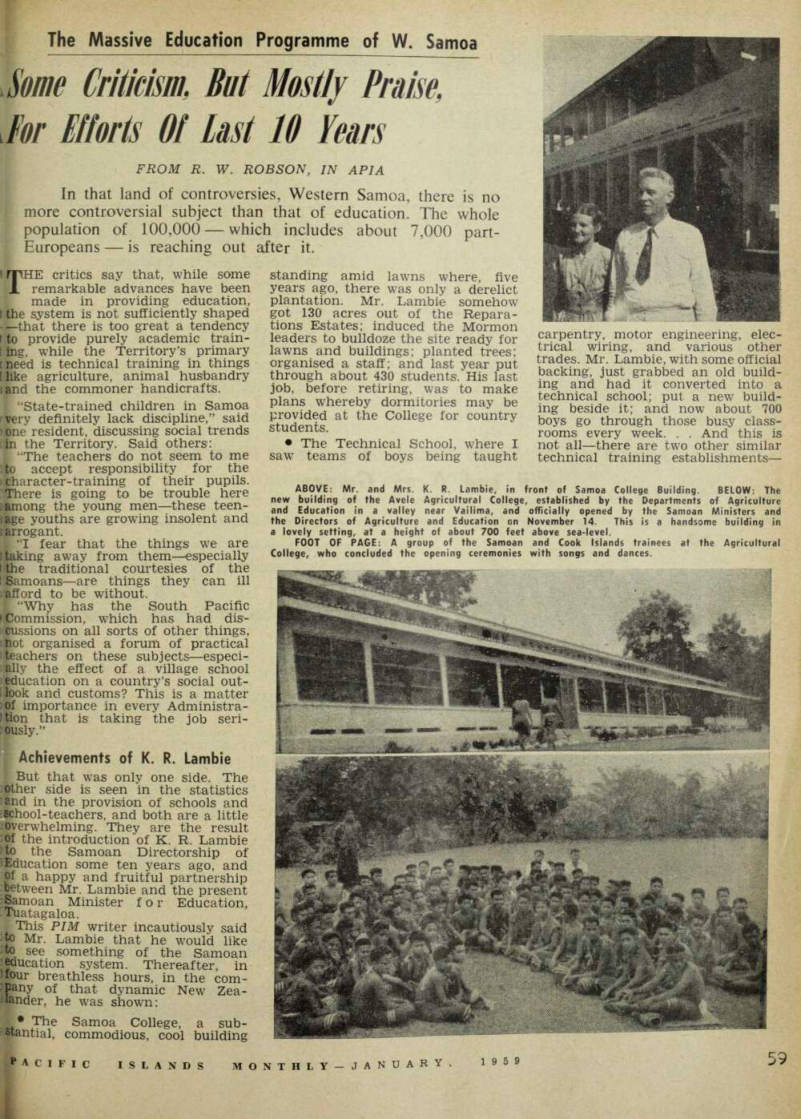
ABOVE; Mr. and Mrs. K. R. Lambie, in front of Samoa College Building. BELOW: The new building of the Avele Agricultural College, established by the Departments of Agriculture and Education in a valley near Vailima, and officially opened by the Samoan Ministers and the Directors of Agriculture and Education on November 14. This is a handsome building in a lovely setting, at a height of about 700 feet above sea-level.
FOOT OF PAGE; A group of the Samoan and Cook Islands trainees at the Agricultural College, who concluded the opening ceremonies with songs and dances.
e e over in Savaii. Education is co eerating with Agriculture to teach e young Samoans to grow food tiffs Mr. Lambie says the Samoans’ [□sumption of green vegetables is
■•easing steadily.
«• The official opening of a new nool at Afega Village—one of :>res of such well-built, tidy estab hments provided all over Samoa Trecent years, so that primary ideation now is available to every ,lage in the Territory. <| The official opening of the new iTicultural College at Avele (out ar Vailima), where some 200 boys ►m Samoa and the Cook Islands ve become the joint charges of :ucation and Agriculture Depart lints, for accommodation and in isive training.
It Happened in 10 Years ft was difficult to keep pace with t story of what has happened in ijst Samoa education in the last l years.
The most dismal chapter was pro ved in the preparations being made T “farewell” Mr. Lambie, then •jut to retire to a farm and a ision in New Zealand. It seemed stupid waste. He still is a man ;the prime of life, and still afire rt h enthusiasm in his work, herein he has had spectacular )(cess.
The system of retiring public ifcials at 50 or 55, just when they ve achieved maximum usefulness een especially in Fiji and Samoa las little to recommend it now. dical science has completely mged living conditions in these inds; and few men want to give their life-work in their ’fifties.
Mr. Parham is the highly-trained and dedicated agricultural expert who was driven away from Fiji, a few years ago, by official indifference.
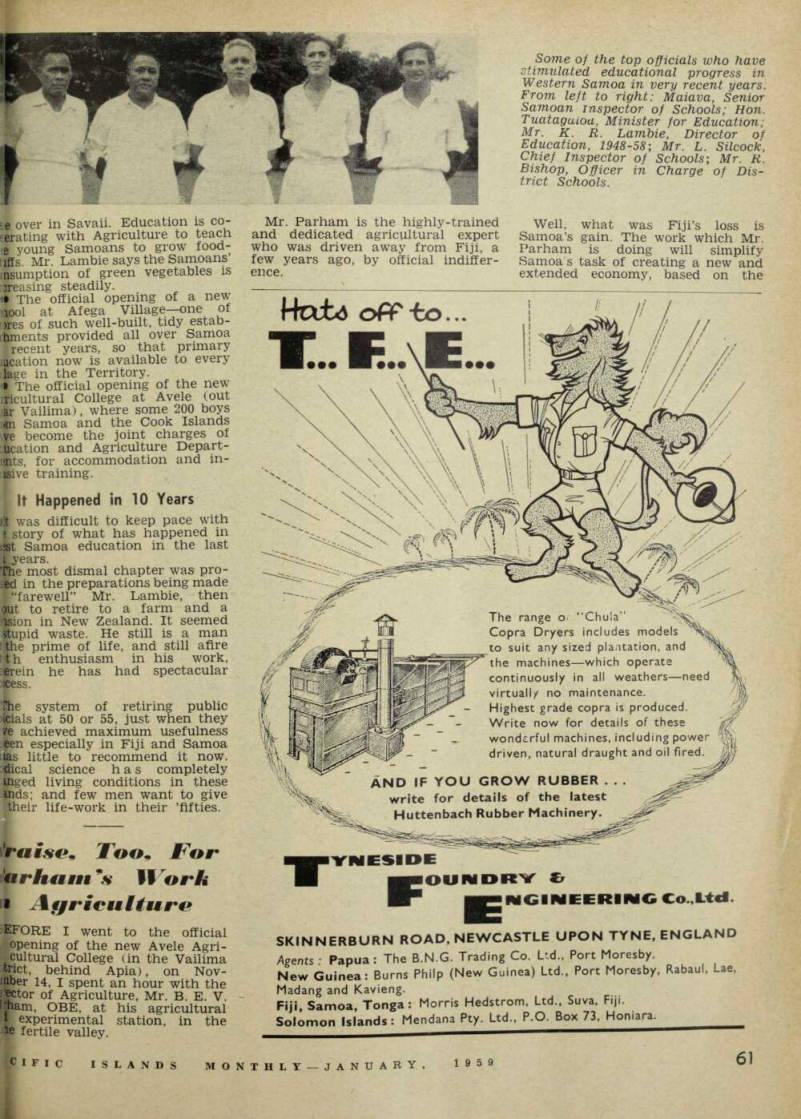
Some of the top officials who have stimulated educational progress in Western Samoa in very recent years.
From left to right: Maiava, Senior Samoan inspector of Schools; Hon.
Tuatagaioa, Minister for Education; Mr. K. R. Lambie, Director of Education, 1948-58 ; Mr. L. Silcock, Chief Inspector of Schools ; Mr. R.
Bishop, Officer in Charge of Dis trict Schools.
Well, what was Fiji’s loss is Samoa’s gain. The work which Mr.
Parham is doing will simplify Samoa s task of creating a new and extended economy, based on the
dbil, to take care of an expanding ■jopulation. tOn that station, a score of ex ijeriments are in progress, to show he Samoans other crops which may >e grown profitably for food or export.
Juv. Parham thinks they may aave the banana leaf spot disease iy the throat —a thing that is Djornmon to the Pacific Islands, and sfauses much loss in Samoa. Science nas produced an oil which, though >iot a fungicide, when used as a ipray does kill the leafspot. Only wo gallons to the acre are required ♦they now are trying to find out )|ow many sprayings a year are deeded.
I They are trying to establish the itrus as a common foodstuff in Upolu. Oranges are grown to a limited extent in Savaii—but, for :cme reason, not in Upolu.
IThe Agriculture Department arries out spraying of cocoa trees or private growers at so much per mndred. This is part of the cam »aign against black-pod, a fungus i&sease of the cocoa plantations, ipocoa trees, if well cared for, will iiear for 80 years in Samoa.
Over-age Palms
lOne of the real problems of Samoa s the age of the coconut palms.
The Department now is assisting he people to plant more palms, to ake care of the increasing popula ion. The target is 5,000 new plant -112 per week, for at least a year II two.
I There is much controversy in lamoa over the washing of cocoa.
Samoa has a high-grade export ]©coa, and it is washed. But big ©ncerns like Cadbury will not buy Samoan cocoa because it is washed, file Department is preaching against lashing— it argues that if a dif ferent technique were followed, Samoan cocoa could establish Accra ijuality and prices. [The Batiki blue grass of Fiji has <»een established in Samoa, and has iirovided an excellent pasture for Cttle. But Samoa at present does 1 lot run many cattle. It is hoped hat the more important sections of he Trust Corporation Estates will develop cattle-farming to a greater <ktent.