Christian And His Men Searched
pp. 55-59 · Read in the full issue



New Light on the Bounty Story
Christian And His Men Searched Nine Months For A Home
The most dramatic period of the Bounty story was per haps the time between the mutiny off Tofua in the Tongan Group, and the settlement on Pitcairn nine months later.
TIO much has been written on the ‘5 mutiny of the Bounty and its sequel the Anglo-Polynesian iiettlement of Pitcairn Island — [jhat, at first glance, it seems nardly possible that anything new ixmld be said on the subject.
If one delves a bit deeper, how ever, most of the accounts turn nit to be largely uncritical re netitions of standard works by iarrow (1831), Brodie (1851), Murray (1853) and Lady Belcher ;:i870), which were themselves based m little more than the reports of 1 few Naval officers, with some naditional information obtained from the islanders of the second jeneration.
To the modern historian these accounts are somewhat suspect, largely because the early chroniclers vere too often enthusiastic partizans n the unending Bligh versus Shristian controversy: or else anxious to paint an edifying picture )f moral regeneration in a Poly nesian Eden. [Furthermore, and no doubt hrough lack of accurate informa tion, they are conspicuously silent in what is perhaps the most event ul period in the whole Bounty latcairn story: the months which
Immediately succeeded the mutiny itself.
All authorities agree that this event took place off the island of Tofua, in the Tonga Group, on April 28, 1789; and most of them that Pitcairn was not reached by Fletcher Christian and his crew until January, 1790 (we now know that, despite local tradition, it was, in fact, first seen on the evening of January 15).
But what happened in the nearly nine months in between has hitherto been dismissed in a few sentences in which the dearth of fact is apt to be disguised by pious platitudes on such themes as the alleged degeneration in Christian’s character after Bligh had been abandoned to his fate.
The Stories of
Morrison and Jenny
The story of what happened dur ing this blank period in the chronicles, is now told for the first time in a documented research study by Pacific historian H. E.
Maude, in the current (June, 1958) issue of the Journal of the Poly nesian Society.
That it can be told at all is due
to two fairly recent discoveries (or more properly re-discoveries) : the Journal of James Morrison, which after disappearing for half a century eventually turned up in the Mitchell Library in Sydney, and
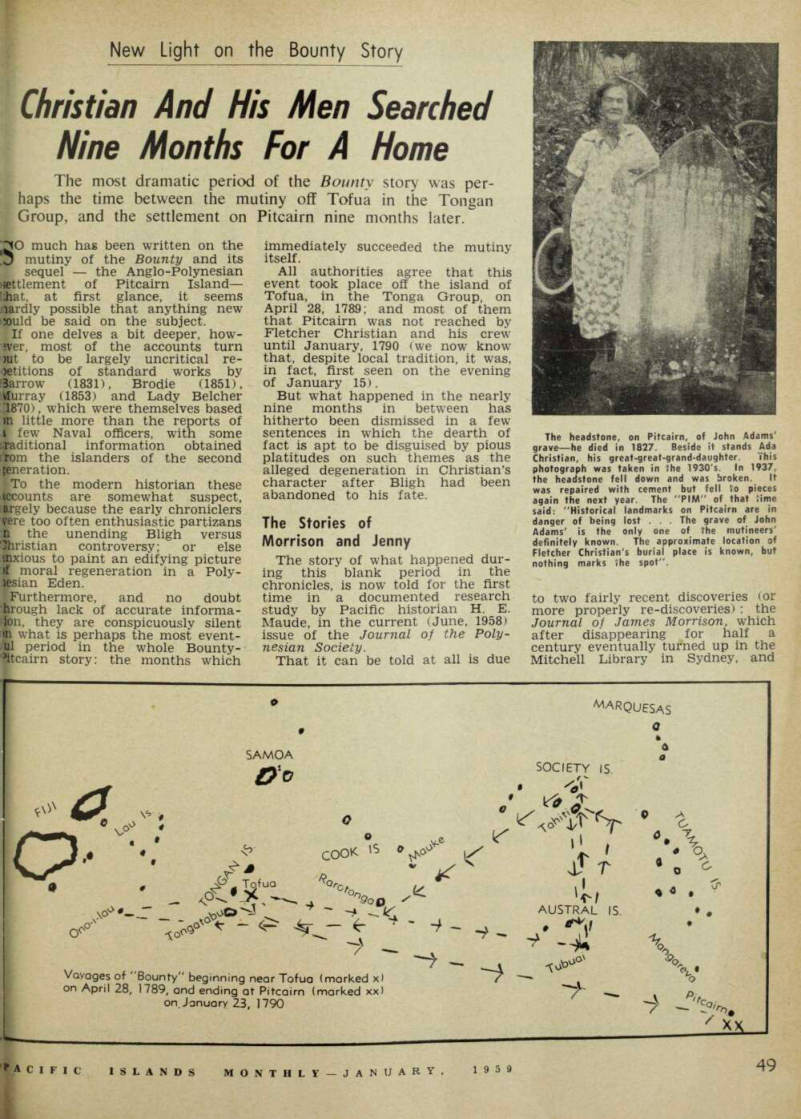
The headstone, on Pitcairn, of John Adams' grave—he died in 1827. Beside it stands Ada Christian, his great-great-grand-daughter. This photograph was taken in the 1930'5. In 1937, the headstone fell down and was broken. It was repaired with cement but fell to pieces again the next year. The "PIM" of that time said: "Historical landmarks on Pitcairn are in danger of being lost . . . The grave of John Adams' is the only one of the mutineers' definitely known. The approximate location of Fletcher Christian's burial place is known, but nothing marks the spot".
.te two narratives of the Tahitian, i sehuteatuaonoa (better known as i>nny), one of which was published . the Sydney Gazette for July 17, 119. and the other in the Calcutta vagal Hurkaru for October 2, 1826. : These informants had one in common: they were nth unwilling travellers on the ounty. Morrison deserted at the j ,'st opportunity—at Tahiti; where mny was shanghaied, initially to the consort of John Adams, and ter of Isaac Martin.
Jenny too deserted as soon as le could; but this was not until 1:17, when the whaler Sultan called f Pitcairn and took her to South merica, from whence she »ntually found her way home.
IMorrison is described as “a born server and recorder with a iaiuine and sympathetic interest in ie island peoples”, who with but t;tle training would have made a )lod anthropologist; while Jenny as a woman of unusually strong naracter, intelligent as well as retty. Her accounts, though they ck Morrison’s detail, are credible id consistent, and accurate where 'er they can be checked.
The two narrators fortunately rerlap and between them cover ie entire period from the mutiny I settlement at Pitcairn. Using >iem as a basis, but checking and nplifying from every other source tat has come to light as a result I several years of studying (Icairn’s history (including nine Onths spent on the island itself), aude has reconstructed the linerary of the Bounty’s final wage. This completely changes te traditional picture of a quick wage back to the delights of ahiti, followed by a direct run to llcairn, which Christian had from :e beginning selected as his
Ijture hideout.
ie Tubuai Experiment
Ipeality was indeed far different; id makes fascinating reading as ie dramatic tale takes us to the iflstral Group, and the island of :übuai, where Christian had ready decided to settle and where lie mutineers were met by 18 girls: ill young and handsome having ie long hair which reached their faists in waving ringlets” (but who •xned out, alas, to be decoys).
The story of Christian’s expon ent in colonisation on Tubuai is aced in detail. The initial battle ith the islanders at Bloody Bay as followed by a visit to Tahiti I procure women for wives, men r interpreters and workers and restock to augment the limited of the island.
Jhey returned from Tahiti, with 0 Pigs, 50 goats and the bull and left by Cook, but the amorous «in Adams lamented that: “We Q not find as many women as s wanted. Nine only came on )ard; and with them, eight men about 10 boys”.
Not long afterwards he was to lose his trousers on Tubuai in another escapade in search of the fair sex.
Despite successful negotiations for the purchase of land, and the construction of the formidable Fort St. George, whose remains may be seen to this day, friction with the local inhabitants led to an abandon ment of the colonisation scheme after less than three months.
Even if the other mutineers had shared Christian’s unusually pro gressive views on native rights they still could never have maintained harmonious relations in the heavily populated and faction-ridden Tubuai of the time.
Our hindsight shows failure to have been inevitable, but at all events, it enabled Christian to learn the lesson that in the end
pointed to Pitcairn: that the only island on which he could safely make his future home must be uninhabited.
The final decision that they should “go to Tahiti and there separate, where they might get women without force” was made by majority vote, 16 to nine, and Christian’s dramatic appeal in the cabin of the Bounty has come down to us through the years between; Gentlemen, I will carry you, and land you, wherever you please. I desire none to stay with me, but I have one favour to request, that you will grant me the ship, tie the foresail, and give me a few gallons of water, and leave me to run before the wind, and I shall land upon the first island the
ship drives to. I have done such an act that I cannot stay at Otaheite. I will never live where I may be carried home to be a disgrace to my family. *’he Isles of Solomon But Christian was not to venture ento the unknown alone; his loyal iriend Edward Young volunteered o accompany him, with seven of he seamen.
Leaving the others in Tahiti as iigreed, the little band sailed from Uatavai Bay: but not for Pitcairn, or Christian’s plan was apparently o rediscover and settle one of the fabled “Isles of Solomon”, never Eeen since their discovery by Mendana and Quires two centuries jtefore.
Jenny and the other women were •n board, but asleep below, and ?hen they woke up to what was Hoot they were a mile beyond the feef, and only one had the courage o swim ashore which, she says, several of them were inclined to o, as they were much afflicted at feing torn away from their friends md relatives”.
Later, after choosing partners, he remaining women who, in enny’s words, were “rather ncient”, were landed on Tetiaroa ;nd the course laid for the west. {Space here forbids more than the riefest mention of the eventful :oyage of the Bounty right across he Pacific; which incidentally re ciilted in the discovery of Raro (Dnga, in the Cooks, where an stonished islander who visited the hip reported that “it was a float ing island; that there were two ivers of water flowing on it; that wo large taro plantations, with
mgar-cane, bread-fruit, and other
fees, were growing there” (pre iumably the vessel’s pumps were :feing used, while she was known •3 have had on board “plants of II kinds that are common in these slands” for growing in the in vaded settlement). t From the Cook Islands on to ;onga, where Jenny saw the horned iattle left by Cook himself: and ihence even farther east as far as nji, where Christian would have ■Jttled in the Lau Group if only ihese islands h~d been found :sstitute of inhabitants.
It may well have been about this tags of the voyage, when any wither search of King Solomon’s .« es seemed hopeless, that l-nristian turned to the copy of ■ [awkes worth’s Voyages left by I'bgh in his cabin and read there lie description of Pitcairn given by ’■arteret, its discoverer; for, as laude states, “the high, tree uvered island, with its running ? ;ater, apparently uninhabited and itearly difficult of access, must ave appeared the solution to his oubles”.
At all events the Bounty’s bows ere now pointed towards it and ,le Pacific crossed for the third
and last time. Two weary months ensued, plugging into the south-east trades, during which Jenny says: “All on board were much dis couraged; they therefore thought of returning to Tahiti .
But it was worth it in the end, for when the island was eventually sighted Christian landed alone to prospect. Two days later he re turned, Adams reported, “With a joyful expression such as we had not seen on him for a long time past”.
The island had, in fact, exceeded his most sanguine hopes; in its fertility, its beauty, its temperate climate and, above all, in its now demonstrated inaccessibility, Pitcairn was ideal for its purpose. And, in addition, the race which had planted it ready for their use had apparently died out or departed, for the traces they found of their occupation were all old.
The Bounty’s long search for a home was over. Three days later she lay under the sea in the bay named after her; burnt to the water-line.
The full text of the paper “In Search of a Home”, on which this article is based, has now been reproduced by the Polynesian Society in its Reprint Series and is obtainable through any bookseller, or direct from the Secretary of the Society, Box 5195, Wellington. NZ. for 2/6 (NZ currency).