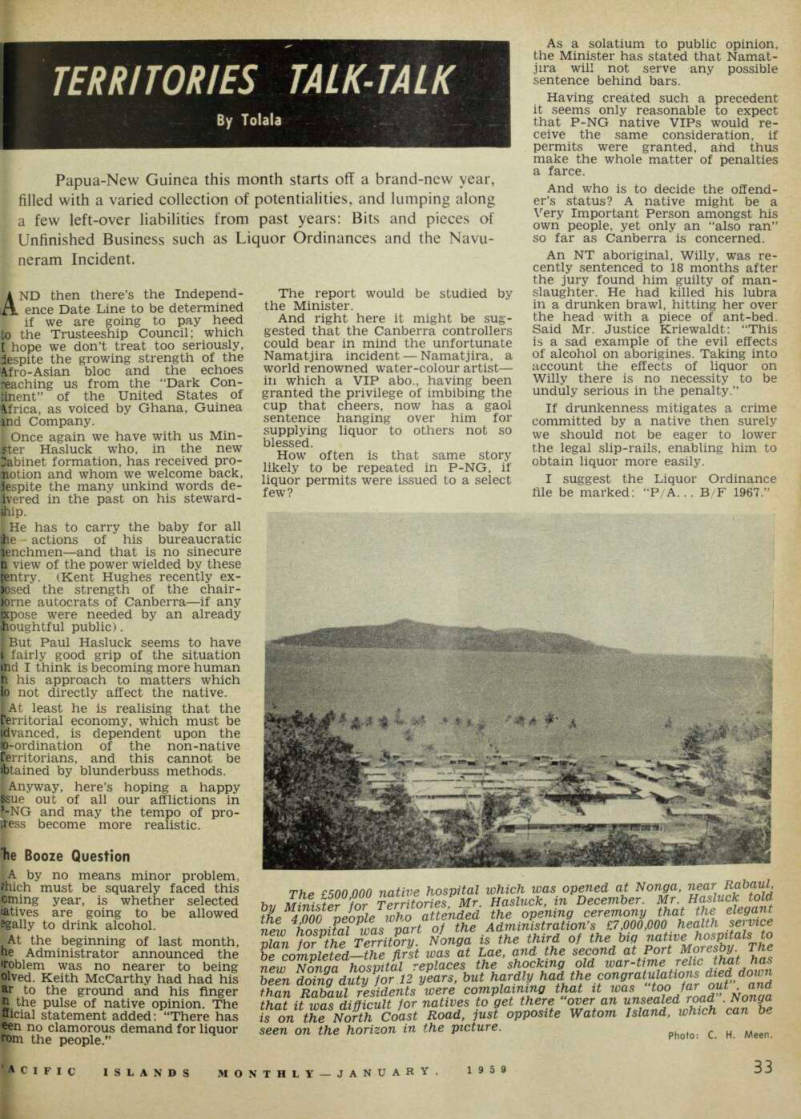
by Minister for Territories Mr. Hasluck, in December. Mr. Hasluck told
pp. 39-45 · Read in the full issue
Territories Talk-Talk
By Tolala
Papua-New Guinea this month starts off a brand-new year, filled with a varied collection of potentialities, and lumping along a few left-over liabilities from past years: Bits and pieces of Unfinished Business such as Liquor Ordinances and the Navu neram Incident.
AND then there’s the Independ ence Date Line to be determined if we are going to pay heed to the Trusteeship Council; which I hope we don’t treat too seriously, despite the growing strength of the Afro-Asian bloc and the echoes reaching us from the “Dark Con tinent” of the United States of Africa, as voiced by Ghana, Guinea ind Company.
I Once again we have with us Min ster Hasluck who, in the new Cabinet formation, has received pro notion and whom we welcome back, Respite the many unkind words de ivered in the past on his steward ship.
He has to carry the baby for all fie actions of his bureaucratic lenchmen—and that is no sinecure b view of the power wielded by these [entry. (Kent Hughes recently ex posed the strength of the chair prne autocrats of Canberra —if any ixpose were needed by an already
houghtful public).
• But Paul Hasluck seems to have I fairly good grip of the situation ind I think is becoming more human n his approach to matters which lo not directly affect the native. lAt least he is realising that the territorial economy, which must be Idvanced, is dependent upon the to-ordination of the non-native ferritorians, and this cannot be Obtained by blunderbuss methods. {Anyway, here’s hoping a happy ssue out of all our afflictions in *-NG and may the tempo of pro fess become more realistic.
he Booze Question
A by no means minor problem, fhich must be squarely faced this cming year, is whether selected latives are going to be allowed egally to drink alcohol.
At the beginning of last month, be Administrator announced the •roblem was no nearer to being olved. Keith McCarthy had had his ar to the ground and his finger 2 the pulse of native opinion. The aicial statement added: “There has €en no clamorous demand for liquor * , om the people.”
The report would be studied by the Minister.
And right here it might be sug gested that the Canberra controllers could bear in mind the unfortunate Namatjira incident Namatjira, a world renowned water-colour artist— in which a VIP abo., having been granted the privilege of imbibing the cup that cheers, now has a gaol sentence hanging over him for supplying liquor to others not so blessed.
How often is that same story likely to be repeated in P-NG, if liquor permits were issued to a select few?
As a solatium to public opinion, the Minister has stated that Namat jira will not serve any possible sentence behind bars.
Having created such a precedent it seems only reasonable to expect that P-NG native VIPs would re ceive the same consideration, if permits were granted, and thus make the whole matter of penalties a farce.
And who is to decide the offend er’s status? A native might be a Very Important Person amongst his own people, yet only an “also ran” so far as Canberra is concerned.
An NT aboriginal, Willy, was re cently sentenced to 18 months after the jury found him guilty of man slaughter. He had killed his lubra in a drunken brawl, hitting her over the head with a piece of ant-bed.
Said Mr. Justice Kriewaldt: “This is a sad example of the evil effects of alcohol on aborigines. Taking into account the effects of liquor on Willy there is no necessity to be unduly serious in the penalty.”
If drunkenness mitigates a crime committed by a native then surely we should not be eager to lower the legal slip-rails, enabling him to obtain liquor more easily.
I suggest the Liquor Ordinance file be marked; “P/A... B/F 1967.”
The £ 500,000 native hospital which was opened at Nonga, near Rabaul, by Minister for Territories Mr. Hasluck, in December. Mr. Hasluck told new hospital was part of the Administratins £7,000,000 health service plan for the Territory. Nonga is the third of the big native hospitals to new Nonga hospital replaces the shocking old war-time relicthat has been doinag duty for 12 years, but hardly had the congratulations died down than Rabaul residents were complaining that it was “too far out . and that it was difficult for natives to get there “over an unsealed ". Nonga is on the North Coast Road, just opposite Watom Island, which can be seen on the horizon in the picture. photo; c H. Meen
Why ... No Clamour?
■ The fact that there is reported to be no “clamorous demand” by 1 the [native] people is somewhat ominous. In view of the reported 1 clamping down on metho. and the unusual increased sales of Aus tralian whisky it would seem to in dicate that those natives who have acquired a taste for what the Tolais used to term tava na long long tcrazy water) have made suitable arrangements to satisfy their alco holic appetites.
I In other words they have gone underground, and all the King’s horses and all the King’s men won’t bring them to the surface again.
It could cause a spot of bother, of course. Not among the Really Influentials but amongst the lower orders who would become jealous of those in the higher bracket.
I In parenthesis, I must say I am astonished at some of the names of the present-day Really Influential People in privileged positions who, in the pre-war years, were anything but persona grata.
But Time moves along, I suppose, and policies undergo a change; though I very much doubt whether the indigene —in this instance — differs vastly from the leopard.
No Colour Bar
Fairfax Ross, MLC, can take a bow for his forthright statement Concerning the absence of a colour bar in the Territory, J “There is a bar,” he said to a local newspaper, “but not of colour.
It’s a bar of achievement.”
In other words it’s a cultural bar and it cuts both ways The native is just as quick to adopt this cultural bar, if a white man does not conform to the native standard, as is the white towards a native who does not obey the demands of civilised living.
Unfortunately, the white seldom bothers to acquire knowledge of
native tradition, far less to conform with their customs. How often have ignorant whites violated native iambus and shown crass disrespect for age-old lores and procedure?
This pronounced disregard for native customs has been most general in the more recent years. In earlier days incoming whites were screened and received tuition in native protocol and realised the value of observing it—or else.
Can we expect that, when they have attained their independence (which will come at some future date), the native culture will be entirely replaced by that of western standards? I should say the answer is in the negative, and, furthermore, there is every possibility that
the government of that day will be found to be far more tyrannical and despotic than any foisted upon them by a paternal and benevolent white administration.
And then the sparks will begin to Ay- History does repeat itself, and there’s no reason to think that an independent New Guinea will be different to all the others, Pioneers Something I read recently turned my mind down Memory’s Lane, and brought back those days when radio, refrigerators and aeroplanes were unknown and even motor-powered seacraft deemed a luxury, It was only in 1914 that wireless
;elegraphy came to Rabaul, then the capital of the German Territory— :dth the erection of the Bitapaka station. Before that, urgent messages •tere sent by steamer to Yap, the cable station in the Carolines, or 0 Australia.
Ice was never a problem in Rabaul ownship. Louri’s ice-works were established well before War I. Life ras easier for the town dweller, but ne plantation people, and those in iie outports, had to contend as best ney could with greasy butter, and inned meats, warm beer and lonths’ old news.
Lack of refrigeration was the aast of a planter’s worries with his wn fowls, pigs, fish from dynamite [looting and balus from a good noot-boy; even beer was made more salatable with the aid of a tub and rashing-soda.
And as for aeroplanes: I remember Ihen the USS Milwaukee arrived 1 Rabaul in the middle twenties, ley put up a couple of seaplanes ut only just. The humid atmos :iere affected the carburettors (or anething) and they had to be rounded.
The biggest bugbear was the lack I speedy transport in cases of ■ergency. We all have our nemories of lives that could have Jen saved had we only had planes ■ auxiliary vessels to take sufferers I medical aid.
I wonder whether present-day erritorians stop to realise what the (-timers had to contend with? ot for a moment would I deny the Swcomers all the modern amenities I life. Good luck to them! But I auld like to see perhaps a modicum ■appreciation shown to the people ho “blazed the trail” and thus ade it possible for the present
lite settlement.
ade Boosting
Auckland Correspondent Shortall :IM, Dec., p. 53) starts a line of Inking for P-NGites. But I fear at with Australia scraping the (torn of the tin for overseas arkets to keep the wheels of in istry turning, P-NG is going to get fie support from the government, ■ambers of Commerce or manu feturers.
JPS puts forward some good fgestions—his return of giant ails to Japan was even featured I “Granny” in the SMH. He also tv e s an appropriate list of •tential products which easily uld become best sellers in some arkets.
To this list I would like to add e always-popular Buin Basket (or ten referred to, incorrectly, as the Basket). Unlike most Islands d other baskets it is most durable; Buka Basket is a lifetime job.
P r °P er organisation this aid become a real money-spinner, d does not cut across any Aus «ian manufactured article.
Another item is cane furniture. 3st of this commodity used to
come from Manila, Hongkong or Singapore. Over thirty years ago I remember buying reasonably well made cane chairs, lounges, tables and book-cases made in TNG native villages, more especially from Buka.
Admittedly the finish was a bit crude at that time, but it improved and with technical guidance I see
no reason why P-NG natives should not produce a cane article com parable to anything from anywhere.
Cane and fibre are grown locally.
And who says that light, cool cane furniture is not to be preferred to tubular stainless steel structures at exorbitant southern prices?
Over to you, SPC experts. (Over)
The Chinese community in Rabaul built this new Kuo Min Tang building some months ago and opened it with all the fireworks and fun on Double-Ten Day—that's October 10 to you, and marks, we think, the anniversary of the Sun Yat Sen revolution. Photo: C. H. Meen.
ils or Sales
:’he arrival of Mr. and Mrs. Pence i their six-months-old son in iney from the US, en route to v Guinea, was reported at the I of last month in the Sydney >*ss, referring to them as “linguist sssionaries”. le had completed a Commando isrse in Mexico to fit him for the tors of the jungle life ahead of 4. The Pence’s missionary organ :;ion is said to be non-denomin onal and is called the Summer jtitute of Linguistics said Mr. ice and explained that the mder —a Mr. Cameron Townsend rent a Guatemala in 1940 to sell Ues to the natives, but discovered y could not read, so he stayed jleach them to read and write ir dialect and then he sold them T Bibles written in their own
iuage.
:t‘s surprising how well these rkers in the Lord’s Vineyard are anising themselves these days 1 one can be excused if one fders at times, exactly what their ;get may be: Saving souls or sell
r Bibles?
lur e 1 y the establishment of jsionary organisations in NG has xhed saturation point. Or is this npetitive confusion to continue ad
biitum?
ring Poor?
n the December issue of the ly a 1 Commonwealth Society’s Inal, Outlook, appears a letter m a native clerk employed by Native Land Commission at baul. He writes; “As I am un e to pay any subscription fees, it ('Useless to beg for continuation |his wonderful magazine, but I )w you have been very good to lin sending them to me for the t five years free. If it is all right you to continue my copies, I uld be very glad as I am very Irested in reading them from time time as they come. . . Thanks I your wonderful work in the yal Empire Society, and now all I best for the new title, “The yal Commonwealth Society”, in editorial note says; “Despatch Outlook will be continued.”
Certainly a very generous gesture the part of the RCS, and one * understand the Society’s in est in what the heading states; Papuan’s Appreciation of tlook”. iut it does give the impression it there is a member of the xiliary Division of the Papuan w Guinea Public Service who is ively struggling to make ends et on a salary inadequate to isfy his aesthetic tastes. have repeatedly heard from >ple in Australia, who have >pted P-NG natives as Pen ends, how readily their corre •ndents “put in the nips” for vari * little items which they claim ; y are unable to secure in P-NG.