Tourist Hotels
pp. 21-152 · Read in the full issue
They Help to Balance Budgets
Fiji Wants More
AS the years pass, and the need grows for earning overseas funds, Fiji becomes more Tour ism-conscious; and this, since War 11, has been expressed with effective ness through the Fiji Visitors’
Bureau.
Various patriotic citizens have given much time to the Bureau; and its work was done excellently by that restless genius, Bob Hewlett.
The Bureau greeted the incoming traveller at Nadi or Suva, with leis, pamphlets and. soothing words; helped him with kindly interest while he was in the country; fare welled him in Polynesian fashion— and (this most important) sent him off with a desire to tell his friends about Fiji, and distribute the appealing literature of the Bureau.
Fiji Visitors' Bureau
It was slow but sure propaganda, and its certainly paid off. It was a bad blow to Fiji Tourism when the mercurial Bob Hewlett was lured away across the world to a similar but much bigger job.
After that the Bureau learned, the hard way, one of the outstand ing facts of post-war life —that suit able executives are very hard to find.
The Bureau’s Directors appointed, to fill Mr. Hewlett’s place, a lively overseas journalist named Peter White. Mr. White, like most strangers in important jobs, felt that new methods and viewpoints were necessary; and he proceeded to point out the errors of their ways to a couple of senior citizens who had contributed much to the Bureau in ideas and honorary services. He could have been right, of course, but he was not very wise.
By November last, the Fiji Visitors’ Bureau and their new secretary-manager had parted com pany.
In December, the Bureau appointed to the job Mr. Don Lane —a young man who has been engaged in busi ness in Suva for several years, and is well and favourably known. He may be short on knowledge of public relations: but he does know the Fiji scene, and he will have the goodwill and help of most of Fiji’s business men.
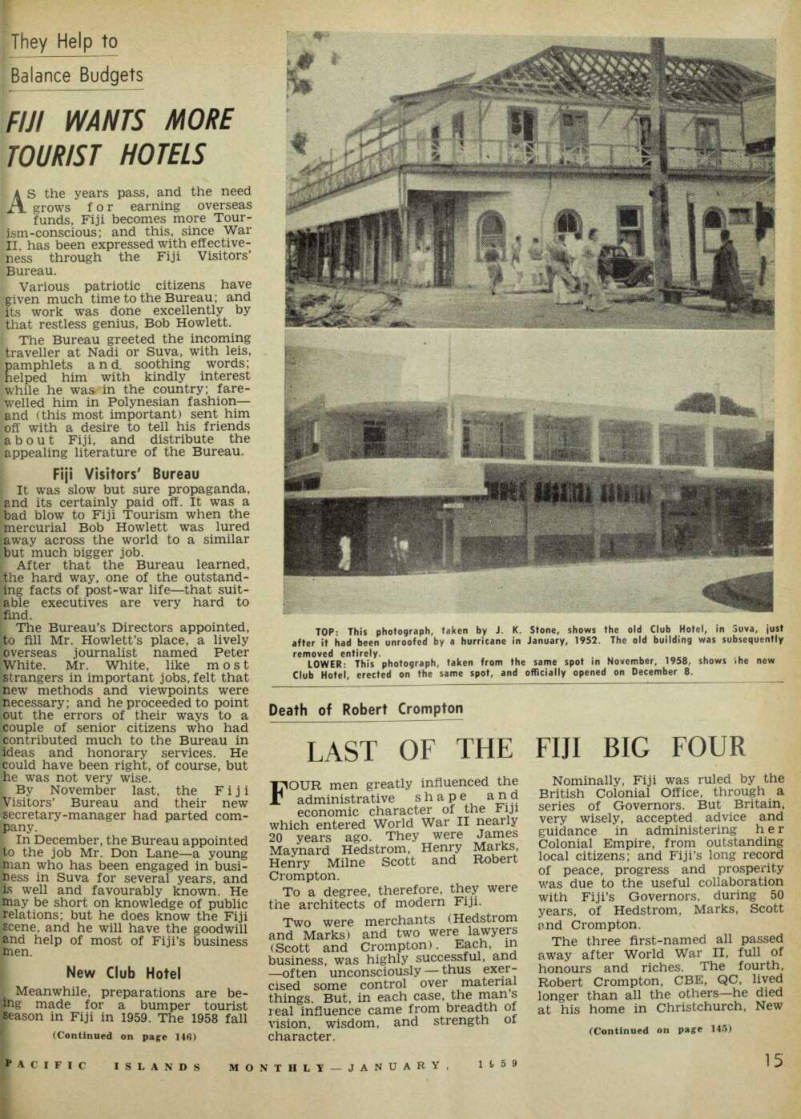
New Club Hotel
Meanwhile, preparations are be ing made for a bumper tourist season in Fiji in 1959. The 1958 fall
(Continued on page 146)
TOP: This photograph, taken by J. K. Stone, shows the old Club Hotel, in Guva, just after it had been unroofed by a hurricane in January, 1952. The old building was subsequently removed entirely.
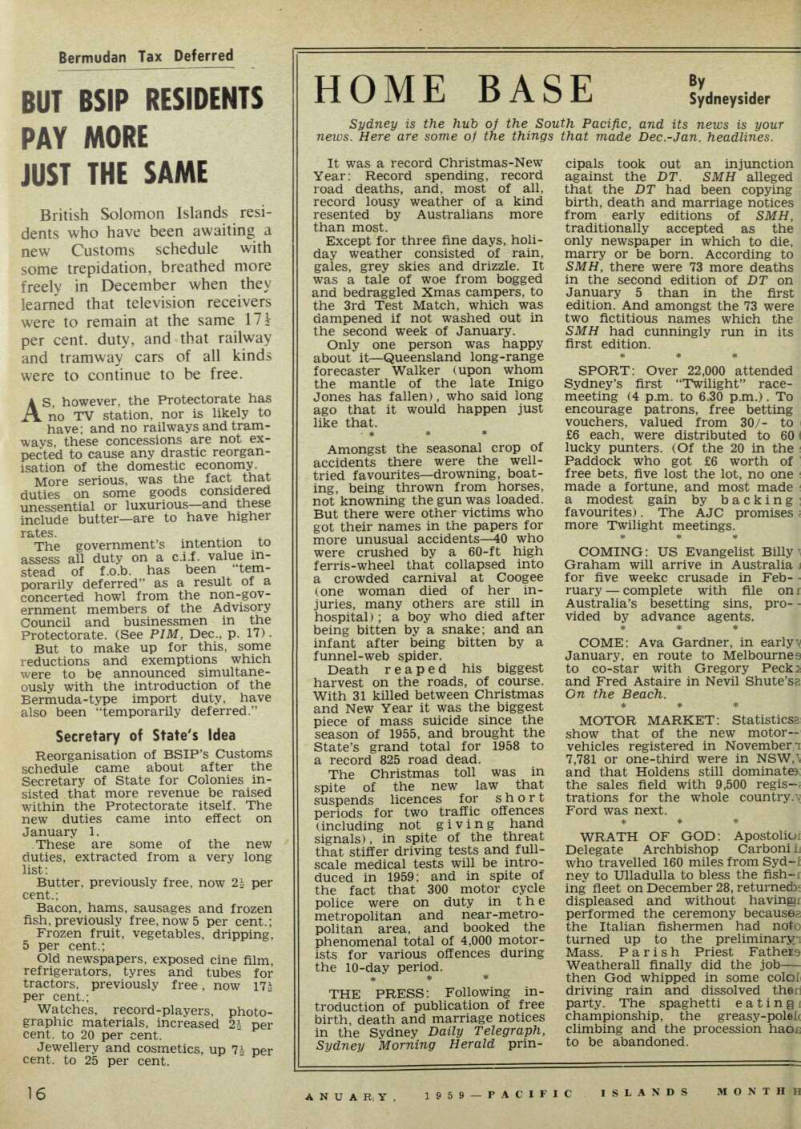
LOWER: This photograph, taken from the same spot in November, 1958, shows the new Club Hotel, erected on the same spot, and officially opened on December 8.
in exports calls for a concerted effort to sell more Tourism.
The new Club Hotel in Suva has been open since early December, and reports that, although this is the “off” season, it is selling enough of its h i g h-c lass, air-conditioned accommodation to prove the theory that there is a need for this class of costly service.
The Government has announced the terms under which it will financially help hotel-owners to build new hotels or enlarge those now functioning.
Awaiting Next GPH Move Meanwhile, Fiji travel interests are watching the Grand Pacific Hotel situation with interest.
There has been a development since the Union SS Co. announced that it would not seek to renew the lease (expiring in April) of the reclaimed land on which the hotel is built and that, under the terms of the contract made some 50 years ago, the Fiji Government is expected to take over the hotel, at current valuation.
No one has hazarded a guess at the value of the hotel, with or with out equipment. It could be anything from £50,000 to £lOO,OOO. One of three things will happen: • The Government will take over, at valuation, and sell to the highest bidder. • The Government will take over, as per contract, and will lease the hotel to some interest which will
co-operate with other Fiji interests in promoting tourist traffic. • The Government will make a mutually agreeable arrangement with Union SS Co., under which the Co. will continue to run the hotel.
On January 3, the Fiji Govern ment invited tenders closing Feb ruary 28, for a 99 years lease of the hotel, as a going concern, fully licensed, equipped and staffed. If the successful tenderer is prepared to “modernise and enlarge” the hotel, the rent will be “nominal” for the first 25 years.
Considerable interest has been shown, both in Fiji and overseas; but there will be no further develop ment until after tenders close.
This gives an average c.i.f. p of $205, which is £9l in Austrai currency.
It is, however, impossible to on those figures an average o to the NG producer, of getting co to the UK, as P-NG export c on copra rises as the f.o.b. p rises.
During 1958, freight charges v £Stg.l3/10/- R a b a u 1-London this with discounting, hand* shrinkage and insurance probu amounted to £A2O per ton.
To that has to be added the CN handling expenses (including sh doring and Government wharfs and shrinkage, which the Bo calculates at another £A3/16/-; finally, export tax and stabil tion fund contribution, which be upwards of £6. There is i change left out of £3O when all is added up.
In 1959, freight rates will. about 40 per cent, lower £Stg.BJ ton, Pacific port to UK port.
In the first week in Janui 1959, the Philippines c.i.f. pricu London was $250 —equivalent; £AIIO. The price being paid hy\ Fiji mill that week was £F7B ton —equivalent to £AB7/15/-.
Prospects for 1959 Few people in the industry commit themselves to any pro tions for 1959. The drought and oo circumstances in the Philippe and internal unrest in Indonr were big factors in the steep n rise in the last quarter of : These conditions carried into i New Year.
On the optimistic side it carj said that, with huge increases the world’s population, partica’i in Asia, there is more demandb the products of the coconut, tainly in Indonesia, and to a j marked extent in the Philippq more coconut products are tel consumed at home.
On the pessimistic side it fact that when prices rise as certain limits, buyers tend to c alternative and cheaper oils ww they can. Bumper crops of suclo seeds as groundnuts and soya bd have been predicted for the cone year.
Another factor in the situatioi the withdrawal of Norway fromrr international whaling agreens which limits the catch of whl Norway has pulled out Russians are not a party to o agreement, and with Norway ouc is useless for the other whsrl countries to limit their activity This breakdown in the agreens is likely to lead to more whaMi on the market in the next seasajE but a lot fewer whales in the fuu: