Free Marketing In 1958
pp. 19-152 · Read in the full issue
It's Been a Happy New Year, Too
Pacific Planters Did Nicely From Free Marketing In 1958
British planters in the South Pacific who a year ago expected the worst when copra, for the first time in a decade, reverted to “free marketing”, found that 1958 realised none of their fears, but to the contrary, brought bigger profits. And they enter 1959 on the same wave of high prices.
IIfHEN the nine-years United ff Kingdom Ministry of Food agreement ended on December 11, 1957, planters with memories hat went back to the open-go narketing of before World War 11, lad some misgivings. It was open ;o marketing with some differences, lowever, as most producing terri ories had made some forward irrangements for disposal of pro »ortion of their production.
With the exception of Fiji, most f the arrangements included dis posal of a proportion to Unilever t a price to be based on Philip pines price.
Papua-New Guinea, which is the iggest producer in the area, rranged to sell about 20,000 tons to Fnilever, about 35,000 tons to Aus ralian crushers, 40,000 tons to the )cal crushing mill at Rabaul and le remaining 5,000-odd tons on the pen market. All these arrange lents were based on Philippines rice.
Again with the exception of Fiji, 11 the territories involved continued ) market through government or mn-government copra marketing sards.
Fiji's Simple System
Fiji, however, disbanded the copra sard that had been in existence iring the currency of the MOF greement, and planters proceeded • make their own individual *rangements.
In the event, the majority dis ced of their copra at the Suva ushing mill of one of the W. R. arpenter companies.
The mill buys at a price that is sed each week and the Fiji planter no sells his copra in this way will nerge from 1958 certainly no worse f—and probably better off—than s brother planter in, for example, 3w Guinea.
Such has been the success of the iva scheme, that producers in estern Samoa and Tonga look »on it enviously. They have con lered a mill of their own, but this an economic impossibility with ■t an output of 25,000 tons of copra r annum, which neither has at esent.
The Fiji system has the merit of simplicity. The planter delivers to the mill, is paid promptly—and the deal is completed.
In New Guinea, it is more com plicated. All copra is purchased by the Board, even that which goes to the local mill. The planter is paid a “tentative price”, which is necessarily a great deal below the final price, and it is not till well into the next year of operations that the final payments are made.
The Test Could Come Later Papua-New Guinea planters are, however, well enough satisfied with their Copra Marketing Board, which was retained after the end of the MOF Agreement at their request.
They have three of the six seats on the Board. The extremely modest “Tentative” price declared for copra by the Board in January, 1958, was partly in order that it could finance its own activities from accumulated funds.
The real test of whether a Board
i s an advantage will come when or if the copra industry falls on hard times.
The tentative P-NG price of £A47 per ton made in January, 1958, had been raised by the end of 1958, to £ASS per ton (top grade). This still
(Continued on page 140
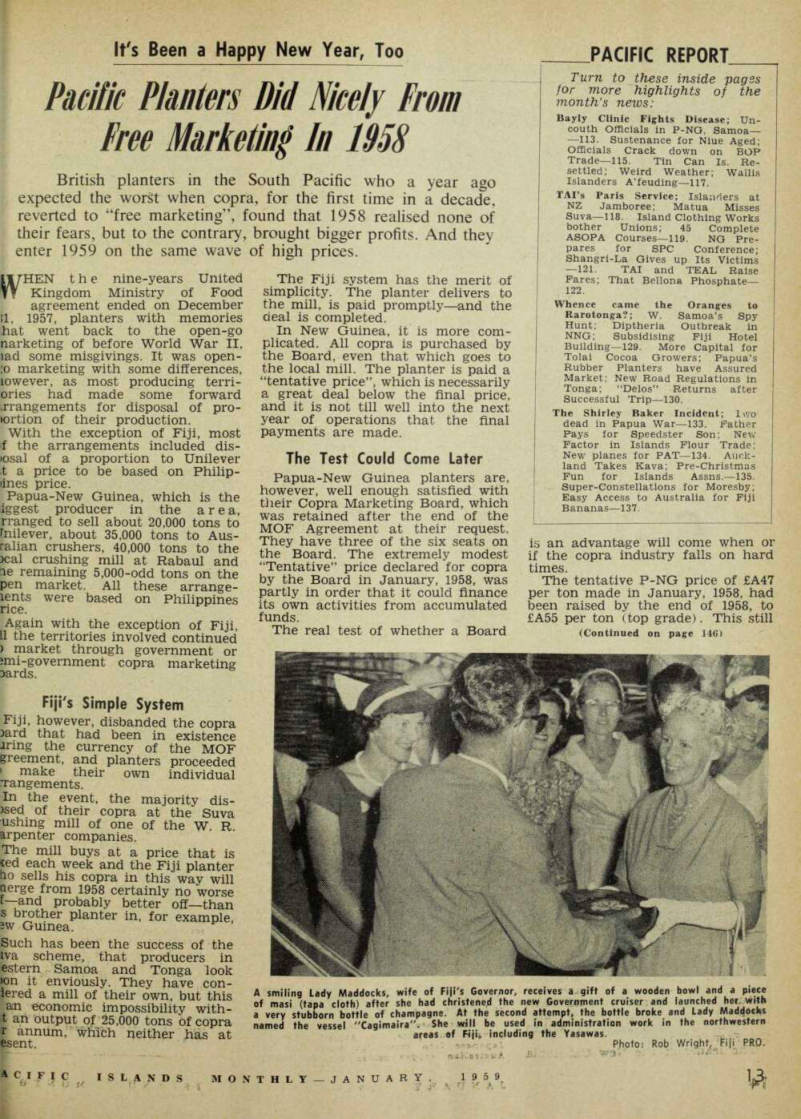
A smiling Lady Maddocks, wife of Fiji's Governor, receives a gift of a wooden bowl and a piece of masi (tapa cloth) after she had christened the new Government cruiser and launched her with a very stubborn bottle of champagne. At the second attempt, the bottle broke and Lady Maddoeks named the vessel "Cagimaira". She will be used in administration work in the northwestern areas of Fiji, including the Yasawas.
Photo: Rob Wright, Fiji PRO.
leave a handsome sum to be paid to planters as a final price.
The final payments will probably be made in the first half of 1959.
As the Philippines price fluctuates from day to day, it is difficult to get a true average for the year. But the Philippines price, c.i.f. London, as quoted in PIM over the last 12 months, has been as follows: January 7, $lB9. July 9, $191.50.
February 5, $188.50. August 7, $l9B.
March 7, $lB6. September 6,5208.
April 8, $193 October 3, $217.
May 7, $197.50. November 4, $235.
June 9, $l9O. December 4, $265.