P-NG Weddings
pp. 141-151 · Read in the full issue
ship Tarawera enters the islands service.
Meanwhile a specially chartered steamer, the Argentinian Reefer which last year carried a shipment of Ecuador bananas to New Zealand, is to call at Apia, on May 9, to lift an extra shipment of 20,000 cases of bananas for the New Zealand market.
The offering of fruit from Samoan growers at present far exceeds the available shipping space and the Department of Agriculture has warned producers to control their output and confine packing to only the best quality bananas.
Solomons Visit by
New Hebridians
A party of eight New Hebridians arrived at Honiara, BSIP aboard the MV Tulagi on March 30. Ac companied by an English and a French District Agent they made an extensive sixteen day tour of all main islands aboard the BSIP Government vessel Kovala.
The main objective behind the visit was for an exchange of ideas and for the New Hebridians to see the working of the native courts and councils.
Five-Year Development
Plan for NNG
In September and October this year, Australian and Dutch officials will meet in conference in Aus tralia to exchange data on develop ments in their respective New Guinea territories.
In the meantime it has been announced from The Hague that with the arrival of the new Governor to Netherlands New Guinea, about mid-June, the Dutch will embark on a five-year develop ment plan for NNG.
The plan provides for intensive economic and geological exploration, especially in some better-known areas of the Vogelkop, in western New Guinea.
In close co-operation with the Bureau of Mining in Hollandia a special Governmental Institute will be established for this purpose. At Delft’s Aerial Mapping Institute thousands of photographs are now being studied to further exploration work.
This year a geological expedition to the northern part of the Vogelkop will continue earlier explorations, which indicated that lead, nickel and zinc ores, are present. Foreign companies have already done some exploration work to the same end and are still showing interest.
Part of the five-year plan will
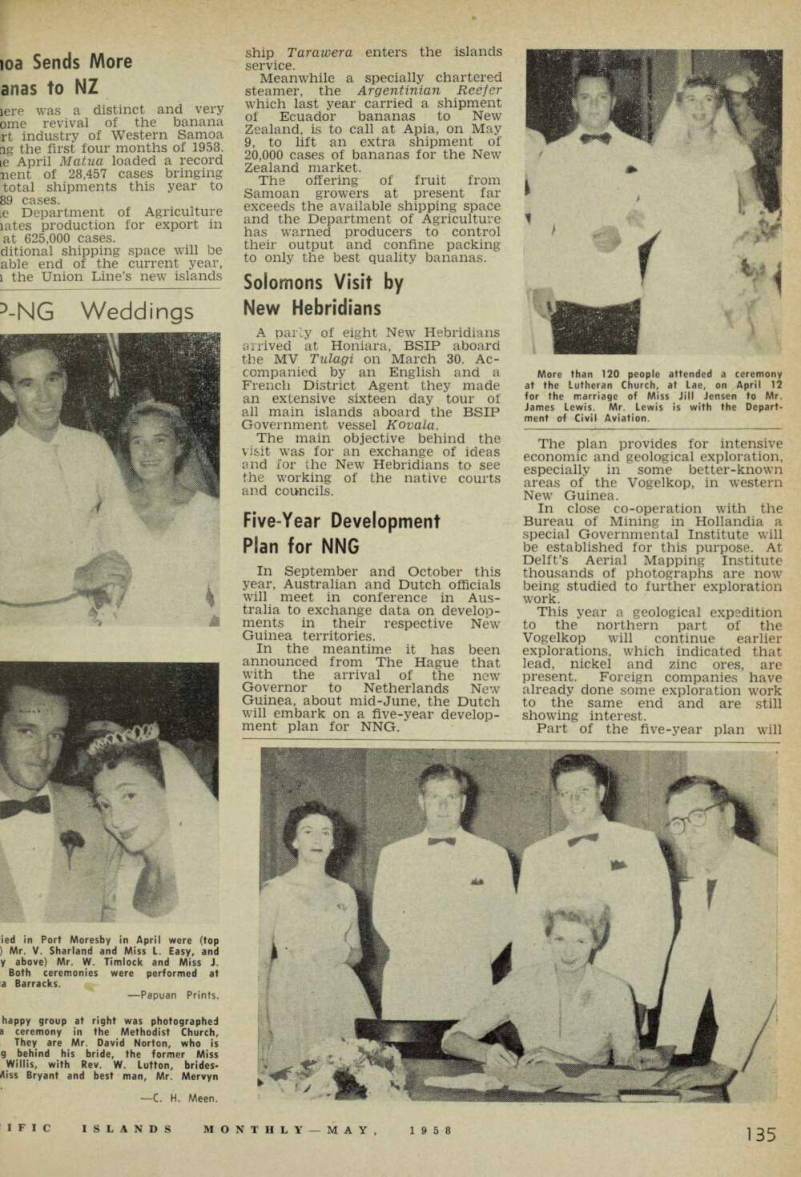
[?]ied in Port Moresby in April were (top [?] Mr. V. Sharland and Miss L. Easy, and [?]y above) Mr. W. Timlock and Miss J.
Both ceremonies were performed at a Barracks. —Papuan Prints.
happy group at right was photographed [?]a ceremony in the Methodist Church, They are Mr. David Norton, who is [?]g behind his bride, the former Miss Willis, with Rev. W. Lutton, brides- Miss Bryant and best man, Mr. Mervyn —C. H. Meen.
More than 120 people attended a ceremony at the Lutheran Church, at Lae, on April 12 for the marriage of Miss Jill Jensen to Mr.
James Lewis. Mr. Lewis is with the Depart ment of Civil Aviation.
be to take steps to bring all Papuans under direct admimstration. About half of the population is now in regular contact with the Dutch, but another 350,000 people still live a stone-age existence.
The almost complete lack of transport facilities will be one of the most serious problems to overcome.
If the results of the investigations are satisfactory, the Government plans to consult private enterprise about further development, This may mean that the economic basis of Netherlands New Guinea can be broadened, with all its advantages for a progressive development of land and people.
"WitiaT 7 ' fallc at Mnrochw
VVITJdZ LdllS dl iVlOreSDy
n n AnnfUor frnico un AnoTner *- ru lSe The Russian oceanographic survey ship, Wit jag, berthed at Port Moresby, on May 1, with two impor tant discoveries a specimen of a rare fish, and the knowledge of an ocean current previously unknown, The Witjaz, which is the first Russian ship seen in Port Moresby since World War 11, is surveying areas of the Pacific Ocean as part of the International Geophysical Year. She has made two previous surveys.
Aboard the 5,600 ton Witjaz
chief of tne expedition, Veniamin Petelin, said her scie had brought up, dead, fromj feet a thin black fish.
The fish known, in Latin as Stilophorus, was caught in a and according to Dr. Petell only the second known spe* in the world. It was first cc in the Atlantic, in 1790, andt one is now in the British Mul This specimen, caught nea* Mariana trench north of Guinea, was described by; Petelin as having protruding?
“like headlights on a car”.
In halting English and wit apologetic smile for the lack t fluency, Dr. Peterlin explained the expedition discovered a trade current which was prev; unknown to the world. The M is studying warm currents in Pacific area because of their in tance in fishing and climate/ Dr. Peterin said that on an ee expedition in August last yeas
trace of the current had found, but this year in a difff season, the current was found travelling from east to west speed of ten centimetres a see The doctor said the cm stretched from the equator to and a half degrees north. HI not yet know the effect of thee rent but the survey ship woul returning for a closer survey it left Port Moresby.
Dr. Petelin said when the £ returned to Vladivostock a n would be made and distribute; participating IGY countries.
Among other work carried oo the research team on the VTI during the five weeks at d after leaving Vladivostock,
■xploration of the ocean at depth with the use of sound ire and a British built echo er. expedition concentrated on rea north of New Guinea, Ing the Mariana trench, an earlier cruise the trench ed at over 32,880 feet. This ition plans to obtain a map 3 trench through the use of ;ounding equipment before re ig home on July 4. more expeditions will sail Vladivostock during the IGY. next trip of the Witjaz is 3d for next August, when the tdll study the ocean bed from northern Japanese Islands to the coast of the Ameri :ontinent. The ship would from 35 degrees north of leutian Islands. ship was thrown open to iblic during her six day stay 't Moresby.
May Advance
selves Out of a Job
7as likely that in about 10 time there would be more ed natives leaving school in -New Guinea than there were or them, the Assistant Ad rator, Dr. John Gunther, said y 2. said he thought such people employ themselves in pri industry and be better far because of their education.
Gunther had been asked at s conference if jobs would be )le for all natives who are oing to school. said the Government would a number of them and would some of its illiterate em with literate. He thought industry would absorb more ore. He believed the natives continue to bass their lives land. don’t envisage a big secon >r tertiary industry in the iry at this stage,” Mr. Gun lid.
r* l du: hh MSn Are DlTmg Off Cant a UTT JdilTO Reports from South Pacific Fisheries Co.’s tuna-fishing base at Pallikulo, south-west coast of Espiritu Santo, New Hebrides, indicate a high percentage of albacore—most valuable variety of tuna —in the catches of the Japanese boats supplying the station.
Built last year, the base is now in full operation. It can handle 32 tons of fish per day, has smokecuring and brine plants, can store up to 500 tons of fish at present, with a further 200 tons in the offing, and can manufacture 20 tons of ice in 2-cwt blocks per day for
the use of the fishing vessels.
Only frozen and cured fish are being exported so far, but a can nery may come later.
At the time that the company was being formed it was stated that a catch of 3,000 tons per year would be necessary to make the venture worthwhile. Heaviest catches were anticipated during the cooler months, f nrfta nplonatAc
LOCOa ueiegdies
Iparn a Lot
LcaMl a The 23 delegates to the New Guinea cocoa conference, held in Rabaul in mid-April, did not pass any resolutions and did not even
and Mrs. John Ardley, photographed after [?]arriage at All Soul's Church, Lae, on 2. She was formerly Miss Kitty Dyer, [?]me from Auckland, NZ. —W. Maidens.
on many points, but they iwledged that they had learned (See p. 16 for Manufacturers’ ). egates included Australian facturers’ representatives, ?rs and P-NG Agricultural ■tment experts. *est bone of contention was tion of the question of cocoa quality—there were almost as opinions as delegates, it is on this point that the Cocoa Industries Ordinance •e largely concerned; legisla > expected to be brought down i June session of P-NG Legis- Council. t delegates did agree, how that freight rates on cocoa in the Territory and Aus were far too high. It was that cocoa could be shipped West Africa to Sydney or 1 to Japan at less than the 1-Sydney rate. And freight 1-UK was only slightly -e were no representatives pping companies at the con e. iter representatives wanted to from manufacturers why African cocoa always brought ch higher price than New i cocoa—up to £ASO per ton They quoted reports and from overseas manufacturers )w that New Guinea cocoa P to WA standard.
P. D. Lloyd, representing acturers, said that the e New Guinea quality was the average quality of West n. West African varied little, 3W Guinea cocoa varied a lot plantation to plantation. He to name NG plantations there was as much as 19 per hell in their cocoa. ■e were no takers, port on the conference is to pared by Mr. F. Henderson, übmission to delegates it will eased to the public. ?ates to the conference were: T. Gunther, Assistant Administrator, ian.
C. Henderson, Chief of the Territory )n of Plant Industry.
A. Bridgland, Agricultural officer in I at the Lowlands Agricultural Experi- I Station, Keravat.
V Reitano, New Britain Assistant Dis- Offlcer (Native Affairs). )walaka, Semi Tokuakua and Napitalai, : Tolai Cocoa Project.
M. Wilton, president of Rabaul Cham- F Commerce.
A. Hopper, Chamber of Commerce.
Allen (Nelson and Robertson), Chamber mmerce.
Green (Territory Director, Robert Gilles- Yew Guinea) Ltd.), Chamber of Com- Corbett (Colyer Watson (New Guinea) Chamber of Commerce.
P. D. Lloyd (Cadbury Fry Pascal! Pty. leader of manufacturers' delegation.
R. Rudder (Nestles Food Specialities ilia Ltd.), manufacturers.
G. Hoadley (Hoadleys Chocolates Pty. manufacturers.
H. White (H. Small and Company Ltd.), acturers.
Mr. E. F. Robertson (Macßobertson Pty. Ltd.),
manufacturers . ,
a J FL J e" ob Scia.rn be Mr. D. Barrett, president of Planters' Association of New Guinea.
Mr. Theo Thomas, planter.
K: Mr. e. Stanfield, planter.
Mr. j. Middleton, planter.
Inside Information Tells
msme miormaiion mis
Another
miiuiisci Jiuiy
The common belief that native people living in their own environment had perfect teeth is not borne cut by examination, says Mr. J.
Francon Williams, assistant director of the Division of Dental Hygiene of the New Zealand Department of Health.
Mr. Williams is spending three months in Papua-New Guinea to advise the Administration on the setting up of a dental service.
He has jUSC returned to Port Moresby after visiting Rabaul, Mad ang, Lae. Goroka and Mount Hagen, Where he Carried OUt dental SUl’veys, mainly of the younger age groups, to see what type of service
is requlred
“As with Polynesians and other native peoples, the standard of dental health here is far from that state of perfection that is com rnonly thought t 0 be assoC iated with people living in a more natu rai life,” he said.
As natives changed from their own foodstuffs to refined European food their dental health would tend to deteriorate more unless they were educated in the proper use of such foodstuffs.
Mr. Williams, who will be in the Territory until June, will also assess potential of natives to staff a den tal service.
Mr. Wiliams is a former dental officer of Western Samoa and es
FASHION IN BANKS. Some of the most attractive buildings in Papua-New Guinea are those of the various banking companies. These two—obviously from the drawing board of the same architect —are Commonwealth Bank piemises. The one below is in Madang, and the one at top, which was nearing completion when the photograph was taken, is in Lae. This one was officially opened by the Morobe District Commissioner, Mr. H. Niall, on April 28. Modern new buildings for the Bank of NSW and the ANZ Bank are also nearing completion in Lae.
led a dental service there with d Samoans and Niue Is *s. am convinced that given an opportunity the local ycung i could be trained to do the just as well,” he said.
h Seminar
►rt Moresby
first World Health Organisa eminar to be held in Papua ruinea began in Port Moresby ty 5 and will last until May iteen delegates representing intries of the South Pacific, he Cook Islands to Guam are iging information on environ l sanitation, including means ;uring safe food and water !S. are certain that a big num cases of enteric disease such [era and dysentery are caused ter contamination,” Mr. Paul in, World Health Organisa egional advisor on environ sanitation, said on the eve conference. is definitely a number one n in the South Pactific. task is to review various as offering and to adapt them 1 conditions in the countries nted at the seminar, hope this seminar will bring 3wer closer and stimulate the
people concerned to work on the problem.”
Those attending range from doc tors to assistant sanitary inspectors.
They Just Kept
On Coming
Triplets were born to a woman in an Anson aircraft on a 60-mile flight between Yule Island and Port Moresby in early May.
The little drama began after a medical assistant at Yule Island radioed the Health Department headquarters at Port Moresby and asked for an emergency flight to pick up an expectant mother be cause he anticipated complications in the birth. It was thought twins might be born.
The Anson, piloted by J. van Santen, chief pilot of Papuan Air Transport, took a doctor to Yule Island, which is an Administration and Mission centre along the coast northwest of Port Moresby.
The plane picked up the woman —a Kerema named Forwak —and three other native medical cases, and began the return flight.
Mr. van Santen said later that about 20 minutes after leaving Yule Island the woman gave birth to a child.
He flew the plane over the water to “avoid bumps” as they continued towards Port Moresby. Then a second child was born and he
circled over the sea near Port Moresby for about a quarter of an hour until the third baby arrived.
“The babies were all born in about 25 minutes,” Mr. van Santen said. “We had no sheets or towels to wrap them in but the doctor used some towels he had around his in struments.
“At one time, I looked around and
saw him sitting there with two babies in his arms. A native man was holding the third.
“When we landed the mother was remarkably well, and wanted to walk off the plane. The doctor re strained her.”
Mr. van Santen has made a num ber of medical emergency flights in the six years he has been with Papuan Air Transport and on an other occasion a still-born child was delivered in a plane he was flying—but never triplets before.
The doctor, Dr. R. B. Rodrigue graduated in Melbourne two years ago and was in Launceston for a year. He had been in the Territory only a month.
Little Hope of Improved
Nickel Position
The depressed position of New Caledonian nickel is brought out by the shipping figures for the first quarter of this year.
Only seven Japanese, or vessels chartered by the Japanese, entered New Caledonia to load ore—com pared with 24 vessels for the same quarter last year.
There appears to be little hope that the situation will improve this year, although two representatives of a big Japanese nickel company will arrive for talks in July.
Independent miner Edward Pen
tecoste has just returned!: Japan, where he sought tc quotas raised for New Cale nickel, but with limited suet;
"Agreement Reached"
Viet Situation
The New Caledonian C ment delegation to North Vie got away all right in Apr within a few weeks Paris annr that “an arrangement had arrived at on the subject repatriation of New Cale Viets”—which is what theE gation went to the Reds to < But there was no announj made on just what the ai ment was, except that accoro Paris it “did not involve the ; metropolitan Government ii way”.
The delegation, two Eun and a Loyalty Islands’ mem: the Territorial Assembly, armed with the results of a census of New Caledonian. during which the Viets were if they wanted to be repat Of 4,500 Viets, 84 per cent., to be sent home, mostly to No Indo China, which is Cornu (Most of the 2,000 Viets New Hebrides have also asl< be repatriated).
A week after the Goven delegation left Noumea, a man delegation of Viets alsE a plane out for Hanoi. The o lion, which, according to 100 port had its expenses paid 1 Communists, comprised a VieE
Ratu K. K. Mara, son of a Fiji p[?] chief, and officer in charge of the Fiji districts, left on a trip to England "Himalaya" in April. He is accompa his wife and two children.
•f Noumea, a Viet from the ebrides, and a New Cale- Pierre Jeanson, proprietor )i-weekly newsheet and a le boxing promoter (he brings Australian boxers to ,). on’s news sheet, Le Cale was recently fined heavily ring published an article dgeria, held to be defama the French Army. [y what the Viet delegation 1 to do in Hanoi nobody t presumably it was to put t’s case, and to get a bit rai indoctrination, vhile, there has been some perturbation in New Cale ver an article published in
'h law magazine, seating st Namese in the French are legally held to be utizens, with all the normal : citizenship. w Caledonian newspaper e judgment to a lawyer, id that conditions had since the opinion had been nd the North Viet Namese iot be considered French ew Caledonia, in early May, 1 wondering just what ar nt the official delegation
had come to with the Reds, and whether the Viets would finally be got out for good, without any strings.
BSIP Gets Better
Air Service, New Airstrip
Commencing in June, Honiara, BSIP will enjoy its air service from Australia (via New Guinea) every week.
Up until now the service has been on a frequency of three flights every four weeks—that is, there is periodically an inconvenient gap of a fortnight.
The service is run from Lae on Mondays, returning thereto on
Tuesdays. The planes connect with the Skymaster aircraft on the Bird of Paradise service and serve Rabaul, Buka, Villalavella etc., as well as Honiara.
Renovation of Henderson airfield has now been completed also and and although there has been no announcement about it, it is likely that the Qantas planes will be using this in place of the Honiara airstrip at present being used
Shark Stories From
New Cal. and N. Guinea
Mystery surrounds the disap pearance at Noumea, New Cale donia, of the native skipper of the
olfers Miss M. Asmussen and Mr. were married at the Ela Protestant ort Moresby, in April, the weekend ritory Golf Championships. Mr. Biddle close to getting off with the golf wedding present for his bride, and battling it out with winner Bernie day of the wedding. —Papuan Prints.
small ketch St. Christophe (patron saint of travellers).
In mid April the little ketch arrived from the Isle of Pines, dis charged her cargo, and the skipper, as his wont, went ashore. No trace of him was found up to May 7.
The only intelligent surmise is that the skipper, coming aboard at night, fell into the water and was taken by a shark. It has been pointed out that the missing man always lived ashore when the ketch was in Noumea.
The beaches and waterways of the Noumean harbour as far as He Nou have been patrolled but without avail.
There was no doubt, however, about the shark’s part in the case of the native fisherman at Fins shhafen, New Guinea who put his arm over the side of his canoe to lift a fish.
The shark attacked, took the fish and part of the arm, the native was flown to hospital in Lae, where his hand was amputated.
Big New Caledonian
Grants for Education
The New Caledonian Territorial Assembly, during its recent budget session announced that subsidies to the value of 34 million francs (£A230,000) had been allotted to private schools, Catholic and Pro testant, in 1958.
These grants had risen from seven million francs (£49,000) in 1950.
In a newspaper statement the Catholic Bishop of New Caledonia, thanked the New Caledonians for their generosity and pointed out that the subsidy was really an economy—private schools take a
considerable number of childiJ the hands of the Goven schools. (The above figures are directly from a report fron Noumea correspondent, and we have no reason to doubt ; they certainly represent edm grants on a grand scale country whose population i than 100,000 with more that of that number natives. — Eds..
No Meat, No Spuds,
And Now No Oranges
Apart from having to parti; willy-nilly, in France’s effort ; her foreign exchange problemr control, New Caledonia hai plently of other trouble in tl 12 months: Drought, meat age, vegetable shortage, mu plagues and latterly, a plague.
Principal offenders are “OC and “Achea” and they havr present in their millions thr cut the island.
These moths, night raiden stroy New Caledonia’s fruit principally oranges and manr It is feared that there will b little citrus harvested this Within a few days of attt the fruit, a mildew forms causes the fruit to fall. Millil fallen oranges and mandarin!!
New Caledonian properties..; bananas are not safe from thej The recent drought conditionn responsible for the record vis? of the pests as dry conditiom tect the hibernating, fertilisa males.
Noumea’s entomologist frco Institute francais de I’Ocean that there is little to be del
Competition between Queensland and Papua-New Guinea sportsmen is growing, and long weekend there is one team or another making a flying visit. In April, a te[?] bowlers from Atherton flew into Port Moresby. Here, Port Moresby Bowling Club pre F. Blanch (standing back) introduces Atherton Club president Douglas Taylor to the W team. —Papuan
Caledonia to combat the pest e citrus trees are planted zardly and irregularly and so almost impossible to protect with any insectide spraying. small grower with a few was advised to put cellulose round each fruit.
Search for Missing
Ik Islanders
\Z Bristol freighter and an Neptune were both involved successful search for two j; Island men adrift in a boat •folk in early May. The men, Francis and Frederick Snell, ;aught in heavy seas during ng trip and spent all night open.
Bristol, flying from Fiji to as diverted by the RNZAF, otted the boat shortly before [eptune, flying from near ' with rescue gear, arrived scene. boat was eventually towed to c, in better weather, by two es.
ig Refuels
> at Speed
first hydraulic re-fuelling for aircraft in Papua-New was installed by Vacuum Pty. Ltd., at Madang at the 1957, but due to non-delivery hose-carts, it did not come Deration until March this fuel is stored in a 4,000 tank away from the air m electric pump pressurises sol ne in pipes under the A special coupling device is connected to ie which allows the fuel to new method of re-fuelling (Vs a great saving in time r e-fuelling, and will cut cost sport with the abolition of lling tankers now in use. expected that the hydraulic mg system will be installed nain centres eventually.