Pacific Report
pp. 119-141 · Read in the full issue

The month’s round-up of news and pictures of people and r ents, from PIM correspondents in the South Pacific.
Restrictions, So
Beer Drought
ting restrictions early in uary so that everyone could c beer freely had one marked t in Suva, Fiji, before the end tpril. The capital city ex nced something in the nature beer drought. feral clubs in Suva refused to jottled beer to take away—the were removed as beer was over the bar. Others let it •eely and experienced a pinch e the arrival of three ships Australia with beer cargoes, st hotels had fairly good stocks astralian beer, but even these ies were becoming thin just e the ships arrived, sre seemed to be an abundance ew Zealand bottled beer, but as a rule, is not popular in ce the permit system was hed hotels in Suva have been ng. The public bars are d nearly every night, mainly Fijians. It is safe to assume the Fijian is spending much now on beer than ever before, :hat there is less money going to wife and family. This ually could be a matter for rn. ier causes of the beer ght” were the late arrival of icnts, expected at Easter; and dsit of several warships with reds of thirsty sailors.
ja, Cooks—Still
he Air Route
• of the things the NZ Terri- Minister (acting in his al ;e role of Minister for Avia announced in Suva (see 120) was that Western Samoa he Cook Islands are to retain flying-boat service for another ears after all. y a few weeks ago it was an ed that the TEAL flying-boat be withdrawn from the Route in August next. TEAL then operate a land plane e from Nadi to Borabora, ng Western Samoa and the NZ Government had asked to continue the flying-boat for another two years, news will be welcomed in territories which were likely e a service they had enjoyed ars, through lack of adequate ds to take large planes r ever, a TEAL DC6 did land
at Aitutaki early this year to pick up stranded passengers when the TEAL flying-boat developed mech anical trouble —which shows that it is serviceable in emergencies.
In this two years grace these Island groups will have to hurry themselves to build adequate air fields to take the land planes of the future. They will of course have NZ’s help in the project.
Mr. Mathison, in Suva, said it was possible that an airstrip at Raro tonga would be developed in pre ference to Aitutaki because Raro tonga has a bigger population.
He said that development of air strips in the two groups would cost the New Zealand Government about £600,000.
Seaman Fatally
Attacked in Apia
Duiing a call of the SS Eastbank to Apia, W. Samoa, the Chinese ships-carpenter was attacked and subsequently died.
On the evening of April 17, the carpenter was walking on Apia’s main beach road accompanied by an Indian sailor friend, when he was suddenly attacked by a Samoan, who punched him so hard on the jaw, he was lifted clear of the ground. In falling he hit his head on the concrete pavement and was taken to Apia hospital in an un conscious condition.
Before the Eastbank left Apia, the Chinese was taken aboard, but his condition became worse and he died while the vessel was proceeding to England via Panama.
A Samoan was later arrested and will be prosecuted for manslaughter.
Fiji Late Wet-Season
Deluge Destroys Road
After a phenomenally dry “wet season”, Fiji began to get some real rain in March, and by mid- April it was literally falling in lumps.
Suva recorded 39 inches between April 1 and 26. The April average is 13 inches.
The northeastern part of Vitl Levu really caught it. It is estimated that, at Vunidawa, over 50 inches of rain fell in the fortnight follow ing Easter.
Roads all over Fiji suffered much damage in this period; the Waini-
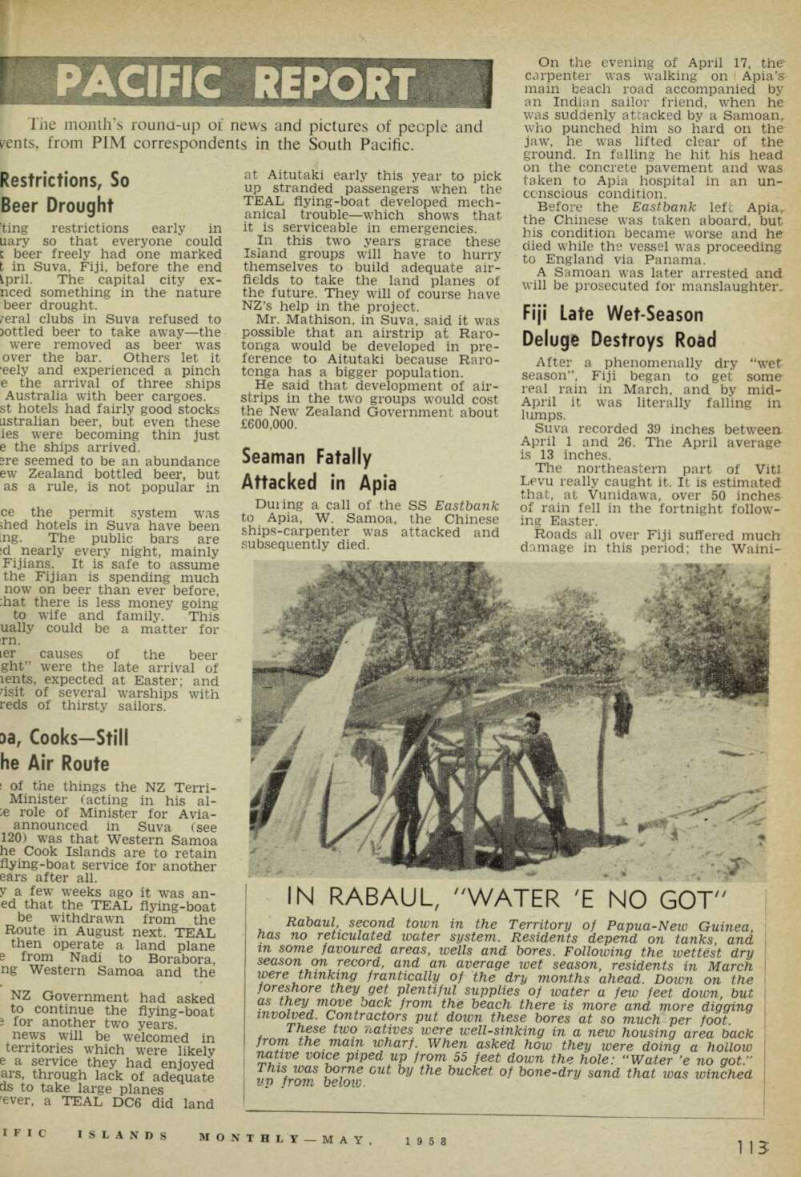
In Rabaul, "Water 'E No Got"
Rabaul, second town in the Territory of Papua-New Guinea, has no reticulated water system. Residents depend on tanks, and in some favoured areas, wells and bores. Following the wettest dry season on record, and an average wet season, residents in March were thinking frantically of the dry months ahead. Down on the foreshore they get plentiful supplies of water a few feet down, but as they move oack from the beach there is more and more digging involved. Contractors put down these bores at so much per foot These two natives were well-sinking in a new housing area back from the main wharf. When asked how they were doing a hollow native voice piped up from 55 feet down the hole: “Water’e no got."
This was borne cut by the bucket of bone-dry sand that was winched up from below.
;a Valley section of the Kings id was most seriously affected, idmaster George Morris, of avu, said these were the heaviest is since 1932. , was announced on April 23 ; the Wainibuka section of the gs Road was so badly damaged had completely disappeared in les—that it would be closed for tirs until the end of May. lis, of course, means that all I communication between Suva the North Coast districts must ia the South Coast and Lautoka, :h doubles the distance, le interruption of road systems :he Colony caused some tem ,ry, but severe, dislocation of supplies, le new Chief Justice of Fiji, Mr. ice Lowe, arrived in Suva in middle of a deluge. He told the nbly, when he was being wel ;d in the Supreme Court, that iras intrigued to learn that his n Court orderly was named i.
3n Co. Experience
s Contract
e Union Steamship Company the successful tenderer for the pear lighterage contract of Apia as from May 1, 1958. The >any has held the contract for ig time but on this occasion it had some hard competition a local syndicate, whose tender lower on some items. Accord to an announcement by the Commissioner, their company t have saved the community £4,000 to £5,000 per annum, t in making the decision in ir of the USS Co., the Execu- ZJouncil took into consideration ood record and the fact that eaborne trade of the Territory :o a great extent dependent on ships of the Union Company, banana trade particularly had ly entirely on the refrigerated ers of the company, oetheless, the award of the act to the USS Co. has ■d some criticism from those contend that local business Bsts should have received pre ce.
ight Touch
.eprosy
ckland people interested in Islands affairs were specula late in April, on the seology of a report concerning various objects of the current of the NZ Minister of Terri > to the Cook Islands, e Herald report contained the
ving interesting sentence: “At
aki he will visit the leper tal built recently to combat it outbreak of leprosy. (Italics urs).
The Aitutaki leper hospital is a collection of buildings built years ago and recently purchased.
Statistics recently published showed the leprosy situation in the Cooks to be serious and to describe it as a light outbreak—as though leprosy could be compared with an outbreak of measles—is surely something worse than an understatement.
Leprosy is a disease which takes years to develop in most cases, and its presence is associated with a low standard of housing or hygiene.
The very reason that the leprosy situation in the Cooks is now so serious can be connected with too many years of the “light outbreak”
type of thinking in official and unofficial quarters in New Zealand, Fortunately, Island Territories- Department’s medical advisers do not consider the present situation in such a way and something is at last really being done about it, but they can only receive the full support of the New Zealand public through a proper disclosure of the facts by New Zealand’s newspapers, Urma fnr I onmcu no P t ' TOi Leprosy in P vUmroi in r nu P-NG medical experts are hope ful that they will be able to control
eventually eradicate leprosy, h is believed to affect at least per cent, of the native popula of 1,750,000. ey do not expect quick results, ire now surveying their problem a view to tackling it on a p scale than before. )rosy is one of the major nic diseases of the Territory, cularly in the Western High ; where 1,000 cases are now : treated, and doctors expect id up to twice this number. i Government Leprologist, Dr.
Russell, said in Port Moresby the campaign against the se would include the establish of mobile rural out-patient s and a form of education to rage the natives to take an ! interest in its eradication, i the whole,” Dr. Russell said, natives are tolerant but etic about treatment and ration of infected persons. We them to keep healthy contacts from patients and to practice n of voluntary isolation.” said the exact extent of y in the Territory was not known, as no overall survey teen made, but small surveys hown an incidence of three (nt, of the population in some re are two distinct types of y in the Territory—infectious non-infectious. The non ious type predominates by 70 per cent.
an High Chiefs
ured in Hawaii
in impressive kava ceremony, ;e of which busy, tourist con- Oahu hasn’t seen for years, Joseph Salafoa of the Samoan in Hawaii, honored departing Chiefs Letuli and Lutu of a Samoa, at Laie, Oahu, in
The visit of the two High Chiefs has resulted in closer understanding and appreciation of the Samoan people by their northern neighbours —a fact which could be borne out by the guest list alone, according to an Hawaii correspondent, Jeanne Booth Johnson, The ceremony was attended by every important Territorial govern ment official, as well as leading rep resentatives of the United States Army, Navy, Air Force, Marines and Submarine services.
Included were Governor Quinn, Mayor Blaisdell, Senator Oren E.
Long (former Territorial Governor), Sheriff Duke Kahanamoku, Police Chief Dan Liu, and Col. William R.
Swarm, serving as Admiral Stump’s personal representative.
The falefono at Laie, located on a picturesque promontary over looking the Pacific, was an un usually fitting site for the ceremony.
Honoured guests occupied the fale fono, including Chief Salafai Papalii, the only living woman chief in Western Samoa, who was the only woman allowed therein.
She is visiting friends in Oahu.
An honour guard of Samoan marines, clad in khaki, red-bordered lava-lavas added to a colourful pic ture.
The importance of the occasion was reflected in the conclusion by the Talking Chiefs that the occur rence was too great for any one chief to deliver the welcoming speech. As a result, each of the chiefs delivered his own welcome.
The ceremonial kava talk was delivered by Talking Chief Fea gaima Alii, climaxed by the sound ing of conch shells. The marine honour guard delivered rifle salutes as each cup was presented. First kava was presented to High Chief Letuli, the last to High Chief Luti.
Following the ceremony, all guests attended an elaborate Luau, with entertainment of Samoa, Tonga, Tahiti and Hawaii.
Taros Get Some
Attention
Completing a research visit to Fiji, Dr. R. c. Cooper of the Auck land War Memorial Museum re turned to Auckland late April with a “bag’' of 200 varieties of taro— or dalo as it is called in Fiji—and also some 60 samples of Fijian medicinal plants.
Dr. Cooper will try to obtain seed from the flowers of the taro
At Laie, Oahu, in Hauxin, prominent members of the Territorial Government make an unusual picture as they sit in the falefono for a kava ceremony to say farewell to visiting East Samoan leaders in April (see story). Below, in the falefono, is Chief Salafai Papalii, only woman chief of Western Samoa, who uxis also on a visit to Hawaii.
Photographs: Jeanne Booth Johnson.
ties in a research project to » or produce better types of food plant which is the prin staple food in most of the ic’s high islands and in some where it has been given il attention. ;le or no research has ever carried out before to improve trains or develop strains suit to certain climates or condi- Throughout the Islands gation is by root and not by ! medicinal plants will be for cancer research at Green- Hospital—to see whether they any properties which inhibit rowth of cancers. This is part world-wide investigation,
ail for GEIC—But
Hush-Hush
irding to an official announce made March 28 at Bairiki, 1 of the Gilbert and Ellice is Colony, a weekly airmail 3 to this isolated colony was encing forthwith thanks to SAAF —and will continue until t notice. ugh the announcement did ty so, it is a safe guess that 3rvice is a useful by-product Pacific nuclear bomb season has reopened in the Marshall Is to the north. During the
ist series the Americans es ted temporary meteorological ation facilities at Tarawa and porary air-mail service was n operation. ons wishing to avail them of the service should very lly note the permissible form ress. Under no circumstances ie name of the village, island, up appear on the envelope, must be addressed simply the name of the addressee id by “c/o. PO Box 10, APO m Francisco, Cal., USA”. On at Tarawa the GEIC postal ities will locate the addressee, nail will bear postage stamps value necessary to send it
to the US and not the lower amount of postage that would normally be carried by a letter ad dressed direct to Tarawa.
Correctly addressed mail will land at Tarawa each Thursday and outward mails from there will de part each Friday.
It sounds a lot of trouble — es pecially as the service is most cer tainly to fold when the Bomb Season ends in August or there abouts.
Islander Faces Murder
Charge in Canada
Mrs. Veia Lowry (nee Love), wife of Mormon Missionary Gilbert Lowry, of Cardston, Southern Alberta, Canada, was charged with the murder of an eight-year-old daughter, Blondie Tahau Lowry, at Cardston on April 11.
Mrs. Lowry, daughter of the late Lieut.-Colonel Love, of Maori Battalion fame, and of a Coojc Islands princess mother, was married to Lowry five years ago in Canada, having met him while he was serving his term as a missionary in the Cook Islands.
Four children have been born of the marriage but the child alleged to have been murdered was a daughter of Mrs. Lowry by another union.
Mrs. Love is a well educated woman of 28. She had returned to Canada from New Zealand only recently after spending eight months there studying genealogies.
The child alleged to have been
murdered was with her on her return to Canada.
In a preliminary court hearing evidence was given by neighbours that the child had attempted on several occasions to run away from home, since arriving at Cardston.
Mrs. Lowry was remanded in custody pending arrangement of bail and a higher court hearing.
Tonga Sponsors
Birth Control
At the invitation of the Tonga Government, Mrs. Ena Compton, in charge of the Auckland clinic of the NZ Family Planning Associa tion, went to Tonga in April to spend a month at Vai’ola Hospital, Nukualofa. There she will instruct Tongan nurses in birth control techniques.
The visit was backed by the International Planned Parenthood Federation and the British Family Planning Association who jointly made available £450 worth of medical supplies.
Last year Mrs. Compton made a circuit of the Islands seeking local medical support for her efforts.
Two Women Die
in Stove Accident
Two European women died In Port Moresby in late April, as a result of extensive burns they re ceived when a kerosene pressure stove they were operating burst
When the Apostolic Delegate in Australia, New Zealand and Oceania, Archbishop Carboni, was in Suva in April for the opening and blessing of Corpus Christi Teacher Training College, he was accorded a Mayoral reception by the Mayor of Suva, Cr. A. D. Leys.
This picture, taken at the reception shows: From left, Bishop Pearce, Catholic Bishop in Samoa, Archbishop Carboni, Cr. Leys, and Bishop Foley, Catholic Bishop in Fiji. —C. L. Cheng.
into flames and showered them blazing fuel.
They were Mrs. Maureen CE aged 25, of Brisbane, and Marguerite Richardson, 35c Chelsea, Victoria.
The women were employed time in a cafe where the aco occurred.
Mrs. Chered died in hospital her parents, Mr. and Mrs. P. V of Stafford, Brisbane, were ; to Port Moresby after being no of the accident.
Miss Richardson died later,.
A native employee at the cafl taken to hospital with burn his back and right arm.
NZ Territories Minister
Does the Rounds
New Zealand’s new Island T tories Minister, Mr. Matl accompanied by Mrs. Matl private secretary J. Thom acting-secretary of Island T tories Department, J. M. Mcl and Mr. R. Clayton, public rels officer of the government Pub Department, left Auckland b< for Suva, on April 25.
At Suva the party transfers Tofua which would call at T!
Niue, Pago Pago and Apia, v the party was to take wing ; and fly to the Tokelau atoll a RNZAF Sunderland flying-E Later they will fly to Aitutas the Cooks to connect with Pomare for Rarotonga.
The Minister and his parts return by TEAL aircraft alonjj Coral Route, and arrive bao Auckland by RNZAF aircrafi May 21.
This is Mr. Mathison’s first 0( tour of New Zealand’s II Territories and neighbor Groups.
Scrap Metal Gets
"A Setback"
Lack of Japanese overseas ci; has caused a setback to the , metal industry in Papua* Guinea, according to Mr. H Pollard, of New Guinea M Limited.
He said in Port Moresby the price of scrap sold to JC had dropped from £22 a toe about £l5 a ton —and this took; account a recent drop in chr freight rates from £lO to £4 ae “Any further drop in pricee make things a bit awk; although scrap doesn’t deterif over a year or two and we < easily hold it until things look; He said his firm had move least 70,000 tons of scrap n from New Guinea since the ; and about 10,000 tons from and Hollandia, in Dutch- 1 Guinea.
He thought there probably another 10,000 tons to be shi in New Guinea, excluding Ras
e the Japanese are working number of sunken ships, e Japanese ship Amazon Maru ite April was loading about tons of scrap at Port Moresby, taking aboard about 3,300 in New Guinea ports, hough a number of Japanese have called at New Guinea for scrap since the war, the \on Maru is the first to load 1 at Port Moresby.
That Runs
ennies
ship which travels thousands iles around the Pacific each on pennies contributed by ly School children, arrived at Moresby on April 2, with an missionaries to work in i. is the 400-ton London mary Society vessel, John ms VI, which brought 12 m pastors and will take others to Samoa after six-year terms e Territory, the time she gets back to \ she will have travelled over miles on this trip alone, erend D. E. Ure, secretary rer of the London Missionary y’s Papua Committee, said butions from children in Aus- New Zealand and Britain nost of the cost of running lip. ecting money was organised 7 through Congregational h and Sunday Schools, ship, which is based on Suva, the society’s posts on dozens cific Islands. i Williams VI is in the charge ptain S. E. Gaskin, who has ) years service with the Union ship Company of New id before he joined her nearly r ears ago.
jn Apinaipi Will Take
nderwafer Look
Papuan Apinaipi Petroleum my is to investigate the lity of oil in the sea bed Gulf country north-west of Moresby, where it holds a to search, two-man geophysical team the Bureau of Mineral -ces will carry out an under gravity survey for the ny.
Port Moresby representative >uan Apinaipi, Mr. D. Mackee eophysicists will carry out a for ten miles out from the between Galley Reach, about es west of Port Moresby, and a, about 110 miles farther the coast. men will use a gravity meter ig from the company’s ship beginning in May. meter instrument, like a bell, is lowered over the
r a hoist and it sits on the I where it measures the force vity. ; connected by an electric to a control panel on the ere instruments give readings ing the composition of the (See “Commerce”, page 160).
id the Neighbours'
overnment
»a is becoming notable in the Pacific for its Parliamentary ions. reported here in recent i, the Trustee Territory of n Samoa, under New Zealand b and direction, now has an legislative chamber, com ath Ministers and a formal ment, and it exercises a sal of legislative authority, mil, a party of about a dozen id women of Eastern Samoa can Territory) passed i Fiji, and they were enter in Suva. They included rs of the Eastern Samoan and House of Representa ;he Speaker of the Senate me officials. Their set-up the American model. The vas returning after a short ) New Zealand, where they o observe the New Zealand lent in operation, a has had an elected Parlia and a team of Ministers iting a Government, for years.
Fijians, who are just as
capable and as literate as the Polynesians in Samoa and Tonga, are beginning to ask questions about the administrative systems being developed in the neighbouring Territories. No one, it would seem, tries to explain to them that the Fijian administrative system is both efficient and economical, in com parison with others, and that, in actual fact, the Fijian community already has a large measure of self-government.
Putting Technical
Know-How to Use
A startling increase in cases of theft and dishonesty committed by
employees of the Samoan Govern ment was disclosed when a large number of Public Works Depart ment employees were charged with theft and forgery in Apia High Court during April.
Several clerks of the electrical branch were charged with forging cash sales dockets for electrical equipment and received prison sentences of from one to two years.
A clerk of the Agricultural Department, Samasoni Apa, charged with forging banana bonus pay ment sheets on several occasions was convicted and sentenced to three months’ imprisonment.
Seven members of the staff of the Public Works Department were convicted of manipulating electrical meters and stealing electrical current. They were each fined £5 or £lO.
W. Samoa's Legislators
Struggle with Finances
The April session of the Western Samoan Legislative Assembly was meeting heavy weather.
The estimates of revenue and expenditure were being debated at considerable length—Education and Health votes taking eight days— with Samoan members voicing grievances and complaints, particu larly, about the running of the Works Dept.
It was doubtful whether the Assembly would terminate its pre sent session in time for the visit of the New Zealand Minister of Island Territories, who was expected to arrive by the Tofua on May 1.
Tanna Islanders Waiting For
Their Ship to Come In
The Cargo Cult still existed on one island of the New Hebrides, Mr. J. S. Rennie, British Resident Commissioner of the New Hebrides, said in Port Moresby in late April.
He said the cult was on Tanna Island, it was not violent or anti-
wo well-known Port Moresby families were united with the marriage, in St. John's in April, of Miss Doreen Crawley, daughter of Mr. and Mrs. D. Crawley, to Mr. [?]s MacGowan, son of Mrs. B. MacGowan and of the late Mr. W. MacGowan. Father bride is with the Royal Papua-New Guinea Constabulary, and the late Mr. MacGowan, time of his death was the assistant-director of the Commonwealth Department of in P-NG. The couple will live in Boroko. —Papuan Prints.
3an but was suspicious of the iment. It had been going about 1941, off and on. ; government has taken the e that there is no point in repression or the exiling of ders, as long as its adherents within the law,” he said, le had not gone past the )f waiting for a ship to come h cargo for them. hope that as more native ment councils are set up, nts of the cult will be won he said. Mr. Rennie was ;■ through Moresby. On April paid a one-day visit to stle, NSW, to complete ements for building a new Residency at Vila —a job verdue.
Philp Heads
NG ■ the death of Mr. E. J. (see elsewhere in this issue), C. Goodsell, a well known scutive, has taken charge of Philp (New Guinea) Limited, ing General Manager, company’s principal branch ers in Papua and New now are:
R Moresby —Mr. W. B.
ARAI —Mr. V. C. Gabriel. -Mr. J. A. Baker.
AUL —Mr. G. A. Clarke.
ANG —Mr. A. Pym.
eceives
can Oranges
rt restrictions imposed in ialand have had some queer ssions.
NZ, hungry for citrus fruit, bought a cargo of oranges from Jamaica. When it arrived, the financial closure had been applied.
The shipment was then diverted to—of all places—Fiji.
Fiji grows very good oranges of its own—in season and when it feels inclined. Large quantities of local oranges and mandarins were flood ing the Suva markets, and selling at from Id to 2d each, when the Jamaican oranges arrived, and were offered at about 8d or 9d each.
There were buyers—but it was not exactly an active market.
RAI Again in Business
as RAI
Completely overhauled, and look ing a somewhat different aircraft to that which arrived at TEAL’s Auckland workshops on January 8, RAl’s Catalina F-OAYD was ready to return to French Polynesia early May.
It will resume the local air ser vice which had been interrupted following the crash at Raiatea of the company’s only other aircraft.
It had been the intention to re name the company Messageries Aerien Interinsulaire (it was pre viously Regie Aerien Interinsulaire) when the assets were taken over from the French Polynesia Govern ment by the French airline TAI, in which Messageries Maritimes ship ping line has an interest. But now the company has been renamed Reseau Aerienne Interinsulaire, thus retaining the initial letters, a change in which might have caused confusion.
Captain Alexander Frame of New Zealand, who brought the aircraft
south to Auckland, and who has been with the company since March. 1953, resumed command following furlough.
His co-pilot was Mr. P. Duval who came out from France in the other Catalina, F-OAVY, in Sep tember 1954.
When that aircraft was lost with her crew at Raiatea he was in France on leave and was recalled.
The work in Auckland has been overlooked by Mr. A. Berge of Noumea on behalf of the French insurance underwriting organisa tion, Bureau Veritas. As liaison of ficer between the French engineers and TEAL’s engineers Mr. Arthur “Johnny” Walker of the well-known Walker family of Tahiti has been constantly at hand. Mr. Walker, who is an aviation inspector with TEAL, went to New Zealand in 1932, The Catalina was originally an amphibian, but was partly con verted to a pure flying-boat when purchased in New Orleans. The main wheels had been removed and the apertures into which they re tract had been boxed in, but the nose wheel aperture remained.
However, on the delivery flight to Tahiti it was found that a very poor job of conversion had been done. The wheel enclosures leaked and when the aircraft took off she invariably had a load of water in these compartments. It would gradually drain out during flight.
The aircraft was never used for passenger work following arrival at Papeete and has been lying there idle for a considerable period.
These wheel apertures have now been properly closed and the spaces converted to baggage and battery compartments. Bad leaks in the fuel tank seams were also repaired.
The seating has been altered somewhat. Originally with 21 pas senger seats, some placed sideways,
The men who operate French Polynesia's airline (left to right): Mr. J. L. Launay, RAI's chief engineer; flight engineer P. Beurierier; chief pilot, Captain Alex Frame; and pilot P.
Duval. This photo was taken at Auckland before the company's Catalina left for Papeete after overhaul. —J. P. Shortall.
This group of Rotuman lads passed through Sydney recently— stopped off at the Polynesian Association long enough to supply bright Polynesian music. Leader is George Tifere Flint. —Tele-Photos.
number was reduced to 19 ; forward. The aircraft’s nose •went surgery and the very eamlined old Catalina snout letely rebuilt, giving the plane er five knots of airspeed and y improved visibility on the in the matter of spray deflec :rom the pilots windows, i badge of the new RAI as ;d on the hull, is identical to of TAl—a white griffin with forepaw on a globe, on an e medallion —except that the 5 below are RAI instead of re have been rumours that lad been negotiating with Sir m Taylor for the purchase or ir of his Bermuda flying-boat \e Bird 111 which has been ig air cruises from Sydney to slands over the past several Catalina was to return to te from Auckland via Lau- Bay, Fiji.
h, Australians Are
ig More of Each Other
scheme to expand co-opera between P-NG and Nether- New Guinea is going ahead V- Dutch in May have invited G tennis team to a week-end match in Hollandia (see i Review), and in April the District Commissioner, Mr.
Cole, invited the District issioner for Hollandia, Dr. F.
Eibrink Jansen, for a visit wak.
Jansen, with his wife, turned the MV Oranje, official vessel Netherlands Governor, and
gave a reception on board in return for a Wewak cocktail party arranged by Mr. Cole.
The Netherlands’ visitors, during their three-day stay, also took a look at Maprik and Dagua.
In other ways, too, co-operation between the two territories is being extended.
The Dutch were the first to experiment in New Guinea with residual spraying of dwellings as a means of combatting malaria, and they passed on the information they gained to the Australians. Now a big spraying campaign is planned for P-NG.
The Dutch made a study of Australian anti-poliomyelitis vac cination methods in New Guinea.
Australian eye speciaists have visited Dutch New Guinea to give their services. The Australian Territory’s Department of Health has arranged for an X-ray technician to service the Dutch machines.
The health services on both sides of the border keep each other advised about epidemics or the treatment of tropical diseases, such as yaws, or other conditions.
“In fact, we practice mutual help,” said Dr. Roy Scragg, acting- Director of Health in the Australian Territory.
The Department of Agriculture of P-NG has supplied the Dutch with plants and seeds of various sorts, and teams of experts have taken their “know-how” across the border.
Recently, an Australian veterinary surgeon visited Dutch New Guinea to assist them with their problems, and other Australians have gone across to help the coconut industry.
Dutch agriculture men have visited the Australian territory fairly frequently to take advantage
of the Australians’ experience in solving the many problems found in growing crops.
In police work, aviation, forestry, public works, geology and the big field of native affairs, the twa territories have found that they have many problems in common and they have attempted to ease the way with exchanges of visits.
With the appointment of liaison officers soon and a special attache in Canberra, it is expected that the flow of information both ways across the border will widen even more.
"Of Course the White
Man is Wanted"
The P-NG Administrator, Briga dier D. M. Cleland, in April, made an attempt to mollify Territorian& who were indignant at some of the remarks that have been passed about them in the last few months, by Mr. John Kerr, QC, and others ( PIM , February, March).
Brigadier Cleland assured the Port Moresby Chamber of Com merce that Europeans were wanted in the Territory and always would be, and that it would be a great number of years before a decision was reached on the future status of the Territory.
The Administrator spoke by invitation to the Chamber, after it had expressed its uneasiness over the future of the European and of capital investment in the Terri tory.
Referring to the uneasiness.
Brigadier Cleland said some state ments had been made in the Terri tory that Europeans were not wanted. He added: “I deplore such irresponsible and ill-considered statements.
In Hollandia, “MV Oranje”, patrol vessel for the Netherlands New [?]ea Governor, prepares for its official visit to Wewak (see story). —W. E. Tausent.
ey do no good to morale and ire far from the truth, which lat Europeans and private jrise are here, they are wanted hey will remain as a bulwark e development of the Terri jas not his purpose to discuss :ue what the ultimate solution ; Territory’s future might be ther it was a Federated lion of Melanesia, or a State stralia, or a Dominion. b sane, practical viewpoint is t will be a great number of before the time of decision ched as to what the future will be,” Brigadier Cleland Dse of us who know the Dry and those of us who just how backward the great Lty of its people are, ap te the tremendous and long task which lies ahead of us the people as a whole are even to begin thinking of they want and the political of their own future. :s not for us, or in fact any ,t this stage to formulate a and fast political objective, is not for us or anyone to i say what the future of the le will be. It is not for us jose upon him something he iot want. is, however, for us to bring ) a state of political aware it which he, and he alone, ;termine his own future. ; day when the indigene can as a cohesive society with a i amount of unanimity and al awareness is indeed a very /ay off—certainly not in our ■ time.” adier Cleland said there was
evidence of a small minority of Europeans showing racial dis crimination against natives.
The indigene was a man of character and dignity and in some cases of better calibre than those few in the community who would disparage him.
He said the settler in the Terri tory today had security, was getting a fair return when his crop or plantation was in full economic production and he had his custom ary rights. The development of the Territory by private enterprise would not have reached its present level if any of these ingredients to success were absent.
A progressive policy of land settlement would continue—that was encouragement of the European in all realms of private enterprise.
New Use for
Ocean Deeps
Much, but not all of the sounding and sampling of the world’s oceans which is currently taking place, is associated with the IGY.
In addition a knowledge of surface and deep ocean currents is urgently necessary to meet the need to dispose of the very increased quantities of radio active waste from scientific and commercial atomic reactors in various parts of the world.
Some of these waste products will be dangerous for 50 years or more; others for shorter periods. They must be dumped in safe containers in ocean deeps where they are not likey to be swept into the shallows, there to pollute edible fish or cause other dangers.
The RAN vessels Quickmatch and Queenborough were working on this study, together with other oceano graphic research, in the Tasman Sea, and the RNZ Fleet Auxiliary
Tui was working the Fiji-Tonga- Somoa area in March-April.
Scientists in the latter vessel were particularly interested in gaining knowledge of the Counter Equa torial Current’s breadth and depth in this area. US and Japanese research vessels were working the North Pacific.
When Tui makes her next cruise in September an effort will be made to spot still greater depths in the Tonga trench, which extends down the east side of the Tonga Group towards NZ, than those discovered by Witjaz a few months ago.
Ml News for
Philatelists
Norfolk Island will have a special issue of stamps in 7d and 8d denominations, available from July 1, says an official handout.
The stamps, however, will only be overprints of the current 7£d and Bid issues and there does not seem to be any particular reason why the issue is being made.
If the 7d and 8d stamps were being overprinted with the higher values it would be more in line with recent practice. It seems too much to hope that postage is to be reduced by id.
Stamps collectors who wish to be in at the birth of these over prints can contact the Postmaster Norfolk Island who will handle orders. (Mint stamps will be available from the Philatelic Sections of the GPO’s in Australian Capital cities.)
No Chance of a
PIR Division
It was out of the question at the moment to consider increasing the Pacific Islands Regiment to
Brooches From Mauke. Mr. Julian
[?] long-time resident of Mauke Island, ea-shell collector of international re [?]d ocal manager for A. B. Donald and [?] commenced the export of coral and other dress jewellery made from [?]n Auckland in March, Mr. Dashwood [?]d a company under the name of Coral (South Pacific) Co. and signed over retail agency for New Zealand, Aus [?]nh the United Kingdom, to an Auck n. Mr. Dashwood told a PIM repre that it was just a sideline, handled by members of his family, but gave of becoming something big, judging interest shown in the samples he south for display. —J. P. Shortall.
i strength, the Administrator pua-New Guinea, Brigadier . Cleland, told the Port iy Chamber of Commerce in ad been asked if any thought en given to this, idier Cleland said it was a of policy for the Army [ties “and would naturally be sed with the Administration implementation, as it could ir-reaching effects”, lid the first step which could
be considered was the formation of a brigade group. Only when that was established and proved could further increments be con sidered.
In New Guinea to
Study AAosquitoes
Dr. Elizabeth Marks, research officer for the National Mosquito Control Committee of the Queens land University is spending two or three months in Papua-New Guinea, identifying the many types of mosquito and their larvae found. She hopes to spend about a fortnight in Dutch New Guinea.
Dr. Marks said that already about 200 types of mosquitoes were known to exist in the Territory.
Her work includes studies of the mosquitoes’ life histories, their habitats and their relation to the surrounding area.
Although it is not the main feature of her work, Dr. Marks hopes that her research will help in identifying the larvae which produces certain types of mosquito.
This knowledge would be useful for control purposes.
She is not working specially on malarial mosquitoes as they are already well known.
Dr. Marks has a travel grant from the Bishop Museum, Hawaii, to carry out her studies.
Holidays on
Thursdays
New Caledonians during the month of May are to have three holidays falling on Thursdays.
New Caledonian school children, however, are not enthusiastic. The holidays falling on Thursday do not mean a thing to them as Thursday is a school holiday, anyway. Under the French system, children go to school on Saturday and have Thursday free. It is a system that many parents in New Caledonia would like changed. When going camping or holidaying over the weekend it is a case of leaving the kids home or waiting till school is out on Saturday afternoon.
Local Government Comes
to Honiara
Honiara, BSIP, has got local government, ahead of more advanced Papua-New- Guinea—with the vexing question as to how it is to be financed shelved for the time being while the Secretary of State for the Colonies considers it.
The Honiara Town Council con sists of 17 members, European, Chinese and natives. All members were appointed by the government.
Initially the council will perforin
[?]Ne At The Polynesian Asso-
At top, Mrs. (saline Gosnell, a uva resident, with her daughter and Josaia Rayawa, of Rewa, Fiji.
Miss Maria Whippy, member of a ily (now on a holiday in the UK), Wiki Byron, of Rarotonga. Below are Mrs. Edward Wong. Mrs. Wong was Miss Honson, of Suva. —Tele-Photos.
ollowing tasks: —(!) General iness of streets, playgrounds ther public places: (2) Main anitary services; (3) Maintain ries; (4) Control of the local it: (5) Control the design of juilding and the standards of als so used; (6) Make recom itions on Town Planning, aws which may be created by council require the Chief ary’s approval. ous sub-committees have been I and their progress or other dll be watched with interest, ilarly the committee to e a solution to the native ;ion problem.
ip to TAI
at Santo
DC3 plane on the TAI between New Caledonia and ebrides swerved from the air n landing at Santo, NH, on 22 and badly damaged a i of the people on board was I, but the service was ded for some time until a ing could be brought from lia on the April Polynesie. pecial permission of Admiral se Lautrec, commanding Naval Forces in the Pacific, lecial flights were made by ncasters of the French Fleet rm stationed in Noumea, planes took engineers and viation authorities to enquire ie accident. ivenience was caused to pas wishing to travel to the ebrides including passengers through from Australia by
g Blase
Bombs
was assumed to be a hydro mb—although in officialese lied a “nuclear device”—was 1 by British scientists near las Island on April 29. was the fifth bomb exploded ain in this area in the past ths and again it is claimed
that it was “clean”. The only thing missing from Device No. 5 was the publicity, protests and fuss that attended No. 1 of just a year ago.
In the councils of the mighty, bombs have become a political weapon; amongst the general public they are old stuff.
Tenders For
Nadi Airport
Tenders for the reconstruction work at Nadi Airport, Fiji, closed in April with the NZ Ministry of Works.
The work, which will cost around £3 million, calls for the lengthening and strengthening of the two exist
mg runways at Nadi in preparation for the jet aircraft which will be using the airport from 1959.
Existing runways are 7,000 ft long. They will have to be 10,000 ft long.
It is understood that Australian.
American and New Zealand con tracting interests have tendered for the job.
It was planned that the modifica tions should be made during the coming dry season—and if that is so. considerable haste is going to be needed in letting the contract.
During certain stages of the re construction, it will probably be necessary to close the airport alto gether to Super Constellation and Stratocruiser aircraft. (Over)
ioa Sends More
anas to NZ
iere was a distinct and very ome revival of the banana rt industry of Western Samoa ng the first four months of 1958. ie April Matua loaded a record nent of 28,457 cases bringing total shipments this year to 89 cases. ie Department of Agriculture lates production for export in at 625,000 cases, ditional shipping space will be able end of the current year, i the Union Line’s new islands