Pacific Shipping And Cruising Yachts
pp. 103-115 · Read in the full issue
The Marine Branch of the Meteorological Office, London, is seeking something new in sea photos for the Marine Ob lerveTs Handbook. These will be used as an aid to all weather ffiservers ashore and afloat in preparing coded weather reports, ust as the standard cloud photos are now used.
iAMEN who are camera fans and think they have photos which clearly fit one or other :he 13 recognised “states of the ’ corresponding with the wind id code figures, should send their tos to London. But there will 10 “pecuniary reward”—just the our of a place in the Observer’s idbook. itisfactory results are likely r with a camera with fast shut and by the skilled use of suit filters. liere is no shortage of photos ng the lower code figures—“sea a mirror”, or “scalelike ripples tout crests”, but it will take skill and patience to differ ate clearly between “high waves, ■ie streaks of foam along wind, begins to roll, spray may affect lility” and, for example “sea ;e with spray, foam and spray air, visibility very seriously af 3d”. ie first of these two specifica s is for a Strong Gale, and the nd fits a Hurricane —according he international coding system.
History In The Melting
’: Many fragments of history associated with the thousands ms of scrap metal disappearing the holds of Japanese ships at h Pacific ports these days.
April the Kinkai Maru loaded mckland portions of many old s, one of which was the three ted barquentine Retriever of
Peter B. Kyne’s Gappy Ricks story.
Retriever was big news in Papeete back in 1920. The 547-ton vessel, bound from Puget Sound to Peru with half a million feet of lumber aboard, struck heavy weather near the Marquesas.
The timber cargo began to work,
Also in Kinkai Maru’s hold were some old naval guns from North Head, Auckland. These were pointed out by Mr. Les Ellis, who will be in Papeete organising the loading of the 36-year-old, 6463-ton Liver pool Maru with another big cargo of scrap when this appears in print.
That consignment will include machinery from the historic Ati maono sugar mill, and probably portions of other old ships. Liver pool Maru will also load at Apia and Suva. Mr. Ellis of Pacific Steve doring Agency, Auckland, left by air for Papeete on April 23.
• New Chains For Old:
Amongst cargo recently arriving at Nukualofa from England were two 45-fathom 34-ton mooring chains to replace chains which had been
chafing the rigging which carried away and a mast went overside. All hands took to the boats on March 31 when the ship was in a water logged condition, and arrived safely at Papeete on April 15.
Four different ships then made a search for the derelict but when nothing was found it was assumed that she had foundered.
But on May 15 the Union Co’s Talune, then on the regular Island run from New Zealand, sighted the derelict while bound from Raiatea to Papeete. The foremast was still standing. She was boarded by the chief officer and six seamen and a tcw-line rigged, but this parted in heavy weather the following night, when a lot of the deck cargo also went overside. The tow was secured again on May 17 and there was great excitement on the Papeete waterfront when Talune arrived there with Retriever in tow.
Much later the barquentine was towed to Auckland and ended her days as a hulk.
down for over 30 years. They are for the big buoys to which over seas vessels pass their lines to haul themselves clear of the wharf in on-shore winds. The chains have Lloyds certificates showing a break ing strain of 127 tons, and are suit able for use by vessels of up to 20,000 tons.
• Lost Overboard: Rolf
Moe, 32-year-old Norwegian bosun of Pacific Islands Transport Line’s Thorsisle, was lost overboard in March as that vessel cleared Nukualofa via the Lahi Passage.
At the time of the accident Moe was standing on the rail heaving on a line which parted. He fell 25 ft on the flat of his back into the water. A lifebuoy was thrown, the ship put about, but no trace of man or lifebuoy were found, despite search by the Customs launch Unga and the ship. . jJ 1. Ujl j 1
• Russians Everywhere:
Russian ships were much in the
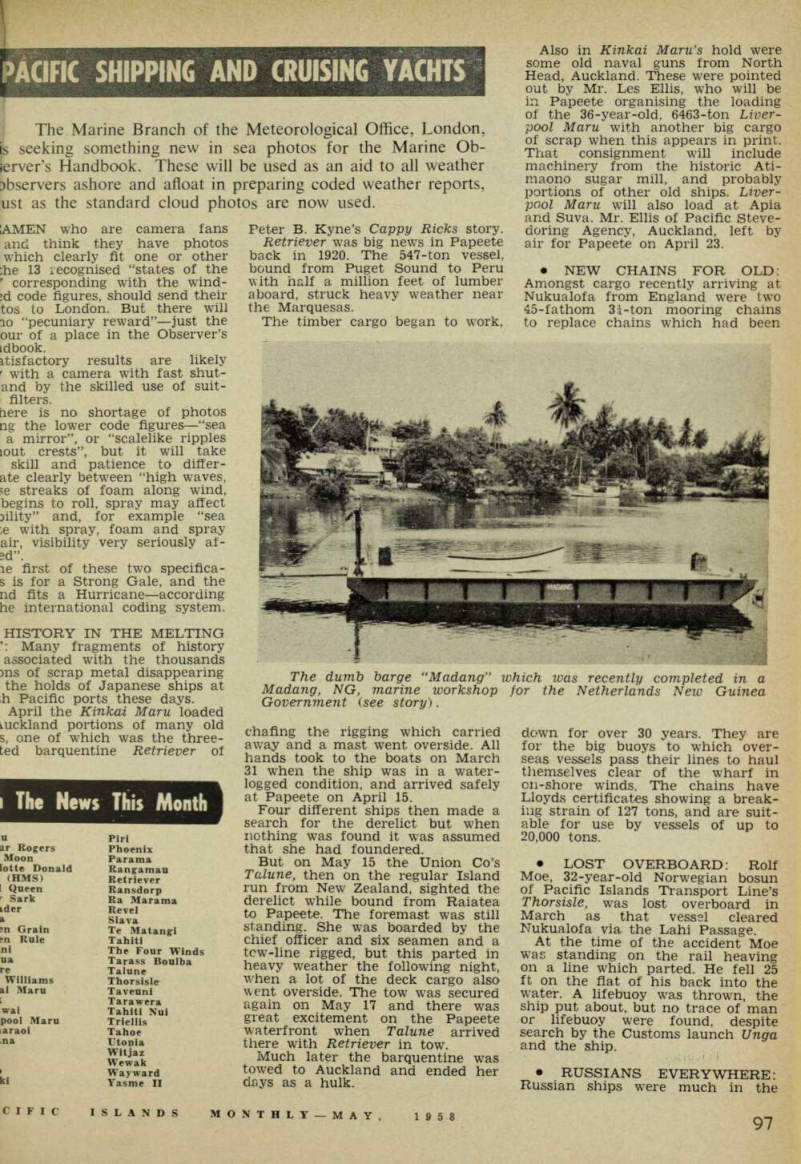
The dumb barge “Madang” which was recently completed in a Madang, NG, marine workshop for the Netherlands New Guinea Government (see story).
7S in April. A 27-ship Russian Uing fleet, homeward bound n the Antarctic for Odessa sed interest at Wellington NZ. he port has seen many American men of late, but the Russians ved somewhat different. Not a 2 of the 1000-odd went near a or made a pass at a local girl! h £59,000 to spend they invaded stores and purchased the most ikely items —miles of all sorts ong-out-of-fashion suitings and s materials; gallons of purga > and medical potions that had on chemist’s shelves for years, rniing up the coast from South, 14,772-ton 29-year-old British t factory ship Slava, the tanker k, and the 25 chasers —each ted Slava with a number suf -I—caused considerable conges on the 2 mc/s radio telephone mels in their almost constant -to-ship voice contacts, le fleet was commanded by tain Alexey N. Solyanik and crew included 32 women, 14 of m were stewardesses and the ainder in jobs ranging from al surgeon to stenographers and untants. Some had their hus is aboard in various capacities, male rating never seen on a ish crew-list was a Trade Union irman! »out one in 20 of the crew could age limited conversation in ish. The fleet left Odessa last ber and had taken 4,122 whales, ling 38,000 tons of oil, the 'd catch of the season, idle the Slava spent its week Wellington, Moscow reported the research ship Ob, which ted in the Russian Antarctic expedition last year, had d again to join in work being ed out by Witjaz— which called ort Moresby in early May.
To Drink Or Not To
NK: Some time ago in this nn we mentioned an official sh medical research report ing seamen who have to take feboats, that they should shun ater, even in the smallest titles, for drinking—Dr. Alain
bard notwithstanding,
e researchers could be right, )r. Bombard, who drifted across Atlantic in a rubber raft, living sawater, fish-juice, and plank m route to prove that sea water % safe life-saver, seems to have further support in an ex lent conducted at Nantes, ce. ere an Indian fakir, Merindrah lah, setting up what he claimed - a world record fast, emerged a locked cage in April after ? 108 days and 4 hours on ing but salt water —five pints daily. He had lost 40 lbs in it on this diet, but he was very much alive. (See page 65 issuej. 3TILL ON DECK: One of the
many waterfront strollers showing Interest in the Cook Islands trader Taveuni as she lay refitting at an Auckland wharf in April, was Mr.
C. S. Gallic—“they called me Ka up there”—who owned and operated cutters in Fiji during the first eight years of this century.
He later served as supercargo in craft sailing out of Samarai and other New Guinea ports, and is now living in retirement after farming in New Zealand.
Captain Pickering and engineer Waka of Taveuni were surprised that Mr. Gallie, now a very alert 78, could still speak excellent Fijian and has a vivid memory of the Group’s geography after 50 years of absence.
• Designed For The Trade:
Tonga’s bare-footed travellers have been given a special thought in the design of the Tonga Copra Board’s new A’oniu, and the Tonga Gov ernment’s Hifofua building in Hol land. Deck plating has been fared off so that bare toes will not be stubbed, and where ever possible all projections on deck or in alley ways have been rounded, A’oniu is of the raised poop and fo’csle type with machinery and accommodation for passengers aft.
The decks aft are teak planked over the metal plating. The two masts are positioned at after end of fo’csle and forward end of poop. each with twin derricks and twin winches. The derrick heads lower
» a house midships, on either [of which are carried, in davits, two motor launches which will e as workboats and lifeboats, vessel’s overall dimensions are •, given as 179 ft 11 in. x 27 ft with a cargo capacity of 800 ifofua, primarily a salvage tug, with cabin accommodation for passengers, measures 113 ft x t x 11 ft draught and has 70 cargo capacity.
Use For Old Ammo: The
;N’s over-age ammunition is finding plenty of use in blast reef passages in the Cook ids. HMNZS Pukaki called at itonga with a further supply laster. A little earlier a charge e up of ten 250 lb bombs was . on the reef at Black Rock
site the radio station to pro a passage for fishermen, and 10 lb charges were fired off end of Avarua wharf in an - to improve the depth slightly, ler big bangs are planned for island reef passages.
NEW COMMAND; Captain ns Bottoms, MBE, well-known a wide area of the South Ic as Mate and Master of Lon- Missionary Society’s John ims, from which he came e in Suva some monthe ago, leen appointed master of A. B.
Id & Co’s Cook Islands based mner Charlotte Donald. replaces Captain Andy Thom vho has reached retiring age probably more years of ac t-free sea-service in those s than any other European, or dead. irlotte Donald arrived back at onga in mid-April under Cap- Andy’s command after annual at Papeete, and is now busy ying some of the islands which not seen a ship for over five tis. itain Bottoms’ varied and in ing experience should prove a I asset to the Cook Islands lant fleet.
• PIRI COMING?: Captain Hugh Williams who sold his 243ton Melva to Australian interests for use in the Darwin-Timor trade last November, arrived back in Auckland from the Cooks aboard Maui Pomare late April to view the wooden 263-ton 41-year-old Piri on which he has an option.
If a deal was completed with Imperial Chemical Industries (NZ) Ltd., present owners, the 8-knot vessel with auxiliary sail, would soon be entering the Cooks inter island trade.
Like Melva, Piri’s 13i ft loaded draught is too great for her to get alongside the Avarua wharf at Rarotonga, but under present har
bour improvement plans she may be able to get into Avatiu Harbour within a year when that harbour is deepened.
• Too Many Ships: In Auck
land Mr. D. C. Brown, hearing news of the possible Piri purchase, said that, with freight competition in the Cook Islands again becoming keen he would put Taveuni , which has just undergone a big refit, up for sale with Inspire, and leave the field to others, so long as he was assured of having his cargoes moved at reasonable rates.
Lack of competition immediately after the war brought him into the shipping business as an essential
SALIE" (sister ship to "Monique”), pur recently by Raymond Mouledoos of a and to go shortly to the New Hebrides [?]ding in this latter archipelago (see April
ans of moving his mother-of irl shell cargoes south and trade ids north to the Northern Group 11s.
► Building Competition
EN; Pacific Islands Ship-building Ltd. of Hongkong (for whom )tain G. W. Dunsford of Auck d holds the agency in Islands t of New Guinea) is actively ering the ship-building market the South Pacific, his company has built many sels for the Philippines, Indo ia, and South East Asia in re t years. he Coral Queen, now nearing ipletion for Western Pacific High emission for use in the Solomons rom this yard. Another keel for Island client may be laid soon.
One-Ringed Circus: The
ricane season just officially ed has been notable for the jistent low-pressure area north west of the New Hebrides.
Imost all through March and ri 1 the South-west Pacific ther chart showed a threaten ing with an L in its centre in general area, and even late Vpril, with the hurricane season wetically well behind, that ring persisted but had drifted east d to share its moist and miser weather with an unwilling Fiji, lis is the spawning ground for ly of the hurricanes which er Fiji or the Queensland coast, mding on the meteorological d.
New Type Ship For Heb
•ES: The 500 tons tanker Rans ) has been sold through Captain L. Kennedy, Sydney Shipbroker, i company registered in Vila, Hebrides—the Southern Cross >ping Co. stails of what the company in is to do with a tanker-type el in Hebrides waters were not icoming at the time this edition b to press. The vessel was for ly owned by the Commonwealth eminent who used her for sporting acid.
Boosting Trade With
j: The successful launching re ly at the slipway of Madang ine Workshops Limited, Madang, of the first steel vessel wholly icated in the Territory, was irated by an informal ceremony ided by Mr. W. P. Ditmar, rep ntative of the purchasers, the :h Government Bureau of Ship ir over two years, the Company been slipping and carrying out irs on Dutch Government ves based at Hollandia, Dutch New lea. le latest venture, the fabrica of an 80 ton capacity all . dumb barge, with a length of eet, entailed careful designing.
planning and expert workmanship. tSee photo, page 97).
The barge, required for the light ering of cargo in Dutch New Guinea ports, was designed in Sydney, and the launching was well within the scheduled delivery period.
The Madang Company has plans for the fabrication of a steel cargo vessel, suitable for the requirements of interisland trade, and has during the last twelve months manufac tured and sold to the Dutch Ship ping Authorities at Hollandia, 22 cargo and ships dingies.
• Cairns - Port Moresby
SHIPPING: Marine Contractors, who own the LST Wewak, which
does "iluaDle service conveying cattle between North Queensland ports and Port Moresby and Lae, are considering the purchase of a new vessel.
Wewak’s main chore is to trans port cattle from the York Peninsula to Cairns but this is interspersed with voyages on the P-NG run. If and when a new vessel is bought to supplement Wewak’s activities, it is likely that it will be used for gen eral service to New Guinea.
None of the ships on the Aus tralia-New Guinea run now calls at Cairns although both Cairns and Townsville were serviced by Burns Philp ships before the war.
The cessation of the services has
a sore point with North nsland businessmen for many . Recently the Cairns Chamber >mmerce submitted a proposal a regular shipping service be lished with New Guinea. If le Contractors bought a new it would, it was thought, “solve Toblem”. was stated that if the com did purchase a new vessel, Commonwealth Government : grant a 50 per cent, subsidy.
Ra Marama’S Long Way
E: Port Moresby, Honiara and will see the Governor of Fiji’s facht, Ra Marama, before she n in her home port, Suva, in June. ; Fiji RNVR crew left for pore at end of April to take lew vessel home via Borneo, *, Darwin and Islands ports.
Moresby should see the new about May 21. imander S. B. Brown FRNVR take charge of operations I the delivery voyage.
Ongue-Twister For Gil
’S: The new Gilbert and Ellice ►lony Government vessel built mgkong is named Moanaraoi probably is in the Gilberts by Captain Ward, formerly in iru, left with a crew last No ;r. They were to travel by ship ike Island then fly to Hong- It is believed that on arrival • new vessel, the government’s Jareau, a vessel of about 75 ft, & offered for sale.
[Igher Standards: Geic
; are to be manned in future rtificated masters and chief jers, and some kind of train :heme is likely to be intro at Tarawa.
Many officers in these vessels have of course, been certificated men, but not always so, especially as re gards engine room staff. Our report says that Fiji standards, which still fall substantially short of British Ministry of Transport standards, will apply. The new training scheme is being organised by Captain Gerry Douglas who was appointed Marine Superintendent for the GEIC at Tarawa some months ago, replacing Captain Clark, who re signed.
• Not Where They Seem:
A British survey ship, HMS Cook, has found that some of the islands in the British Solomons group are not in positions shown on charts.
Vella Lavella, for example is four miles out.
Cook, which is doing four months survey of parts of the Solomons ar rived at Port Moresby in mid April for stores and fuel.
The vessel’s main work will be around Honiara and Gizo and she has left camp parties at each place to carry out surveys.
The ship carries three echo sounders one of which can pene trate to 5,000 fathoms. The officers said they got echoes from 4,000 fathoms when approaching Guadal canal recently. Three of her boats also carry echo sounders.
The ship is also fitted with radar and electronic devices for fixing her position while surveying and equipment for oceanographical re search and has facilities for draw ing and photographic reproduction of her surveys.
The ship arrived in the Solomons area at the end of March via Suva, after a four months refit at Auck land. Last year she did a survey in Fiji waters.
She will leave the Solomons in
This is the “Southern Cross VIII”, after her launching at Ballina, [?]W, on March 8. Built by Ballina Slipway & Engineering Co. for [?] Melanesian Mission. She will be dedicated in Sydney in May.
for Singapore where she will a refit and receive orders . the Admiralty, id down as a frigate in 1945, : was completed as a surveying at Devonport, England, in 1950, commissioned in 1951. e carried out surveying duties he west coasts of England and [and before leaving the United ;dom in March 1957 to attend hydrogen bomb test at Christ- Island and carry out a survey iji-
For Fruit Trade: First
;1 to be built in Hongkong for Union Steam Ship Co., the re rated fruit ship Tarawera, 1750 deadweight cargo capacity and t 1550 tons gross, was launched le Taikoo Dockyard on April 23. good deal smaller than the >any’s other fruit freighter la —both have no passenger mmodation Tarawera will be as required in the Cook ids, Fiji - Tonga - Samoa, or >-Tasman fruit services. She five holds. She should enter ce in a few months time.
Crew For Tahiti Nut.
de Bisschop and companions, ed Callao April 13 on the id and main stage of a voyage Constitution, Chile, to Poly , in Tahiti Nui 11. st stage was a 41-day coastal ige to Callao. Crew are now i as Alain Blum of Tahiti, ch oceanographer Jean Pel , and Chileans Juan Burenios Juan Fischer —the latter a ng engineer
H-Bomb Protest: Golden
the 30 ft Los Angeles ketch protest mission to Eniwetok,
reached Honolulu April 19 on sec ond attempt, and skipper and crew their received a warning from the US Navy to keep clear of the Mar shall Is. area.
However the voyage proceeded, but did not get far —a Coast Guard vessel turned them back to Hono lulu.
• Triellis Launched: Latest
addition to the British Phosphate Commissioners’ fleet, and similar to the 9994-ton Triaster built 1955, Triellis was to be launched at Glas gow on May 14.
Like the other vessels, she has a high standard of crew and pas senger accommodation, and will be
The new ship commemorates the name of Sir Albert Ellis who was for 32 years a NZ member of the Commission and the discoverer of the value of the Nauru and Ocean Island deposits.
The ship was to be launched by Mrs. C. M. Rich white, wife of a New Zealand commissioner who re cently retired.
• Passing Through: A 57 Ft
trawler named Golden Grain left Brixham, England, for Wellington, NZ on April 24 and will probably call at Papeete and possibly other Island ports en route. The vessel was purchased by Wellington fish erman Arthur Dickenson and is powered with a 44 hp diesel and
Two of the vessels damaged in Fiji’s hurricane early this year [?]ing repaired at Levuka. “Koroibo”(ight) owned by Burns Philp [?]S) Ltd. was badly damaged and sank off Gau Is. She was later ised and towed to Levuka. “Chum”, also owned by BP was blown hore at Koro Island. She also was towed to Levuka for repairs.
Photos: B. Obed.
employed in the Australia-New Zealand - Nauru - Ocean - Christmas (and sometimes Makatea) services as a phosphate carrier and trans port vessel for the Commission’s staff.
The new receiving station which Cable & Wireless Ltd. have recently completed at Samabula, near Suva. The installation work was carried out by Cable and Wireless technicians whilst the station was operating. There are 16 80 ft masts on the site, which support seven different aerials. — A. C. E. de Trafford
With the owner is a crew of MATTT vnMAKJT pt7 PT app
m 'tnjmv Rapfc E fn MflV
New Zealand’s Island Terri-
. !nrm,in«o/ tvfof
* i oif 'otth
Fand that brok^s^hrouah-
he contacted , e iikelv second hifnd rprdare i iiKeiy second nana replace ' surh rpnlarpmpnt was found Waui P&mare was pxnemfvp Tpfit P This w g as ed K 6 vearTagn lt was said bv top that said oy me Department that
issel would be good for only ;r four years—the normal following which Lloyds un ters require extensive surveys, luly 1956 the then Minister iced that the government had ised the preparation of plans new vessel. A lot of people it that this meant that a new had been ordered; almost ;ars later the vessel has still ordered. atement made from Welling ,e in this April indicated that ms were submitted to Sir J. es & Co., London shipping ;ants, who had suggested nations. The Wellington re laid that these “had been vith” and that tenders would be called”. he speed at which govern operate it does not seem very that a tender will actually spted and a firm order given late 1958, and so it is un that delivery will take place 1962.
IRAMA AWAY: The new 56 v, built by Bjarne Halvorsen Berry’s Bay, Sydney for the Administration, got away Sydney May 3. Captain W. i who came down from the ry to take delivery of the reckons on three weeks for
the passage back home to Port Moresby. He has a crew of seven natives.
The vessel will be used for Ad ministrative purposes in the West ern District of Papua—hence the name, Parama, after a small island near Daru. She will probably have a native skipper.
This is the eighth of these K type vessels that the Halvorsen yard has built for the islands in recent years. Parama is the second Ad ministration vessel of her type; one has gone to Choiseul, BSIP. and the others are owned by Steamships Trading Company.
The vessels have a hold capacity of 2,000 cubic feet —and when used
for that work can carry about 25 tons of copra. They have a draft that is very suitable for the kind of river and reef task they are called on to do.
Parama is equipped with neat two-berth cabin accommodation for travelling native public servants — medical assistants and so forth.
The native crew for the delivery voyage arrived in Sydney by air on April 27. They lived on the vessel but the local office of the Terri tories Department showed them the sights of the city in their free time.
None of them had been South be fore and, so Captain Howard says, they were “completely amazed” at what they saw. (Over)
[?]n Auchterlonie and David Beard, now in [?]d with "Mahina II", will complete of the yacht from the Cooks to Fiji, [?]ossed the Atlantic from England in "several years ago. —J. P. Shortall.