Australian Gold Seekers
pp. 88-101 · Read in the full issue
"Karkar's" Papers Tell a New Story Germans Gave Aid to Early Australian Gold Seekers
• When the papers of that well-known German New Guinea pioneer. " Karkar ” Smith (Paul Ignatius Schmidt), were examined, after his death a few months ago, his friends found an unfinished letter , dated April, 1955, addressed to Pacific Islands Monthly. The fragment contains some valuable historical material ; so it is repro duced below exactly as “Karkar” wrote it. It should be noted that Matt Crowe and “Sharkeye” Park are usually credited with the dis covery of the Morobe (or Bulolo) goldfield.
IN the Editor’s Mailbag of the February, 1955, PIM I saw a letter by Mr. Charles G. Deland: Do You Remember Matt Crowe”?
In a footnote to this letter you quoted the Pacific Islands Year Book as saying that Matt Crowe and Sharkeye Bill Park before 1914, were always prowling about the Morobe ranges (which at that time was German territory). You said they were seeking for gold and were always being chased off by the German officials.
I was shooting Birds-of-Paradise in the Morobe District of German New Guinea from February until November. 1913, and I met Crowe, Sharkeye Park and Jim Preston in Morobe, at that time.
In 1912, they went on a prospect ing expedition up the Markham and Bulolo Rivers with the consent and assistance of the German Gov ernment. They were supplied with rations, carriers and even with a few police boys. Instead of being chased by the German officials, they were treated wdth every considera tion by the Germans.
When I met them in Morobe, in 1913, they had taken out a licence to shoot Birds-of-Paradise in the Morobe District, but I never met them in the bush. I heard later that Matt Crowe and Sharkeye had parted after a row, and that Crowe went shooting in the Finisterre Mountains, behind the Rai coast, and that later he went back to Papua, across the Papuan border.
"Still Unexplored"
I was shooting mostly from Bayern Bay, up the Nassau River and up the Francisco River, at the back of Salamaua. Salamaua was my headquarters at that time—all the hinterland was still unexplored, and the natives were still in their nat ural state.
There was a lot of fighting going on between the coastal tribes and raiding parties from the interior (called Kail by the coastal natives), but they never interfered with us.
I got on well with all of them.
At that time, I crossed over from tlie headwaters of the Nassau River
to what I know today to be the Bulolo River; but as there were not many suitable Birds-of-Paradise about I turned back towards the ccastal region. I had no idea that I had been in rich gold-bearing country.
When I got back to Morobe after the season finished—the Birds-of- Paradise begin to lose their plumes after August of every year—l met Sharkeye Park and Jim Preston again in Morobe.
They were waiting for the Nord- Deutscher Lloyd steamer Manilla.
This was a small steamer which used to run between Singapore and Kavieng, calling at nearly all the smaller places in the New Guinea mainland and Bismarck Archipel
ago, bar Buka and Bougainville four or five times a year.
We met every day at the police master’s bungalow. There were thre German officials at that time ti Morobe—the DO or Stationsleite was Klink, the name of the police master was Krauss, and Hessel barth was the “small doctor”.
“Sharkeye” told me at the timi that he, Matt Crowe and othe Papuan miners had worked som rich pockets along the middle am upper Waria, with good success This was long before Morobe gold field was opened.
I know that Klink kept in gooc neighbourship with the Australia] Magistrate at Journa, across th Papuan border, and that they use to visit each other unofficially. 1 enjoyed the five weeks we spen together at Morobe very much.
A few days before Manilla ws due, Beatrice Grimshaw, the well known novelist, arrived from acros the Papuan border; and when th Manilla arrived we all went ove to Rabaul together.
Great Eruption of 1888
In another unfinished Mi “Karkar” refers to a statement u PIM of June, 1955, in which then is a note on the “Lake Wisdm Eruption”. There was a note in PII that, towards the end of last cen
(Continued on page 95)
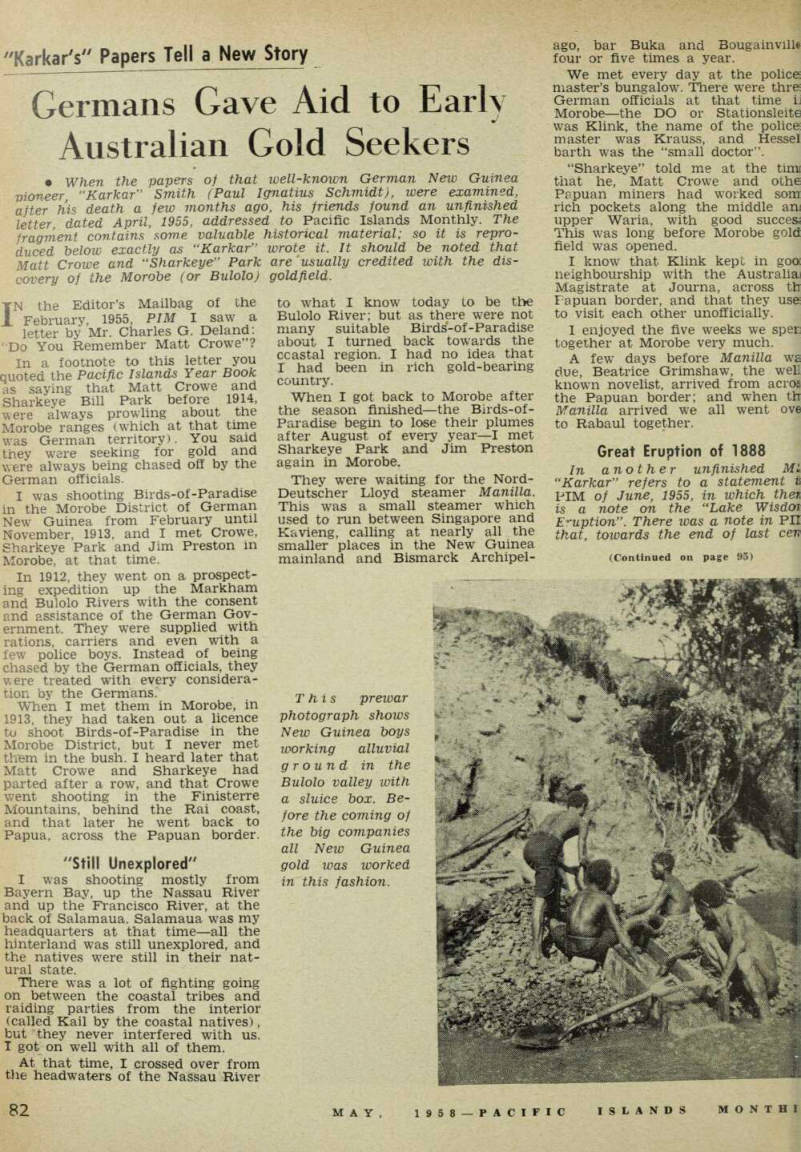
This prewar photograph shows New Guinea boys working alluvial ground in the Bulolo valley with a sluice box. Be fore the coming of the big companies all New Guinea gold was worked in this fashion.
, a tremendous volcanic ex ion blew out the centre of Long ’id and that the natives of the id departed before the eruption, rkar” comments: jcordlng to the reports of the Guinea Company of that time, eruption did not take place on I but on Ritter Island, a small id in Dampier Strait, between most westerly point of New ain and Rook Island. It oc ed in March, 1888, and it blew nost of the middle of the island, left only a small, half-moon ed rim of the crater, still stand created a big tidal wave, which ; all along the coasts of the Guinea mainland, the Bis archipelago and the Solo s: and, according to Dr. Wend , it was noticed on some parts le Australian coast. vo German explorers, Below Hunstein, who were doing some ; for the Company at Cape csster, were caught by the wave and lost their lives. An New Guinea identity, a Dane sd Peter Hansen, was running ide store at Peterhaven, in the Islands, at that time.
the idea of tying in with the Kuria- Abemama royal house. Agnes was married to King Tokatake.
Agnes and Tokatake had a son, Tekanaiti.
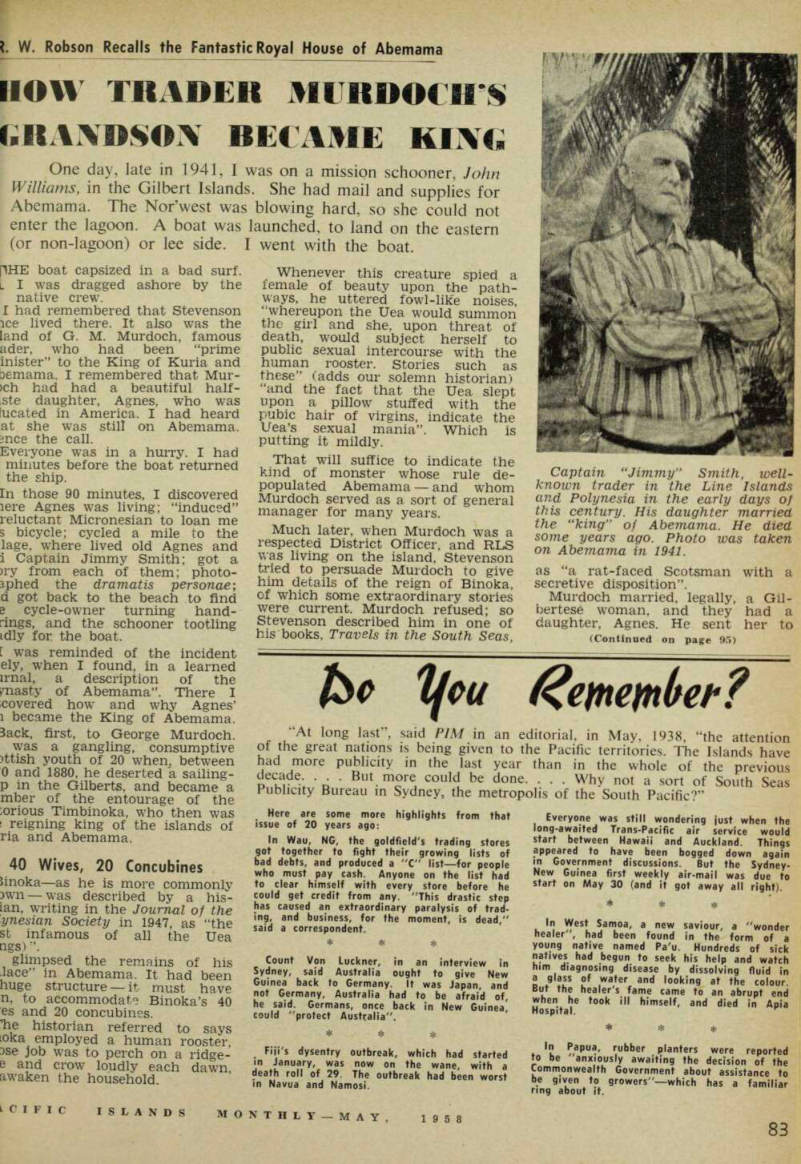
Old Captain Jimmy Smith, a famous trader in the Eastern Pacific in the years between 1870 and 1920, and who had married a woman of Nauru, had settled on Abemama.
They had a comely daughter.
Queen No Longer
When I called at Abemama, in 1941, and found Agnes Murdoch, her husband was dead, and she no longer was queen. Her husband’s brother had succeeeded to the throne—Tekanaiti (Agnes’ son) was too young. But that king also had died; and when I made my brief, uncomfortable call (I still was
soaking from the upset in the surf) Tekanaiti had (a) married the comely daughter of Captain Jimmy Smith and (b) become Abemama’s paramount chief.
Except that Captain Smith is dead (he was 83 when I saw him) I had heard nothing of these people for many years, until I saw an article in a review, which stated that “Tekanaiti had failed to in terest himself in the welfare of his subjects and had acted in a manner that did not command respect”; and that an attempt was being made to transfer the kingship to another branch of the royal family.
In 1941, I wrote of Agnes Mur doch: “She still is slim, and straight and distinctive, with a charming voice and an American accent; and, despite her isolation, she can talk interestingly of people and affairs”.