They Have Wondrous Voices
p. 85 · Read in the full issue
(Like a Pig under the Gate)
The following opinions on the value of the Papuan singing voice are—in their full, unedited, entirety—reprinted from Port Moresby’s long defunct “Papuan Times’’, of February 11, 1914.
Because the editors of the “Pacific Islands Monthly”, with cunning bred of experience, suspect that these views are still capable of being fanned into fire despite the passage of 40 years, they wish to make it clear that they are publishing the material merely for public information, and that they have no desire, or any intention, of becoming involved in personal controversy with Papuan bands, choirs —or lonely white men. Readers are now on their own. . . .
[THE Papuan Times takes the L following from the Melbourne Herald: “Amid the palms and ong the coral strand of Samarai, i the coast of Papua, the singing the native young men and aidens is simply superb, says Mr.
T. Foenander, Clerk of External lairs Department, in charge of ipuan affairs.
“ ‘They harmonise spontaneously four parts,’ he states, with ithusiasm. ‘The resonance and lume of their singing is wonder - 1. Its richness and fullness light the ear of the music lover, never heard anything like it. If could bring a concert party to istralia, the musical world here >uld be in raptures.
“ ‘Left to themselves they would ig and dance all night. Never ce did I hear a discordant note that beautiful island. If a puan cannot sing, he will not ig.’ ‘Mr. Foenander has a right to press an opinion on the singing Papuans. For eight years he s been choirmaster of the lurch of the Sacred Heart, St.
Ida. Before that he was tenor oist at St. Mary’s Cathedral, dney, being the first amateur ected to fill that position. 1 ‘All the natives of Papua are Iblown baritones,’ Mr. Foenander orms us. ‘Tenors are as scarce in Victoria. As one walks along i coral path that skirts Samarai, 3 stops to listen to the song that native youth has just begun. ‘Hardly is there a fairer place earth for the lover of music than - coral path with the waves ashing below, and the palms tling at one’s elbow. Sea and r are wrapped in the glory of the iset, and the harmonious refrain ms part of nature’s vespers.
Idyllic
‘Rounding a rocky corner the ranced listener finds a choir ier a palm that tops a knoll »ve a little cove. Youngsters are ashing about in the water and nng their voices to those of their sr brothers and sisters. One may
listen for a false note but he will not hear one.’
“The singing pervades life through Papua more than any thing else, adds Mr. Foenander. ‘Even discipline cannot drive music from the native constabulary. After drill in the evening they sing with might and main, and often keep in full volume until 8 o’clock, when lights must be cut.’ ”
With respect to the above, this paper was never a choir master, nor has it a tenner to its name, but nevertheless it cannot permit the above statement to pass unchal lenged, nor without risking its un professional opinion thereon.
The native of Papua has a dis cordant note in his voice which more resembles a pig under a gate than any other sound we can recollect.
He has two notes—the top one, and the one underneath.
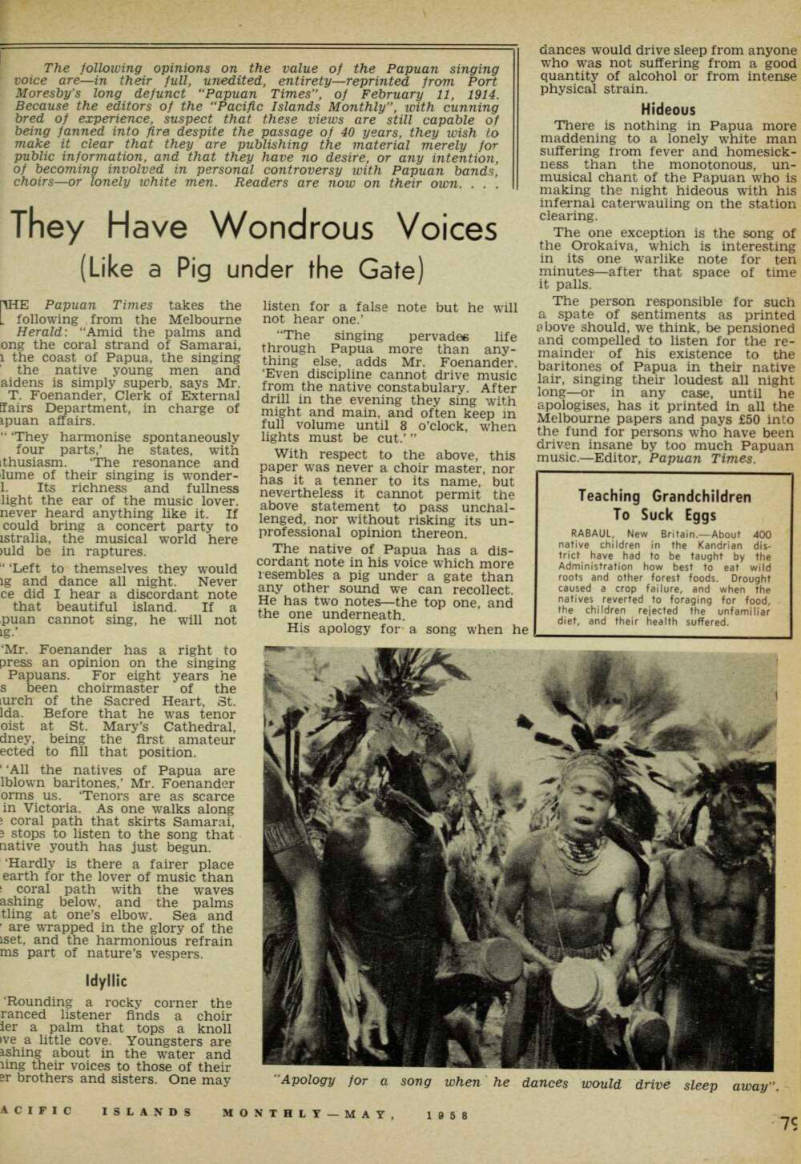
His apology for a song when he
dances would drive sleep from anyone who was not suffering from a good quantity of alcohol or from intense physical strain.
Hideous
There is nothing in Papua more maddening to a lonely white man suffering from fever and homesick ness than the monotonous, un musical chant of the Papuan who is making the night hideous with his infernal caterwauling on the station clearing.
The one exception is the song of the Orokaiva, which is interesting in its one warlike note for ten minutes—after that space of time it palls.
The person responsible for such a spate of sentiments as printed above should, we think, be pensioned and compelled to listen for the re mainder of his existence to the baritones of Papua in their native lair, singing their loudest all night long—or in any case, until he apologises, has it printed in all the Melbourne papers and pays £5O into the fund for persons who have been driven insane by too much Papuan music.—Editor, Papuan Times.
“Apology for a song when he dances would drive sleep away”.