approaching?
p. 65 · Read in the full issue
iji’s Population Figures [?] 'Explosion Point' approaching?
By a Special Writer
The official estimate of the
filiation of Fiji, as on Decern >r 31, 1957, is contained in the
ble, this page.
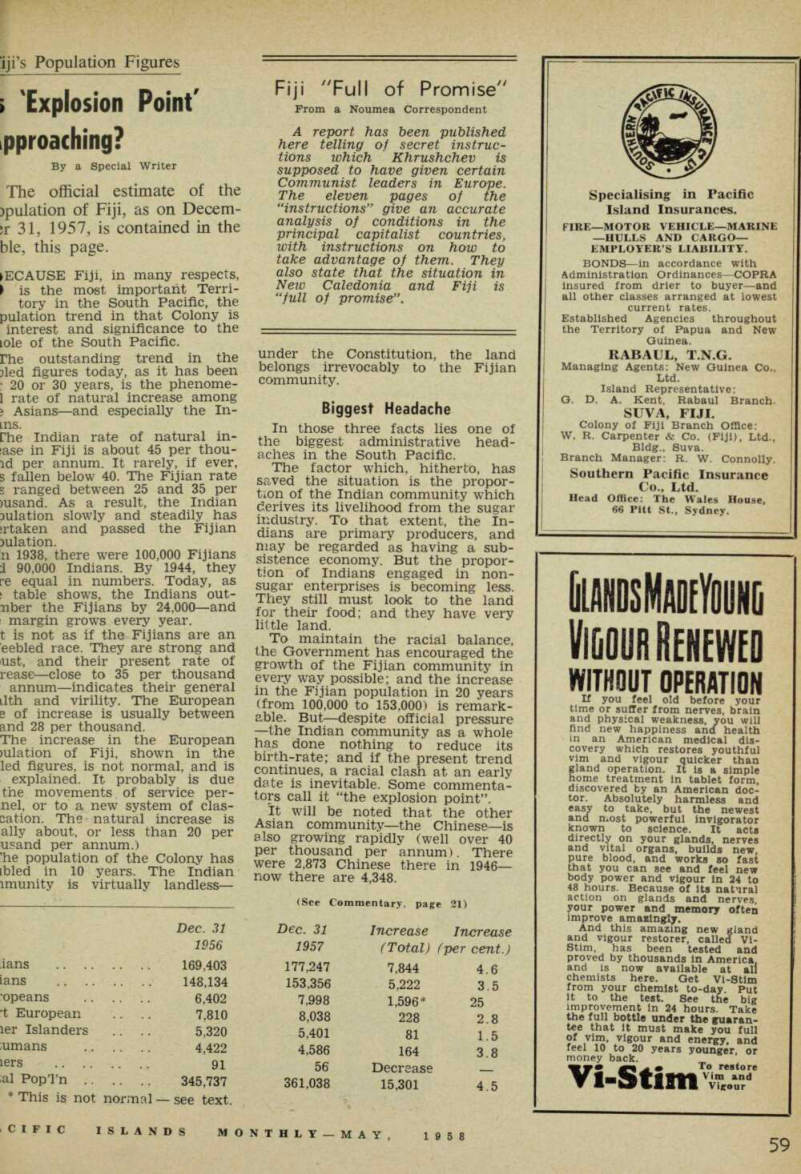
BECAUSE Fiji, in many respects, > is the most important Terri tory in the South Pacific, the pulation trend in that Colony is interest and significance to the lole of the South Pacific, rhe outstanding trend in the jled figures today, as it has been • 20 or 30 years, is the phenome l rate of natural increase among ? Asians—and especially the In ins. rhe Indian rate of natural in lase in Fiji is about 45 per thou id per annum. It rarely, if ever, 5 fallen below 40. The Fijian rate s ranged between 25 and 35 per msand. As a result, the Indian Dulation slowly and steadily has irtaken and passed the Fijian mlation. n 1938, there were 100,000 Fijians i 90,000 Indians. By 1944, they re equal in numbers. Today, as ; table shows, the Indians out nber the Fijians by 24,000—and margin grows every year, t is not as if the Fijians are an eebled race. They are strong and ust, and their present rate of rease—close to 35 per thousand annum—indicates their general ilth and virility. The European e of increase is usually between and 28 per thousand.
The increase in the European >ulation of Fiji, shown in the led figures, is not normal, and is explained. It probably is due the movements of service per nel, or to a new system of clas cation. The natural increase is ally about, or less than 20 per usand per annum.) ’he population of the Colony has ibled in 10 years. The Indian imunity is virtually landless—
under the Constitution, the land belongs irrevocably to the Fijian community.
Biggest Headache
In those three facts lies one of the biggest administrative head aches in the South Pacific.
The factor which, hitherto, has saved the situation is the propor tion of the Indian community which derives its livelihood from the sugar industry. To that extent, the In dians are primary producers, and may be regarded as having a sub sistence economy. But the propor tion of Indians engaged in non sugar enterprises is becoming less.
They still must look to the land for their food; and they have very little land.
To maintain the racial balance, the Government has encouraged the growth of the Fijian community in every way possible; and the increase in the Fijian population in 20 years (from 100,000 to 153,000) is remark able. But—despite official pressure —the Indian community as a whole has done nothing to reduce its birth-rate; and if the present trend continues, a racial clash at an early date is inevitable. Some commenta tors call it “the explosion point”.
It will be noted that the other Asian community—the Chinese—is also growing rapidly (well over 40 per thousand per annum). There were 2,873 Chinese there in 1946 — now there are 4,348.
(See Commentary, page 21)
Dec. 31 Dec. 31 Increase Increase 1956 1957 (Total) (per cent.) ians 169,403 177,247 7,844 4.6 tans 148,134 153,356 5,222 3.5 ’opeans 6,402 7,998 1,596* 25 *t European 7,810 8,038 228 2.8 ler Islanders 5,320 5,401 81 1.5 ;umans 4,422 4,586 164 3.8 lers 91 56 Decrease ;al PopTn * This is not normal — 345,737 see text. 361,038 15,301 4.5