Fiji Talanoa
pp. 55-61 · Read in the full issue
A Suva Observer Talks About Various Matters of Interest
Ratu Sir Lala Sukuna’s 70th birthday was on April 22.
He celebrated it by formally retiring from public office and one the jobs he gave up was that of Speaker of the Fiji Legislative Council.
E was never very happy in this . post. Throughout his life, over and over again he has shown liance amounting to genius, but has never been particularly ;rested in routine things like iting-procedure. row that he has retired, the islative Council is left without a iaker. Why if ever needed one i question. The Governor had ays presided in the past and re seems no reason why this uld not have continued, s long as there is an official jority in the Council the official nbers have to vote in accordance Government policy. When :k decisions on that policy have be made, perhaps as a result ;he turn of a debate, it is better the Governor to be on hand nake decisions. here is a lot of speculation ut Ratu Sir Lala’s successor, ire are not many elder states i in Fiji who have the time or detachment from business or lie affairs to be able to take the job. But the solution may e to be to get someone from >ide —a retired Governor or mial Secretary from somewhere ;he Colonial territories, perhaps. :ouple of years ago Mauritius ointed a Speaker—Sir Robert iley, whose last Colonial ointment was High Com moner for the Western Pacific. ? With
ny Firsts
here have been a lot of “firsts” latu Sir Lala Sukuna’s 70 years, e was the first Fijian to go seas for secondary education; first Fijian university graduate; first (and only) Fijian barrister; first Fijian to serve in an seas military campaign, the winner of a foreign decoration bravery; the first Fijian District imissioner; the first Fijian to •me head of the Fijian Admini tion; the first (and only) Fijian ;ht (twice); the first Speaker of Legislative Council of Fiji; and first (and only) Fijian to esent the British Common- Ith at the United Nations (as adviser at a meeting of the steeship Council).
The Fiji
Family Wright
Mrs. M. E. Wright, who died in Suva last month, was the mother of a remarkable group of sons.
She and her husband were true pioneers. Georgius Wright came to Fiji in 1872 as a drill instructor for Cakobau’s constabulary. Mrs.
Wright was a daughter of Captain Benjamin Hughes, of Watertown, New York, noted among Pacific skippers of last century.
The Wright family spent their early days in what was then the wild hill country of Colo, where Mr. Wright was Governor’s Com missioner.
Three sons served in World War I. Edgar was killed in action.
George returned to become one of Fiji’s best-known police officers.
He died in 1942.
Maitland (Maitey) is still going strong. In his day he was one of Fiji’s finest athletes. He captained the famed Imperials Rugby team in Suva when it was at the height of its form. In the season he still turns out at Albert Park for the Garrick cricket team each Sunday and teaches the young fellows a thing or two. He still shows spark ling evidence of the stylish batting and bowling of his youth.
The other two Wright boys, Oscar and Rob, are enthusiasts about any thing connected with the sea.
Oscar spent several years with Harold Gatty when Harold was making an intensive study of the fishes of Fiji to decide which would
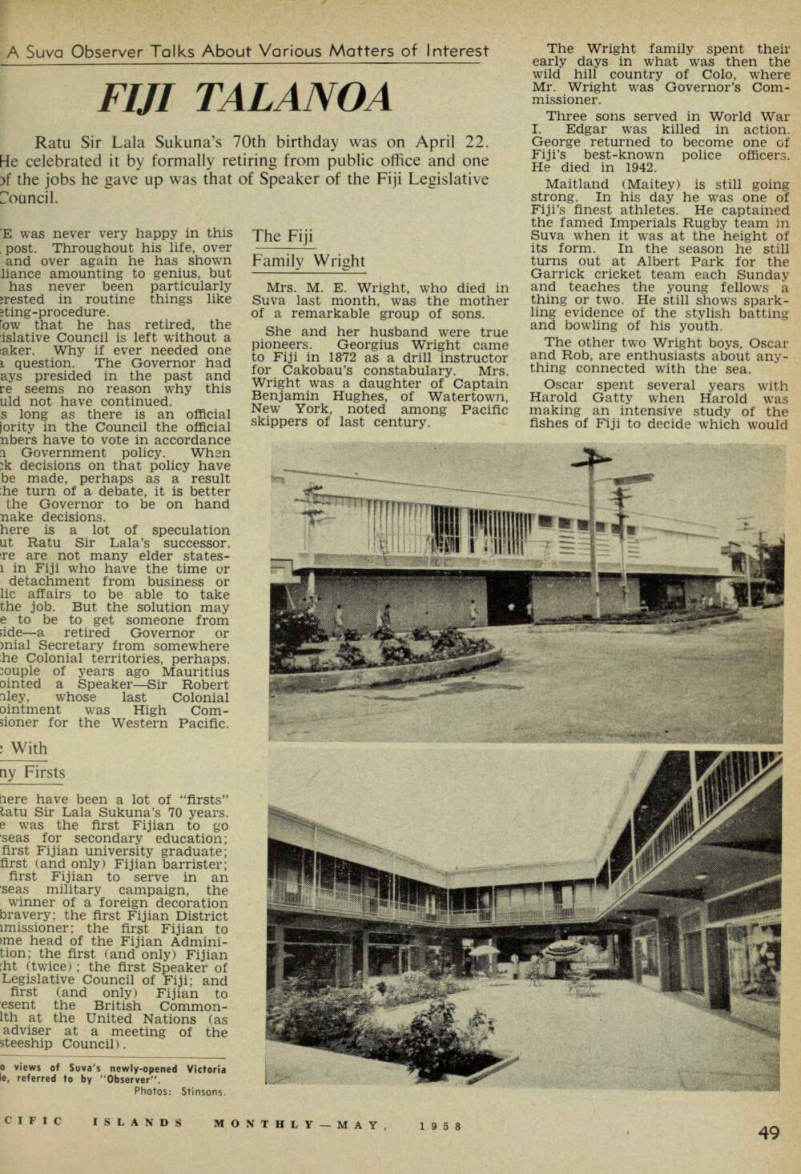
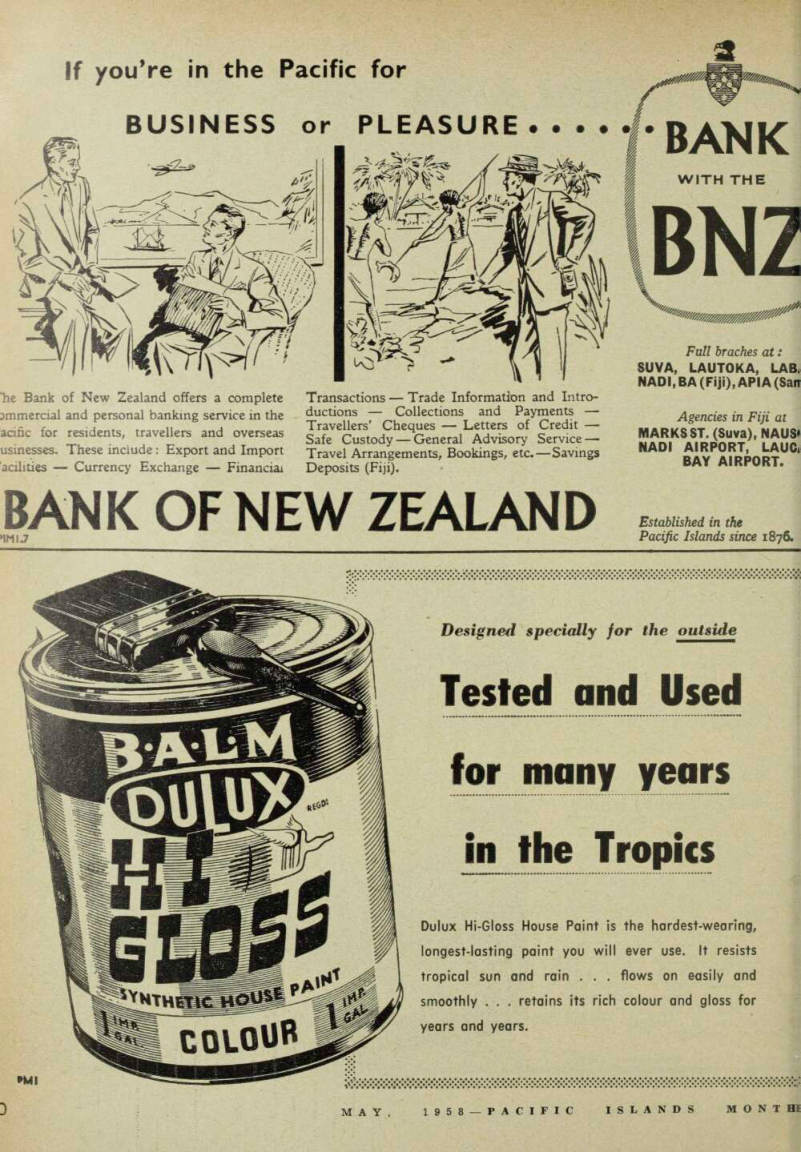
[?]o views of Suva's newly-opened Victoria [?]e, referred to by "Observer".
Photos: Stinsons.
the best to market for his South a Marine Products Ltd.
Then Oscar’s feet, never very 11, became thoroughly itchy and made his way to Majorca, by iy of Hongkong, Singapore and rope. [n Majorca, he and his wife, ma, joined forces with Errol mn, of movie fame, and they i highly successful spearfishing d underwater exploration ex iitions. a youth Rob joined the crew a cruising yacht which called at pa. In her he made his way San Francisco, where he played ! saxophone in dance bands, rked in restaurants and taught mming for a while at the rmont Hotel. le made his way back across the nfic as leader of a ship’s band, i then he stayed for a time in stralia. le came back to Fiji in the o’s and supervised underground 'k at Vatukoula in the early r s of the gold mining industry. [is next job was in charge of the a building the breakwater which loses the landing area at icala Bay flying-boat base, ifhile he was in San Francisco of his jobs was in a photo phic studio, and he acquired an ‘rest in photography which has lained with him. ►uring the war he became photo pher for the Public Relations ce in Fiji and PIM readers have i many examples since then of work that has brought him orld reputation. ut he still loves the sea, and still loves to fish, and for the t year he has been writing a 7 popular weekly column, “Hook, e and Sinker”, for the Fiji les. [rs. Wright had an unusual by. She collected little shoes, ;nds sent them to her from over the world, and a cabinet the Wright home at Nasese, a, is crammed with miniature ;wear of all shapes and in trials ranging from wood and her to porcelain and satin.
Avenue
►pared
here was a lot of fuss a few ks ago about a suggestion that avenue—or, rather, two avenues : trees near Natabua, at the roaches to Lautoka, should be down. he avenues are one of the n beauty spots of the area, but trees were planted at the turn the century, when traffic was what it is now. As a result, road between the trees is row. o every now and then some y proposes that the trees should cut down. hen there are roars of protest, the middle of which somebody
makes the obviously sensible suggestion that another row of trees be planted at one side. In this way a double avenue would be created to make a two lane highway.
Everybody agrees that this is a good idea, except the advocates of destruction, or those who think the trees could be turned to commercial advantage.
But nobody plants the extra row, the fuss dies down, and all is quiet until somebody else comes up once more with the bright idea of cutting down the avenue.
Then the mixture as before.
But A Tree
Was Not
There was a tree in Suva that was cut down despite loud public protest.
It was outside the Post Office and its branches spread across the whole street.
It was a magnificently, venerable tree, held in pride by the locals and much admired by visitors.
But bureaucracy, which ruled the affairs of Suva in those days, had its way. A senior police officer decided that the tree was a traffic hazard and down it came.
Very shortly now, when the new Suva Post Office is completed, the present Post Office corner will be rounded off, and there will be a junction from which a new thoroughfare, Scott Street, will run through to the Metropole Hotel.
The old tree would have been in the centre of the junction, a natural dividing point for traffic.
Now an artificial “island” will doubtless be built, and that, my children, will be progress.
Recession
In Levuka
The town of Levuka, which depends for most of its economic life on trade in copra, is feeling the pinch at the moment.
All Fiji copra for export is being turned into coconut oil at Island Industries’ mill—and the mill is in Suva.
This means that the most profit able way of selling copra is to take it direct to Suva, and Levuka’s trade has accordingly been much reduced.
There are, however, several hopes.
Carpenters are thinking seriously of starting a whaling industry in Fiji, and the plan is to base it on Ovalau, within easy distance of Levuka. But at least another season’s research will be needed before the go-ahead signal can be given, and, of course, whaling is a seasonal industry.
More immediate prospects are from bananas. In the past year there has been a lot of planting in the Lovoni Valley, Ovalau, and on Koro and other Lomaiviti (Over)
lands. If the amount of fruit >r export can be built up ifficiently, the Union Company’s ips would probably call at Levuka pick it up. be BUT in Z Bananas The Lomaiviti bananas could be pplemented by fruit from vusavu, where Fijians of Cakau ove Province, inspired and led Ratu Penaia Ganilau, have inted big areas in the Savudrodro Jley.
But—and it is a big but —the w Zealand Government began the ir by threatening to cut imports, d although this decision has been rtly reversed, for 1958 there is no arantee for the future, jevuka is one of the most ractive towns in Fiji. Besides tural beauty it has a tradition hospitality, and it is full of tory. A bit of energetic effort [ld attract many more tourists.
Another standby for the town is it it is still the main educational tre for southern Vanua Levu and i scattered islands of Lomaiviti. ievuka has weathered a lot of rms in the past and it will doubt survive this one, too.
anging Face
Suva
r ictoria Arcade, where McDonald’s ;el and Calembeen and the shops dw once stood, is the latest and haps the most handsome lition to Suva’s architecture.
Jthough rents are high, all the ps on the ground floor have n taken. There are still some s along the second floor 3onies, where most of the space •eserved for offices, lay beach umbrellas beside a den in the central courtyard ce an attractive setting for ming or afternoon tea parties, for after-theatre suppers, ew buildings along the full ?th of Suva’s foreshore have isformed the face of the city the past few years. newer generation of architects e made interesting use of o’es, both for decoration and to ;at the western sun which has lerto made many Suva shops offices unbearably hot in the ;rnoons. ouvres in the handsome Native ds Trust Board building, near Government offices, are fixed, iind them is a corridor, giving ?ss to the line of offices on each r. ear the Native Lands Trust
rd building is Broadcasting
ise, attractive outside and ndidly equipped inside, he frontage of the whole city k opposite the Cable and Wire office has changed. Every shop )ffice building has been replaced e the war. Just beyond, the
new Club Hotel is steadily taking shape. All bedrooms and the main public rooms throughout the hotel are to be air-conditioned—another st |P forward.
Next to the Victoria Arcade is a completely re-modelled Bank of New Zealand, taking in what used to be Sid Levy’s jeweller’s shop.
A building of particularly striking and very pleasing design is tucked away round the corner. It is Nicolas House, headquarters of the Catholic Mission in Fiji. Very effective use has been made of modern materials in this building.
Beyond the Triangle, the five storey first section of the new Post Office is reaching the finishing stages.
Walter Horne’s building has gone, but the gap is to be filled by a giant department store which will take in the present Morris Hedstrom’s and Carpenters’ stores.
Work has begun on Carpenters’ new headquarters, in Rodwell Road just beyond Burns Philp’s main store, which is shortly to be extended to Stewart Street, Malcolm Brodie’s house, scene of so many memorable parties, is no more. The steps, and the hill on which the house stood, have been carved away and the Pacific Biscuit Company’s factory has been extended, the new section being arranged to blend architecturally with the old.
Further along Rodwell Road,
vards Walu Bay, is the Phoenix icatre, which would hold its own architecture, decoration and jipment with wide-screen picture ;atres in most towns of com rable size abroad. 3 erhaps the biggest transforma n which old-timers would see in va —apart from the splendour ich has descended on Naiqaqi— in Gumming Street, t is still All Nations, and a lot the old customs prevail, but the turesquely insanitary hovels have le. The street is one of modern icrete shops, with fluorescent iting and chromium fittings.
Hi the alleyways running towards bukalou Creek have become little ades.