To Confirm La Perouse Relics
p. 39 · Read in the full issue
[?]y Be a Cannon There, Too
Markings On Lead Ballast May Help
" pim” in April reported details of the recovery by a French expedition of relics believed to be from the ivreck of La Perouse’s vessel “Astrolabe”, presumed sunk off Vanikoro about 1788. The expedition was led by the French Resident Commissioner of the Flew Hebrides, Monsieur P. Anthonioz, who, in Paris last year studied the original charts of Captain d’Urville.
The following report, giving some additional information on tne historic search, is from Mr. L. W. Filewood, of Vanikoro, who was present part of the time.
E French party was provided ivith aqua lungs, underwater cameras, air compressors, and ;he other equipment necessary irry out a comprehensive search ;he areas in which it might Dnably be assumed the wreck 1 have taken place, te party arrived at Vanikoro in early hours of the morning of :h 17, in the Condominium Don Quijote under the cap :y of Jack Barley. Within a t time it was under way to the at Wreck Passage which pre -3 expeditions had established reasonable certainty as the s of the wreck, based on the ng of parts of a vessel consis with the period during which Arouse was lost, i evidence was found at the spot tried, and operations were ?d down the reef towards the ; and a further attempt was e, this time with success. ►wever, as diving was being ed out from a small dinghy, a fresh north-west breeze ing, causing a strong swell and the incoming tide was very ig, the party returned to Peou • about six hours work, to make agements for better diving ities and further tools and ament. usual, the Kauri Timber Com r provided every possible assist i by way of local knowledge of y spots, currents, tides, winds, and also provided a large plat l barge from which to operate.
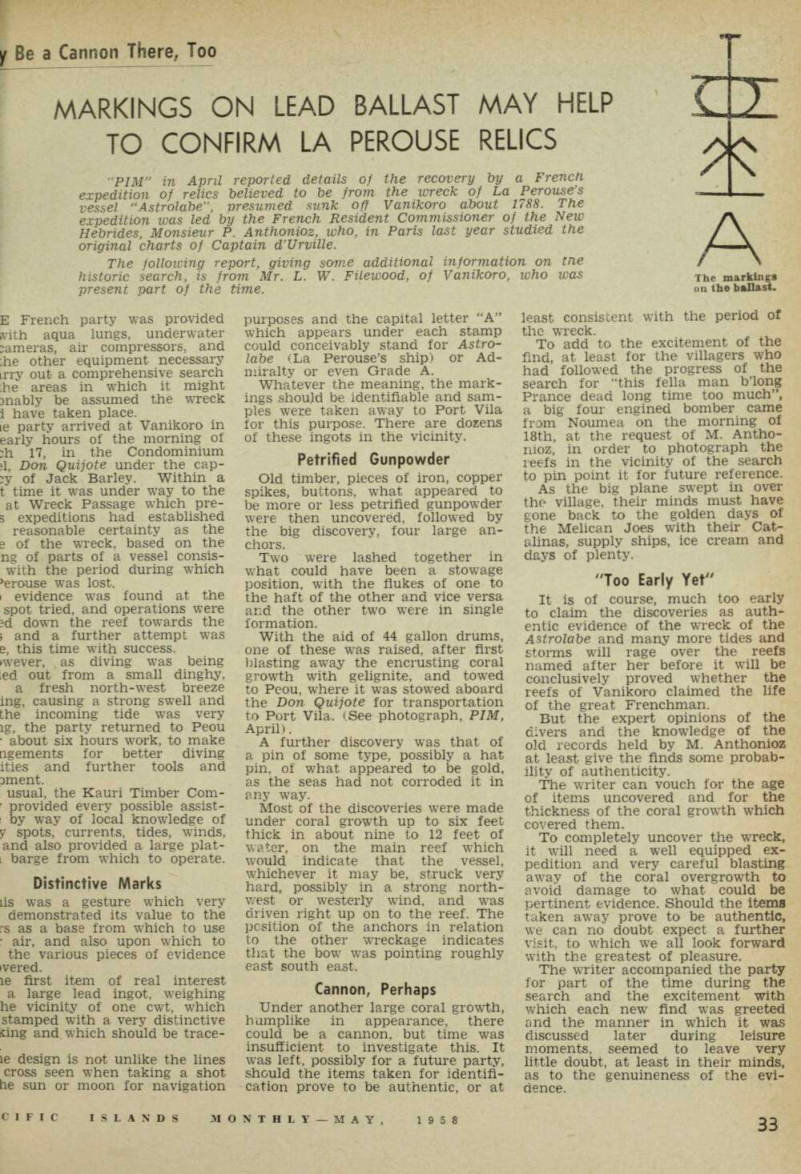
Distinctive Marks iis was a gesture which very demonstrated its value to the rs as a base from which to use • air, and also upon which to the various pieces of evidence ivered. le first item of real interest a large lead ingot, weighing he vicinity of one cwt, which stamped with a very distinctive sing and which should be trace le design is not unlike the lines cross seen when taking a shot be sun or moon for navigation
purposes and the capital letter “A” which appears under each stamp could conceivably stand for Astro labe (La Perouse’s ship) or Ad miralty or even Grade A.
Whatever the meaning, the mark ings should be identifiable and sam ples were taken away to Port Vila for this purpose. There are dozens of these ingots in the vicinity.
Petrified Gunpowder
Old timber, pieces of iron, copper spikes, buttons, what appeared to be more or less petrified gunpowder were then uncovered, followed by the big discovery, four large an chors.
Two were lashed together in what could have been a stowage position, with the flukes of one to the haft of the other and vice versa and the other two were in single formation.
With the aid of 44 gallon drums, one of these was raised, after first blasting away the encrusting coral growth with gelignite, and towed to Peou, where it was stowed aboard the Don Quijote for transportation to Port Vila, (See photograph, PIM, April).
A further discovery was that of a pin of some type, possibly a hat pin, of what appeared to be gold, as the seas had not corroded it in any way.
Most of the discoveries were made under coral growth up to six feet thick in about nine to 12 feet of water, on the main reef which would indicate that the vessel, whichever it may be, struck very hard, possibly in a strong north west or westerly wind, and was driven right up on to the reef. The position of the anchors in relation to the other wreckage indicates that the bow was pointing roughly east south east.
Cannon, Perhaps
Under another large coral growth, bumplike in appearance, there could be a cannon, but time was insufficient to investigate this. It was left, possibly for a future party, should the items taken for identifi cation prove to be authentic, or at
least consistent with the period of the wreck.
To add to the excitement of the find, at least for the villagers who had followed the progress of the search for “this fella man b’long Prance dead long time too much”, a big four engined bomber came from Noumea on the morning of 18th, at the request of M. Antho nioz, in order to photograph the reefs in the vicinity of the search to pin point it for future reference.
As the big plane swept in over the village, their minds must have gone back to the golden days of the Melican Joes with their Cat alinas, supply ships, ice cream and days of plenty.
“Too Early Yet"
It is of course, much too early to claim the discoveries as auth entic evidence of the wreck of the Astrolabe and many more tides and storms will rage over the reefs named after her before it will be conclusively proved whether the reefs of Vanikoro claimed the life of the great Frenchman.
But the expert opinions of the divers and the knowledge of the old records held by M. Anthonioz at least give the finds some probab ility of authenticity.
The writer can vouch for the age of items uncovered and for the thickness of the coral growth which covered them.
To completely uncover the wreck, it will need a well equipped ex pedition and very careful blasting away of the coral overgrowth to avoid damage to what could be pertinent evidence. Should the items taken away prove to be authentic, we can no doubt expect a further visit, to which we all look forward with the greatest of pleasure.
The writer accompanied the party for part of the time during the search and the excitement with which each new find was greeted and the manner in which it was discussed later during leisure moments, seemed to leave very little doubt, at least in their minds, as to the genuineness of the evi dence.
The markings on the ballast.