Commentary
pp. 27-29 · Read in the full issue
arp New Turn In
donesian Situation
lOM being a comic-opera war, with even near neighbours smiling tolerantly as Indonesian lists and rebels made ugly faces shot off guns harmlessly at i other in Sumatra, affairs in mesia suddenly took a more ms turn at the end of April. >w, unless much diplomatic is exercised, some of the Pacific itries could become embroiled. >mbers, appearing unexpectedly i somewhere in the northeast, obviously manned by skilled men, began attacking and •usly damaging any ships using nesian Government ports; and, Dnsequence, shipping was being iedly withdrawn, ds campaign began just as the dion in Sumatra was fading a very inglorious conclusion, Soekarno triumphant. Its pur is clear. Indonesia’s economy dy is tottering, the result of > of corruption and mismanage ’<* Plus the strain of the itran “war”. Paralysis of ship could give it the coup de grace. e Communists have been get ready to take over in Djakarta, arno has been helped very i by the Soviet countries in his against the Sumatran rebels.
West, therefore, might be ex d to applaud this new develop in the rebellion against irno. t it is no time for cheering, planes, and other help for the s —now active in the Moluccas Celebes archipelagos, just north ustralian New Guinea —have supplied from Formosa, by iona 1 i s t (anti-Communist) a. The bombing attacks are carried out by European ably American) mercenaries, ? for the rebels, but almost inly being paid by Anti-Red ;sts. the bombing attacks have num success, and Soekarno’s •nment collapses, what will m? The best we can hope for 1 be the emergence from the so-economic confusion of a rate Moslem administration, ig the worst would be the e of power by the Reds, in association with Red China loscow. ess America, and the West, repared to intervene in Indo to seek some kind of stable nment, they would be well ;d to use their strongest in
fluence to halt the bombing of the ports and shipping.
Early in May, Soekarno was howling to Moscow that these are Western bombers from Nationalist China, operated by American air men, If Moscow accepts that state ment, the Communist nations will provide fighter planes for the pro tection of the Indonesian ports.
That will be simply one step nearer to the establishment of a Communist State, right across our northwestern frontier. ☆ ☆
As NT Seethes, 'Mother'
Hasluck Knows Best
r[ERE are 20,000 Europeans domiciled in Australia’s Northern Territory. They believe that they should have some voice in the government. Evidently, the Minister and Department of Territories thought so, too, because they authorised an election, and six qualified men were appointed members of the Council, by popular vote.
The latter made recommenda tions. Other qualified people, after inquiry, recommended that those recommendations be treated with respect.
The elected members and their representations were treated so lightly by Minister and Department heads alike that, the six men, as a protest, resigned in a body. They published strong criticism of Minister Hasluck, his aloofness and his intolerance. (Someone has said that he models himself upon Mr.
Menzies, whom he hopes some day to follow!) The Parliamentary member for NT, Mr. Nelson, vote-less but belligerent, took up the cause of the NT Councillors (resigned), and is threatening to retire and force a by-election on the issue.
Minister Hasluck and Territories Secretary Lambert, in brief appear ances in print, have played down the NT incident, denied that there is any kind of trouble in the Administration, and argued that the Department knows what it is doing.
Mr. Hasluck suggested that the six would perhaps be a little less irritable when the hot weather passed!
Papua and New Guinea folk have followed these events with some interest. P-NG, living under a similar administrative set-up, and similarly compelled by circum stances completely outside their control to accept Messrs. Hasluck
and Lambert as the directors of their lives and fortunes, probably would like to send leather medals to the six rebels in NT.
There are almost as many Euro peans domiciled in P-NG as there are in NT, and there is far more economic and social development in the Island Territory. Yet the P-NG residents have only three elected members in their Legco; and their Council, like that in NT, is com pletely dominated by officials who must carry out Canberra’s wishes.
There are conditions in NT, as m P-NG, which make government by a democratically-elected body both undesirable and impracticable.
But equally undesirable is the flat-footed, bureaucratic dictator ship of Canberra, as applied to NT and P-NG. Its undesirableness becomes manifest when, at the head of the dictatorship, is a clever, sincere but intellectually-arrogant man like Mr. Hasluck. He is quite sure that he has forgotten more about the science of ‘ tropical administration than the average Territories’ resident has ever learned—and he probably is right, most of the time. That, probably, is why he and his Departmental heads have such a reputation for consistently over-riding the Admini strators.
But that does not alter the fact —daily becoming more prominent and insistent—that all men and women over 21 consider themselves entitled to a voice in their own government. Ignore them, and they become troublesome—and embarr assing.
If Minister Hasluck were as wise as he is clever, he would have used his P-NG Administrator (and, presumably, the latter’s opposite number in Darwin) as a constant channel of communication between dissatisfied sections in the Terri tories, and Canberra. Far too often, we see delegations of resi dents of P-NG or NT going directly to Canberra to discuss, with the official czars there, matters which should, as a matter of course, be settled in the Administrators’ offices.
The machinery is there, but it is not used for the purposes for which it was planned.
The NT rebellion should remind Mr. Hasluck that, while he may ignore his Administrators and some of the residents some of the time, he cannot ignore all Administrators and residents all of the time. ☆
The HCL on
South Sea Islands
AN announcement in the Fiji Times in mid-April that the winner of the Win-an-Island contest and his friend could do with some work to cover out-of
pocket expenses, just about ties up the biggest piece of ballyhoo that was ever launched in the sacred name of publicity.
Kent Shelby (who won the island by supplying the last line of a limerick) and his friend Douglas Howard, were then living in a Suva boarding Imuse (at the expense of the Fiji Visitors’ Bureau) awaiting the sailing of Orsova on May 5, which would take them back to California and reality, two months before they had planned to go.
They arrived in Fiji from the US at end of February to claim their island—a pint sized piece of mud, mangroves and sand off Lautoka, uninhabited except by visiting Fijian and Indian fisher men.
A native hut had been built, and furnished by local firms—but just for a fortnight. At the end of that time, a launch arrived and actually took away everything from the primus stove to the camp beds, leaving the two men to fend for themselves. They insist that it was not this that got them down — although it seems to us to have been unnecessarily inhospitable— but that no money went with the prize and they found the cost of living, even in the simplest way, more than “we had ever imagined”.
The biggest mystery throughout this piece is why Fiji allowed itself to be associated with this nonsense.
If it were in hope of a publicity boost, the Colony is likely to get more than it bargained for. It is human nature to turn sour with disillusionment, and if the US newspapers don’t play up this South Seas idyll that misfired, it will be a miracle.
And now that the temporary occupiers of “Ava Ava” have gone home, can we hope perhaps that the islet will revert to its pre- Hollywood native name of Yawalu? ☆ ☆ ☆
BABIES: Problem for
Fiji's Five Communities
FROM the outside, looking in, the British Crown Colony of Fiji appears quiet and placid.
It has been quiet and placid for 80 years.
If the lack of signs to the contrary is any indication, the British Colonial Office imagines that it will remain so always.
Seemingly, Whitehall never learns.
It has been shown, many times, in many places, that failure of the governing agency to appreciate population trends will lead inevi tably to political disturbance and humiliating loss. Some of the disasters that have overtaken the British Colonial Office since World
War I could have been avoided if the bureaucrats had read the signs right, and reacted accordingly.
But they went their own way, blind and stubborn; and the end result is not beautiful in our sight.
In 28 years, Fiji’s Indian popu lation has come from 20,000 behind the Fijian population, to equality with it in 1944, and a lead of 30,000 today. Nearly half Fiji’s population now is Indian. This journal, and some leading men of the South Pacific, have directed attention, again and again, to this dangerous situation. Little has been done.
The Fijians, a proud and virile people, own the lands of Fiji; and the Fijians are increasing at more than normal rate. (See population figures, on page 59). The Fijians will not give up their land rights to meet Indian needs. The intro duction of the Indians was none of their doing.
The population has doubled, in a little more than 20 years, to 360.000. It will double again, to 750.000, within 25 years.
So far, the Indians have been quiet, peaceful, and reasonably co operative. Indian leaders —like Fijian and European leaders —are quite capable of seeing the develop ing problem, and applying to it the rules of simple logic.
An increasing proportion—cer tainly a majority—of the Indians now are Fiji-born and Fiji educated. They had no say in the immigration policy which brought their forebears in to grow the sugar-cane and work the mills.
Fiji now is their established home. inevitably, they or their children are going to demand equality with Fijians and Europeans, in all matters connected with Fiji.
Some Governors —especially Ronald Garvey—have sought aim desperately for a solution. TM thoughts have taken shape measures for making Fiji Is available for Indian use; inj concerted attempt to change Fijiii from village communal life toe system of individualism, in generation. The planning is sou enough, and practical; but th are mere palliatives.
There are five communities Fiji—Fijians, Indians, Europes Chinese, and Euronesians (p European, and part Polynesian j Melanesian). So far, these co munities have permitted earnest, painstaking men from British Colonial Office to regul their lives, and shape the fut) of Fiji. Will they be content w that system, much longer? : the answer, look around the font British Empire!
It is improper and most unu that this ugly and develop problem of Fiji’s future should j left indefinitely on the knees i short-term, inexperienced Gov nors.
Fiji was lucky in getting Ronald Garvey, in 1952. He • wise, experienced and exceedin tactful in handling the sensii leaders of the five Fiji communitj and so we have had peace, the law of averages, his succes; —due in a few months—could J a stiff-necked and unimaginaj bureaucrat; and that kind Governor will cause grave trov in Fiji.
It is time to do away with old system.
It clearly would be impracticas and unjust, to introduce the M of “democracy” that is based J manhood suffrage and a come roll. (It works badly enoughr countries of one race—it would: sheer disaster in Fiji).
Fiji needs something between j present system and common democracy something that give an adequate voice to o section of the people, which guard the fundamental rightsa the indigenous race, and which place upon the shoulders of five communities, whose futun in Fiji, the responsibility for fint: an administrative system that give some reasonable guarantee peace and justice.
The situation calls—with urgee now—for some sort of Convene, in Fiji to consider the problc of a new Constitution, and to nr: recommendations. The move e such a Convention should o from the British Colonial OC There is not a sign of it.
It would be very embarrassin the Whitehall wallahs remas passive for so long that the leas of the Fiji communities begarj yell. That could lead to a site ition already demonstrated, nauseum, in too many Bn Colonies.
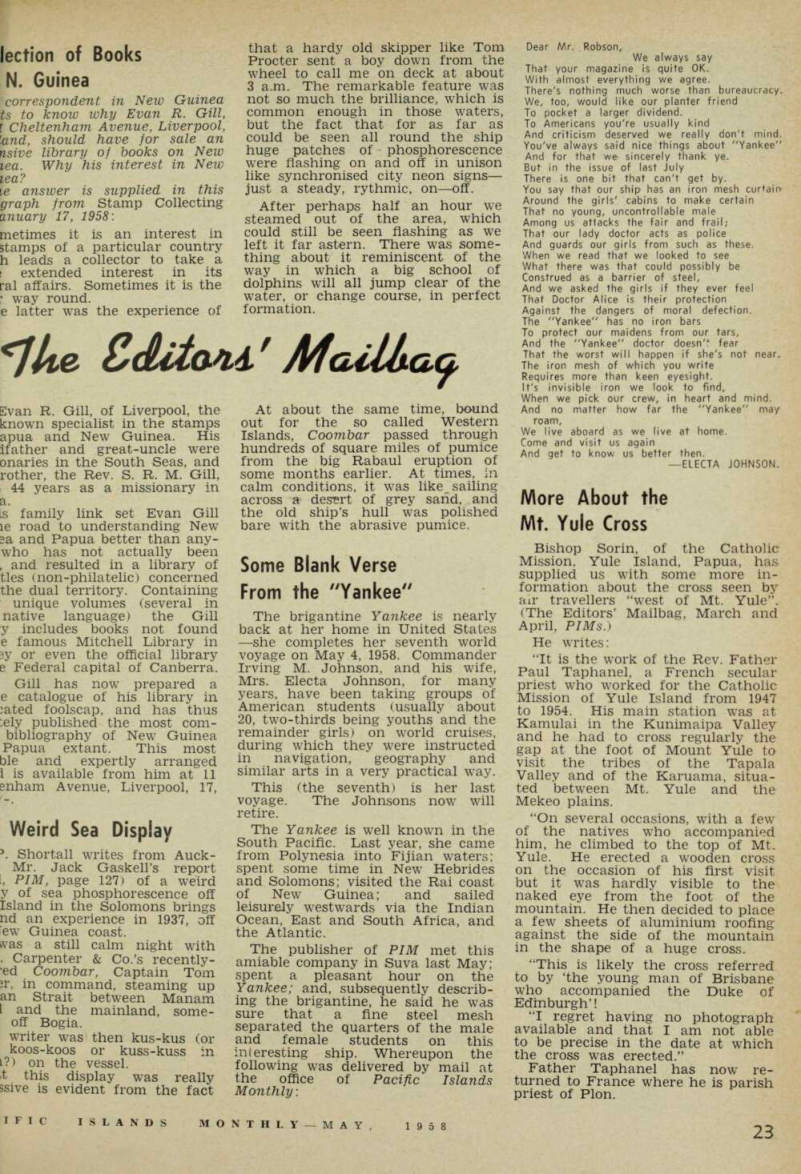
THE PASSING ERA: The day of the "tem porary" Islands' building—the shack of tarred paper, the fibro-sided box, the galvanised iron shanty, the ex-Army recreation hut —is finally passing. Nobody is sorry about it; for far too long have ugly, "temporary" buildings been blots on Islands' beauty spots. This issue of "PIM" publishes photographs of some of the attractive, modern buildings that are going up in the place of the old horrors (see pages 119, 139), and here is another one—a new, two-storey post office building now on the site of the former ramshackle post office at Honiara BSIP.
lection of Books
N. Guinea
correspondent in New Guinea ts to know why Evan R. Gill, I Cheltenham Avenue, Liverpool, '.and, should have for sale an nsive library of books on New tea. Why his interest in New tea? le answer is supplied in this graph from Stamp Collecting anuary 17, 1958: metimes it is an interest in stamps of a particular country h leads a collector to take a i extended interest in its ral affairs. Sometimes it is the • way round. e latter was the experience of
that a hardy old skipper like Tom Procter sent a boy down from the wheel to call me on deck at about 3 a.m. The remarkable feature was not so much the brilliance, which is common enough in those waters, but the fact that for as far as could be seen all round the ship huge patches of phosphorescence were flashing on and off in unison like synchronised city neon signs— just a steady, rythmic, on—off.
After perhaps half an hour we steamed out of the area, which could still be seen flashing as we left it far astern. There was some thing about it reminiscent of the way in which a big school of dolphins will all jump clear of the water, or change course, in perfect formation.