But About
p. 23 · Read in the full issue
Cocoa on the Warangoi But About 10 Years Late
After about 10 years of agita tion, the New Guinea Adminis tration opened its heart towards the end of last year and granted five cocoa blocks along the War angoi Valley, about 30 miles out of Rabaul.
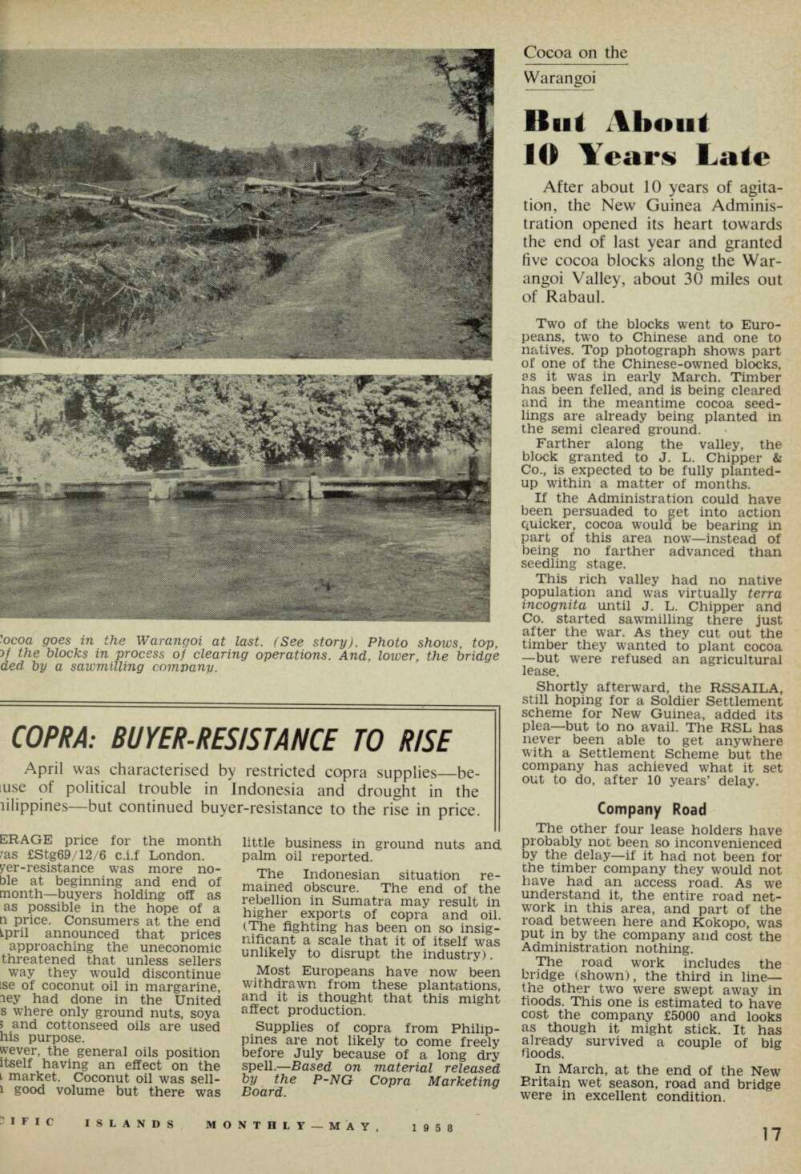
Two of the blocks went to Euro peans, two to Chinese and one to natives. Top photograph shows part of one of the Chinese-owned blocks, as it was in early March. Timber has been felled, and is being cleared and in the meantime cocoa seed lings are already being planted in the semi cleared ground.
Farther along the valley, the block granted to J. L. Chipper & Co., is expected to be fully planted up within a matter of months.
If the Administration could have been persuaded to get into action quicker, cocoa would be bearing in part of this area now—instead of being no farther advanced than seedling stage.
This rich valley had no native population and was virtually terra incognita until J. L. Chipper and Co. started sawmilling there just after the war. As they cut out the timber they wanted to plant cocoa —but were refused an agricultural lease.
Shortly afterward, the RSSAILA, still hoping for a Soldier Settlement scheme for New Guinea, added its plea—but to no avail. The RSL has never been able to get anywhere with a Settlement Scheme but the company has achieved what it set out to do, after 10 years’ delay.
Company Road
The other four lease holders have probably not been so inconvenienced by the delay—if it had not been for the timber company they would not have had an access road. As we understand it, the entire road net work in this area, and part of the road between here and Kokopo, was put in by the company and cost the Administration nothing.
The road work includes the bridge (shown), the third in line— the other two were swept away in floods. This one is estimated to have cost the company £5OOO and looks as though it might stick. It has already survived a couple of big floods.
In March, at the end of the New Britain wet season, road and bridge were in excellent condition.
[?]ocoa goes in the Warangoi at last. (See story). Photo shows, top, of the blocks in process of clearing operations. And, lower, the bridge ded by a sawmilling company.