Pacific Report
pp. 119-155 · Read in the full issue

lunda Airstrip
ack in Business
The old American airstrip at !unda, in the British Solomons, back in use—for commercial rcraft. Qantas began using the rip from March 24, on the thrice onthly service between Honiara id Lae, New Guinea.
The strip was reconditioned in a ne-months’ works programme, id now has refuelling facilities id a 7,000 ft runway—which is ore than capable of handling the 23 ’s using it. It’s obviously oomed for bigger things in the dening Pacific air network (see M, February, p. 21).
Munda replaces Barakoma as the k-down point for Gizo, Admini •ation centre for the Western lomons. Passengers from Gizo 11 now have to contend with a : hours’ launch journey, instead three as before. \ Honiara report says that use Henderson Field for aircraft has ;o been approved by DCA, but thing is known there about when mderson will replace the present miara strip.
Henderson, like Munda, could be important link in the new Pacific ■ chain.
dan Question Finally
Jts an Answer
fhe officially unanswered question whether New Guinea Asians mted Australian citizenship uld be able to work and live in stralia without restriction, has iv been answered—officially, Australian Immigration Minister svnley said in answer to questions the Commonwealth Parliament March 11 that NG Asians mted citizenship would be Dwed in Australia without any trictions at all. le said it has been estimated it about 2,200 Asians in P-NG re eligible for naturalisation as as residence requirements were icerned. However, there was no imate of the total number able satisfy all requirements for zenship, he added, rhe decision to grant selected w Guinea Asians Australian zenship was made about 12 nths ago, but not until towards - end of last year was an aouncement made giving details the qualifications needed for zenship.
Then the announcement did not te whether Asians would be )wed to enter Australia freely, i there was some confusion on i point (see PIM, November, 7, p. 19) .
Meanwhile, in Lae, NG, in late rch, the annual State Congress
of the Returned Soldiers’ League resolved that “any person” who collaborated with the Japanese during the war should not be eligible for Australian citizenship, even if there were doubt that he acted under compulsion.
Rabaul sub-branch of the RSL brought the matter by up asking for a rigid screening of applicants for naturalisation. The decision will be forwarded to the Federal body of the RSL.
A Shield of Pity Against
The Woodsman's Axe
Noumea, New Caledonia, has not a great many tourist attractions as Islands territories go. But among the things that visitors comment on are the tree-lined streets —attractive, shady avenues that many ether Islands would like, and haven’t got.
Now the Noumea town council wants to take away many of the trees. Its explanation is that they are old and dangerous, and there is risk of falling branches injuring someone; and that the falling fruit from some of the trees has an of fensive smell.
But Noumea’s tree lovers—and it appears that there are a great deal more of them than the council contemplated—have rallied to the cause.
Newspaper letter writers and even poets have put up a spirited resist ance in an effort to halt the woods man’s axe.
They have pointed out that the problem of falling branches can be solved if the council properly pruned the trees, and that the argument about a smell is a some what quaint excuse in a town where gutters are as noisome as Noumea’s.
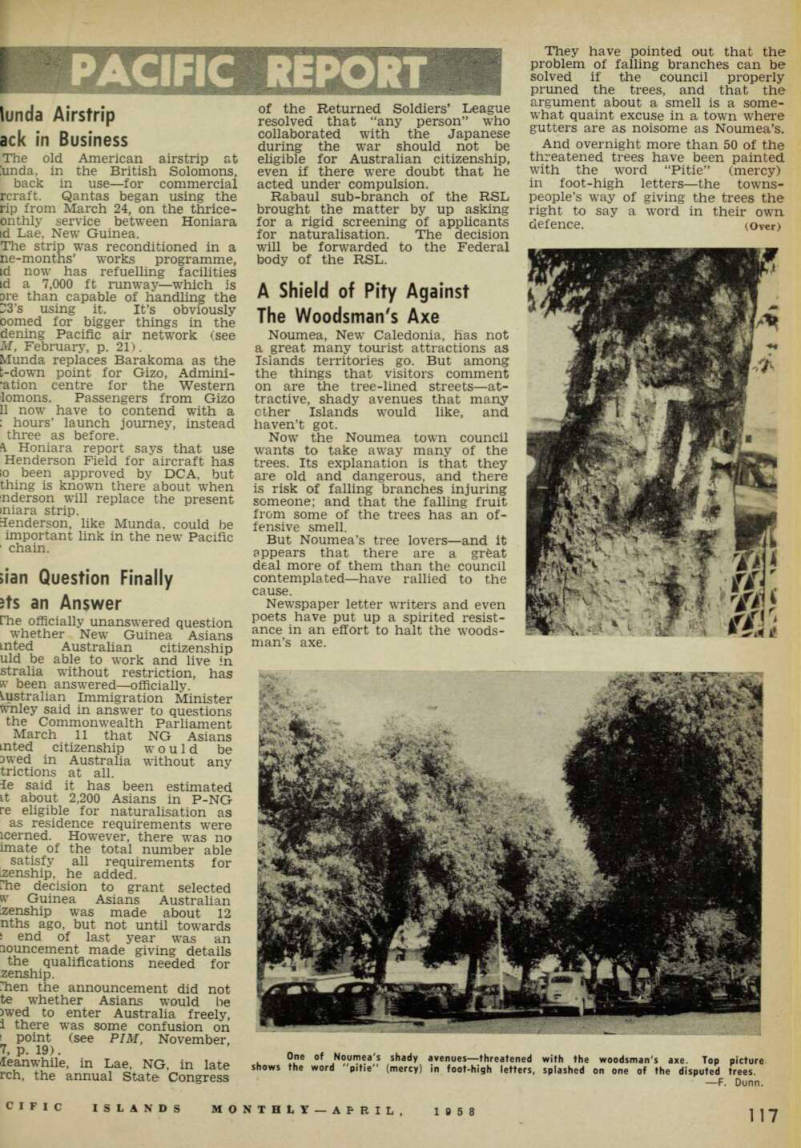
And overnight more than 50 of the threatened trees have been painted with the word “Pitie” (mercy) in foot-high letters —the towns people’s way of giving the trees the right to say a word in their own defence. (Over)
One of Noumea's shady avenues—threatened with the woodsman's axe. Top picture shows the word "pitie" (mercy) in foot-high letters, splashed on one of the disputed trees. —F. Dunn.
-Operatives Conference
r Port Moresby
tort Moresby will be the scene a South Pacific Commission ference on co-operatives from y 1 to August 1. About 30 co ra tive officers and administra i officials from many South ific territories will attend, elegates will discuss the growing icrtance of co-operatives in ific development. They will study bus techniques for organising n, and for training staff to run n. he meeting will also study and >rt on ways in which the SPC d help territories with their iperative programmes.
king The
payer
is interesting to speculate on thoughts of the proud ancestors the present Polynesians, were able to peruse the current lates of expenditure in the Cook ids —with particular reference tie item of £2,500 for the pur e of cows’ milk for school Iren. wever healthy atoll children leir limited diet of coconuts and may seem—and appearances )ften very misleading as health ;ys have shown —the modern cian turns thumbs down on iuts as a substitute for cows’ sn if this were not the case, present economic situation in
took Islands is such that there y are not enough drinking iuts available because sufficient not been planted. 3 Estimates make it clear, '/er, that buying and doling out milk is only a part of the Each little island must have ,000 milk-room for the storage nixing of the milk, s year two water-catchment and milk-rooms (combined) 36 built at Manihiki and two enrhyn at a cost of £3,300
per island. Pukapuka will have a similar installation costing £1,650 and Rakahanga a simple little £l.OOO milk-room only. Allowing that the milk side of things costs £l,OOO per time, a sum of £7,500 will be devoted to the cause of milk this current year. All this milk is im ported in the form of dried full cream milk powder.
About £27,000 will also be spent in the Cook Islands this year in transporting public servants and school children within the Group and overseas.
Roughly half of this amount will be spent on local internal trans port, and probably about 40 per cent, of the total sum will be in volved in moving people from point to point on Rarotonga’s 20odd miles of main road. There is no organised private road transport, though some non-government passengers are shifted by privately owned motor trucks, so these costs apply to government vehicles and drivers.
Some £B,OOO will be spent on road maintenance, of which £5,250 will be expended on Rarotonga’s 21-mile main road.
The Question of
That Continental Shelf
The Law of the Sea Conference being held at Geneva, was, as expected, well bogged down at the end of March on the issue of an agreed width of Territorial Waters, regarding which the 87 nations represented hold widely divergent views.
Agreement had been reached on a definition of the continental shelf, but it appears to leave plenty of room for dispute. By a majority of 51 votes, with 10 abstentions, the following definition was approved; “. . . the term Continental Shelf is used as referring to the sea bed to a depth of 200 metres or beyond that limit, to where the depth of the superjacent water admits to the exploitation of the natural resources of the said areas”. u The definition applies also to . . similar submarine areas adjacent to and surrounding islands”.
The critical words in italics above appear to be a highly unsatisfactory compromise, for evidently the Continental Shelf will vary in width as the technical resources available for exploitation of the “resources” are improved.
For example, while it may not be possible to drive an oil well or exploit minerals at depths greater than 200 metres today—though this is doubtful—it may well be possible to do these things in a very few years time.
But even with the shelf defined, there is still the question of what goes with it. Some delegations favoured total control of everything on, above, and below the surface of
i continental shelf sea bed; some sidered that only minerals uld be under the control of the ntry adjoining the shelf; and srs again wished to include tionary fish” with minerals — t is, pearl shell, beche-de-mer, ben there is the question of the ritorial Sea. This is the sea /e the area of the Continental If but Deyond the limits of •itorial Waters. For example, tralia’s Continental Shelf ex 1s far beyond the present three ! limit of Territorial Waters, in Coral Sea area and round the ;h towards New Guinea, Timor Indonesia. Where exactly does iralia’s Continental Shelf end the shelf of these other itries start? here the waters between Aus a and Papua, an Australian
tory, are nowhere deeper than metres, is all this water to be r Australian control? Torres it has traditionally been re -3d as an international r-way and part of the High Similar situations exist all the world, and involve Freedom le Seas. ider the latter heading there is question of pollution, radio e and otherwise, i the question of radio-active tion Britain and the US were d to adopt an unfortunate ion. No one can deny that jar-bomb tests, however jsary, do interfere with free nation of the High Seas, even if do not cause pollution. itain and the US considered this is a question for a dis sent conference and not for present conference. At the 1 time, and as a favourable ire, the US announced that ?n observers would be invited ie next Marshall Islands tests ee for themselves that there
sghgible pollution.
rtugal proposed that the ition of Freedom of the High should include “freedom to rtake research, experiments,
and exploration” which would presumably permit nuclear-bomb testing.
Some Iron Curtain countries maintained that Freedom of the Seas must also include freedom of access to the seas, where a country is cut off from the sea.
It will be surprising if any really worthwhile agreements come out of the conference.
Problem of the Illicit
Grog Merchant
One day in March saw a record number of drunks before the Noumea court—49 for the day, and all native.
The event underlined what ap pears to be a growing problem in Noumea, despite Government efforts to reduce drinking cases.
Among some of the recent regu lations passed to keep drinking in check are one forbidding the sale of liquor to be carried off the premises after 8 p.m., and on Sat urday afternoons and Sundays; and another making it an offence to drink liquor on public highways and Government land (although beaches and river banks are ex empt) .
On the other hand natives are now allowed to drink imported beer where once they had to be content with the weaker local brew (beer import figures for 1957 were on the increase 800,000 gallons from France), and bar licences can still be allocated (Noumea has recently got a new one, called “Sputnik”).
A Noumea correspondent reports that the regulation banning week end sales for home consumption is not expected to make much dif
slice to the habits of the intem ate, as Intelligent drunks will in stocks before the deadline — i.m. on Saturday. , is difficult, too, to deal with problem of the illicit grog ■chant —a title which, in the lie mind anyway, seems often refer to some of the Indo nese shopkeepers of Noumea.
ptions, But No
md submarine volcano off Vanguna he Western Solomons has been ve again, for the first time since , when a small island appeared remained visible for several :s before disappearing, le new eruptions—a main one, wed by four smaller ones— ; not produced any islands, but hick yellow cloud rose about ft.
Consulate in Papeete
I Close
avellers arriving in Auckland i Papeete in March reported the British Consulate at iete, Tahiti, established many 5 ago, is to be closed down at end of June. r the past five or six years the il has been Mr. Fredrick A. evenish, of England, te rumour in Tahiti is that ustralian or New Zealand trade tentative may now be estab d, and that this official would le British interests in that tory.
earch of a Portrait
he Artist
English social anthropologist, Anthony Forge, has begun a of life among the natives of Sepik district of New Guinea i can study the place of art eir social life. This is a new >ach in anthropological study e Territory. . Forge, since he graduated imbridge, has been working for hD at the School of Economics >ndon University, is working among the Abelam 6s —a fairly large group living e country around Maprik, in lorth of the Sepik district, ong the facets of the question Forge will study are the onship between the artist and ociety, and whether he has ge in the community.
-Known Fiji Resident
looting Case
Nat Chalmers, aged 70, well I in Fiii for many years as a ter and solicitor, and as a pro
minent member of the Indian society called Kisan Sangh, was sentenced in Sigatoka magistrate’s court on March 20 to six months’ imprisonment. He had been charged by the police with discharging a shot-gun at Taraivina Lewatu, a Fijian woman who had been a member of his household for a considerable time, with intent to do previous bodilv harm grevious ooany narm An appeal was lodged immediately, and Chalmers was released pendmg the appeal, on £lOO bail.
The incident on which the charge is based occurred on February 14.
Chalmers wished Taraivina to return to her village and he says she promised to do this, and he gave her
a cheque for £5O. She went into Sigatoka and cashed the cheque; but, instead of departing, she re turned to Chalmers’ house. The police alleged that Chalmers, in an attempt to scare her away, dis charged his gun at her. She was severely wounded in the foot • . . , • , .
nf Snn? tut
had no thou g ht of injuring the woman. She had developed TB, and he was anxious that she should live elsewhere. A payment was made to her on the understanding that she should return to her village. He did net know she had returned to his house. He had a shot-gun handy and loaded, in an attempt to kill a rooster that had been attacking
ickens, and he fired a shot rooster. It was sheer mis that the Fijian woman had n the line of fire—he did □w she was there and did not her. ng a plea for mercy, Mr. srs’ counsel, Mr. M. S. Koya, I out that Mr. Chalmers now i old man; he had practised Fiji; and before that he had i high police official. The *ate (Mr. Jedder e-Fisher) t, found that the police had >hed their case, incident caused one cancella f plans Chalmers had made to Queensland, the West and the United Kingdom sugar prices, and the sentence ike interfering with amended or the overseas tour, riginally had booked to leave i February 25, but as the it occurred on February 14 Id not leave the Colony until arge had been disposed of.
He then planned to leave in the Southern Cross in July, but the new turn of events may prevent that, too. The appeal is unlikely to be heard for some time, as there is a congested list in the Supreme Court and only one judge to deal with it.
Cabin Class on Orient Line
Orient Line’s 24,000-ton Orion will be converted to carry “Cabin Class” passengers instead of first class passengers, as from 1958.
Cabin class is an innovation for Orient Line. It will suit those who want to pay less than first-class fares for better than tourist class accommodation, food and service.
Orion’s cabin class passengers will be able to enjoy the spacious lounges, air-conditioned dining room and wide deck areas of the former first-class section of the ship.
Fares from Sydney to London will range from £205 Stg. in 6-berth cabins to £260 Stg. for single-berth cabins, and £270 Stg. in twin-bedded cabins with private bath.
Orion will continue to have tourist “B” class accommodation for those wanting inexpensive travel.
Piscatorial Mystery
Solved
One of the great mysteries of Nature has been the whereabouts of the Pacific spawning grounds of albacore—the choicest variety of tuna and a migratory surface feedihg type of fish found far from land.
Japanese fishery researchers now claim that the mystery has been solved. A fishing vessel operating along the equator somewhere west of the Gilbert Is. recently caught swordfish whose stomach contents included newly spawned albacore.
A Hurried New Use
For an Old Stand-By
P-NG’s material-of-a-thousand uses—steel arc mesh, much of it left over from the war—was being belted and bent into even more weird and wonderful shapes in March.
Many a Territory employer had suddenly decided that it was just the thing for machinery guards in his workshop.
The reason for his unusual interest: The Territory was having a visit from an industrial safety engineer, as first step towards introduction of new safety legisla tion for P-NG.
The engineer, Mr. lan Anderson, of the industrial service division of the Department of Labour and
National Service, Melbourne, s three weeks looking at P industrial conditions.
Mining and native labour leg tion already includes Safety visions, but with the induu expansion in the Territory in last 10 years, these measures a wide enough to cover everybody New legislation will be draft© a matter of priority, accordin Assistant Administrator, Dr.
Gunther.
Curses and Contempt Foi
The NG Tax Man
March was head-tax monk Papua-New Guinea. Europeans? until the end of the month toe then £2 to the tax-gath Natives had longer—but the ministration got really busy coL ing the money, apparently to< press everyone that it was see about the business.
The £2 head-tax on all males? the age of 18 became law last This piece of nonsensical legisla as someone pointed out at the
put the Administrator on the , tax level as the lowliest garden in Government House groundsa The tax gathering was not ▼ out incident—even in the early ' of March.
Evidently little attempt had made to prepare the natives this pay-out, and most househOD were infuriated by the fact it was left to them to try to exi to their servants why they suddenly called upon to “tM away” £2. And some of the renr by householders to their staff not calculated to boost Adminir. tion prestige in native minds. .
Some labourers who work ur agreement simply could not had £2 at March 1, unless they* stolen it. With two pay-days o:c year gone, with an agreement c
»ulates 10/- in the hand and 15/erred. £2 was beyond them, lives working at casual rates e better placed—but far from ised. ax-gatherers visited places of iness on pay-day. One Port ■esby garage reported that when ax collector had taken all the es of three native workers and but 10/- of another, the natives blamed their employers and ced off the job. i the same week another Port esby native was fined £2 for g abusive language to a tax lerer. le Raluana natives of the elle Peninsula area of NB, who
i the Administration some ago by declining to form a e local government council, had -ome across with their tax late ’arch and were apparently in ninds as to whether they would ouldn’t. vever, in spite of these inter > side-lights, most natives following the pattern of :er-parts in Australia: cursing :oughing-up. fact, one report from Rabaul ed that 60 Wewak natives had id their way into the Rabaul e Affairs office, and demanded 7 to speak to the tax officer, happily pushed £129 into his 3. ■opean attitude to the tax best be summed up as com ic with contempt.
' well-known missionary had n exemption on the grounds of hip—which most people re d as a poor show. i Mr. N. Russell, a Customs employed by Burns Philp Ltd., at Port Moresby, has Jd to pay the tax on the os that it is unconstitutional, as challenged the Administra
tion to do Its worst. Most Terri torians say: “Good on him”.
FOOTNOTE: It takes a native labourer under contract almost 7 weeks to earn £2; few European males in the Territory would have to spend more than a half-day earning the same amount.
New Aircraft For Rabaul
And New Caledonia
Rabaul, New Guinea, now has an amphibious aircraft which will be available for charter service. It’s
a Republic Sea Bee, cruising at about 95 mph, with room for three passengers.
Operator is Mi'. H. Kenny, former chief instructor for the Royal Queensland Aero Club, and the air craft will fly under the name of Kenair Air Services.
The amphibian should be useful in the rugged New Britain area, where a shortage of land strips would severely restrict the use of a regular-type charter aircraft.
Transpac, the New Caledonian airline, which operates Rapides, has
new aircraft this time a De vdlland four-engined Heron. The craft was flown from Paris in >ruary with a crew of four, and ; now entered into the Loyalty mds service.
ick Smoke and
:itement
unday mornings in Honiara, tish Solomons, are usually placid ut the morning of March 2 was ttle different, as the first of the n’s early risers soon saw. cross the sky stretched a great of black smoke. Soon after, Naval vessel sped across the izon. And from along the coast *e came an unusual hum, and flicopter came unexpectedly into T. tiis was unusual activity. There a mild wave of excitement in iara. What did it mean? check revealed the explanation, ong the Guadalcanal coast ng the night, bunker oil had oded in one of the old wartime mese wrecks, belching out ds of black smoke, i American cruiser spotted the ie while on its way to Iron om Sound, to lay a wreath in annual ceremony honouring the who lost their lives in the il battles off Savo Island, te cruiser sent up the helicopter ivestigate the smoke.
ember Start For
eete Airfield
test of the long succession of ■ts and rumours on the estab lent of an international air at Papeete was a statement 5 in Auckland at the end of nary by General Georges Fayet, iging director of TAI. e General said that his infor- Dn now is that work will com ic there in November of this and, according to the present the airport should be ready service by November, 1960. e will be a 10,000-ft runway ble for jet operations.
ds Fruit Trade
everse at New Zealand imports large bities of fruit from the Islands at news—though it certainly ws when she suddenly refuses iport such fruit, s well knpwn is the fact that Zealand is not only shipping >d deal of fruit to the Islands las recently started to tap a antial dollar trade in this
lodity, thanks to increasingly
shipping connections with the -nan Islands. v Zealand can find a market anolulu for apples, pears, and 3 during the off-season in the d States. In March the
largest shipment of apples to be shipped so far—3,l2s cases—left Auckland per Mariposa. Monterey loaded 524 crates and 2,088 cartons of plums and 2,031 cases of pears on her February voyage north.
The trade is at present limited by the amount of cool storage space available, and the Matson Line vessels may have additional cooler capacity installed to meet the growing trade.
Any Bids For
Cl Freezer?
The Cook Islands Administration would be prepared to hand over the Rarotonga freezer to private enterprise on satisfactory terms, according to a Rarotonga report.
The freezer, built by the govern ment several years ago, is the only
retailer of frozen meat and im ported produce on a big scale in the Cook Islands.
Busy Air Lanes
At Rarotonga
For a place with no scheduled air services, Rarotonga, in the Cook Islands, has seen quite a lot of air activity lately.
Early in February a Kimball Air ways Catalina arrived from Papeete with members of the Honolulu ‘Friends of Tahiti” Club aboard, and a week later a second Catalina, Spirit of Magellan, arrived from Tafuna on a round - the - world movie-making flight, after visiting Bermuda, the Azores, Paris, Rome, Cairo, India, Pakistan, Thailand, Borneo, Australia, Fiji, Samoa (see Movieland Drops In”, page 87)
s second “cat” met with s engine trouble, and as the >t of a spare engine would many weeks, the entire party to board a local vessel for iki, to connect with a TEAL ft home.
February 17, a Dakota arrived Christmas Island via Penryhn litutaki, departing for Christ igain on February 19. . on March 4, the NZ Civil on radio facilities calibration ft arrived on one of its e visits.
You See It,
You Don't
trican Kent Shelby, owner of Ava” Island, Fiji, which he n a limerick competition (see ;ine article, page 84) saw some 5 dream end in late March, in he and friend Douglas d had arrived on the island, ire in which they lived was lied. But one Saturday, most including beds, dressing table, cutlery, had to be removed t was on two weeks’ loan from srn Hotels Ltd. ’Uva correspondent says that articles from beds to teaspoons on the launch, the bure pretty bleak and bare, ever, the Americans were curbed— they knew they were ?.to Fiji to rough it. island has excellent fishing
[?]ican Samoa now has a Youth Officer— [?]hief Le'iato (above). District Governor [?]Eastern District. His duties include [?]g and implementing recreational [?]s for the territory's youth, with the [?] of instilling pride in their traditions, [?]he ability to adjust to change wrought developments".— Pan American Prints.
mds around it, but also plenty nangroves. mosquitoes and flies e mosquitoes no doubt due to proximity of the mangrove np. le correspondent adds, “Apart i coming out to Yawalu (‘Ava ) from the US occasionally for oliday, there is nothing much by could use the island for. .nd I doubt very much if Kent by is going to worry himself eat deal about it after he leaves for home early in May.”
rer Cigarettes
iji
>st people who smoke in Fiji :e cigarettes; and they now are \ to pay at least Id more per et of 9 or 10. The import and e duties on tobacco and to ) manufactures were raised at ?nd of March by about 25 per , by the Legislative Council, is was no new policy. Over years ago, when certain manu ring interests sought Govern support of their plan to lish cigarette factories, the s were lowered, for a period tree years. The factories were fished; very many Fiji resi : smoke either Star or Crown i cigarettes, made in Suva; now the Government has re id to the subject, with its well ed tax-gathering hand ex ■d pointedly.
import Restrictions
I. Samoa—Yet
? Western Samoa Government lecided that for the time being 111 not follow New Zealand’s and impose import restrictions, vever, traders have been ed that it is a matter of earn nough by exports to pay for :ts and that the Government continue to watch the position y in the future it appears that eas funds are likely to fall to agerous level the Government I be forced to act.
for Importing
vah Witness Literature
resident of Honiara, BSIP, E. aterson, went to gaol for a ti at the end of February for •ting a prohibited publication i Watch Tower and Bible Tract ty called Make Sure of All is. had been found guilty on Feb -18 and given the option of r a month’s gaol. He took the ti. ? Watch Tower and Bible Society is connected with the rah’s Witness sect. This sect is ’ently making a direct assault
or. Pacific Islands territories; its activities have been noted in several places. (See Editors’ Mailbag, p. 27) .
New Caledonia S Budqet Blues
, 3
Get a NZ Reaction
, New Caledonia s attempts at balancing the new budget are worrymg New Caledonians, who can see themselves gettmg the rough end ot the stick.
Revenue for the year (about £A7million) is based on 1957 figures, a£ L was a , recor s* year and 1958 shows every sign of not being a lecoid, New Caledonians think
they will end up getting hurt where it hurts most—in the stomach, Imports of foodstuffs from Aus tralia have already been drastically cut, and potatoes are among the niany lines that now cannot be im ported from there. “The man in the street looks to the future with ap prehension,” says PlM’s Noumea coi respondent The situation is no brighter when locked at from the point of view 0 f nickel ore exports. The picture there seems to be pretty black.
New Zealand in March was doing some complaining about how the French currency troubles in the Pacific were affecting her. a report from Papeete published
tfZ inferred that the French :opolitan government had or d French Pacific territories to e or reduce imports from NZ, ‘reprisals” against NZ for re ly introducing its own import ictions. ie Union Steamship Go’s trans -5c freighter Waitemata, on her I north-bound voyage from NZ, to bypass Papeete for the first
time because of the lack of cargo.
But NZ overlooked the fact that the French were in trade trouble before NZ was.
Guiding's First Lady
Gets a Warm Welcome
A “hopeful, glowing future’’ is what the World Chief Guide, Lady Baden-Powell, predicts for Papua- New Guinea scouting and guiding.
“It is the answer to the problems of the multi-racial countries,” she says.
She made the comment in Port Moresby in March after a brief tour of the major Territory centres, meeting children who were flown, or who canoed or walked for many miles to see the deservedly famous head of the guide movement, widow of the man who launched the scouts.
In Port Moresby she presented a cheque to a native village council from Queensland guides who have “adopted” the village (the money will be spent on village amenities); in Lae she signed her name in a big block of cement which will be part of a new scout hall; in Rabaul she gracefully but firmly declined to plant a tree, because she “never plants trees”.
Among her official duties was the presentation of the Medal of Merit to Mrs. Thelma Price, in Port
Moresby, and the Queen’s Scout badge—the highest award in scouting—to 17-year-old Peter Hall, son of Mr. and Mrs. Leigh Hall, at Lae.
Lady Baden-Powell plans to visit Fiji before moving out of the Pacific, via the Philippines, Malaya and Hongkong.
Coral Route Loss
Lower
Loss on the TEAL Coral Route service will be about £NZIO,OOO lower in the 1957-58 financial year than in the previous year. ,_T^ S was stated by New Zealand’s Minister of Civil Aviation and Island Territories, Mr. Mathison, when commenting on the future of the Australian-NZ TEAL relation ship in March. The Coral Route is not part of this joint arrangement. roUte last y ear Was
Fiji Airways: No New
Development
Little has happened to alter the internal airways position in Fiji, beyond the bare announcement, in March, that Fiji Airways has been purchased by Qantas Empire Air ways, Ltd. (owned by the Aus tralian Commonwealth Govern ment).
It is understood that Fiji Air ways (taken over as part of Kata fa ga Estates, Ltd., in the estate of the late Mr. Harold Gatty) will be registered in Fiji by Qantas as a Company; but that the business will be closely integrated with the activities of Qantas.
Matters of major importance have engaged the attention of the Qantas chiefs in March and April —Austraiian rulings regarding the purchase of new inter-continental planes, and new developments con nected with TEAL, the Australia and N Zealand-owned company.
Most of the Qantas chiefs were abroad (in New Zealand and else where) in April. An announcement
POSTERITY. Everybody seems intent as the world Chief Guide, Lady Baden-Powell, [?]ribes her name in a block of cement in Lae in March. The block will go at the base [?]flagpole at a new scout hall Lae plans to build. Top picture shows 17-year-old Peter [?]of Lae, just after the Chief Guide presented him with his Queen's Scout badge. (See story this page).
t Fiji was expected on their n to Sydney. senior member of Qantas Op ms staff, Captain R. O. Mant, w in Suva, managing Fiji Air- Captain Mant is well-known -NG, where on occasions he elieved the Qantas New Guinea ger.
f'W Fly to Work in
ration Nadzab
ployees were flown to work at New Guinea, on March 24. were Qantas employees flown idzab to put into opertion the scheduled DC4 flight to land tie old wartime airstrip. Just a week’s concentrated effort by is staff produced a waiting sheds and outhouses in the e of nowhere, and when the touched down on time, passen and cargo were quietly and jntly transferred to waiting i and set down in Lae 20 bes later. izab, about 28 road miles from (26 by air) was built during var when its 80 miles of sur strips, taxiways and parking were used extensively by all of aircraft. The main strip, i has been kept in repair by department of Civil Aviation, is >f nine strips. It’s about 7.000 g and capable of taking almost dnd of aircraft. ’s 5,000-ft strip is at present repair and the shuttle service en Nadzab and Lae will be med for about a month. The is staff will be flown back i and forwards each day. itas area manager for P-NG, O. Denny, said that the usual -y Lae run would take only 20 '6S longer for passengers and an hour for cargo. Customs passenger formalities would >e handled at Lae airport, lough the operation got away flying start, bad luck dogged is for the rest of that week.
One morning, heavy rainfall in Lae prevented the DC3’s from land ing, which meant a five-hour wait at Nadzab for DC4 passengers.
The following morning, the hy draulic system on a DC4 failed while the aircraft was landing.
With only sufficient power left to get the wheels down, the pilot had to use emergency brakes, which caused the aircraft to slew off the runway, burst all tyres and finish up in the kunai. Passengers were shaken but unhurt.
Qantas engineers worked all day digging the aircraft out of the trough it had ploughed and special cranes and spare parts had to be flown from Australia to put her back in the air.
A feeder DC3 puts down at Nadzab in front of a temporary passenger shelter, which was still being erected when the picture was taken.
Lower picture, taken up the strip, shows the good mesh surface.
Liang for
ual Charter
ie New Guinea Australia Line ir-vessel Sinkiang will be with n from the BSIP-New Guinea ce from July to September for annual charter work for the sh Phosphate Commission, e will be replaced for that d by the Pakhoi, which will rtake Sinkiang’s usual Island duties. ikiang, during her charter, will time-expired Chinese labourers Ocean Island and Nauru back ongkong and will pick up new irers there for the phosphate ings. b will subsequently do several between Nauru—Ocean Island the Gilbert Islands, returning ■expired Gilbertese labourers picking up new recruits.
Golfers Raise
ey and Laughs
ifers in Lae, New Guinea, d their versatility and showed they could give with the wit ill as the stick, when they put ie first local show of its kind two-hour non-stop revue—in olf club house in March. ;kdrops, sets and costumes, ng, music, dialogue, skits and mances were produced by Mrs.
Fingwell and a crowd of hard ng golfers. h a professional air, they took udience back to the Roaring ties; behind the Iron Curtain, nto Lae’s nudist colony. ) melodious tenor voice of l Phillips; the rendering of his version of “Trees” by pianist i Albrecht; the slightly blue of compere Ginty Stevens, he patter of comedians Mauri ps and Les Wheate kept the ice entertained and chuckling I the many scene changes, leen, but not unsung, were
behind-the-scene workers, some of whom also participated in the pro gramme. Lois Niall painted the backdrops, but also did a good job as a harem girl, a Russian girl dancer, and hula girl. Ralph Phillips was responsible for the lighting, as well as appearing in several of the skits. And most important of all, v/as unseen Eddie Roberts who built up the amplifying system and kept it running smoothly.
Such was the popularity of the show that by special request it was played to a full house for a third night—which is something for Lae.
There are about 250 members and 70 associates in the club and the object of the revue was to raise money for a PA system and other amenities.
New Ship for
Nickel Company
The Nickel Company of New Caledonia has chartered the 8,000ton British motor vessel Rushwood to replace the Norwegian Belray, recently returned to its owners.
The ship will carry coal and coke between Noumea and NSW ports, and when necessary will load nickel ore for the smelters at Noumea.
Rushwood is expected in Noumea in April, with 3,000 tons of gypsum and general cargo.
Talk of a Trade Recession
In W. Samoa
Western Samoa is to suffer fur ther severe cuts in expenditure, again affecting public service salaries (see PIM, February, pp. 21, 115).
The Government plans to make a 10 per cent, saving in local of ficers’ salaries from January 1, next year, by drawing up a new salaries’ scale.
No salary reductions will be made
this year, but reductions in the number of people employed will be made.
There has been considerable un rest in the Health Deparment fol lowing the dismissal of about 75 Samoan medical practitioners, nurses and others.
New legislation is planned to in crease postal rates and marriage fees.
West Samoa’s new Customs Bill, which proposes inreases in duty for
all kinds of goods, including to bacco and beer, did not get through the Assembly in early March, despite a plea of urgency by the Council of Ministers who wanted the higher rates of duty to take effect on goods aboard the Waihemo and Maiua, then in port.
After a heated debate, the As sembly passed a motion by Mr. G.
F. Betham to defer consideration until the Budget session at the end of March.
Mr. Betham suggested that mem bers should have time to consider the increases and possibly find other means of balancing the budget. (Over)
[?]ckland in March, bound for Niue aboard [?]fua", were Mr. and Mrs. A. J. Dryden, [?] the centre, Mrs. J. W. Roughan. Mr. [?] will install new timber milling [?]ery at Niue. —J. P. Shortall.
Mr. T. Smith, and the former Miss Judith Coghill, photographed shortly after their marriage in the Methodist Church, Rabaul, New Guinea. —C. H. Meen.
1. F. Paul, Minister of Eco- Development and Leader of nent Business, said the pro icreases in Customs revenue ow have to be deleted from 8 Estimates, and Govern :penditure would have to be id the new semi-automatic ie exchange would be can- Apia correspondent says ipears to be a trade reces ig on, which might further •evenue during the year, rriving from Australia and aland have been bringing all cargoes, and because of 'her, local copra production iped—and the price is lower, er, there are hopes of a oa crop in April or May, he
)oes Over the
on Brink
years of wobbling on the -NG is finally to make a ep towards establishing V education in the Territory next year, higher classes, it to Queensland grades VIII, will be established Moresby, Lae and Rabaul. her classes will be estab ater”. sw schools will be open to of all races, provided they -hed the required standard, fluency in English, and 3hed the accepted standard development. iccepted standard” was de- P-NG Administrator n March as “the level at lildren can attend classes lefit to themselves and causing any social prob-
The new move means that after the end of this year, parents will not be paid secondary education allowances for new students who will be within daily reach of classes. This has caused an outcry.
Allowances, meant to relieve the cost of fares to Australia, are at present paid by the Administration to all parents, whether Government employees or not, who have to send their children to secondary schools in Australia because there is no where to send them in the Terri tory.
New Caledonia in March also de cided to cut down on money being paid out so that pupils could get a higher education in Francs.
In the past, “bourses” have been given pretty freely, but in future a means test will be applied, and parents with enough money to give their children advanced education outside the territory will have to meet the full cost themselves.
Labour Disputes Machinery
—Plus Tropical Inertia
It is suspected that mischievous influences—some of which may be subversive in character are in creasingly at work among the in dustrial classes in Fiji.
The Fiji Government recognises that the trend in industrial move ment is towards collective bargain ing through trade unions: and so in 1956 steps were taken to review the existing arbitration machinery, for the settlement of disputes.
Thus, provision for increased trade union activity was made in aood time.
Fiji has a Labour Advisory Board.
Plans for new and more effective
arbitration machinery were ; before that Board in Octobe and February, 1957; and the trade unions and similar on tions then were invited to o them.
Finally, a Bill was prepaf the Legislative Council, an lished in January, 1958.
The Bill came before the lative Council at the end of: Then began urgent represen asking for postponement of until next session of Councij were made by Industrial V Congress, Public Servants’
Fiji Stevedores’ Union, Education Workers’ Societ others.
The plea was not received Colonial Secretary until Ms after the Bill had come bet Council.
The Council decided tha bodies had had ample no the Government’s proposal,, the character of the Bill; po ment was refused; and the came law.
Comments by the trade; on the proposals should ha* made—and they were certaf vited. But, as usual, laiss, ruled —and the unions “mis bus”.
AAore on That Naval
Base Without a Navy
Latest Australian politii discuss the importance Manus base to Australia is : Affairs Minister Richard. who inspected the base i March on his way home f SEATO conference at ManiJ “There’s Not Much to Do Manus”, PIM, March, p. 11 Mr. Casey said Manus ns air bases, and P-NG itses “very important” to Austrai the defence point of view..
He said that knowing the of Manus and of the establishment America hai
Mr. and Mrs. P. J. Murphy, of travelled from Auckland in the March to visit their son Paul, wit[?] of New Zealand staff at Apia, Wes[?] —J.
is very interested to see that alia was maintaining at least limum establishment in Navy Air forces which could be rapidly built up in an :ency. \ could not afford to reduce ishments much more without g below the essential mini required,” he said.
Casey said 68 American navy called at Manus for fuel last md this showed that the base iractical usefulness. ; are extremely fortunate to an island base in this part * world. No one knows what uture holds and it is very rting for us to have it. think we can keep it in its it condition.” said Manus had a good air which could be extended if ;ary. w Guinea is geographically tant from the point of view istralia’s defence and Manus
is the outpost of the Australian defence system.”
Mr. Casey said long range weapons might change the strategy of the future but “we will always need a base and the value of Manus and New Guinea is undoubted.
“In this part of the world, our thinking should be conditioned by the vast manpower of communist China.
“We are interested in nuclear weapons, but we must try to remember that so-called orthodox forces and weapons have a greater meaning in this part of the world than in Europe.
“That is why I have been pushing on every opportunity for liaison be tween NATO and SEATO.
“The communist threat is world wide and we may easily lose out if our thinking is divided into areas,” he added.
Gill Collection of
P NG Books
A copy of most of the books, pamphlets, official reports, and
magazines dealing with affairs and events in Papua and New Guinea, between 1885 and 1955, and col lected between 1920 and the present day, is included in the Gill Collec tion, which is now in England and which has just been catalogued.
They number many hundreds. The Catalogue covers 50 closely-typed
foolscap pages.
The library deals with Papua and the Trust Territory of NG gener ally; but it does cover the history of Papua very closely. Some of the books are rare and valuable: all appear to be useful, as works of
Islands ' Weddings
At left, Mr. and Mrs. Raphael Chue, happily prepare to cut the big cake at their wedding reception in Rabaul. Bride was formerly Miss Henrietta Tse.
Signing the register at the Church of St.
George the Martyr, Rabaul, are Mr. and Mrs, James Fairhurst. She was formerly Judith Read, daughter of former DC and wartime Coast watcher, Mr. Jack Read, and Mrs. Read, of Namanula. — C. H. Meen.
Right, Mr. James Miller and his bride, the former Miss Sue Glasby, also appear to be having a happy time cutting their cake, after their marriage at Taurama Chapel, Port Moresby, in March. Mr. Miller is with APC, —Papuan Prints.
irence. The name of Arch con Stephen R. M. Gill is well wn in P-NG through its long tciation with the Anglican sion in Papua. is believed that the books are sale, but Mr. Evan R. Gill hopes ; the library as a whole will nately be taken over for main ince in either Australia or ua. Its right place would be the Lie Library in Port Moresby, limited number of copies of Catalogue are for sale at 21/ling—application to Mr. Evan Gill, 11 Cheltenham Avenue, rpool 17, England. collection of 220 “old, rare and books, etc., on Papua and New tea” is being offered for sale Messrs. C. P. J. Van Der Peet, sellers, of 33-35, N. Spiegle it, Amsterdam, Holland. Any interested should ask for Cata ) No. 101,
s Reluctant Debutante
iches Into 1958 Season
e New Zealand Government’s Leal mon s t e r-c hi 1 d Maui ire, bustling through her an refit so as to cope with an pectedly early orange crop in 2ook Islands, made a very re nt departure from Auckland n March.
February the target ETD was >y Island Territories Depart as March 18, and a great deal ertime work was done on the in the hope of meeting that which, however, proved im- Dle. ling date was then set at h 28. Then, as is usual with Pom arrivals and departures, :onflicting announcements be-
gan to appear, to baffle intending passengers and their friends.
The newspapers of March 27 con firmed a “tomorrow” sailing. The morning paper of March 28 gave two firm times in the shipping column—3 p.m. and 1 p.m.
Then the tomtoms took over.
There was a technical hitch in the engine room . . . the greaser told the cook (and that will be definite) that tomorrow, March 29, 4 p.m., was the time. Some farewelling friends worked on that deadline, though the afternoon paper offered 7 a.m. Passengers who had been ordered to board at 4 p.m., March 28, and had booked out of their hotels were permitted to remain aboard overnight.
At this stage the authoritative board at the gang-plank gave de parture time as 8 a.m., on 29th. and away she went at that hour— but was back and firmly secured to another wharf by 2 p.m. The greaser had been right—almost.
The friends who had worked on the greaser’s deadline and taken their extra hour in bed that Sat urday morning were a little sur prised to find Pom Pom at a dif ferent wharf —but they hadn’t
missed seeing their friends off. In fact they could have spent all day Sunday with them— Pom Pom was still at the wharf Monday evening, at least so the Monday evening paper said. PlM’s roundsman didn’t feel like investigating further.
What was obvious from all this was that Pom Pom was all set up for yet another thoroughly unpre dictable year’s operations and there was some strong backing that there would not be enough Cl oranges ready to fill her holds on this first voyage, after all the hurry up refit.
Mormon Mission to
Be Restricted in Samoa
In recent years the Latter Dav Saints Church (Mormons) have started a vigorous religious cam paign and propaganda in Western Samoa.
They have opened a college for Samoan children and have built a large number of churches in outside districts of Upolu and Savaii and these building activities are being carried on at present.
The number of Americans con
They're Queuing tor Australian Fruit
This crowd was queued up outside a store in Noumea, New Caledonia, in March, in the hope of getting a share of a new shipment of Australian fruit —including pears, apples and grapes. But there won't be enough to go round—there never is. Because of foreign exchange difficulties, New Caledonia, finds itself importing food from all sorts of far-off countries, at great expense.
Lately, potatoes, apples and milk have come from France, onions from Libya, tomatoes from Italy. Local eggs have reached a record price of more than £1 Aus tralian a dozen. PIM's Noumea Correspondent comments; "Instead of Australian External Affairs Minister Casey giving locomotives to Asia, he might like to think of sending a few shipments of Australian fruit to fruit-hungry New Caledonia".- Photo by F. Dunn.
ted with the Mission in W. 10a, including teachers and ders is 140, while the number of erents of the LDS Church in 10a is estimated at about 4,000. jme of the other Missions in the ritory have approached the Gov nent and asked that the activi of the LDS Church be re sted. They claim that the house louse campaigns of the Mormons irritating and annoying the loans and might lead to serious ble. le Mormons claim that under existing Trusteeship Agreement b is freedom of conscience and iom of religion and their ac ies should not be restricted. 1 also point out that they have sted large amounts of money in Ferritory and have never asked Samoans to contribute to their ch, in contrast to other Mission ;s. In Import Duty alone on rials imported from overseas, Mormons paid £50,000 last year, ; the members of the Mission i on their living expenses in )a an estimated £30,000 per yertheless, the High Commis r, acting on the advice of the itive Council, has informed the dent of the Mormon Mission, in future only one Missionary )e allowed for 200 Mormon ad its and that the total number * admitted into the Territory De 38 including teachers. b action taken by the Govern restridting the activities of the Church recalls the happenings e island of Niue when the Lon- Missionary Society requested hen Resident Commissioner to admission to Mormon mis ries. The RC pointed out that id no right to deny admission y Mission. The Mormons were ,ted.
I Returned Men Will
Fight for Land
education of P-NG natives display only”, wasn’t good h, old soldier, Colonel H. T. b”) Allan, told the New a Branch of the Returned rs’ League, in opening its il Congress at Lae in March. can push native education ist, and bring some students Lstralia merely to please the e told delegates from all over ’erritory. But, he said, the cal things, the physical side, nattered, hospitals in main centres all right, but what were i were more medical patrols the villages, to get to the bring practical help to e President, Mr. Bob Bunting, told Congress that a land nent scheme was still the e’s most important objective.
"ial assistance for ex-service
men to establish themselves on the land was a right that every state in Australia had —but not P-NG.
So far, the League had met nothing but disappointment and frustration, Mr. Bunting added.
Feeling at Congress seemed to be that despite the justice of the claim, the Commonwealth appeared to be planning to win the fight simply by not putting up its fists.
As every year passed, ex-servicemen were getting older, and it was becoming too late for many to benefit by a land scheme, if introduced.
Many who would have settled on the land had taken to other occupa tions.
The possibility of income taxation in the Territory also added to the frustrations of many ex-servicemen, who felt that if tax were intro duced there would be little incentive to keep fighting.
Some delegates attacked recent critics of the Territory who had spoken at the summer political conference in Canberra in January ( PIM, February, March).
Mr. J. W. Hughes said if the European were relegated to a
position of impotence, it could mean disaster for New Guinea.
It was announced at Congress that Life Membership of the RSL a high honour had been approved for NG residents, Messrs.
“Jerry” Pentland and Bert Heath.
Both men served in the two World Wars, and both became famous as Territory airmen.
This Public Service
Will Work Longer
In Western Samoa, public servants have reversed the usual trend and from April 1 will work longer hours.
Working hours will be extended from the present 35 hours to 38 hours a week. The work will be carried out on a five day week basis, but essential services will be provided to the general public on Saturday mornings and will be paid for as normal time and not on an overtime basis.
The new working hours for clerical and administrative staff will be from 8 a.m. to noon and from 1 p.m. to 4.35 p.m. In future overtime will be calculated on the basis of a 40 hour week.
Polynesians in NZ
In 550 Ad?
A senior New Zealand geologist has fixed the arrival of the first Polynesians in that country at about 550 AD which is very much earlier than genealogical and other studies have suggested.
The geologist, Dr. H. W. Wellman of the geology department of Wel lington University College, said in a public lecture at Gisborne in March that the earliest date of Polynesian settlement by “Carbon -14” dating of charcoal in camp fires was 1200 AD, but he was convinced that other camp sites at lower geological levels would indicate a date nearly twice as far back.
Some of the earliest camp sites so far found were in the South
Mr. W. Parker, a teacher with the Catholic Mission in NG, was aboard the "Bulolo" in March, bound for Madang after nine months' leave in Australia. Mr. Parker has been teaching in the Islands for eight years.
d. Dr, Wellman felt sure that sment in the north would have at a much earlier date, as the e, coming from a warm ite, would naturally establish selves in the northern parts of :ountry.
Bill Passes, with
e of its Teeth Drawn
3 of the first important jobs e new Commissioner of Inland me (in other words, the Taxa- Commissibner) in Fiji, Mr. D. rnes, was to bring the Income Amendment Bill before the lative Council, at the end of i, and so reconcile it with the igs of the Select Committee it would be acceptable to the :il. was quite successful.
Maurice Scott—who might be bed as in a position to judge en Big Business and the com man—said the Bill now was to the Colonial Government to the taxpayers. Mr. J. N. y, another practising lawyer his ear close to the ground, that Mr. Barnes had clearly ined the situation, and left ig unanswered. • Bill, when very hurriedly fil led last November, raised a outcry. had been too hurriedly pre —probably to allow the re- Commissioner, Mr. Drysdale, fide it through the Council 3 he left. leemed to plan too great and rbitrary powers for the Com
missioner; retrospective taxation; taxation of undistributed profits; and a new shape for tax-gathering powers that might be regarded as oppressive.
The chief critics of the measure quoted a promise given by the pre sent Governor, a couple of years ago, that taxation would be slanted in every reasonable way to encourage increased private investment for the development of Fiji.
The Select Committee included some of the Colony’s soundest citi zens; and they did a thorough job and produced a masterly report, which should serve for some years as a guide to both Government and Taxation Commissioner.
It now has been emphasised that the Government’s chief purpose in framing the new Bill was to catch, within the taxation net, various trading concerns which were using the old taxation machinery to evade the payment of fair taxation, through Company law.
By adopting the Committee’s main recommendations, and amend ing the Bill in other ways, most of the objectionable features were re moved; and all parties—except those who had been making improper and profitable use of the existing laws— appear satisfied.
"Consolidate, Don't Extend"
In New Guinea
Instead of opening up new areas of the Territory, the Administration should spend its money consolidat ing the old ones. This is the view of a select committee of the P-NG
Legislative Council, set up to con sider the new Budget and the works programme.
The committee said the money available for capital works this year was already insufficient in the de veloped areas, and expansion into new areas should be reduced until essential works could be completed.
Round One in
Taxed v. Taxers
A group of Cook Islands’ business men won the first round of a battle with the Taxation Department in a court case at Rarotonga recently.
It is possible however, that the Department may come out on top in the end.
It will be recalled that four years ago the New Zealand taxation de partment stirred up a hornet’s nest in the Cooks by sending down two assessors to collect back tax owing over a long period by a number of people liable, at NZ rates, under a law introduced about 1938.
Taxation on the New Zealand scale, though it affected few Islanders with their low incomes, had always been rejected by the Island Councils as unfairly based, and although some individuals had paid it, others had not—and the NZ government had, until 1954, made no determined attempt to collect it.
Opposition to it was strong and resulted in a visit by the then Minister to talk things over. As a result, a new local system of taxa tion was approved by the Cook Islands’ Legislative Council and the
[?]ka, pretty headquarters town for the Eastern Highlands of New Guinea, was a village of 11 houses in 1952, It had more [?]200 houses, with banks and several stores. Since the Goroka has continued to prosper, as shown in this arerial photograph, taken by [?]Keith Colyer. The large duilding in the centre is the airport hangar. Goroka is still one of the busiest air centres in Australia of its [?]tories.
NZ Government and was brought into force a couple of years ago.
Meanwhile some very substantial sums of money in Post Office savings bank accounts had been impounded by the taxation depart ment pending production of docu ments proving that the sums in volved were not actually owing in unpaid back-tax.
When the new Cook Islands taxa tion system was introduced many thought that the sins of the past would be forgotten. Some who had been well off were now not so, and payment of the back taxes would be a hardship.
But there was the question of those who had paid up, according to the law, down through the years.
Were they to be refunded all they had paid? If sins were to be for given this would obviously be neces sary, in justice to all.
But whoever heard of a taxation department willingly refunding sub stantial sums? The question seemed to be: was the taxation department, having failed to enforce the law and collect the taxes owing over a long period, now legally entitled to collect all those back sums to 1938?
Judge Kay, in the recent case was of the opinion that the department was not. The action was brought by a group of the “bigger fish” who engaged a barrister from Auckland to plead their case. Some thousands of pounds are involved.
Heifers For Papua—On a
New Cattle Ship
One hundred heifers—the basis of what is hoped to be a new beef cattle industry in Papua—are due to reach Port Moresby in the auxiliary ketch Natone on April 19.
Natone has been fitted out as a regular cattle vessel, and after its first important shipment it will be available to carry cattle to other Pacific islands.
The April shipment, comprising Poll Shorthorns, is valued at £3,500, and is headed for Tiaba station, 12 miles out of Port Moresby. It was loaded at Brisbane.
Mr. L. F. McEachern, chairman of Eriama Estates Ltd., which leases Tiaba, said in Brisbane in April that the heifers were the first of about 400 head to be shipped to Port Moresby over the next two months.
He said, “It’s hoped the arrival of these heifers, and the shipping of stud and herd bulls shortly after wards, will mark the birth of what will be a flourishing beef cattle industry in the Territory.”
Mr. McEachern said the heifers in the April shipment had been bred on Messrs. Gordon and Douglas Munro’s Wyaga stud, Goondiwindi, Queensland, and were noted for their adaptability to all types of conditions. Munro’s stud supplied herd bulls to Northern Territory and Channel country properties.
The second shipment, he said,
would include 65 heifers from Wyaga, 30 from Wallace Munro’s property at Moree, and three stud bulls purchased through Dalgety’s at Sydney’s Easter Show. Seven herd bulls from Mr. Keith Munro’s Trellario, Moree, and store and fat cattle, would follow later.
Mr. McEachern also gave details of the Natone (formerly the Antarctic exploration vessel Wyatt Earp) as a cattle ship.
He said Eriama Shipping Com pany had chartered her from the Sydney Ulverson Shipping Company for 12 months, with the option of a further six. and she had been fitted for cattle carrying at a cost of £5,000.
She had a special ventilation system changing the air in the hold 20 times an hour. Five stalls, each holding 14 head, were in the hold, and other cattle were being carried in covered stalls on deck.
Norfolk Whaling Again
PlM’s Norfolk Island coc pondent reports that the win industry’s factory is to start again there. Operations will If at Byron Bay in May, and J chaser will arrive at NorfolL soon as the quota is obtained
Outlook Bad for New
Caledonian Nickel
There is pessimism—and employment in New Caleo over the world nickel position,, nickel is the basis of the coll economy, and the reason fon recent boom years.
Independent miners in NC a stock of 120,000 tons of ore w cannot find a market, and have had to close down or e on with skeleton staffs.
Mr. Lafieur, a prominent; dependent miner, made an a;j on the Government at the clti of the Budget session in MI asserting that there was chance of getting the revenue the mining industry that has budgeted for this year. New (• donian nickel was now mee competition in France f Canadian nickel selling at hal;i price, and unless the Metropm Government could subsidise thu refined metal, there couldf: economic catastrophy for the is? he claimed. Japan, too, was buying cheap refined nickel America.
I lampions Are Only
n Export
From a Noumea Correspondent USTRALIAN heavyweight cham pion Allen Williams lost his fight against New Caledonian mpion, Doudie, here in March, nobody was very much inter id. he cynical New Caledonian box fan must surely be asking just r many boxing champions Aus ia has. Fighters from Australia e been coming here to fight for umber of years, and they are all tnpions of something or other, id another question that is being ed is how, in this country where ign exchange is at a premium, exchange procured to bring champion here? it for the record, Williams lost oints, and the match was closely ht.
i Irish Rally
the Shillelagh
From Norman Baxter, in Suva 3RT was crazy and mixed up in Suva on Sunday, March 16, Dn the eve of St. Patrick’s It all started when a few men in Suva began to boast tieir cricket prowess, le Garrick Club, a strong Sun team, took up the challenge though the forefathers of their m, Vince Costello, came from Emerald Isle. it of sentiment Vince promised Irishmen a shillelagh, a grand rish weapon in no way inferior akobau’s War Club. case you’d be after thinking [rish Eleven is an impossible >, the following team—Mac. irdy, Barney Conlon, Michael [ dy, Patrick Cahill, Shaun ckett, Gerry O’Campbell, n O’Clarke, Desmond McKin ey, Alex Griffiths, Brian )hy, Patrick Daly and Tom aaig—all promised to bring to the green in the name of ’atrick. ien it came to the day of match the Irishmen found how that they could not raise ill eleven. The nominated iger, Fred Hay, had to work the organiser Tom McCuaig, io go home because of stomach •le —so the Garrick obligingly a couple of men. ice Costello kept a watchful n the proceedings, with divided ties when he was able to take off for a bowls match.
Jrybody had a lot of fun but ■nsh found the task they had hemselves was a little uphill te presence in spirit of *of ‘‘little people”. Still they the Garrick a fright early in
the match, even though the Garridk ran out easy winners.
Half-a-mile away on the Suva bowling green the Irish and Scots engaged in a St. Patrick’s eve “barney”.
By a unique process of assimila tion, the printed score sheets carried some hitherto unfamiliar Gaelic names. There was Jack “O” Daunt, Bill “O” Needham, Henry “O” Bray, Bert “Mac”
Henry, George “Mac” Williams and Wal “Mac” Uwins.
Like the cricketers the Irish found that they could not rise to the standard set by their “haggisted” opponents and went down 88 points to 78 on the overall score, although they managed to win two games, the same as the Geordies, which wasn’t too bad.
fact this year a highlight of the season could be a Nadi-Suva match.
Nadi can, with some justification, claim to have the strongest cricket eleven in the Colony. They massacred Suva in a representative game late in January, and have toyed with Lautoka and Ba in other rep. games. Nor does all the cricket talent come from men from overseas working at Nadi Airport.
A couple of Fijians, in Aseali Driu and Mosese Bogisa, would be among the first chosen for a Fiji representative team.
Nadi does have some advantage over Suva when playing at Nadi, for the wickets are concrete, covered with matting. Suva wickets are turf, and are also covered with matting. A game worth watching