Pacific Shipping And Cruising Yachts
pp. 103-117 · Read in the full issue
Affairs continue dull in the South West Pacific shipping business —with generally far more vessels offered for sale than there are customers to buy them.
Fhe post-war ship boom is ended; ps now cost such a large lount in comparison with pre i prices, the small ship business now almost beyond anyone but I Business.
Jost of the new vessels entering vice are government orders —and m places far removed from the ith Pacific. This drift of orders the Continent and Far East has ant less islands work in Aus lasian ship yards. There is some ibt as to whether ships from far ces are cheaper in the long run, yever. (see p. 111), t’s not a Depression—but it is •ugh of a recession to start re :ting on the traditional pivot ition New Zealand and Australia g enjoyed in the South Pacific pping business.
Tiere are still some new births, course. Two christenings are eduled for Sydney in the next nth.
Scow Named
’he 56-ft scow being built by rne Halvorsen, Sydney, for the >ua-New Guinea Administration, be named Parama. (We thought first, on hearing the name over phone, that it was Taurama i that the vessel was being led in memory of an historic at at the PIR Barracks. Meaning Parama is not known). he christening will take place, bably on April 19, at Berry’s Bay. ne of personage officiating has yet been announced.
Mate Of Australia To
Listen Southern Cross
outhern Cross, the eighth vessel )ear this famous name was suc ifully launched at Ballina, NSW March 8 before a large crowd. was built by Ballina Slipway Engineering Co., a subsidiary of 3. White Pty. Ltd., of Sydney, i designed by Sydney naval utect Arthur N. Swinfield. be has an overall length of 72 and a beam of 20 feet. She has immodation for the Bishop of anesia while on tour, the master, e European passengers, and a ive crew of eight. Being in fact Bishop’s yacht, she will cover an irnous area in the course of her ies, and for this reason, has a :e capacity for fuel oil and h water. She will be powered
with (2) 4L3 Gardner diesel engines along with auxiliary equipment for refrigeration, etc. She is built of NSW hardwoods, with the exception of decks, deckhouses and bulwarks —which are of Oregon. All fasten ings and sheathing are of copper and she is very strongly constructed and beautifully fitted out.
Trials should be carried out in the near future whereupon she comes to Sydney from Ballina for dedication by Archbishop Mowll (about May)—thence on to Honiara,
Bsi.
This new vessel comes from the same builder and designer as Eaddeley, now well known in the BSI and New Hebrides.
Manus Backwards Arrives
The 45-ft motor vessel which was built at Maryborough, Queensland, for the Manus Association of Native Co-operative Societies, arrived in the Territory in February.
Named Sunam (Manus spelled backwards) she will carry copra, shell and other trade goods and passengers for the co-operative societies on Manus.
She will be the 12th vessel owned by native co-operatives throughout the Territory. The others range in size from 16 ft to 60 ft, and are valued at about £86,000.
Melva Gives Satisfaction
In Sydney recently was Mr.
Aitken-Quack, purchaser last No vember of Mr. Hugh Williams’ 243ton Melva. He expressed satisfaction with his purchase, which is now operating between Darwin and Timor, mainly carrying stores and equipment for the Timor oil prospecting company.
Mr. Aitken-Quack, an English man, was formerly with John Manners. He has called his own company Dartim Shipping Co., which is a contraction of Darwin and Timor. Melva is now registered in Hongkong and is crewed by a team of Bathurst Islanders.
Bulolo Fires Unsolved
The person or persons who started the half-dozen fires on Burns Philp’s MV BulolO on March 9 remain unknown.
Three of the fires were in cabins, three in the dining room and another on the staircase. They were soon put out and not much damage was done. Sydney Arson Squad de tectives said that an inflammable liquid had been used.
A party had been held on board by crew 7 members on the night be fore the fires but detectives are working on the theory that the fires were started by a former crew member who had been dismissed or bore a grudge. All present crew have been interrogated—and many ex crew, from as far away as Bribane.
The vessel sailed for P-NG ports on March 17, on schedule.
Nuguria In 50 Fathoms
Results of the preliminary inquiry into the sinking of Nuguria oft Long Island, NG (PIM, March, p. 21), was that striking a submerged object was probably the cause.
Nuguria, of about 40 tons and 60
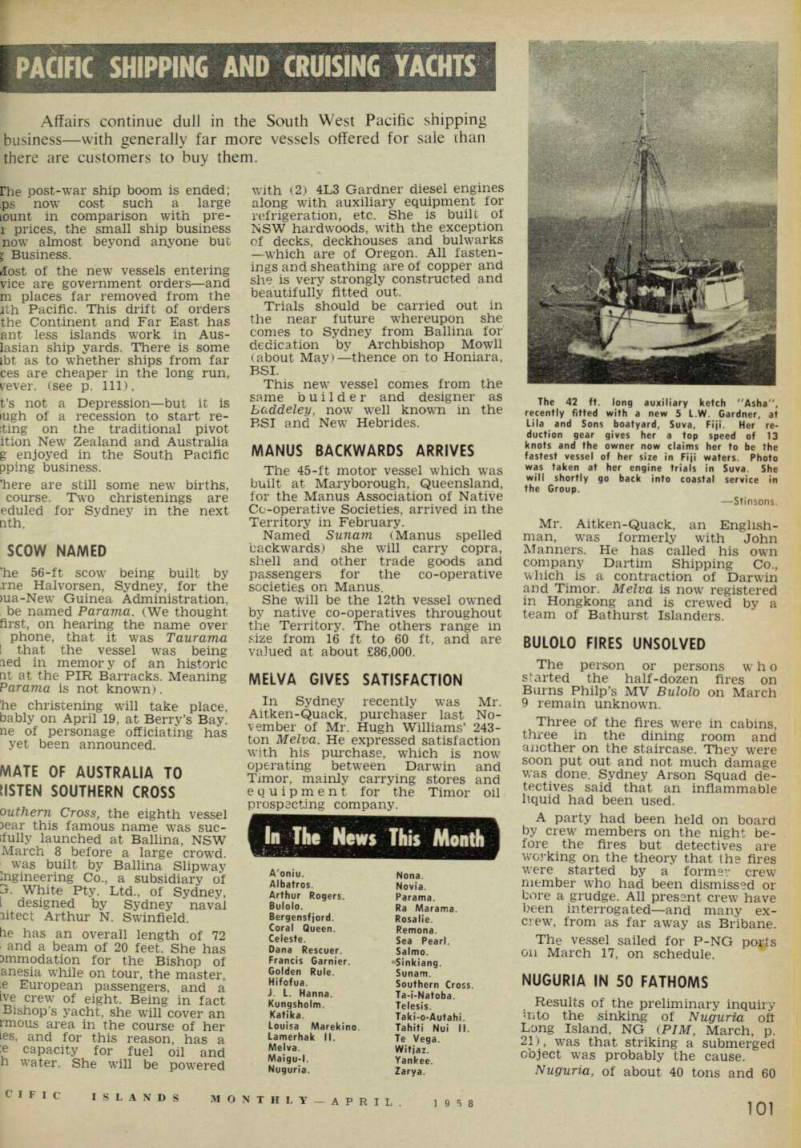
The 42 ft. long auxiliary ketch "Asha", recently fitted with a new 5 L.W. Gardner, at Lila and Sons boatyard, Suva, Fiji. Her re duction gear gives her a top speed of 13 knots and the owner now claims her to be the fastest vessel of her size in Fiji waters. Photo was taken at her engine trials in Suva. She will shortly go back into coastal service in the Group. —Stinsons.
t, has been well known around k Britain and New Guinea bers since mid-way through the r, when she began operating as a ;pital ship. The hold, subsequently id for cargo, was originally a *e operating theatre, iter the war she was converted cargo carrying and was operated a long period under charter the Bougainville Company.
Darently the company later ght her—it has been reported t she was sold by them last r. Her master at the time of her ling was Capt. Bert Wickham, » described as part-owner. uguria was on a voyage from >aul to Madang with tran iped cargo from the Far East.
March 7, she struck what was arently a log, but examination «ed no visible damage. On the ning of March 8, more than a ■ of water was noticed in the ine room. Pumps and a bucket ade failed to make any head against the intake and the per headed the vessel for Long nd. The ship finally sank on a f off the island but later slipped into about 50 fathoms of water, native crew’ of 12 and 10 native lengers got ashore without dif- Ity and were later picked up by Army vessel, Tarra.
Fch That Radio
Fallation
land ship owners purchasing vessels should take note that r radio telephone installations have to comply with new 7 lations under some adminis :ons after October 15 next year, luipment manufacturers are taring to produce sets to meet new requirements, but mean e there are likely to be at tive price-tags attached to the -obsolete sets. So owners should e certain from their local radio ectors that the contemplated illation will meet requirements will not have to be replaced, le new regulations will call for ansmitter of not less than 50 s or more than 200 watts aerial sr for a vessel of Class 111 and i. power of 15 watts to 100 watts a Class IV vessel, ass 111 vessels are cargo ships w 1,600 tons. Class VI are ships a license to carry more than passengers coastwise. Many ids craft are within these classes in some administrative areas r existing low-powered gear have to be replaced next year.
Gan Ship
(S Officers
ie Tonga Copra Board has y been advertising for a ified deep-water master and f engineer for its new 500-ton
A oniu now nearing completion in Holland and expected to be de livered May-June.
The term of service is for three years, principally within the Group but occasionallv further afield but occasionally further afield.
As the vessel is being delivered by contract the above officers will presumably take control at Tonga, The advertised rate of salary ranges between £T.1,340-£T.1,440 (equivalent to Australian currency) for master, and £T.1,300-£T.1.400 for fu a oncTi n opr cne e gneei.
It would appear probable that the smaller Hifofua, for delivery from the same yard a little later, will be entirely manned by Tongan officers.
Non-Magnetic Schooner
As a result of world-wide in quiries concerning the probable lt ‘“£ ra So a . nd P resent whereabouts of the 680-ton non-magnetic Russian research schooner Zarya, it appears that the vessel is still in the South Atlantic or Indian Oceans and that she may traverse only the extreme Western Pacific in the latter stages 0 f her IGY voyage, which will term mate at Vladivostok, „ Hll rw Sli.o will not/ enter the Pacific vis- Cape Horn as earlier reported. She i s to call at Mauritius, Bombay, Diego Garcia, and Wetheroo in Western Australia.
Supplying the above information the Superintendent of the Magnetic
spartment of the Royal Greenwich eervatory added that Zarya was lit in Finland four years ago >ecially for her present work. Not tirely non-magnetic, she is lipped with special degaussing lipment.
She carries instruments for the itinuous recording of the hori ital and vertical magnetic com lents of the earth’s magnetic d Magnetic declination is also itinuously recorded, with true ■th established by gyro. In diti o n, continuous electronic an soundings -are recorded and an current observations made.
Fails Of Coral Queen
lue for delivery late June, the md of the new modern steel sels building in Hongkong for WPHC for use in BSIP waters, be named Coral Queen, will be somewhat small vessel than anesian, 241 tons gross, delivered year. he tonnage of Coral Queen is not available, but her dimensions 104 ft o.a. x 24 ft x ft ilded depth, as compared with ; ft x 27 ft. tie will have a mean draught of
t, a cargo capacity of 4,200 cu. nd a service speed of about 10 s. The propulsion units of both "Is are identical—t win 144 i. Gardner BL3 diesel s —a led pair. •raZ Queen will have special mmodation for the High Com ioner, cabin accommodation for >ther first-class passengers, and ision for 40 deck passengers. vessel’s external hull and rstructure will be shot-blasted zinc sprayed to prevent rust.
Melanesian was built by the old established and well-known Hong Kong and Whampoa Dock Co. Coral Queen is being built by Hong Kong Transportation Co.’s ship-building subsidiary, Pacific Islands Ship building Co., which has built a large number of vessels for service in South East Asian waters.
The Auckland Harbour Board has just ordered two large steel lighters horn this company, which appears to be actively seeking South Pacific business.
One or more other vessels are also building in Hongkong for the WPHC fleet for use in GEIC waters and details are being sought from Tarawa. It is understood that a
crew has already been despatched for the first of these.
Time Sigs For Fiji
Because some Fiji smallships are not equipped with radio receivers suitable for the reception of time signals from WWVH in Hawaii— the source of time signals most used in the South Pacific —and be cause some seamen apparently find the WWVH time signal difficult to understand, Fiji authorities have arranged to relay signals from Radio New Zealand over the local Fiji Broadcasting Service stations.
Reports of these signals, at 0700
Gmt. 2000 Gmt, And 2100 Gmt.
[?]tika", one of the New Guinea coastal [?] at a Madang company's slipway in [?]ary. Madang slipways are increasingly [?]ar with smallship owners—even from as way as Netherlands New Guinea.
ire being sought in March by the va Harbour Master. Captain W. Harness. They are the familiar lip system, marking the last five :onds of the hour which ends with » final pip.
Ol For Disgruntled
Gineer
hi engineer who damaged the irication system of the co jratively owned 44-ton Fiji ketch -i-Natoba subsequent to his dis ssal by the owners, was sentenced three months gaol in a Suva irt early March. ’he vessel was at sea when the v engineer discovered the nage and the ship put back to t. The accused admitted the ince.
Velist Afloat
a January we mentioned Ernest Gann’s Panama-registered brig ine Albatros which cruised south French Polynesia in 1956. hat veteran windjammer skipper 1 one-time master of Zane Grey’s ierman, Captain Fred K. bingat, writing from his home San Pedro, says that Albatros, unsold, is now at Oakland pre ing for a cruise to Scandinavia, will sail, presumably via lama, in April, with writer Gann ard to seek further best-selling 7ot many in the Islands saw itros in 1956. She is almost a "r ship to Irving Johnson’s aid Yankee, and an attractive det prepared by Gann, and sent ig by Captain Klebingat, gives Lhat is known of her interesting ory. uring the war she served as a man submarine officers’ training t and as a direction-finding ti o n for submarines in the ntic.
'ter the war she was seized by British—together with the craft known as Yankee, and others later sold to the Dutch Royal Lloyd Line as a train vessel for officers, who used her that purpose from 1949 to 1953 r spending $25,000 on her. len the 90-year-old head of the ffi company, a firm believer in training for his officers, was ed to give way to other opinion the subject and Albatros was up and soon purchased by n. ider his ownership she has been d with many modern navi- Dnal aids. She measures 117 ft all x 82 ft w.l. x 92 ft deck x ft beam x lOi ft draught, rdmg to the booklet, and she is 7 tons gross and 49 tons nett, wording to Gann, she has been irately clocked at 13 knots with engine or staysails. Her 300 hp Dat motor drives her at about 6 ;s under power alone. She is a
riveted iron or steel vessel. She may yet be seen through the Islands.
Her name takes the Dutch form with a single “s”.
Launched With The Aid
Of M. Chanel
Some time ago we reported the launching of a mission ship with the aid of coconut milk. In March yet another variation was offered at the pearling atoll of Manihiki when Louisa Marekino, a shell divers tender, was sent down the ways with the assistance of two quart bottles of Parisian perfume.
The launching report does not explain why one quart could not have done the trick.
Measuring 19 ft x 81 ft and built by shell trader Tangi Jim, the com pleted vessel, decorated wi h mats, streamers, and every kind of needle work gift from fancy lace to colourful bed-spreads, was first blessed by the Rev. Father Marinus, then launched by Mrs. Don Bryan, wife of the island’s Resident Agent.
To follow soon are two other craft being built by Ben Ellis, a leading citizen. These boats, and others, too, will be heading for Suwarrow, probably in tow of the ketch Taveuni, when that vessel returns from her Auckland refit in April to transfer a diving team to the latter atoll.
Off The Beam
On the basis of signals received back from their Sputniks, visual sightings of same, and other IGY data, Russian scientists have de termined that Greenwich Mean Time as at present used by navi gators is way out.
Clocks have been running slow, they figure, by a full thousandth of a second per day—so you weren’t and aren’t where you thought you were at all.
New Govt. Yacht
For Fiji
To be named Ra Marama, and to be manned, both on the delivery voyage and in service, by Fiji RNVR officers and crew, a new wooden twin screw motor yacht is due at Suva from the yard of John I.
Thornycroft & Co. Ltd., Singapore, in May or June.
Of teak, with metal sheathing to the waterline, Ra Marama is in tended for transportation of the Governor about the Group on his official duties, medical patrol work, and hydrographic survey duties when not otherwise engaged.
She replaces Viti II ex Royal Flight, sold late 1954 to Captain E. T. S. Withers for use on the Lautoka-Yasawas passenger cruise
THERE SHE BLOWS! But this is no whale — it’s a huge water spout which appeared in Suva harbour recently and moved parallel with the reef for about half a mile before collapsing. —Fiji Public Relations Office.
vice and by him renamed Blue 7 oon. la Marama is a vessel of pleas profile with moderate sheer, ed bow, cruiser stern, and raised I’sle which extends back to about dships. On the after part of this :’sle and at the fore end of a *ish deck-house is the bridge, ‘rail length is not known, but iwn dimensions are 85 ft b.p. x ft bm. x 6 ft max. draft. There 10 provision for carriage of any jo. She is powered by a pair of dner BL3 diesels, ommander S. B. Brown, FRNVR, or naval officer, will be in com id on the delivery voyage. He a crew are already standing by Singapore. tie contract price of the vessel sported as £F.60,000. At additional she will later be equipped with ain instruments for hydro )hic survey work.
Big Uplift
r. Les Ellis, who in his .city of chief stevedore of Pacific edoring Agency, of Auckland, probably had more contact with inese ships and seamen in post years than anyone else in New and, vail be leaving Auckland a big Islands job in April. ! will fly to Papeete to stevedore loading of the largest consign b of scrap metal probably ever leave that port in what is led to be the largest Japanese ever chartered for this type argo since the war. th the Papeete carbo aboard vill sail in the ship to Apia, then to Suva, where further ignments will be loaded before vessel stops off in New Zealand, eparations for the shipment been in hand for months past.
South Pacific east of New lonia has been combed for all ble wrecks and scrap dumps to abute to this special charter ng. Scrap still remains, but at int comparitively low prices it d not be worth while moving im certain inaccessible islands. . Ellis was last in Papeete as id officer in that American
d flag-of-convenience-regist
ship Sea Pearl, since lost off Guinea. Last year he organised S scrap shipment from Pago
Eone Owns That Wreck
‘ have reported previously that panese fishing vessel has been id for sale by the Receiver of k in Suva, With numbers of vessels planting themselves y on South Pacific reefs in it years, and with a general est in other wrecks—in some of very ancient vintage—as itial sources of scrap metal, a mg may be timely: All such cs, no matter how old, have an
owner, even if they have long since been “abandoned”.
Whoever this owner may be, all negotiations regarding purchase of such a wreck must be carried out through the Receiver of Wreck — usually the Chief Collector of Customs—of the country administer ing the territory on which the wreck lies, and there are heavy penalties for even boarding such a wreck without his permission.
In many cases the Receiver will be the official “owner” of old abandoned wrecks, but in any case Customs duty will probably be chargeable on materials salvaged, if the vessel was registered outside the territory on which it was wrecked.
In the case of a wreck lying on an isolated submerged reef outside
the administration of any country, the wreck presumably is admin istered by the Receiver of Wreck of the country in which the ship is registered, or she may be con sidered as flotsam, in which case any portion salvaged must be de livered to the Receiver of Wreck of the country to whom the salvor be longs.
Maritime law is highly involved, but the point we make is that no wreck is ever “abandoned" in the sense that whoever comes along at a later date may help himself with out fear of legal complications.
French Naval Accident
Four seamen of the French sloop Francis Gamier, a vessel well known
Jouth Pacific waters, were seri y injured, one losing a hand, as result of a flash-back by a »rs gun which was firing an ial salute as the vessel arrived Wellington, NZ, from French nesia in mid-March. The vessel earlier been engaged in at ited salvage of the Papeete d Catalina aircraft which tied in Raiatea lagoon with y loss of life. The aircraft first ; in about 20 feet of water but swept by the current into :t 120 feet of water before all es were recovered.
Very Is Costly
February PIM we noted that ralian shipping men were ulating as to what it was going ost Prince Tungi to have his h-built vessels A’oniu and fua delivered. The answer is rently “plenty”. The Auckland )our Board has just accepted a er of £Stg.lo,3oo for the delivery s new tug Aucklander— a vessel imparable size or smaller. That of money gives a somewhat rent look to the favourable ling prices offering in Europe other distant parts, and should s ship owners to check again tearer markets.
Service To Bsip
e New Guinea Australia Line’s riment in running one of its
ships via the Solomons has proved successful.
The call at Yandina has, however, been cut out as there was not suf ficient support from the port. The company is pleased with the sup port it is getting in the way of passengers and cargo from Honiara, and calls at this port will continue.
The Sinkiang has been used on this service. After Honiara, calls are made at Rabaul and other New Guinea ports before heading south to Sydney.
Duty-Free Fuel In Papeete
Standard Oil’s tanker J. L. Hanna arrived Papeete February 9 with the first consignment of gasoline and petroleum for the company’s newly completed bulk installation at Point Fare Ute, Papeete.
SAURL Petroles, a locally formed company, will market all of Standard Oil products; they commenced busi ness February 25.
An innovation of interest to visit ing yachemen will be facilities for the sale of duty-free gasoline and kerosene.
Witjaz On Third Igy Journey
The Russian hydrographic re search vessel Witjaz, now familiar in some parts of the Pacific, will probably visit Port Moresby on her third cruise just commenced. (Over)
NO EXPENSE SPARED.—Expected to arrive in Papeete during the next few months [?] the MV "Telesis" owned by Theron S. Cederlund, of Sausalito, California. This vessel [?]is a converted US Navy submarine chaser on which no expense has been spared in the conversion. A four man crew operates the vessel.
Bob Fenton (ex "Taihoa") is mate.
"Telesis" has a length of 110 ft., beam 18 ft. 5 in., draft 6 ft. Power is supplied [?]y twin 1,200 h.p. diesel engines, giving a cruising speed of 10 knots with a maximum [?]peed of 22 knots. Cruising range exceeds 3,000 miles. Accommodation includes four [?]double and three four-berth staterooms, equipped with central heating and forced air [?]rentilation, along with five lavatories and three showers. Also a lounge, dining area, [?]lalley and large deck areas fore and aft. Operational equipment includes radar, record [?]ng and visual fathometer, loran, radio direction finder, radio-telephone, auto pilot, gyro [?]ompass and a one ton capacity power winch.
The owner hopes to cruise the Pacific Islands but is also interested in charter [?]ork for scientific expeditions, etc. Enquiries in this respect should be addressed to [?]im care of PO Box 99, Sausalito, California, USA.
e cleared Vladivistok March 23 67 scientists on board. e visited Rabaul, NG, on her voyage last July-August; the laus, Suva and Wellington, NZ, tier second Pacific expedition, ing the last port on January ir Vladivostok via the meridian ’2 deg. E.
Chant Navy Programme
from April 1, the special tic transmission of the BBC hant Navy Programme, formerly i at 0730 GMT. has been ntinued. The initial trans on is on Thursday, 1830 GMT, the repeat transmissions are on Friday at 1245 and 2200 P. The latter (10 a.m., Saturday, time) is well received in the ic/s band at present, and the r two are well received on r frequencies.
Owners For Rosalie
e motor-vessel Rosalie has to new owners after 12 months p. and will enter the Noumea- Hebrides trade. is vessel is of wooden construc and was built in New Zealand ig the war. She is a sister ship e ill-fated Monique , which dis ared in calm weather on a ?e between Mare Is. and nea some years ago-taking her 123 people.
'salie has been used in the New donia coastal trade but has lying at anchor in Noumea 3ur for the last year. The com that owned her is in liquida-
Japanese Take Most Whales
If an agency report from Tokyo is correct, the six Japanese whaling fleets now homeward bound from the Antarctic took no less than 11,723 blue whale units of the allowable catch of 14,500 blue whale units permitted jointly to all nations en gaged in that area.
The total was reached in mid- March. The report may have meant that the Japanese took 11,723 whales, which might be very con siderably less than that number of blue whale units. This adopted unit, based on the largest blue whales,
represents several whales of smaller varieties.
Tokyo Radio said, however, on March 17 that one factory ship which had sailed for home that day had 8,000 blue whale units aboard, sc the agency report could be correct and would indicate a very small catch for some of the 20 expedi tions owned by the other four nations involved.
[?]feboat "Dana Rescuer" (see PIM March, p. 103) on demonstration cruise around the world.
Photo: Max R. Hart.
L/Vs Of Cruising Yachts
LAMERHAK II should be on the move n soon. Israeli Joseph Havkins returned lydney per ORCADES early March to pre the 23-ft. yawl for continuation of his mnavigation voyage via Philippines, Hong , Indonesia, South Africa, South and North ■ica. Havkins flew back to Israel from ralia a year ago after hitch-hiking from ey to Darwin. At home he made a re tour earning sufficient to pay his fare to Sydney by sea via the US and to ce the next stage of his voyage. He ; a lecture tour through the US when •aches there in a couple of years time.
TAKI-O-AUTAHI, claimed the shortest craft ross both Atlantic and Pacific, reached land, owner Mangan's home port, March id the yacht is now for sale. But that not mean that Bill Mangan has swallowed mchor; he's looking for a larger craft to nue his ocean wanderings.
NONA of London, 71*ft. gaff cutter, with and Mrs. J. Chaning-Pearce, Mr. C. J.
Her, and Mr. W. C. Hodgson aboard, made and March 4, having cleared Papeete 24 previously, thus completing, in the 57ild yacht, the voyage which commenced in 1956. Finances were running low and ise some cash on the trans-Pacific run hip's radio telephone set had been sold i Galapagos. Mrs. Chaning-Pearce's mother in the wharf to greet the yacht at Auck- Principal complaint: not a fish was d to assist the providoring department e way from England. Cost of the cruise, ing yacht: £3,500.
REMONA of San Diego, Cal., a 105-ft. schooner sailed by owner Bob Insinger his wife, family, and an unspecified r of friends, has been in South Pacific ; these past two months, having visited Guinea, the Solomons, Fiji, and Pago from where she was to clear for Papeete lome again. She called at Honolulu on utward voyage. Under other ownership veil found craft figured in the Trans- Race (US-Hawaii) —the one prior to the event. Mr. Insinger purchased the yacht :posing of a tuna fishing business. The made an unscheduled call at Honiara, mid-February for news of Mate Indrek i, who had to leave the vessel in NG as flown to Moresby for hospital treat- GOLDEN RULE, loaded with ideals but s not with seamen, put back to Los s in February a few days after sailing H-bomb protest voyage to Eniwetok. iled again from San Pedro on March 27, ban-the-bomb cruise. Four persons are rd.
AHITI NUI-11, arrived Callao from Con n on March 29, before the final kick stward on the KON-TIKI - SEVEN LITTLE S road to French Polynesia, is made of i cypress logs, has a 13-ft. x ft on deck for crew, and is "ketch-rigged" lasts 40-ft. and 33£ ft. high respectively, roportionate sail area it will be scarcely to call this a "drift" voyage. TAHITI is manned by Captain Eric de Bisschop > companions.
S Your Yacht In Lloyds Register?
why not? There are many advantages ring your craft listed in this inter lly known Register. All yachts, whether or foreign, may be listed at no cost d that they have a working sail area ;ss of 300 square feet or, in the case or cruisers, if they are not less than waterline. This famous publication ap :ach April, price £Stg.3/17/6, and each appears Lloyds Register of American at $2O or English equivalent price. A in these publications does not mean ification, but all yachts will be classified 'ds surveyor if their construction meets deifications laid down and owners wish
them to be classified, for which there is naturally a surveyor's fee to pay. A form for listing details of a yacht may be obtained from the Editor, Register of Yachts, Lloyds Register of Shipping, Garrett House, Manor Royal, Crawley, Sussex, England. Details must be lodged by December for the following e d' t,on - • The rest of SALMO's world cruise has been postponed due to an expected increase in the Hamilton family Lieut.-Commander Hamilton will sail for the US from Tahiti, via Tuamotus and Marquesas. • TE VEGA was scheduled to depart Papeete on a round trip charter to Rarotonga on February 6. • CELESTE, of Balboa, owned by Richard Cosmos, has been sold to Donald Cameron (ex-
Celebes, Solquist, Miranda) For $5,000.
Mr. Cameron has since dry-docked the vessel
for welding repairs, and eventually plans to cruise the Society group and head for the States via Honolulu, to dispose of CELESTE on the west coast. NOVIA, 34-ft. San Diego ketch, will be remaining in New Zealand waters for some time Owners Lee and Anne Gregg left Auck land for the US in mid-February by air to settle some business there following the death of a relative. ARTHUR ROGERS, more work-boat than yacht these days, was momentarily expected in Auckland from the New Hebrides in February.
Tom Hepworth was reported to be accompanied b V a member of the well-known Tongan Stephens family on his dodge south through the hurricane zone. Meanwhile Diana, who came south by air as special nurse in care of Bob Grant of VE TEGA some time ago, is visiting friends in the Sooth Island of NZ, pending Tom's arrival.