The Month's New Reading
pp. 90-97 · Read in the full issue

With Judy Tudor
One of the things we can be pretty sure about with our cruising-yacht friends is that we will hear of them again—when they go back home and write a book about it.
THE Pacific-American west coast voyage of Moonraker, which decorated the pages of PIM for a couple of years, 1953-55, has now been made into a book by owner, Dr. Peter Pye, as sequel to his first effort Red Mains’l, which told of the Atlantic crossing.
This second story is called The Sea is for Sailing —which may be regarded as either a nice piece of lomantic alliteration, or a dig at many small ship sailors who regard the periods at seas as undiluted hells between the comforts of ports.
Peter Pye and his wife Anne, took 20-years-old Christopher as crew on 29 ft., 60-years-old Moonraker. Of Moonraker, Pye says she “looked like a box and sailed like a witch”.
Of Christopher; “ . . . a rather gorgeous young man in an ex quisite reefer jacket . . , with kit bag, suitcase, bowler hat and gun”.
Christopher’s background was as decorative as his person. His father was sending him on the trip in stead of to university. When the Pye’s were rowing him out to Moon raker, with all his gear, through pouring English rain, the doctor had a sudden inspiration. “Have you got a dinner jacket in that case?” he asked. “Yes, of course I have”, Christopher replied.
For all that, Christopher seems to have acquitted himself well, in his floating university, and at one stage—in spite of the dinner jacket and bowler hat—takes a job as a plumber’s mate, at $7O per week.
Through Moonraker’s hobnobbing we meet many old sailing friends —the Smeetons of Tzu Hang, the Homdahls of Viking, Wanderer 111, the Greggs of Novia, and Ernst Lamberty, now settled in the New Hebrides.
Most books about ocean sail ing have a certain calm sameness which is probably half their charm.
The Pyes sailed through Panama to French Polynesia, thence to Hawaii and from there to Canada and Alaska. From there they returned down the whole length of the west coast of America back through the Panama, West Indies, Florida and heme.
One of the most entertaining parts of the story is the six months they spent with the Smeetons at their farm at Musgrave on Van couver Island—a somewhat spartan existence that must be good train ing for long ocean voyages.
D {TH ! u SEA J S FOR SAILING, published by Rupert Hart-Davis. 20/- Aust.) y
Back to the
Middle East
A USTRALIAN writer John Laf fin’s second literary pilgrimage to old Australian battle-fields (Middle East Journey —the first was Return to Glory and was about Papua-New Guinea) is designed for Australian consumption. Mr. Laffin thinks that Australians are the best fighters in the world, and sets out to prove it. For anyone outside the clan the result is likely to be as irritating as an inferior American war movie is to a non-American audience.
In the course of collecting ma terial for his book, Laffin visited Egypt, Libya, Greece, Crete, Israel, Lebanon, Malta, Syria, Morocco and Italy; and in writing it he has rehashed quite a lot of war history.
For the rest it covers little that a
thousand other books have already covered better.
The Australian soldier who ser in any of these areas will no do find much to interest him, ,how< —both in descriptions of the pit. in which he fought, as they now; and in descriptions of places that gave him recreation!
Mediterranean vice is adequai covered—as it probably had toe in any book dealing with fight men.
Most interesting parts of book are those dealing with the cemeteries of North Africa—for ways in which they resemble cemetries in the tropical Pac but more particularly for the w in which they differ.
It is a book that probably ] to be written sometime—and far as it goes it is adequate. (MIDDLE EAST JOURNEY, published by A= and Robertson, Ltd. 18/6 Aust.)
Expert Fishing and
Dirty Murder
IT does not seem possible that placid sport of trout-fishing; England should get deeply mii up with a first-class mur mystery; but this is what happe under the ingenious pen of Co Willock. Mr. Willock is the “angll correspondent” of the London Dt
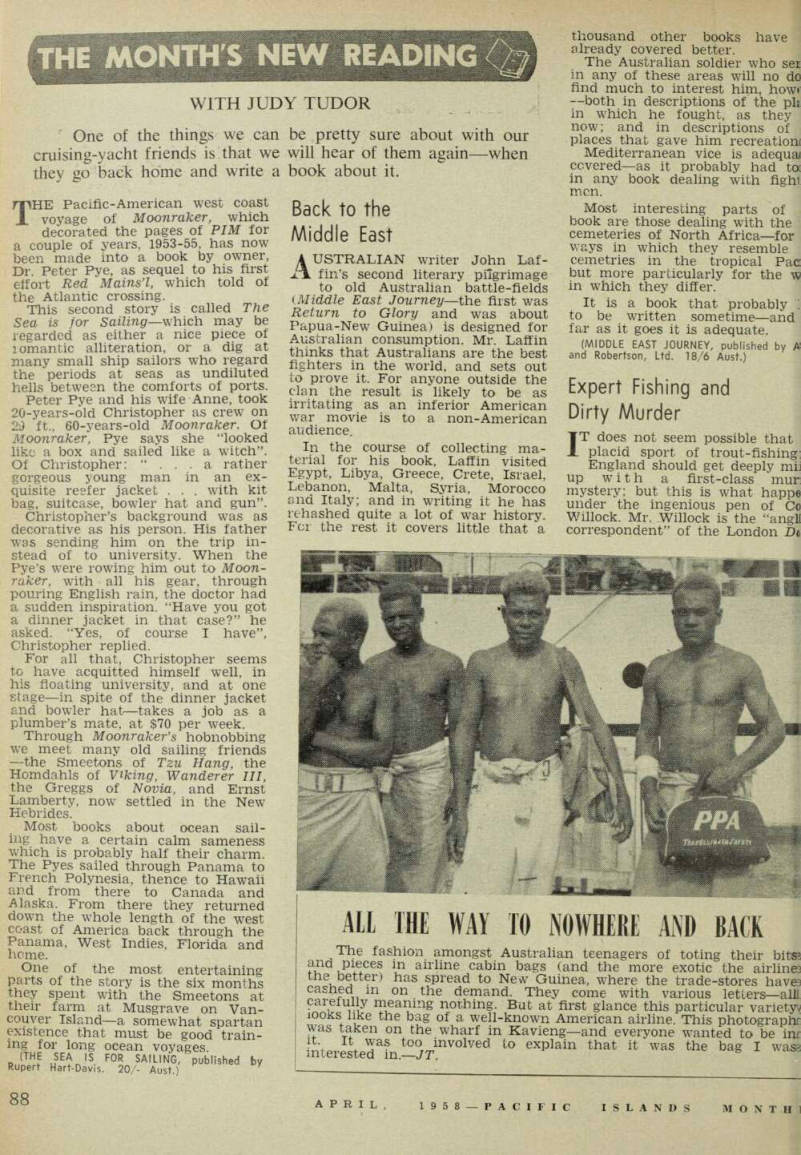
ALL THE WAY TO NOWHERE AND BACK The fashion amongst Australian teenagers of toting their bite[?] AND PIECES IN airline cabin bags (and the more exotic the airlines[?] the better) has spread to New Guinea, where the trade-stores haves[?] cashed in on the demand. They come with various letters—al[?] carefully meaning nothing. But at first glance this particular variety[?] looks like the bag of a well-known American airline. This photograph[?] was taken on the wharf in Kavieng— and everyone wanted to be in[?] it. It was too involved to explain that it was the bag I was interested in.— JT.
Herald; and also is ambitious as a -writer of thrillers.
What he has written about the catching of trout, carp and salmon is—for the Antipodean reader, at any rate—exceedingly interesting.
But the machinery of his Whodunit creaks a little at the joints.
He sends a rather pompous Lon don publisher off on an angling holiday, and there goes with him, as a sort of Man Friday, one of the publisher’s junior photographers.
The publisher’s curvaceous and quick-witted secretary is presently dragged into the picture; and by then the fish-catching story is all mixed up with murder, hidden treasure, and general dirty dogginess among the guests of an anglers’ inn.
The publisher proceeds to aid the top-r ank i n g dectective-inspector named fiord (no one stops to ex plain why he isn’t Ford!) to solve the mysteries. Quick-moving, imag inative and, at times, amazing. (DEATH AT THE STRIKE, published by William Heinemann, Ltd., Sydney. 17/- Aust.)
Fiction Much
Stranger than Truth
MORRIS WEST’S factual account of life in the slums of Naples, which appeared under the ;itle Children of the Sun got full narks from the world’s book critics.
“Passionately felt”, said The Tablet. “Passionate and outraged feeling”, said the Times Literary Supplement. Someone else called it in “impassioned plea for the ur :hms of Naples’ slums.
Unfortunately impassioned pleas, md so forth, don’t usually sell in arge numbers, no matter what the eviewers think of them and ob viously to cash in on mass appeal, Vest or his publishers decided to do” a fictionalised version of the ;ame theme: graft and sin in nodern Italy.
This — The Big Story —has already )een rapped over the knuckles by he same critics who were lavish n their praise of Children of the Sun. it has been called a pot >oiler.
Writers, like everyone else, need o keep the pot boiling and if they onfined themselves to writing ocial documents they probably would not eat. There is a great deal )f difference in writing fiction— where the critics can crack down >n you for lack of literary merit— md writing fact about a well mown social evil which the critics Pill judge from its message—which hey wouldn’t care to ignore—and lot from its literary qualifications.
Why blame West therefore for everting to type? He has already written two other novels — Gallows m the Sand, which was a highly maginative story of buried Spanish
treasure; and Kundu an even more imaginative piece of writing about love and life in the Highlands of New Guinea.
The Big Story continues the pattern. If no better, it certainly is no worse than tens of thousands of other novels that come hot off the presses of the world each year. It may be far fetched—but so are most of the stories of Continental highsociety.
The hero is an American newspaperman, whose beat is the plush hotels and behind-the-scenes politics of Europe. He feels he has reached the pinnacle of his career, his big story, when he has almost
within his grasp the documentec history of one of Italy’s corrupt bui politically important aristocrats.
But at the last moment the big story blows up in his face. It i! what went wrong with the stor? that forms the theme of this novel i s background of novel* like Mr Wes t’s that give rea den exaggerated ideas of the lushnes* 0 f i if e 0 f newspapermen fabulou* hotels; aristocratic estates when legions of retainers will do every thing including murder; gorgeous women of little or no virtue, But this is standard fare in storie* of this type, and forgivable. Wha l we can’t forgive is the fact thai
aving progressed to page 220, with to go, it is all ended in a childish, nartistic fashion that would daunt ren the most ardent and case ardened thriller reader.
Either his publishers were pushing im too hard for the manuscript, r Mr. West got fed up with it imself. (THE BIG STORY, published by Wm. Heine ann. 17/- Aust.)
's In Your
wn Hands
lOW to read palms and please people is the subject of a small booklet published by World’s r ork —which usually confines it- If to religious works of various mensions.
The Modern Palmist, is by Dennis irry Jackson, BA, who has worked id is famous throughout six of ose British phenomena, Butlin’s ffiday Camps.
Mr. Jackson, BA, is an exuberant trovert who calls himself a srious palmist” (as distinct from e tea-shop variety that will see rk strangers and a journey over e water for 2/6 all in with your a).
Probably because of that BA he tacks palmistry from the psycho *ical and scientific angle. This ok will show you how to do like se—although some of the con isions you might come to after iding the letterpress and consult l the diagrams are quite terrify- T o • According to Mr. Jackson, your 1m can show whether you are ptured, got eye-strain or sensitive ms —as well as things about your c life, your brain power and your sic personality. [t’s all good fun —even though a f-diagnosis might leave you un cided whether you are the sen ive literary type (plus bad ineys); or a potential Rugby In mational (with a tendency to irds miscarriage).
THE MODERN PALMIST, published by World's rk. 3/9 Aust.)
In Brief
RED JADE: By Robert Payne, le theme of this novel is con lerably removed from the writer’s svious effort —the life of the young sus. This setting is in Peking of 50, and concerns the events which How the saving of the Emperor )m wild boars by Prince Lien. The ince is offered two gifts as & ward, and chooses something close disaster in a handsome young rvant named Molo and an Im rial concubine called Red Jade, le story is based partly on history. [Published by Heinemann. Australian price, /6-) (Over)
Vhat's New in Pocket Books
CHESE Fontana and Pan Books should be currently available at your book shop. Our copies are rom Wm. Collins (Overseas) Ltd. nd the prices in Australian irrency are: Pan Giant 5/-; rreat Pan 3/6; Pan 3/-; and ontana, 3/6.
Raintree County: Ross
ockridge Jr.’s best-seller which is ipposed to have done for America’s [iddle West what Gone With the Hnd did for the Old South. It is le story of one July 4 in Raintree ounty—but consists also of flash icks of the principal character, >hnny Shawnessy. The story has *en made into a motion picture arring Elizabeth Taylor and bntgomery Clift. (Pan Giant).
A Ring At The Door: Further
iges from the case book of surgeon eorge Sava for those people who ce to read about other people’s sides and the miracles of modern edicine. (Great Pan).
Carve Her Name With
■HDE: The now well-known story r R. J. Minney (first published 56) of Violette Szabo, the London top assistant who became a British cret agent in Occupied Europe and is shot by the Gestapo, aged 22. lis book inspired the J. Arthur mk film of the same name, olette left a daughter Tania, now lout 15; and her parents Mr. and rs. Charles Bushell, who migrated Australia some years ago. (Great in). (Young Tania, now 15, is a pupil a boarding school in Armidale, SW. Her grandparents live at Long tty, NSW. It was announced in mdon at the end of March that trust-fund will be set up for Tania om the proceeds of the film, which is recently been released in UK, d it is hoped, will be as success l as “Reach for the Sky”.
The Abc Murders: Agatha
iristie thrillers go round and ound and never die out. This rennial first saw the light in 36 —long enough ago to be fresh r new Christie (and Poirot) fans, reat Pan).
THE RINGER: Edgar Wallace— e father of the modern thriller— ?d 26 years ago, but his books are i enjoying a new vogue. This rticular one was regarded by allace fans of the 20’s as his best. ; had led a fabulous life before bting the literary jackpot with his /steries —some readers may re jmber some of earlier stories out Africa— Sanders of the River, J. (Pan).
STILL DIGGING; Sir Mortimer heeler, better known in Britain— lere he is a TV personality—than t here, gives this title to a book out himself and his adventures . archaeology in Britain and the iddle East. The narrative is rather asmodic —he calls it a scrap-book and there is a great deal more out Sir Mortimer than about
archaeology, but if you are interested in the latter and not the former, with the help of the “Contents” you can find what you want. Sir M. specialises in pre- Roman England. (Great Pan).
More From The Primeval
FOREST: Albert Schweitzer, the most publicised missionary since Livingstone tells of his second period in Africa, 1924-27, when he returned from Europe to find that the hospital he had set up had fallen into decay and he had to set about rebuilding it. (Fontana).
The Saint Steps In: Leslie
Charteris has Simon Templar up to his usual Robin Hood tricks. “Gay, debonair, tough”, as the book jacket describes it. This time it is in wartime America. There is the usual quota of beautiful females. (Pan).
The Megstone Plot: Andrew
Garve lives up to the promise of his earlier thriller Death and the Sky Above, and in a world of over worked thriller situations pro duces something quite new— although something is certainly owing to the Burgess-McLean affair. (Pan).
Dr. Bellamy Of Papua
Into PlM’s records go a series of articles published recently in Medical Journal of Australia, written by Robert H. Black, of Sydney School of Tropical Medicine.
Bellamy arrived in Eastern Papua, in 1903, and worked first in administration with the famous C. A. W. Monckton; and then was 10 years in charge of the anti venereal hospital in the Trobriands.