Forever Fijian
p. 88 · Read in the full issue
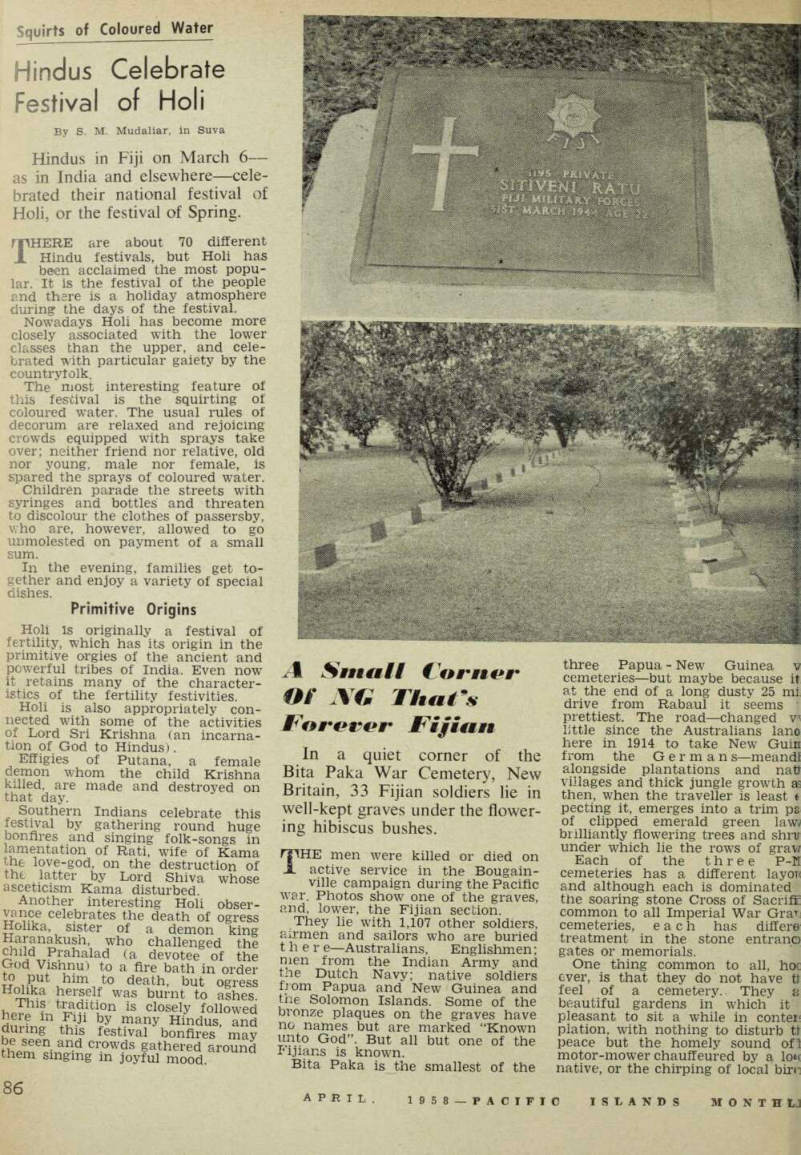
A Small Corner Of NG That's Forever Fijian
In a quiet corner of the Bita Paka War Cemetery, New Britain, 33 Fijian soldiers lie in well-kept graves under the flower
ing hibiscus bushes.
THE men were killed or died on active service in the Bougain ville campaign during the Pacific war. Photos show one of the graves, and, lower, the Fijian section.
They lie with 1,107 other soldiers, airmen and sailors who are buried t h e r e—Australians, Englishmen; men from the Indian Army and the Dutch Navy; native soldiers from Papua and New Guinea and the Solomon Islands. Some of the bronze plaques on the graves have no names but are marked “Known unto God”. But all but one of the Fijians is known.
Bita Paka is the smallest of the
three Papua - New Guinea v cemeteries—but maybe because it, at the end of a long dusty 25 mi drive from Rabaul it seems ■ prettiest. The road —changed v\ little since the Australians lano here in 1914 to take New Guin from the German s—meandf alongside plantations and natt villages and thick jungle growth aa then, when the traveller is least e pecting it, emerges into a trim ps of clipped emerald green law; brilliantly flowering trees and shru under which lie the rows of graw Each of the three P-M cemeteries has a different layoic and although each is dominated the soaring stone Cross of Sacfififi common to all Imperial War GraL cemeteries, each has differe' treatment in the stone entrano gates or memorials.
One thing common to all, hoc ever, is that they do not have tt feel of a cemetery. They a beautiful gardens in which it pleasant to sit a while in conterf plation, with nothing to disturb tt peace but the homely sound off motor-mower chauffeured by a lon native, or the chirping of local birn