[?]Or £10 A Month
pp. 87-101 · Read in the full issue
[?]t's Hard Work for [?]he Japs in Rabaul
[?]O Hours A Week
By a Staff Writer
After all the talk-talk that pre
eded the arrival of the Japanese
alvage teams to Rabaul about a
ear ago, their presence there has
lilted not a ripple on the local
lill-pond.
E THEN they pack up and move on —probably in April—business houses who have enjoyed leir custom will be sorry about it.
Okada Gumi, the outfit which is Ding the salvage, might have been . Rabaul longer if there had been d dispute as to who owned some the sunken vessels in the harbour.
L. Chipper and Co. says that it )Ught them all; the Administra on says that it did not. A Supreme curt case is pending to settle the ■gument.
By that time Okada Gumi will •obably have moved off —to Buin— id once gone is unlikely to come ick to get what scrap remains, iless there is a sudden revival in ic scrap metal market.
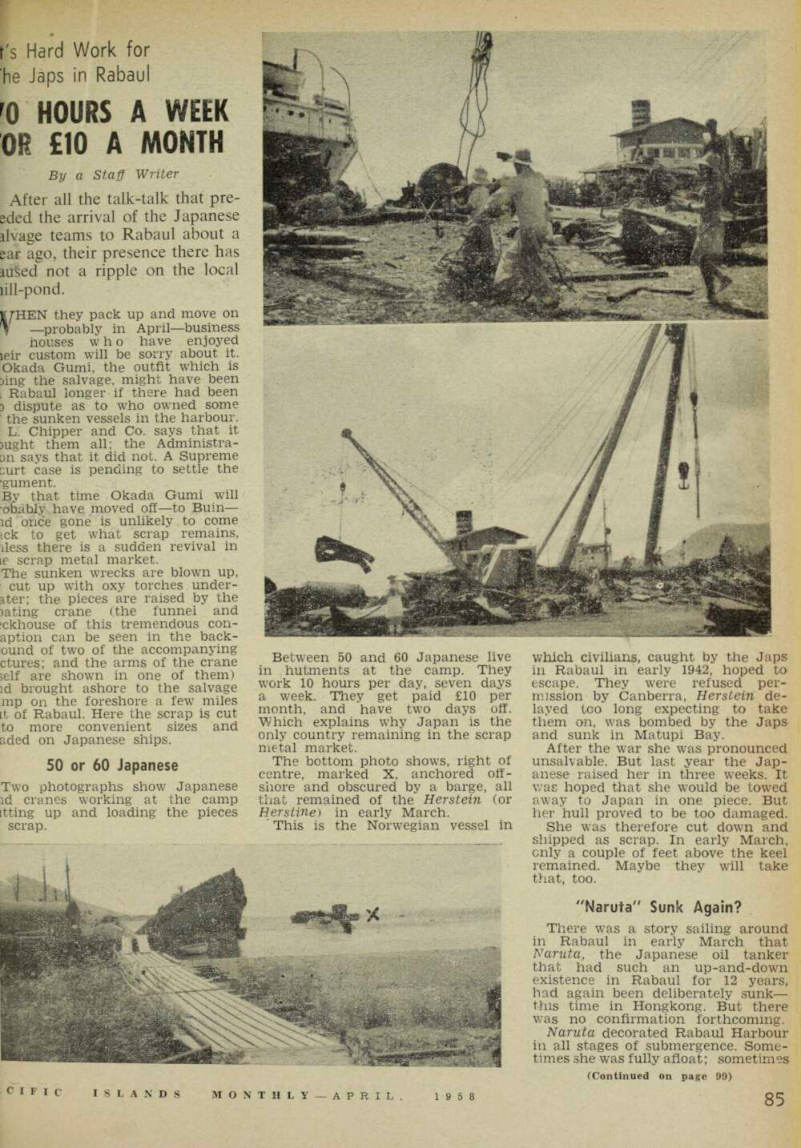
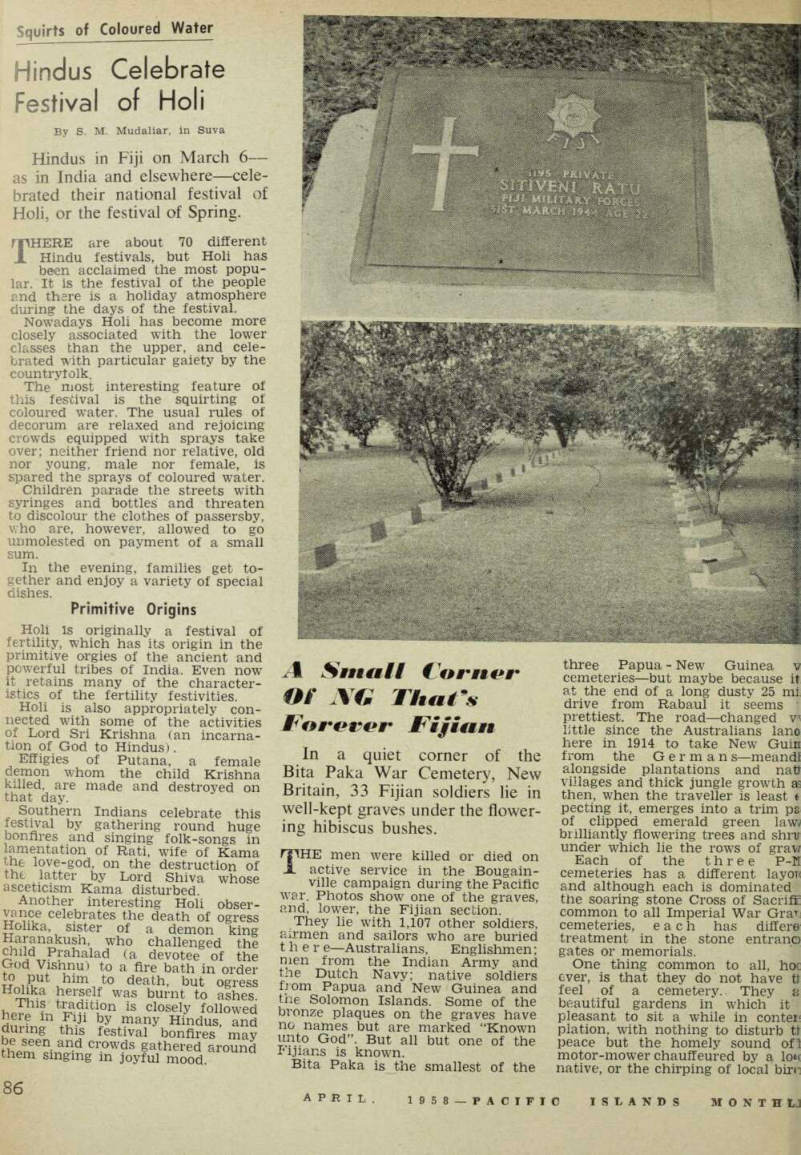
The sunken wrecks are blown up, cut up with oxy torches under ater; the pieces are raised by the lating crane (the funnel and i ckhouse of this tremendous con aption can be seen in the back ound of two of the accompanying ctures; and the arms of the crane self are shown in one of them) id brought ashore to the salvage mp on the foreshore a few miles it of Rabaul. Here the scrap is cut to more convenient sizes and aded on Japanese ships. 50 or 60 Japanese Two photographs show Japanese id cranes working at the camp itting up and loading the pieces scrap.
Between 50 and 60 Japanese live in hutments at the camp. They work 10 hours per day, seven days a week. They get paid £lO per month, and have two days off.
Which explains why Japan is the only country remaining in the scrap metal market.
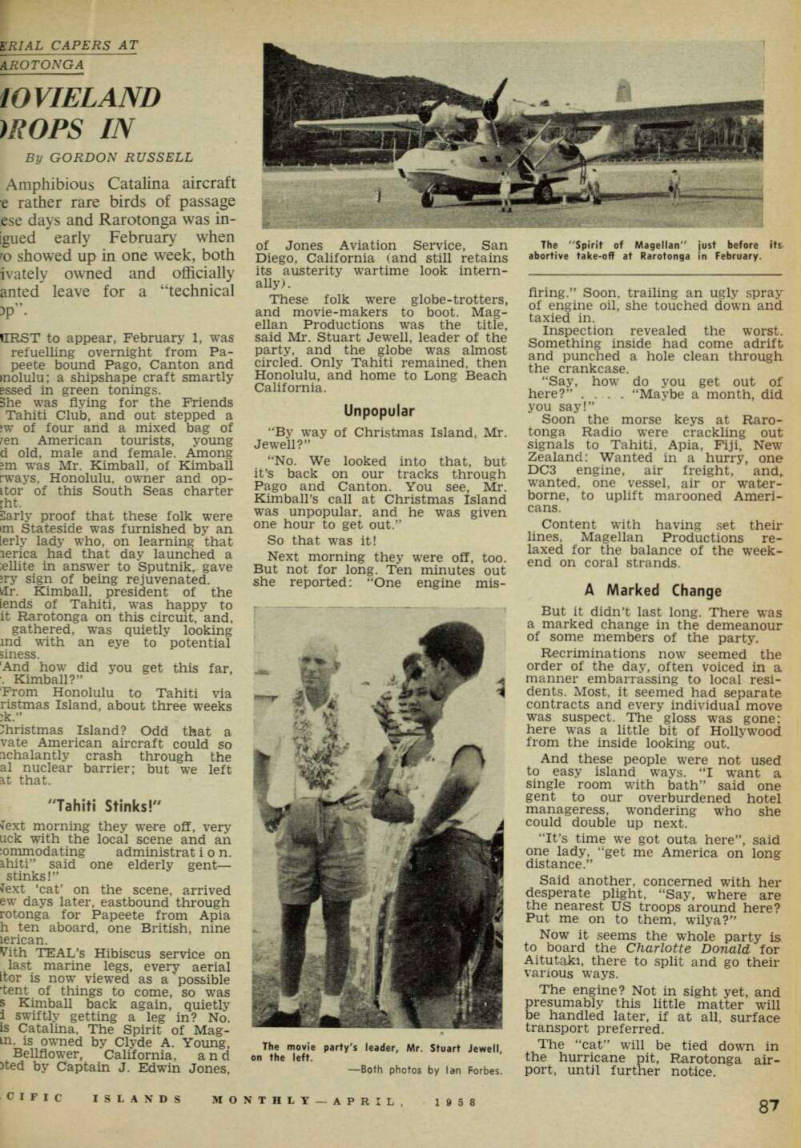
The bottom photo shows, right of centre, marked X, anchored off shore and obscured by a barge, all that remained of the Herstein (or Herstine ) in early March. ’ This is the Norwegian vessel in
which civilians, caught by the Japs in Rabaul in early 1942, hoped to escape. They were refused per mission by Canberra, Herstein de layed too long expecting to take them on, was bombed by the Japs and sunk in Matupi Bay.
After the war she was pronounced unsalvable. But last year the Jap anese raised her in three weeks. It was hoped that she would be towed away to Japan in one piece. But her hull proved to be too damaged.
She was therefore cut down and shipped as scrap. In early March, only a couple of feet above the keel remained. Maybe they will take that, too.
"Naruta" Sunk Again?
There was a story sailing around in Rabaul in early March that Naruta, the Japanese oil tanker that had such an up-and-down existence in Rabaul for 12 years, had again been deliberately sunk — this time in Hongkong. But there was no confirmation forthcoming.
Naruta decorated Rabaul Harbour in all stages of submergence. Some times she was fully afloat; sometimes
(Continued on page 99)
only her superstructure was visible above the water. Sometimes she was in one part of the harbour; some times in another. The Navy used her for a while; and at another stage her then owners (Anderson’s NG Co.) had her pumped out, re floated and put up for auction. They hoped to get rid of her as a going concern but bidding failed to reach the reserve.
Thereafter she continued her up or down existence until last year, when she was again floated and towed to Hongkong. The story is
that by the time she got there the bottom had again fallen out of the scrap metal market and that she was taken to a convenient part of the harbour and sunk once more —pending the recovery of the market.
Grim Postscript: With The
remains of 2,550 Japanese war dead from the Philippines aboard, the Japanese vessel Ginga Maru arrived at Tokyo, March 10. Japanese killed in the Philippines exceeded 75,000.