When Britain Was Reluctant
pp. 85-98 · Read in the full issue
The Chiefs Feasted on Boiled Rice and Biscuits When Britain Was Reluctant About New Guinea
By G. A. King
It is now more than 73 years since the first definite action by Britain on New Guinea—the proclamation of a protectorate over what became known as British New Guinea, and is now called Papua.
THE ceremony of proclaiming the protectorate was carried out at Port Moresby on November 6, 1884, by Commodore J. E. Erskine. commander of the Imperial naval squadron in Australian waters—in those days Britain provided for our naval defence —and he told the chiefs and natives generally that they would henceforth be placed under the protection of Queen Vic toria and Her Majesty’s Govern ment.
“Evil-disposed men will not be ible to occupy your country to seize four lands, and take you away from four homes”, the Commodore said.
He added: “We are amongst you is your friends. Always keep in mur minds that the Queen watches >ver you, looks upon you as her :hildren, and will not allow any me to harm you.”
Quaint happenings occurred on IMS Nelson on the day before the iroclamation of the protectorate.
Jr. John F. Mann, of the Royal Geographical Society of Australasia, guest of Commodore Erskine, has corded what happened:
About 4 p.m., the chiefs from vari ous parts of the islands, together with the Rev. W. G. Lawes and the Rev. James Chalmers, both well known missionaries, were assembled on the deck of the Nelson.
“One chief, Boe Vagi, wore a red
‘wide-awake’ hat and a shirt,” Mi Mann wrote. “Another chief cam over the side “dressed” in somethin supposed to represent a shirt. It wa so torn and filthy, however, tha a native teacher, after a private am presumably tactful talk, induced hin to take it off in order that he migh look somewhat respectable. Bo Vagi had already worn his shir for two years!
Boiled Rice and Biscuits
“A tub of boiled rice and suga was then set before the natives and, squatting around, each chie was supplied with a large basin full, and an iron spoon with whicl to eat. Before beginning the ‘feast’ the teacher recited grace,” but Mr Mann says that “the words wen lost upon the natives, their thought.* obviously being on the boiled rice The basins having been emptied, th(
chiefs turned their attention to ship biscuits, two of which had been served out to each man.”
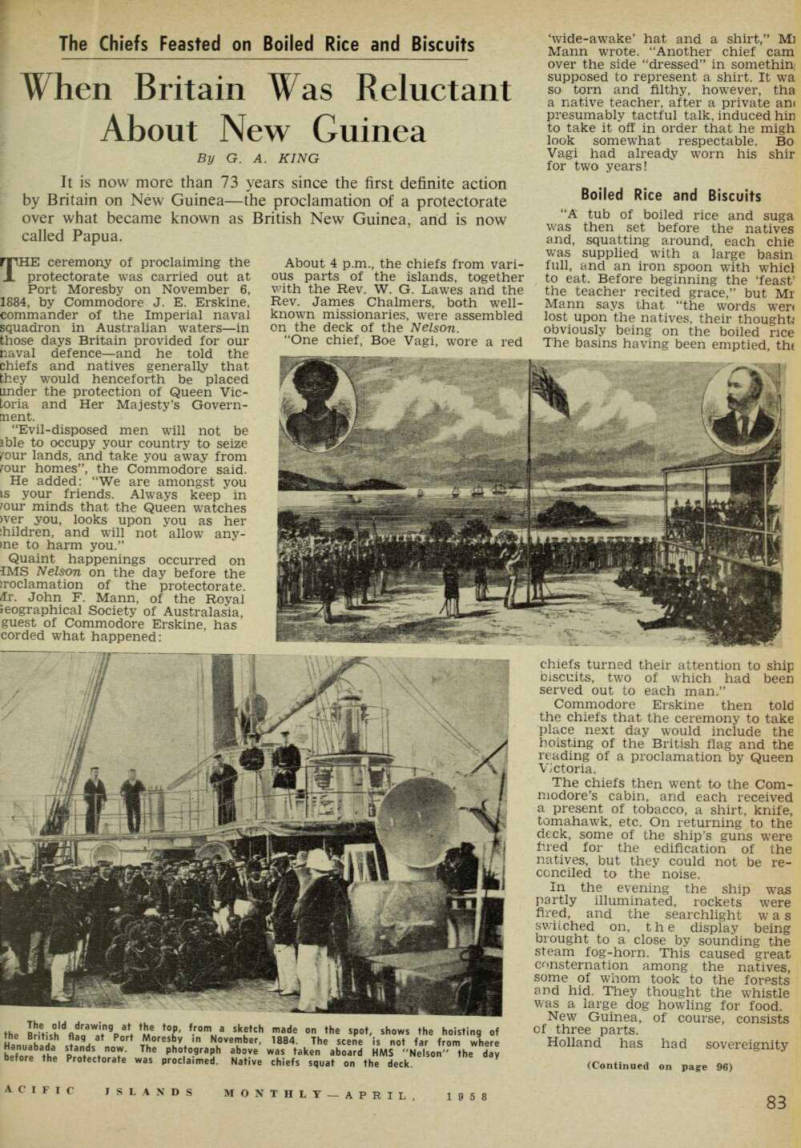
Commodore Erskine then told the chiefs that the ceremony to take place next day would include the hoisting of the British flag and the reading of a proclamation by Queen Victoria.
The chiefs then went to the Com modore’s cabin, and each received a present of tobacco, a shirt, knife, tomahawk, etc. On returning to the deck, some of the ship’s guns were fired for the edification of the natives, but they could not be re conciled to the noise.
In the evening the ship was partly illuminated, rockets were fired, and the searchlight was switched on, the display being brought to a close by sounding the steam fog-horn. This caused great consternation among the natives, some of whom took to the forests and hid. They thought the whistle was a large dog howling for food.
New Guinea, of course, consists of three parts.
Holland has had sovereignity
(Continued on page 96)
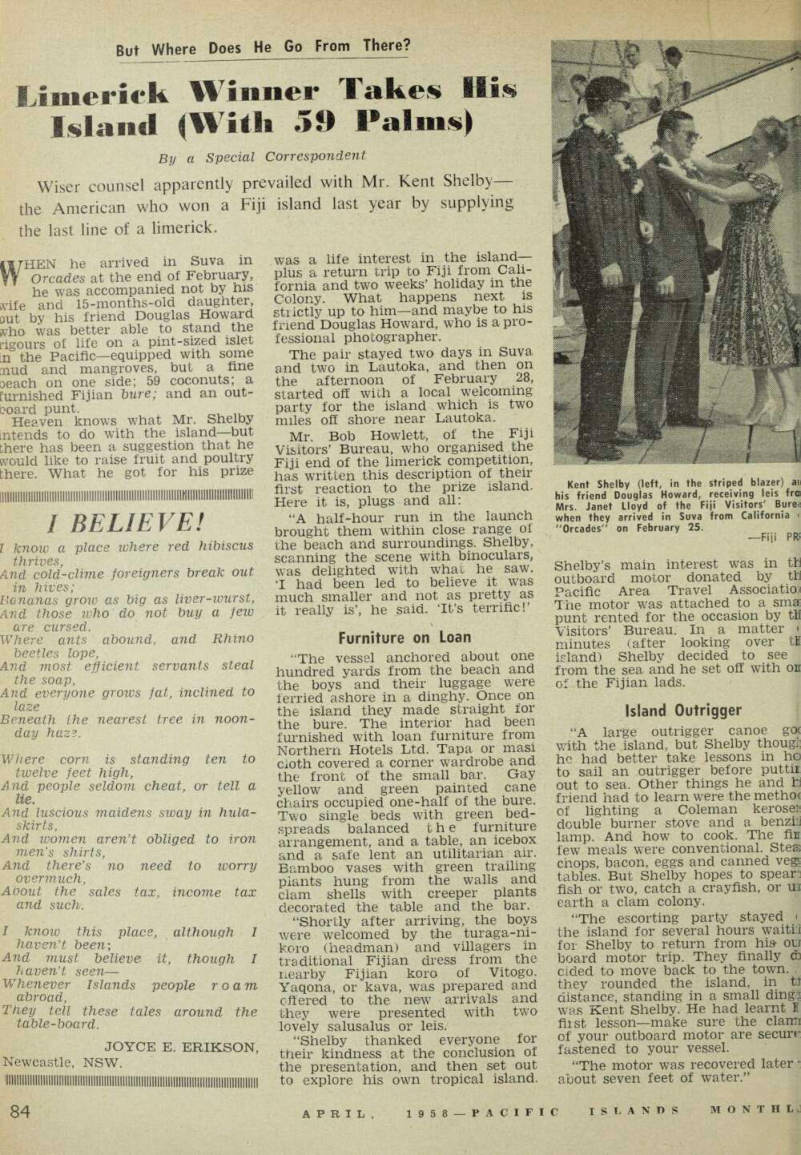
The old drawing at the top, from a sketch made on the spot, shows the hoisting of the British flag at Port Moresby in November, 1884. The scene is not far from where Hanuabada stands now. The photograph above was taken aboard HMS "Nelson" the day before the Protectorate was proclaimed. Native chiefs squat on the deck.
over the western part of the island of 158,000 square miles since 1848; there is what is now Papua, formerly British New Guinea, the south eastern part of the island, compris ing 90,000 square miles; and the north-eastern portion of the island, formerly German New Guinea, and named by the Germans Kaiser Wilhelm’s Land, of about 70,000 square miles.
The surveys and reports of Cap tain J. Moresby in 1874 brought home to Queensland, and to many
people in other parts of Australia, the dangers to Australia if New Guinea, opposite to Torres Strait, fell into the possession of a foreign power.
"Annexation" Disallowed
Queensland was not impressed by the dilatory attitude of the British Government; and in 1883, because of reported German designs on New Guinea, the Premier of Queensland, Sir Thomas Mcll wraith, ordered the annexation of the south-eastern mainland of the island. The annexa tion was carried out by Mr. Henry Marjoribanks Chester, a Police Magistrate and Government Resident at Thursday Island.
That action by Queensland was,
however, disallowed by the Briti Government—just as the sugge tions of Charles B. Yule (1864) aj Captain Moresby (1874) had be ignored by the authorities in La don.
However, London relented; aj at Port Moresby, on November 1-884, Commodore J, E. Erskine, H then in command of the Australii Naval Station, with his flag flyu on HMS Nelson, proclaimed a pn tectorate over what was to becoi British New Guinea. Other ships the Australian Squadron at t) ceremony included HM Shi Espiegle, Raven, Harrier aj Swinger— all small vessels, fc vastly impressive in the eyes of t) natives.
Before the end of 1884, Germai annexed the north-eastern part New Guinea.
British New Guinea was formal annexed to the Crown on Septemb 4, 1888; and, had it not been 1 the reluctant attitude of the Briti Government, German New Guin could have become British territoi In 1901, when the Commonweal came into being, the Australii Government agreed to take ov British New Guinea as a Territc of the Commonwealth, and lai it was formally so declared unc the name of Papua.
What was formerly German N 1 Guinea was occupied by Australii forces in September, 1914, t) month following the outbreak World War I, and the possessii was given up by Germany as a of the peace terms. Under a Leag of Nations mandate the territo was entrusted to the Australii Government, which set up an aE ministration in 1921.
Later, the Territory was plac under the trusteeship system esta lished under the United Naticr Charter, and Australia became ti sole administering authority und a decision of the General AssemH of the United Nations on Decemfcl 13, 1946.
Changed Attitude
How different is the attitude New Guinea today compared wi the early eighties of last centur;' Only a couple of years ago, du ing a discussion in the Unit!
Nations Political Committee on IT donesia’s claim to Dutch NO Guinea, Australia’s representati: said that Australia unalteratt opposed any transfer of sovereign over Dutch New Guinea.
He said that the Japanese hr taught us the bitter lesson “thi New Guinea will forever be potential invasion springboard Australia. There is not one dissenr vent voice in Australia tods] political or individual, which wou deny that the security of Austral and the security of New Guinea a indivisable.”