Try The Long Way Home Just Once
pp. 61-65 · Read in the full issue
[?]ed by a Pikelet, or— TRY THE LONG WAY HOME JUST ONCE
From JUDY TUDOR, in New Guinea In spite of the march of time, New Guinea travel still has many raps for the unwary. In a general way it is still far easier to get ourself into a place than out of it. This was my undoing.
mid-February, between two chores, I embarked on a leisurely nine-days’ journey by ship, Lae dang - Lombrum - Lorengau neng - Rabaul. I was decanted Rabaul on a Thursday, which e me just the two days equired for my business there ren by Qantas on Saturday •ning direct, to Lae to pick up Skymaster for Moresby, in ity of time for the opening of Legislative Council on Monday, •ch 3. hat’s what I thought, at when I bounced into Qantas :e on that Thursday morning, mnounce that I “had asked for ooking” on Saturday’s plane, I informed sweetly but firmly ; I was. of course, only fifth on waiting list. shall draw a veil over the sequent proceedings—except that he next 20 minutes they con ed me to my entire satisfaction I hadn’t a hope-in-hell of ing out of Rabaul that side of : Tuesday. But they did admit, ctantly, towards the end of the resting conversation, that they a vague idea there was another ne in the Territory, called idated Airlines, and that —yes, r did think the latter had a it out of Rabaul on Saturdays.
All Full Up MAL found itself the same happy position as tas —full up, with waiting list, iturned to the pub to lick my nds. had either to reconcile myself dssing the Legco meeting (which one reason why I had gone 3 -NG in the first place) or it
now was time “to know a man that knew a man”. To cut the story short—this man knew things to such good effect that I found myself booked out of Rabaul at dawn Saturday, by MAL, for Lae— the long way round.
This meant that for twice the normal Rabaul-Lae fare, I was going to see from the air, in 10 hours, all the places I had just spent nine days viewing leisurely from the sea. In addition, there would be two more touch-down points—Wewak, on the mainland
coast, and Goroka, in the High lands.
At least I was manoeuvring my self into a position where, if the milk-run plane were not held up anywhere, I could make Port Moresby during Sunday. The journey itself seemed dreary in the extreme.
But I was wrong about that. It wasn’t the most entertaining day I have spent in New Guinea—but it certainly was one of the most interesting.
These long-way-round planes are primarily for carrying native labour to their new jobs or returning time-expired labour home. There fore, European passengers are in the minority and the plane is of the freighter type, with canvas or metal seats along the side of the unlined fuselage: and any freight offering is stowed under nets in the middle of the floor. (Over)
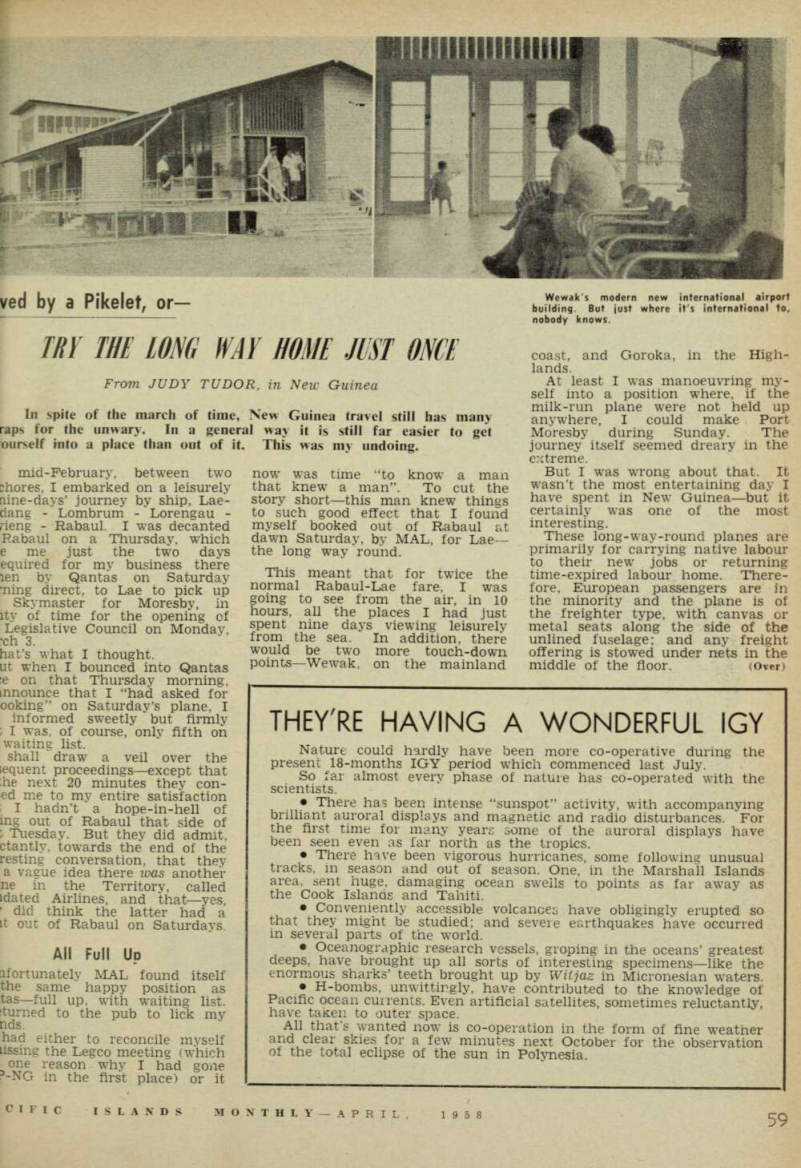
Wewak's modern new international airport building. But just where it's international to, nobody knows.
But on this occasion I was intro iced to a small dark cupboard unediately behind the pilots. In is cupboard are half a dozen black ;tal boxes, marked DME— ssponding Type, and so forth; *ctric motors, and a few miles wires and cables; a few bits of jgage; the plane’s papers, in a 11-dog clip; and, fitted sideways, 0 blue leather aircraft chairs ed permanently in the upright jpare-for-ditching position.
Quivering Ear-drums
Dne of these seats was mine, was infinitely more comfortable in the seats outside—but there re certain drawbacks. In that ice, the engines seem not more in two inches from your vering ear-drums; and there is way to look out except by nding up, so close behind the its that you are breathing down back of their necks, lere and there along the way, the day wore on, we would pick Europeans and drop them again ther on. Some would come to re my cupboard—but rarely for re than one hop. t was too noisy—you couldn’t see —it was too sick-making—it* was hot. ; was all these things; but by ; time I was so completely unated by the place nothing rt of a bomb would have dis ced me. You can travel the sh air lanes of the world, all 1 Carpets and champagne cock s—but5 —but how often do you get to ;here, on the spot with the pilots, nigh the abracadabra of seven 3-offs and landings?
Lire— l’ve travelled in De Havil 1s and Drovers, where a single t pumps handles and pushes ehes in full public view. But ive always had the notion that, hese bigger jobs when the crew ppeared behind that door, they jably guided the plane with a while they played gin-rummy naybe cooked themselves a meal, ot so. On the ground the pilots r act like aerial super-cargoes, iting natives in and checking ves out; dredging up a bottle range cordial from somewhere m lot, tiny airstrip building and ing a European child a drink; ring cargo and scribbling madly sheaves of paper. In the air different, and two pilots of Queen’s flight could not give e attention to full routine, here is the black-magic of take and landing, when they touch y confounded thing in the cock muttering some incantation 3h sounds like “Automatic pilot, s. tanks . . .” Then, with two s of hands on the dual controls, 1 are off into the business of nally-always, foolproof flight, here was only one rift in this of my happiness. Something
Id happens to my metabolism the air, and although normally worry little about food, once aloft develop such hunger I soon could te pieces out of fellow passengers.
Pangs of Hunger
Somewhere between Kavieng and omote, then, I began to regret icerely the spurned tea and toast dawn, and think sadly of the urs ahead before Lae at five the evening. It was clear, from e contents of that cupboard I labited that not so much as a ermos of coffee would be forth ning from that plane.
But when I went into the onset-hut terminal at Momote — ;re, sitting alone and unattended, s a huge plate of pikelets, flanked a teapot and cups.
Sveryone else in the place was ihing around with pieces of paper madly figuring, and ignoring this inty. I did my best to prove, whoever provided it, that it was ; unappreciated.
Vhen I was wandering around h my fourth pikelet and second ) of tea the Chief Pilot, larently having observed this, ne up and said pointedly that would get something >to eat Madang. Would I like a salad?
When do we get to Madang?” isked. ibout two, I was told. It was then a.m. I rushed off and got ither pikelet and came back and 1 a salad would do fine, thank . very much. ‘here is nothing much to dnguish one of these New Guinea strips from another —except that a round trip like this you are to get seven different varieties weather in the same day. But mote will for ever be associated my mind with pikelets; and dang with the best salad and ee ever—although eaten in a m marked Crew, hot as a furnace i thick with the fumes of a Dsene stove. o—these outport NG airports V only in the size of the tin-shed ting-room—all except Wewak. some reason, I had never been k to Wewak since I left it per lently just before the war. But new Wewak was no relation that. Gone was old Boram itation where we used to occupy ?race-and-favour, leaf-thatched se on the Point, when waiting the Macdhui. Instead, there is airport, with the best terminal dings in the Territory.
International, No Less r hen some more swamp is filled md the run-way enlarged, it will an International Airport, I was ut International to where? No can say. is international now in a minor —the last stage out of New nea to Hollandia, NNG, and the ■ one coming back. But that
doesn’t warrant the present set-up.
Maybe someone has plans—plans for a new Australian route to the Far East. * * * Somewhere after five, we bumped down out of Goroka’s rain into Lae’s hazy sunshine, journey completed.
I thanked the pilots for an interesting day and they looked at me as though they thought I was crazy—as well they might. They had done the same trip in the reverse direction the day before, and were basking in the knowledge that they would not be flying again until late in the following week.
But even after the noise of those engines had faded from my head, I
still thought the long way round an experience everyone should try at least once. Take the short way home always, and you miss an interesting facet of New Guinea life.
And where else in the world do you get such pikelets as those at Momote?